Sales Conversation Framework: A B2B Rep's Guide
Discover what is sales conversation framework and how it boosts B2B sales success. Learn to engage authentically and close more deals.
Published: July 12, 2026
Author: OffBook Editorial Team

Sales Conversation Framework: A B2B Rep’s Guide
A sales conversation framework is a repeatable, modular system that guides sales reps through buyer interactions without scripting every word. Unlike a rigid script, it gives reps a logical structure to follow while leaving room for real judgment and authentic dialogue. For B2B sales teams, this distinction matters enormously. Structured, modular frameworks can achieve close rates as high as 25%, turning roughly one in four conversations into a closed deal. That result comes from replacing improvisation with a repeatable system, not from memorizing lines.
What is a sales conversation framework, and why does it matter?
A sales conversation framework is the industry term for what practitioners also call a sales communication framework or conversational architecture. It defines the goals, sequence, and logic of a sales dialogue without dictating the exact words a rep must use. The framework tells you where the conversation needs to go, not what to say word for word.
The practical payoff is significant. Reps who internalize a framework spend less time figuring out what to do next and more time listening to the buyer. They can handle unexpected turns without losing their footing, because the framework gives them a mental map rather than a script to recite. This is the core difference between a sales dialogue that feels like a conversation and one that feels like a pitch.
Frameworks also matter at the team level. When every rep follows the same conversational logic, sales leaders can diagnose problems, coach consistently, and replicate what works. Without a shared structure, every rep is essentially running a different sales process, which makes coaching nearly impossible.
How does a framework differ from a traditional sales script?
Scripts require full compliance. Every word is predetermined, and deviation feels like failure. Frameworks require understanding the logic behind each stage, which lets reps adapt in real time when a buyer takes the conversation somewhere unexpected.
The behavioral difference shows up fast. A rep following a script who gets an off-topic question often stumbles, rushes back to their place, or loses the buyer’s trust. A rep working from a framework treats that detour as information. They explore it, then guide the conversation back to the next logical stage.
Frameworks build rep judgment instead of enforcing compliance. That judgment enables natural, two-way conversations that buyers actually want to be part of. Buyers can tell when they’re being read to from a script. They cannot tell when a rep is following a well-internalized framework, because it feels like a real conversation.

Scripts also create a fragile onboarding process. New reps must memorize exact language before they can perform. Frameworks shorten ramp time because reps learn why each stage exists, which is faster to internalize and easier to apply across different buyer types and deal sizes.
Pro Tip: When training new reps, teach the goal of each framework stage before teaching any suggested language. Reps who understand the “why” adapt faster and perform better under pressure.
- Scripts demand word-for-word compliance; frameworks demand logical understanding.
- Scripts break when buyers go off-path; frameworks treat detours as useful data.
- Scripts slow onboarding; frameworks accelerate it by teaching intent over language.
- Scripts produce robotic interactions; frameworks produce authentic dialogue.
What are the core stages of an effective sales conversation framework?
Most effective frameworks share a common architecture, even when the labels differ. A typical structure runs approximately 30 minutes and breaks into four stages: understanding, reflection, offering, and decision-making.
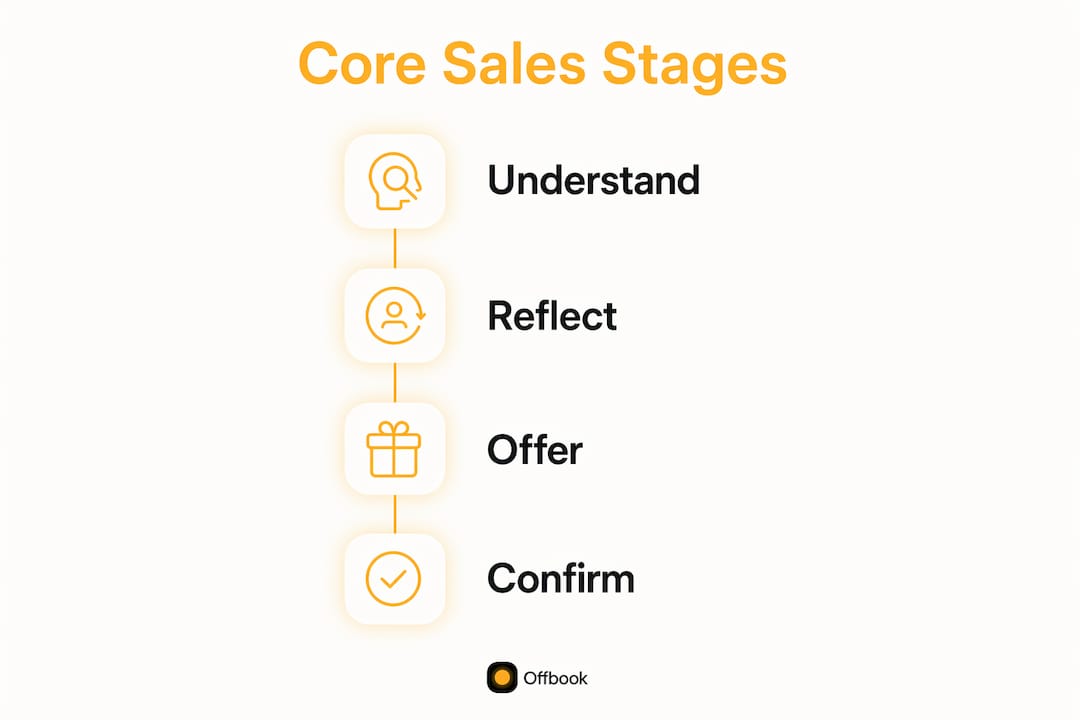
The understanding stage is the longest and most critical. This is where the rep diagnoses the buyer’s situation, quantifies the cost of inaction, and builds the foundation for everything that follows. Rushing past this stage is the single most common reason deals stall later. Buyers who feel heard in the early stage are far more open in the later stages.
The reflection stage is short but powerful. The rep summarizes what they heard, surfaces any contradictions, and confirms that both parties share the same picture of the problem. This step alone separates average reps from great ones. Most reps skip it entirely and jump straight to their solution.
| Stage | Typical Duration | Primary Goal |
|---|---|---|
| Understanding | 15 minutes | Diagnose the buyer’s situation and quantify the problem |
| Reflection | 5 minutes | Confirm shared understanding and surface any gaps |
| Offering | 5 minutes | Present a solution tied directly to the diagnosed problem |
| Decision-making | 5 minutes | Clarify next steps and remove barriers to commitment |
The offering stage is deliberately short. A rep who has done the understanding and reflection stages well does not need a long pitch. The buyer already knows the problem. The rep simply connects the solution to what the buyer just described in their own words.
- The understanding stage should consume at least half of the total conversation time.
- Diagnostic questions in this stage focus on business impact, not product fit.
- The offering stage loses power when it arrives before the buyer feels fully understood.
- Modular frameworks let reps expand or compress each stage based on the buyer’s pace.
Pro Tip: If a buyer starts asking about pricing before you’ve finished the understanding stage, treat it as a signal to slow down, not speed up. Premature pricing conversations almost always stall.
How can sales teams implement frameworks in B2B environments?
The biggest implementation mistake is treating a framework like a new script. Reps who memorize framework language instead of framework logic will perform just as rigidly as they did with a script. The goal is to internalize the purpose of each stage so deeply that the right questions surface naturally during the call.
Skipping diagnostic stages or rushing to present solutions creates friction that shows up later in the cycle. Buyers who were never fully heard tend to raise objections at the worst possible moment, right before signing. Thorough diagnosis upfront feels slower but shortens the overall sales cycle.
Practical implementation follows a clear sequence:
- Map your current calls. Record and review five to ten recent calls. Identify where reps are rushing, where buyers disengage, and which stages are missing entirely.
- Define your framework stages. Choose a structure that fits your average deal size and buyer type. A four-stage model works well for most B2B SaaS conversations under 45 minutes.
- Train on intent, not language. Run roleplay sessions where reps practice the goal of each stage using their own words. Correct for intent, not phrasing.
- Use real-time support during calls. Tools like Offbook surface live prompts during video calls, reminding reps which stage they’re in and what questions to ask next, without a bot joining the meeting.
- Review and calibrate weekly. Use call recordings to identify where reps deviate from the framework and why. Adjust training based on patterns, not one-off mistakes.
Modular frameworks allow reps to internalize the reason behind each step, which produces better adaptability and consistency across calls. Consistency in intent matters more than consistency in exact wording. Understanding the full B2B sales cycle helps teams see where each framework stage fits within the broader process.
Why do structured sales conversations convert better?
Structured conversations convert better because they shift the rep’s role from persuader to facilitator. Conversational architecture helps buyers arrive at decisions themselves, which lowers resistance and produces more durable commitments. A buyer who talked themselves into a decision is far less likely to back out than one who was talked into it.
The psychological mechanism is straightforward. When buyers feel heard and understood, their defenses drop. When their defenses drop, they share more. When they share more, the rep can connect the solution to real, specific pain rather than assumed pain. That connection is what closes deals.
“Purposeful interventions during sales conversations, such as surfacing contradictions and doubts, create deeper relationships and better outcomes. Interventions that shift, deepen, or broaden customer thinking build trust far beyond simply pushing for the next step.”
Purposeful interventions like reflecting back a buyer’s stated concern or naming a contradiction they haven’t addressed yet do more for trust than any amount of rapport-building small talk. These moves require a framework, because they require the rep to be listening rather than waiting for their next scripted line.
The operational benefits compound over time. When every rep follows the same conversational logic, the team’s results become predictable. Leaders can identify which stage is causing the most drop-off and fix it systematically. That kind of structured call approach is what separates teams that scale from teams that plateau. For B2B firms building out their sales motion, an AI-informed approach to reinforcing framework adherence is becoming a standard part of the stack.
Key Takeaways
A sales conversation framework is the single most reliable tool for improving close rates, reducing ramp time, and building buyer trust at scale.
| Point | Details |
|---|---|
| Framework vs. script | Frameworks teach intent and logic; scripts enforce compliance and break under pressure. |
| Four-stage structure | Effective frameworks run about 30 minutes across understanding, reflection, offering, and decision-making. |
| Diagnostic priority | The understanding stage should take at least half the call; rushing it stalls deals later. |
| Real-time reinforcement | Live coaching tools like Offbook prompt reps during calls, keeping them on-framework without disrupting the conversation. |
| Consistency compounds | Teams using a shared framework can diagnose drop-off points and improve results systematically. |
Why I think most sales teams are solving the wrong problem
Sales leaders spend enormous energy on scripts, talk tracks, and objection-handling libraries. I get it. Those things feel controllable. You can write them, review them, and hand them to a new rep on day one. The problem is that they solve for the rep’s comfort, not the buyer’s experience.
Every time I’ve watched a high-performing rep in action, the thing that stands out is not their language. It’s their patience. They slow down when a buyer hesitates. They ask a second question when most reps would have moved on. They treat the conversation as something to be understood, not managed. That behavior comes from a framework, not a script.
The shift from persuader to facilitator is not a soft, feel-good idea. It’s a close-rate strategy. Buyers in B2B environments are sophisticated. They know when they’re being sold to. A rep who shows up with a framework and genuine curiosity will outperform a rep with a perfect script almost every time. Sales leaders who prioritize framework training over script memorization will see it in their numbers within a quarter.
The future of B2B sales calls belongs to reps who can think on their feet within a structure, not reps who can recite the right lines. Train for judgment. The language will follow.
— Neil
How Offbook helps reps stay on-framework during live calls
Sales teams that understand framework logic still struggle to apply it consistently under the pressure of a live call. That’s the gap Offbook fills.
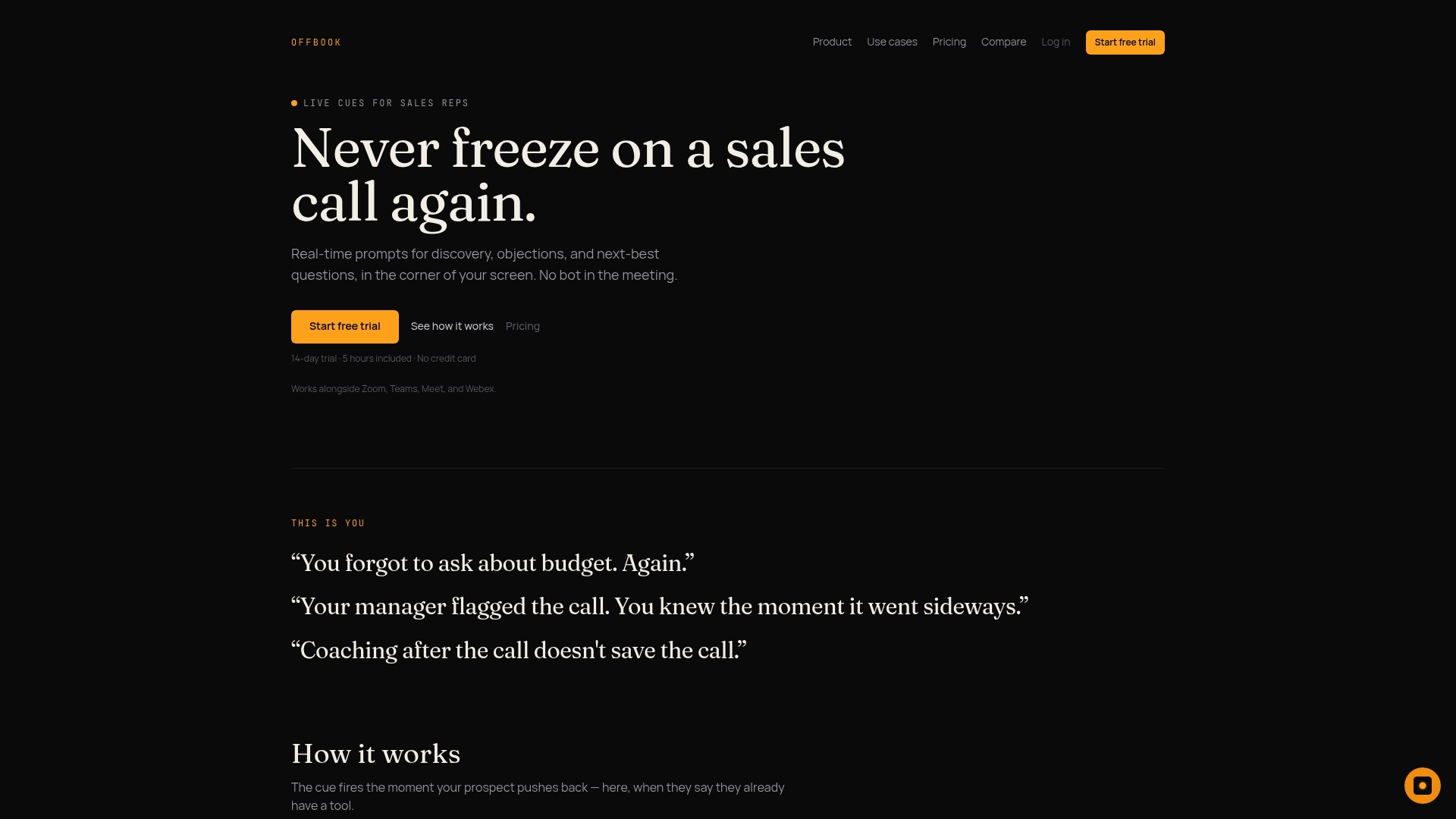
Offbook is real-time AI call coaching built for B2B SaaS teams. It listens to your video calls and surfaces live prompts on-screen, telling reps which questions to ask, which qualification gaps to close, and which objections to address, all structured around proven methodologies like MEDDIC and MEDDPICC. No bot joins the meeting. The buyer never knows it’s there. Offbook also generates pre-call briefs so reps walk into every conversation already knowing who they’re talking to and what matters to them. For founder-led teams at the seed and Series A stage, Offbook turns framework knowledge into consistent execution, call after call.
FAQ
What is a sales conversation framework?
A sales conversation framework is a modular, adaptable guide that structures a sales dialogue around defined stages and goals without scripting exact language. It gives reps a repeatable system for guiding buyers toward decisions while maintaining authentic, two-way conversation.
How is a framework different from a sales script?
A script requires word-for-word compliance and breaks when buyers go off-path. A framework teaches the logic and intent behind each stage, allowing reps to adapt in real time while staying on track.
What stages does a typical sales conversation framework include?
Most effective frameworks include four stages: understanding the buyer’s situation, reflecting back what was heard, offering a connected solution, and facilitating a decision. A common time split allocates 15 minutes to understanding and 5 minutes each to the remaining three stages.
Why do reps skip the diagnostic stage, and what does it cost them?
Reps skip diagnosis because pitching feels productive and questioning feels slow. Premature pitching before fully understanding business impact creates friction that surfaces as late-stage objections and stalled deals.
Can a sales conversation framework work for different buyer types and deal sizes?
Yes. Modular frameworks are designed to flex. Reps can expand the understanding stage for complex enterprise deals or compress the offering stage when a buyer is already well-qualified, without abandoning the overall structure.