10 Step Sales Call Privacy Policy Checklist for Sales Teams
Practical playbook for sales teams: a 10 step checklist to craft recording notices, ready consent scripts, retention defaults, and an OffBook vendor example.
Published: September 30, 2026
Author: OffBook Editorial Team

A sales call privacy policy needs to state, in plain language, whether the call is recorded or monitored, why that data is collected, how consent is obtained, and how long recordings are kept. Get that in writing, then check it against state recording laws, the TCPA, and the FTC’s Telemarketing Sales Rule. Those three legal buckets decide whether your wording actually holds up.
TL;DR:
- Most states require explicit consent from all participants before recording sales calls, making it safer to treat every call as if all-party consent applies.
- A clear, written privacy policy must specify whether calls are recorded or monitored, the purposes, consent methods, access controls, retention periods, and subprocessors involved.
- Using a retention window of around 90 days for recordings and logging consent with timestamps and call IDs strengthen legal defensibility and compliance.
- Telemarketing rules mandate scrubbing calling lists against the Do Not Call Registry monthly, restricting calling hours, and obtaining prior written consent for autodialed or AI-generated calls.
- Implementing scripted disclosures, regular training, and monthly audits reduces compliance risks and ensures consistent, legal communication during sales calls.
Table of Contents
- Core elements to include in a sales call privacy policy
- Recording consent rules: federal baseline and state law variation
- Telemarketing, TCPA and Do Not Call rules that affect sales calls
- Operational checklist: implementing policy controls across sales workflows
- Sample policy clauses and scripted language for consent and notices
- How a real-time AI coaching vendor approaches privacy
- Author perspective: practical trade-offs and recommended defaults
- OffBook as an alternative approach to in-call privacy
- Sources
- FAQ
Core elements to include in a sales call privacy policy
A privacy policy for sales calls is a legal document and an operational one. It has to hold up if a regulator asks for it, and it has to be specific enough that a sales rep or a customer support agent knows exactly what to say on a live call.
Five elements make up a defensible policy. Miss one and you either expose the company to a complaint or leave your team improvising language on the fly, which tends to go worse than a written script.
- Recording and monitoring statement: name whether calls are recorded, monitored live, or both, and cite the legal basis (consent, legitimate business interest, or contractual necessity).
- Stated purposes: list every use of the recording, such as sales coaching, quality assurance, dispute resolution, or fraud prevention, since a purpose not listed is a purpose you cannot rely on later.
- Consent mechanism: describe how consent is captured (verbal announcement, checkbox, calendar disclosure) and how a caller can revoke it, plus a contact method for privacy questions.
- Access and retention controls: define who can access recordings, how long they are stored, and the deletion or redaction process once that period ends.
- Third-party subprocessors: name the categories of vendors who touch the data (transcription tools, coaching software, CRM integrations) and confirm the sharing is limited to the stated purposes.
The subprocessor clause is the one teams skip most often, and it is the one that draws the most scrutiny during a vendor security review or a customer’s own due diligence process. If a coaching tool, a transcription service, or a call recorder touches the audio, the policy needs to say so, even at a high level.
Retention deserves its own line rather than a vague “as needed” phrase. A 90-day retention window for coaching recordings, followed by automatic deletion, is a concrete commitment that a legal team can defend and a customer can understand. Compare that to “retained as long as necessary,” which says nothing enforceable.

Pro Tip: Write the policy once for legal defensibility, then write a second, shorter version for the live-call script. The two should say the same thing, but the script needs to fit in one breath.
Recording consent rules: federal baseline and state law variation
The federal Wiretap Act sets a one-party consent floor: if at least one person on the call agrees to the recording, the recording is generally lawful under federal law. States are free to set a stricter bar, and many do.
A 50-state survey from Justia shows that most states follow the one-party standard, but a meaningful group of states require all-party consent, meaning every person on the call has to agree before recording starts. The exact list shifts depending on how a state defines “conversation” or “communication,” and some states carve out exceptions for business calls or specific industries, which is why a state-by-state legal check matters more than memorizing a static list.
For a sales team making interstate calls, the safe operational default is to treat every call as if the strictest plausible rule applies. That means announcing the recording and getting an affirmative response, not just proceeding after a passive disclosure. It costs a few seconds per call and removes the guesswork about where the person on the other end happens to be sitting.
Most states in the country default to one-party consent for call recording, but a subset require consent from every participant, and the safe approach for any interstate sales team is to assume the stricter rule applies. Justia’s 50-state survey documents the split and the exceptions by medium.
Consent alone is not enough if you cannot prove it happened. Build a habit of logging:
- The exact announcement or checkbox language shown to the caller.
- A timestamp and call ID tied to that specific session.
- The channel used (voice announcement, web form, calendar invite) so a dispute can be traced back to the source.
A technical compliance reference on call recording recommends testing how consent announcements behave across transfers and conference calls, since a caller moved into a new call leg without a fresh announcement can create a gap in the consent record. That gap is exactly what a plaintiff’s attorney looks for.
Telemarketing, TCPA and Do Not Call rules that affect sales calls
The Telephone Consumer Protection Act applies whenever a call uses an autodialer or an artificial or prerecorded voice, and in those cases the caller needs prior express written consent before dialing. A live, manually dialed sales call from a rep sits outside the strictest TCPA triggers, but the moment automation enters the picture, the bar rises.
The FTC’s Telemarketing Sales Rule adds its own layer: telemarketers must give prompt oral disclosures early in the call, keep specific records, and respect the National Do Not Call Registry. Calling hours are restricted to between 8 a.m. and 9 p.m. in the recipient’s time zone, and failing to disclose required information during the call is treated as a deceptive practice with civil penalties attached.
Registry compliance is not a one-time check. Telemarketers must scrub their calling lists against the Do Not Call Registry every 31 days, and as of September 30, 2025, the registry held over 259 million active registrations, according to the FTC’s Do Not Call Data Book. That scale means a stale list is a near-certain compliance gap, not an edge case.
The FCC has also moved directly on AI. Its ruling on AI-generated voices confirms that TCPA restrictions on artificial or prerecorded voices apply to current AI technologies that produce human-sounding speech, and prior express consent is required before those calls go out. A sales operation experimenting with AI-generated outreach voices needs to treat that consent requirement as settled, not pending.
Practical controls that lower enforcement exposure:
- Scrub the calling list against the Do Not Call Registry on a fixed monthly cadence.
- Cap outbound calling to the 8 a.m. to 9 p.m. local-time window.
- Keep prior express written consent on file before any autodialed or AI-voiced call.
- Train reps on the required oral disclosures so they open every call the same way.
Operational checklist: implementing policy controls across sales workflows
A policy is only as good as the workflow that enforces it. The sequence below moves from before the call to after it, so each control lands where a rep or a system actually touches the data.
- Capture consent before the call starts. Add a short disclosure to booking pages, calendar invites, and signup checkboxes so the caller sees the recording notice before they ever pick up.
- Use consistent wording. A line like “This call may be recorded for training and quality purposes” belongs in every pre-call touchpoint, not reworded each time.
- Announce at the start of the live call. State that the call is recorded, name the purpose in one sentence, and pause briefly for an objection before continuing.
- Log the proof, not just the fact. Save the call ID, timestamp, and exact wording used, since “we announced it” is not evidence on its own.
- Store recordings behind access controls. Limit playback to the people who need it for coaching, QA, or dispute resolution, and apply role-based permissions rather than open folders.
- Apply a fixed retention schedule. Delete or anonymize recordings automatically once the retention window closes, rather than leaving deletion as a manual, easy-to-skip task.
- Disclose AI or automated processing. If a coaching tool or transcription service is listening in real time, say so in the same breath as the recording announcement.
- Give a pause or opt-out path. Let the caller ask to turn off automated processing without ending the call entirely.
- Train reps on the script quarterly. A rep who has not reviewed the wording in a year will improvise, and improvisation is where compliance gaps start.
- Audit a sample of calls monthly. Check that announcements happened, consent was logged, and retention rules were followed as written.
Pro Tip: Treat the consent announcement the same way you treat a required disclaimer in a regulated ad: scripted, tested, and never left to the rep’s memory.
Sample policy clauses and scripted language for consent and notices
Adapt these directly rather than starting from scratch.
- Privacy policy paragraph: “Sales calls with our team may be recorded or monitored for training, quality assurance, and coaching purposes. Recordings are stored securely, accessed only by authorized personnel, and retained for a limited period before deletion.”
- Live-call announcement: “Just so you know, this call is being recorded for quality and coaching purposes. Is that alright with you?”
- Multi-party wording: “Everyone on this call should know it’s being recorded for internal training. If anyone would prefer we not record, let us know now.”
- Calendar invite line: “By joining this call, you acknowledge it may be recorded for quality and training purposes. Contact us before the call if you’d prefer not to be recorded.”
Pair any retention table with a short access clause: “Only sales operations and coaching staff may access stored recordings, and access is logged.”
How a real-time AI coaching vendor approaches privacy
Procurement teams evaluating AI sales tools should ask how a vendor handles consent and raw data before signing anything. A real-time AI coaching vendor’s approach may include coaching software that listens to live video calls and surfaces on-screen prompts without a bot joining the meeting, structured around sales qualification frameworks, requiring per-session consent rather than a blanket, one-time agreement. Such software can also generate pre-call briefs on the people and companies a rep is about to meet.
When vetting any vendor in this category, ask directly and consider how AI for agencies delivers real productivity gains to ensure ROI and operational impact.
- Which subprocessors touch call audio or transcripts, and for how long.
- What retention options exist for recordings versus derived coaching notes.
- Who inside the vendor’s organization can access raw call data, and under what controls.
- Whether participants can pause or opt out of automated processing mid-call.
A vendor that can answer all four clearly is easier to defend during a customer’s own security review, and it is one less clause your legal team has to write from scratch.
Author perspective: practical trade-offs and recommended defaults
Given a choice, I default to shorter retention and more explicit consent every time, even when the stricter state rule probably does not apply. The cost is a few seconds of friction per call. The upside is a policy that survives an audit instead of one that gets picked apart the first time a customer asks pointed questions.

Track how often callers object to the recording announcement and where in the script that happens. If objections cluster right after a specific phrase, rewrite that phrase before it becomes a pattern.
Loop in legal counsel the moment calls cross state lines at volume, involve autodialers, or use AI-generated voices. Those three situations are where a reasonable guess stops being good enough.
— Neil
OffBook as an alternative approach to in-call privacy
Most call recording tools solve privacy by locking down access to a full audio file after the fact. OffBook takes a different route: it coaches reps while the call is happening, using live prompts rather than a stored recording that has to be secured, retained, and eventually deleted by someone remembering to do it.
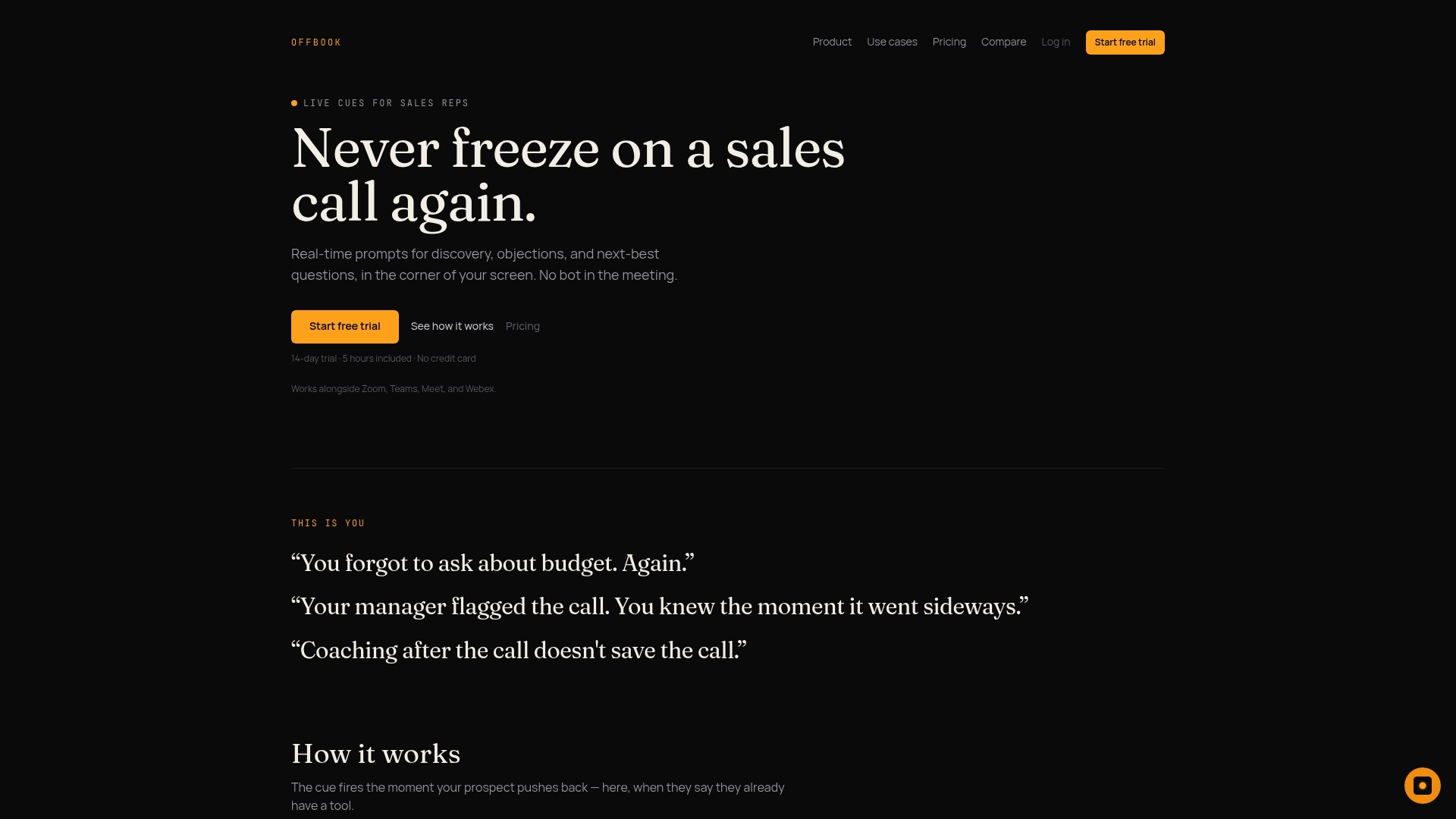
That design choice maps directly onto the compliance work covered above. Explicit per-session consent replaces a blanket policy checkbox, and because OffBook surfaces cues on-screen instead of joining the call as a visible bot, there is less raw audio changing hands between systems in the first place.
- Real-time coaching cues can appear during the call, built around common sales qualification frameworks.
- Pre-call briefs can prepare reps on the company and people they are about to talk to.
- Consent is ideally captured per session, rather than assumed from a one-time signup.
If your team wants a closer look at how this fits into an existing sales process, the OffBook pricing page outlines the Power and Team plans, and a trial is the fastest way to see the consent flow firsthand.
This article is general information, not a substitute for advice from a qualified lawyer. Consult a qualified legal professional about your own circumstances before acting on anything here.
Sources
- Complying with the Telemarketing Sales Rule | Federal Trade Commission
- Implications of Artificial Intelligence Technologies on Protecting Consumers from Unwanted Robocalls and Robotexts | FCC
- Recording phone calls and conversations - 50 state survey | Justia
- Call recording consent laws by state | Asterisk Reference
FAQ
What not to do in a sales call?
Avoid recording or monitoring a call without disclosing it first, since several states require consent from every participant, not just the caller. Also avoid vague purpose statements like “for quality,” which give you little cover if a customer later asks how their data was used.
What are the 7 steps of a sales call?
Common frameworks describe preparation, opening, needs discovery, presentation, handling objections, closing, and follow-up as the core stages, though the exact count and order vary by methodology. The privacy-relevant steps are preparation, where consent is disclosed, and follow-up, where recordings are stored or deleted according to policy.
What is a customer privacy policy?
A customer privacy policy is a public document explaining what personal data a business collects, why it collects it, how it is used and shared, and what rights the customer has over that data. For sales calls specifically, it should state whether calls are recorded, the purpose of that recording, and how long it is retained.
What is considered a sales call?
A sales call is generally any outbound or inbound call where a business representative discusses a product or service with intent to generate a sale, which brings it under telemarketing rules like the FTC’s Telemarketing Sales Rule when it involves outbound solicitation. Calls placed with an autodialer or a prerecorded or AI-generated voice carry additional consent requirements under the TCPA.