RevOps' Role in Scaling Sales, Explained
Discover how RevOps transforms scaling sales by unifying processes and data, leading to faster ramps, cleaner pipelines, and increased accuracy.
Published: August 17, 2026
Author: OffBook Editorial Team

RevOps’ Role in Scaling Sales, Explained
RevOps is the operating function that makes sales scale predictably by unifying people, process, technology, and data into one accountable system. Instead of sales, marketing, and customer success running on separate spreadsheets and separate definitions of a “qualified lead,” RevOps forces one shared source of truth. That single change is why Gartner projects 75% of the highest-growth companies will run on a RevOps model by 2026.
For a sales leader trying to scale past the founder-led chaos stage, here’s what actually changes once RevOps takes hold:
- Faster rep ramp because onboarding follows a documented process instead of tribal knowledge
- Cleaner pipeline because every deal follows the same stage definitions and exit criteria
- Sharper forecast accuracy because revenue data lives in one system, not three
- Lower customer acquisition cost because marketing and sales stop working from different lead scores
- Stronger expansion revenue because customer success and sales share the same account intelligence
Companies that treat RevOps as a real function, not a title change for an ops analyst, report materially higher growth rates and profitability than peers who skip it. Mature RevOps teams are roughly twice as likely to beat revenue targets and 2.3 times as likely to beat profit targets. A tool like OffBook, which coaches reps live during calls, is one example of the kind of RevOps lever that turns a strategy document into a measurable change in seller behavior. The rest of this guide covers exactly how that works, stage by stage.
Key Takeaways
RevOps drives sales growth by unifying people, process, technology, and data into one accountable system that improves forecast accuracy, deal velocity, and rep ramp time.
| Point | Details |
|---|---|
| RevOps is a function, not a title | It requires cross-functional authority over sales, marketing, and customer success, not just a reporting analyst. |
| Match tooling to your stage | Overbuilding tech before you have documented process creates operational debt that compounds as you grow. |
| Track a small KPI set | Forecast accuracy, win rate, and time-to-ramp tell you whether RevOps is working; report them on separate cadences. |
| Fix data before automating | Clean records and consistent field usage first, since automation on dirty data multiplies errors, not results. |
| Pilot real-time coaching | A tool like OffBook closes the gap between sales training and live call behavior, measurable in a 30 to 60 day pilot. |
Table of Contents
- What Is RevOps and What Are Its Four Core Components?
- How RevOps Actually Drives Sales Growth
- What Stage of RevOps Maturity Is Your Company In?
- Which KPIs Prove RevOps Is Working?
- What Tools Make Up a RevOps Tech Stack?
- Why Do RevOps Initiatives Fail, and How Do You Avoid It?
- How Do You Start or Scale RevOps? A 6-Step Roadmap
- How Does Real-Time Coaching Fit Into a RevOps Strategy?
- Why Smart Operators Treat RevOps as the Growth Engine, Not Overhead
- How OffBook Fits Into a Scaling RevOps Stack
- Frequently Asked Questions
- Sources
What Is RevOps and What Are Its Four Core Components?
RevOps is the cross-functional discipline that owns the entire revenue engine, from first marketing touch to renewal, instead of letting sales, marketing, and customer success each optimize their own slice in isolation. Salesforce frames it as the function that aligns those three teams across the full customer lifecycle to improve conversion and cut revenue leakage. That framing matters because most “RevOps” failures happen when a company hires one person, calls them the RevOps lead, and never actually gives them authority over the other departments’ data or process.
The function breaks into four components, and each one needs a clear owner.
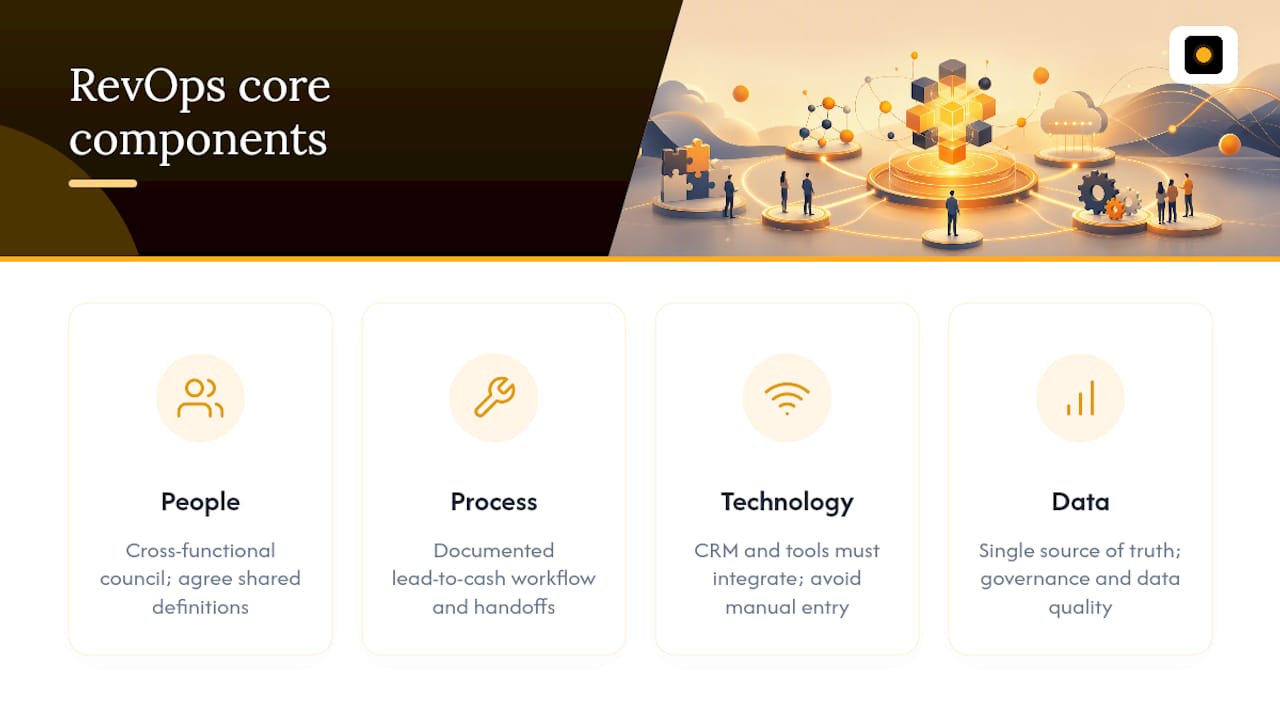
People. This means a cross-functional council, not just an operations hire. Sales, marketing, and customer success leaders need to sit in the same room and agree on shared definitions: what counts as a qualified lead, what counts as an opportunity, what counts as churn risk. Without that mandate, RevOps becomes a reporting function with no teeth.
Process. This is the documented lead-to-cash workflow: how a lead becomes a pipeline opportunity, how that opportunity moves through stages, how a closed deal hands off to customer success. Richardson’s sales research describes RevOps as the “glue” that enforces consistent handoffs and reporting, which is exactly what prevents revenue leakage as headcount grows and informal hallway conversations stop scaling.
Technology. Your CRM, enablement platform, and forecasting tools need to talk to each other. Integration platforms like MuleSoft exist because disconnected point solutions are the default failure mode, not the exception. If your tech stack requires manual data entry to reconcile two systems, that gap will widen as your team grows.
Data. A single source of truth for pipeline, forecast, and customer health. Governance here means agreed field definitions, deduplication rules, and someone accountable for data quality, not just a dashboard nobody trusts.
Pro Tip: Before you buy a single new tool, write down your lead-to-cash process on one page. If your sales, marketing, and customer success leads can’t agree on what happens at each handoff, no software will fix that. Fix the agreement first.
Early-stage companies should implement People and Process first. Technology and Data governance can wait until the workflow itself is stable. Buying enterprise RevOps tooling before you’ve agreed on definitions is the single fastest way to burn budget on software nobody uses correctly.
How RevOps Actually Drives Sales Growth
The connection between “RevOps” as a concept and “more revenue” as an outcome runs through a handful of concrete mechanisms, not magic. Here’s what changes in a rep’s actual week once RevOps is functioning properly.
Pipeline hygiene improves because stage definitions become non-negotiable. Instead of every rep deciding for themselves what counts as a “qualified opportunity,” RevOps enforces exit criteria for each stage. A deal doesn’t move to “proposal” without a confirmed budget and economic buyer identified. This alone tends to raise forecast accuracy, because managers stop rolling up numbers built on individual optimism.
Lead routing gets faster and more consistent. RevOps typically owns the SLA that says a marketing-qualified lead gets a sales touch within a set window, often under an hour for inbound demo requests. That SLA, paired with automated routing rules based on territory or deal size, removes the lag that kills conversion on high-intent leads.
Enablement becomes targeted instead of generic. Highspot’s research on RevOps shows that centralized analytics let leadership see exactly where deals stall, which turns sales enablement from a library of generic decks into coaching aimed at the specific skill gap costing you deals. If reps consistently lose deals at the objection-handling stage, that’s a training investment, not a content problem.
Escalation paths catch at-risk deals before they die quietly. A well-run RevOps process flags deals that stall past a defined number of days in a stage, routing them to a manager for a save play instead of letting them rot in the pipeline until the quarter ends.
A few metric-level outcomes tend to show up once these mechanisms take hold:
- Forecast accuracy typically tightens as stage definitions standardize across the team
- Deal velocity increases when routing and escalation remove manual delays
- Win rates rise where enablement targets the actual point of seller failure
- Revenue leakage from dropped handoffs between sales and customer success declines
None of this requires enterprise headcount. It requires agreement on process and someone with the authority to enforce it.
What Stage of RevOps Maturity Is Your Company In?
Building RevOps at the wrong scale for your company’s stage creates what GSR’s RevOps architecture research calls operational debt: complexity and tooling costs that compound as you grow instead of paying off. A four-pillar model of data infrastructure, process design, technology governance, and performance intelligence needs to be sized to where you actually are, not where you hope to be in two years.
-
Pre product-market fit. You don’t need a RevOps hire. You need a founder or head of sales who owns pipeline hygiene manually, a shared spreadsheet or lightweight CRM, and one clear definition of what a qualified lead looks like. Anything more elaborate is premature.
-
Early scaling (post-PMF, building repeatable motion). This is where a first dedicated RevOps hire typically makes sense. Growth-stage hiring guidance from a16z puts that hire point around $5 million to $8 million in annual recurring revenue, with stage-appropriate tooling rather than an enterprise platform built for a company five times your size. This stage is about institutionalizing what’s working: documenting the sales process, setting up basic reporting, and establishing SLAs between marketing and sales.
-
Scaling to scale (multiple sales segments, growing team). Here you automate what used to be manual and start layering in performance intelligence, like forecast modeling and cohort-based expansion analysis. A common resourcing benchmark is one RevOps professional for every 10 to 15 sales reps, adjusted for the complexity of your motion.
Pro Tip: Don’t hire a full RevOps team before you’ve validated your process manually. A fractional RevOps consultant for three months, focused purely on documenting your lead-to-cash workflow, often reveals more value than a full-time hire who inherits an undocumented mess.
Timeline signals to watch: if your sales cycle length is unpredictable and forecast misses are routine, you’re overdue for stage two. If you have five or more sales segments and still route leads manually, you’re overdue for stage three.
Which KPIs Prove RevOps Is Working?
RevOps needs to own a small set of metrics that connect directly to revenue outcomes, not a dashboard with forty tiles nobody checks. Here’s the core set and how to think about each one.
| KPI | What It Measures | Target Signal by Maturity |
|---|---|---|
| Forecast accuracy | Variance between forecasted and actual closed revenue per quarter | Tightening variance quarter over quarter as stage definitions standardize |
| Pipeline velocity | Speed at which deals move from creation to close | Shortening cycle time as routing and escalation improve |
| Win rate | Percentage of qualified opportunities that close won | Rising as enablement targets specific loss reasons |
| Time-to-ramp | Days for a new rep to hit full quota productivity | Shrinking as onboarding becomes documented and consistent |
| Customer acquisition cost | Total sales and marketing spend divided by new customers acquired | Declining as lead qualification and routing improve |
| Expansion rate | Revenue growth from existing accounts versus new logos | Rising as customer success and sales share account data |
| Revenue leakage | Value lost to dropped handoffs, discounting drift, or churn | Shrinking as handoff SLAs and data governance tighten |
Report forecast accuracy, win rate, and expansion rate to the board. They speak directly to growth and predictability. Reserve pipeline velocity, time-to-ramp, and revenue leakage for weekly or biweekly sales and RevOps cadences, where the goal is catching problems early rather than summarizing quarterly performance. Time-to-ramp deserves particular attention if you’re hiring aggressively. A structured onboarding plan tied to clear 30/60/90 milestones is one of the fastest levers for moving that number.
What Tools Make Up a RevOps Tech Stack?
RevOps tooling falls into a handful of categories, and the mistake most scaling companies make is buying tools in the wrong order, or buying “best of breed” in every category before the process those tools are supposed to support actually exists. GSR’s research is blunt about this: stage-fit tooling beats a shopping list, and sequencing investments correctly avoids administrative drag that slows the whole team down.
- CRM (system of record): Platforms like Salesforce anchor your pipeline data, deal stages, and forecasting. Everything else in your stack should sync back here.
- Sales enablement: Tools like Highspot organize content, track what reps actually use in deals, and tie usage data back to win rates.
- Revenue intelligence and forecasting: Platforms like Fullcast help model capacity, territory design, and pipeline coverage against quota, which matters once you’re managing more than one sales segment.
- Automation and orchestration: Workflow tools that handle lead routing, task creation, and follow-up sequencing so reps aren’t doing manual data entry between systems.
- Analytics and BI: Reporting layers that pull data from your CRM and enablement tools into dashboards leadership actually trusts.
- Real-time coaching: Tools like OffBook that listen during live calls and prompt reps with the right question or objection response in the moment, closing the gap between “we trained on this” and “reps actually do this.”
Before buying anything, run it through a short checklist: Does this tool integrate cleanly with your CRM, or will someone need to manually reconcile data every week? Does the seat cost scale sensibly as your team grows, or does it punish you for hiring? Can you test data fidelity in a 30-day pilot before committing to an annual contract? A tech stack checklist built for scaling teams walks through these tradeoffs in more depth.
Why Do RevOps Initiatives Fail, and How Do You Avoid It?
Most RevOps failures aren’t tooling failures. They’re organizational failures that tooling can’t fix.
- Overbuilding tooling too early. Buying an enterprise forecasting platform when you have twelve reps and no documented process just adds a system nobody configures correctly. Fix: match tooling to your actual stage, not your ambition.
- Unclear ownership. If sales, marketing, and customer success each think RevOps belongs to someone else, nobody enforces the shared definitions the whole model depends on. Fix: assign a RACI chart for every cross-functional handoff before you build anything else.
- Bad data hygiene. Duplicate records, inconsistent field usage, and stale contact data quietly poison every report built on top of them. Accenture’s research makes the point sharply: AI-powered RevOps delivers outsized returns only when the underlying data is clean, otherwise automation just amplifies the errors faster. Fix: run a dedicated data cleanup sprint before automating anything on top of that data.
- Lack of executive mandate. A RevOps hire with no authority to enforce process across departments becomes a report-generator, not a change agent. Fix: get explicit executive sponsorship and a stated SLA for cross-functional cooperation.
- Low adoption. Reps ignore a new process if it feels like extra work with no visible payoff. Fix: tie adoption to something reps already care about, like faster deal approval or fewer manual updates.
Watch for early warning signs: if forecast variance isn’t improving after two quarters of “RevOps,” or if reps are quietly maintaining a shadow spreadsheet outside the CRM, the implementation is failing and needs a course correction now, not at the next planning cycle.
How Do You Start or Scale RevOps? A 6-Step Roadmap
Here’s a pragmatic sequence that works whether you’re standing up RevOps for the first time or fixing a broken attempt.
- Assess your current state (weeks 1 to 2). Map every tool currently in use, every handoff between teams, and where deals or leads currently fall through cracks. Talk to reps directly. They know exactly where the friction is.
- Align stakeholders (weeks 2 to 4). Get sales, marketing, and customer success leaders to agree in writing on shared definitions: qualified lead, opportunity stage criteria, churn risk signals. This step gets skipped constantly, and it’s the one that determines everything else.
- Map the lead-to-cash workflow (weeks 4 to 6). Document every step from first touch to renewal on one page. Identify the two or three handoffs causing the most leakage.
- Fix data basics (weeks 6 to 10). Deduplicate records, standardize field usage, and assign an owner for ongoing data quality. Don’t automate on top of dirty data.
- Pilot one automation (weeks 10 to 14). Pick the highest-friction manual task, often lead routing or stage advancement, and automate just that one workflow. Measure the before-and-after cycle time.
- Measure and iterate (ongoing from week 14). Track forecast accuracy and pipeline velocity monthly. Expand automation to the next highest-friction point once the first pilot proves out.
By 90 days, you should have documented process, cleaned core data, and one working automation pilot with measurable before-and-after numbers. By 180 days, that pilot should have expanded to two or three workflows, and forecast accuracy should show a visible, trackable improvement quarter over quarter.
A short governance checklist keeps this on track:
- Assign one accountable owner for each pillar (people, process, technology, data)
- Communicate every process change to reps before it goes live, not after
- Build a simple feedback loop so reps can flag friction points as they happen
- Review adoption metrics monthly, not just outcome metrics
How Does Real-Time Coaching Fit Into a RevOps Strategy?
One of the more underused RevOps levers is real-time coaching, and it’s worth understanding as a concrete example rather than an abstract concept. The gap most sales organizations never close is between “we trained the rep on MEDDIC” and “the rep actually uses MEDDIC on the call that matters.” That’s the gap a tool like OffBook is built to close: it listens during live video calls and surfaces on-screen prompts, questions to ask, objections to expect, qualification gaps to fill, without a bot joining the meeting.
As a RevOps intervention, it slots into the same feedback loop RevOps is already supposed to be building:
- Pre-call briefs replace the fifteen minutes a rep spends scrambling to research a prospect, giving them a structured summary of the company and the people they’re meeting before the call starts.
- Live in-call cues close the gap between what enablement teaches and what actually happens under pressure on a call, prompting reps in real time when they miss a qualification question or fumble an objection.
- Instant post-call debriefs feed straight back into your CRM and coaching cadence, closing the loop that normally takes a manager days to review manually, if it happens at all.
For a measurement framework, watch three things during a pilot: time-to-ramp for new reps (does structured live coaching shorten the runway to full quota), conversion rate on qualified opportunities (are more deals surviving the qualification stage), and objection-handling consistency (are reps actually using the framework, not just nodding along in training).
Pro Tip: Get explicit consent and disclosure norms sorted before rolling out any call intelligence tool. Reps adopt tools faster when they understand it’s coaching them, not surveilling them, and prospects need to know a call is being analyzed.
Enablement and RevOps alignment produces real seller productivity gains specifically because RevOps supplies the data and cadence that make coaching targeted instead of generic, a point Highspot’s own research on enablement backs up directly. A real-time coaching pilot with a small cohort of reps, run for 30 to 60 days, is the fastest way to see whether this lever earns a permanent spot in your stack.
Why Smart Operators Treat RevOps as the Growth Engine, Not Overhead
The mistake I see most often isn’t skipping RevOps. It’s treating it as a compliance function, a reporting layer bolted onto sales after the fact instead of the operating system sales runs on. Senior operators who’ve scaled through a Series A to a Series C don’t think of RevOps as admin work. They think of it as the difference between growth that compounds and growth that requires hiring your way out of every new bottleneck.
Start small with a business scalability checklist for mid-market growth. Pick the one handoff costing you the most deals right now, whether that’s marketing-to-sales lead routing or sales-to-customer-success onboarding, and fix that single workflow before you touch anything else. The instinct to build a comprehensive RevOps function on day one, with a full stack and a dashboard for every metric, is exactly the overbuild that creates operational debt nobody notices until it’s expensive to unwind. Measure the fix. Then move to the next bottleneck.
A short checklist for where to look first: check whether your sales and marketing teams agree on what a qualified lead is (most don’t), check how long a lead sits before first sales contact, and check whether your forecast has missed by more than 15% in either direction over the last two quarters. Any one of those gives you a concrete starting point instead of a vague mandate to “improve alignment.”
How OffBook Fits Into a Scaling RevOps Stack
If your RevOps roadmap includes fixing seller behavior, not just fixing process and data, real-time coaching is one of the fastest levers to test because it changes outcomes on the very next call, not next quarter. OffBook connects into a RevOps tech stack the way enablement and revenue intelligence tools do: it listens live during video calls, prompts reps with the right question or objection response structured around MEDDIC and MEDDPICC, and generates pre-call briefs and instant post-call debriefs, all without a bot ever joining the meeting.
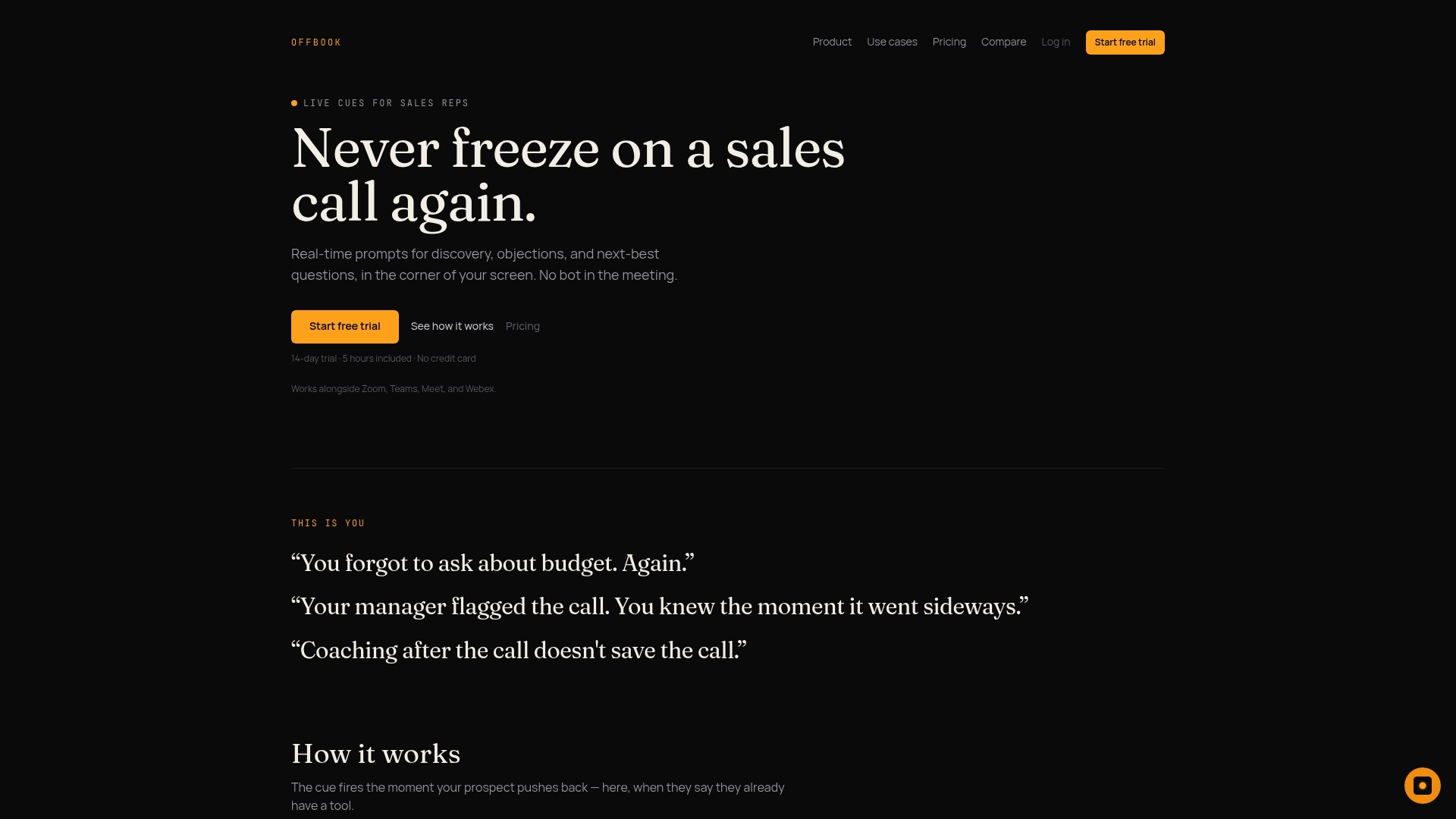
For a RevOps leader deciding where to run a first pilot, a small cohort works best: pick five to eight reps, run it for 30 to 60 days, and track time-to-ramp for newer reps, conversion rate on qualified opportunities, and how consistently reps hit the qualification questions your framework requires. Those are the same KPIs RevOps should already be tracking, which makes this an easy pilot to fold into an existing reporting cadence rather than a separate initiative competing for attention. If you’re building or tightening a formal coaching program around this kind of tool, a guide to building a sales coaching program covers the governance side. To see what a pilot looks like for your team, visit the OffBook sales page and start a trial.
Frequently Asked Questions
What is the main role of RevOps in scaling sales? RevOps aligns sales, marketing, and customer success around shared data and process so that growth doesn’t break every time headcount increases. It’s the difference between scaling sales predictably and scaling the chaos along with the team.
When should a scaling company hire its first RevOps person? Most growth-stage guidance points to roughly $5 million to $8 million in annual recurring revenue as the point where a dedicated hire pays off, though a fractional RevOps consultant can validate the need earlier.
What KPIs show RevOps is actually working? Forecast accuracy, pipeline velocity, win rate, time-to-ramp, and revenue leakage are the core set. If none of these are improving within two quarters of standing up RevOps, something in the implementation needs fixing.
Does RevOps replace the sales operations role? No. Sales operations typically becomes one function inside the broader RevOps model, which also includes marketing operations and customer success operations under shared governance.
How long does it take to see results from a RevOps initiative? A focused pilot, like fixing one lead routing workflow or piloting real-time call coaching, can show measurable results within 30 to 60 days. Full institutionalization across a growing team typically takes two to three quarters.
Sources
- Revenue Operations: The What, Best Practices & RevOps Guide
- Revenue Operations: RevOps’ Impact on Go-to-Market
- Revenue Operations: Why RevOps Is the Engine Behind the Fastest-Growing SaaS Companies