Catch 5 Renewal Risk Signals Live: Verbatim Prompts for Customer Success Reps
Learn the five in-call renewal risk signals, exact lines to say, and a triage checklist reps can use live to prevent churn before renewal.
Published: September 19, 2026
Author: OffBook Editorial Team

Renewal risk signals are the specific things a prospect or customer says mid conversation that reveal a deal is slipping: a shift in tone, hesitation before answering, an unprompted mention of a competitor, deferral language, or a change in who shows up to the call. When you catch one, write it down, rate its severity from 1 to 3, and check it against the trend rule: two distinct signals across two consecutive touchpoints means it’s time to run a save play.
TL;DR:
- Monitoring for unprompted competitor mentions can reveal renewal risk up to 180 days earlier than usage data, allowing proactive retention efforts.
- A change in sponsor or champion, especially if they send a delegate or skip calls, signals the highest risk severity and warrants immediate action.
- Two different renewal risk signals across two consecutive touchpoints or a single high-severity alert should trigger a formal save play.
- Recognizing subtle sentiment flattening or hesitation language requires noting exact words and asking curiosity-driven questions to uncover true account needs.
- In-call prompt tools like OffBook can help identify signals live, enabling immediate follow-up and documentation that improve retention outcomes.
Table of Contents
- What Are the Five Renewal Risk Signals to Listen For?
- What Should You Say When You Hear a Renewal Risk Signal?
- How Do You Triage a Renewal Risk Signal Once You Spot One?
- How Do Renewal Risk Signals Fit Into Your Call Cadence?
- Why In-Call Timing Beats Post-Call Notes Every Time
- Get Real-Time Prompts on Every Renewal Call With OffBook
- Sources
- FAQ
What Are the Five Renewal Risk Signals to Listen For?
Each signal has a distinct verbal fingerprint. Learning to recognize them in real time, not after you review the transcript, is what separates a saved account from a surprise churn notice.
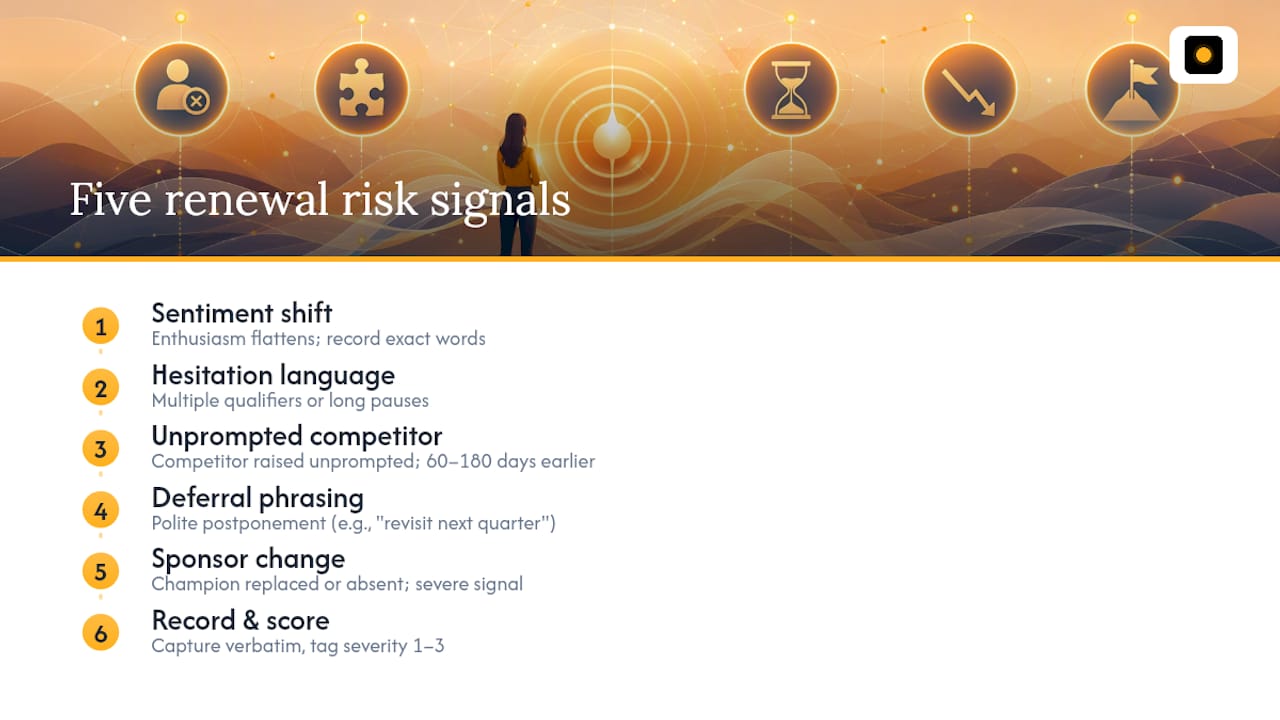
Sentiment shift is the easiest to miss because it’s rarely dramatic. A champion who used to say “we love this” now says “it’s fine” or “it does what we need.” That flattening of enthusiasm is a real signal. Mark it with the exact words used, not your paraphrase.
Hesitation language shows up as qualifiers stacking up before a commitment. Listen for “I’d have to check,” “probably,” “I think so, but let me confirm,” or a long pause before answering a direct renewal question. One qualifier is normal caution. Three in one call is a pattern.
Unprompted competitor mentions carry more weight than almost anything else on this list, because the buyer brought it up without you asking. Conversational signals like this tend to surface risk well before usage data ever moves, sometimes 60 to 180 days earlier than a dashboard would flag it.
Deferral phrasing sounds like “let’s revisit this next quarter” or “we’re not ready to decide yet.” It’s polite, and it’s often the clearest early warning you’ll get.
Sponsor change means your original champion sends a delegate, skips the call entirely, or a new name suddenly appears on the invite with no context. This is often the highest-severity signal on the list because it can mean the person who fought for you internally is gone.
For each signal, capture the verbatim quote in your notes, tag it with a severity score of 1 (mild), 2 (moderate), or 3 (severe), and move on. Don’t stop the call to analyze it. Score it, flag it, keep talking.
What Should You Say When You Hear a Renewal Risk Signal?
You don’t need a script that sounds rehearsed. You need short, curious lines that redirect the conversation toward value instead of triggering a defensive standoff. Here’s a prompt bank organized by signal.
- Sentiment shift: “You mentioned it ‘does what we need.’ What would make it feel indispensable instead?” or “Sounds like something’s changed since we last talked. What’s on your mind?”
- Hesitation language: “What information would help you feel confident deciding today?” or “Who else needs to weigh in before you can commit?”
- Unprompted competitor mentions: “What’s caught your attention about them?” followed by “What would you need to see from us to keep this simple?” Never argue the comparison. Ask what problem the competitor solves that you haven’t addressed.
- Deferral phrasing: “What happens between now and next quarter that changes the calculus?” or “If we solved [specific issue] this week, would timing still be a blocker?”
- Sponsor change: “Help me understand how the decision is being made now that [name] is involved,” or simply, “Who’s the best person to loop in for this renewal?”
The through line across all five is curiosity before persuasion. Experts who study renewal conversations point to a useful reframe here: instead of treating a product update or usage change as a reason to ask for a commitment, use it as an entry point to discover what value actually looks like for this account right now. That single mental shift changes almost every line above from a defensive maneuver into a real conversation.
Pro Tip: Pause for a full three seconds after asking a probing question. Reps who fill silence too quickly train buyers to give shallow answers. Let the discomfort do its job.
Confirm commitment before you hang up. If you got a real answer to any of the above, restate it back verbatim and ask them to confirm it as the next step. Vague agreement is not a next step.
How Do You Triage a Renewal Risk Signal Once You Spot One?
Not every signal deserves a full save play. The trend rule keeps you from overreacting to noise: two distinct signal types across two consecutive touchpoints, or one signal scored at severity 3, is what should trigger action. A single mild hesitation on an otherwise normal call is not a crisis. A sponsor change followed by deferral language on the next call is.
Guides that study churn conversations consistently land on this same threshold. Trend based rules outperform single-call judgment calls because they filter out the ordinary friction that happens on almost every account at some point, and only escalate the accounts showing a repeatable pattern.
In-call play, when the trend rule fires mid-conversation:
- Ask directly for a smaller commitment than the full renewal. “Can we lock a 15-minute call with your decision-maker next week?” is easier to get than a signed contract on the spot.
- Name the risk out loud, gently. “It sounds like timing is a real concern. Is that fair?” Buyers respect directness more than reps assume.
- Never leave the call without a dated next step in the calendar, even a small one.
48-hour follow-up checklist, after the call ends:
- Log every verbatim quote and severity score in the CRM against the account, not just in personal notes.
- Notify whoever owns the relationship above you (manager, or the original AE if you’re CSM) if severity hit a 3.
- Confirm the documented next step has an owner and a date, not just a vague “will follow up.”
- If a competitor was named, flag it to product or marketing to support your email marketing retention efforts. That verbatim quote is worth more than a survey response.
How Do Renewal Risk Signals Fit Into Your Call Cadence?
Signals are only useful if they’re visible across touchpoints, not just inside one call you’ll forget by Friday. That means building the habit into both ends of the conversation.
- Before the call: Check the last logged signals on the account, confirm the sponsor is still the same person who attended last time, and scan recent support tickets or contract questions for anything that hints at friction before you even say hello.
- After the call: Capture four fields immediately: signal type, verbatim quote, severity (1 to 3), and next-step owner with a timeline. This takes ninety seconds and it’s the difference between a real trend line and a gut feeling six months from now.
- Set your cadence by account tier. Quarterly signal reviews work fine for most accounts. Strategic or enterprise accounts deserve a monthly check, and any account should get an immediate, event-triggered review the moment a sponsor changes or a support escalation lands.
Active capture like this consistently beats passive tools. AI-moderated check-ins and structured conversation logging produce far richer signal data than a short NPS survey, which most buyers simply ignore or click through without real feedback, undermining the completion rates teams actually need to trust the data.
Why In-Call Timing Beats Post-Call Notes Every Time
The mistake most teams make isn’t failing to notice risk. It’s noticing it too late, after the call ends, when the moment to actually address it has already passed. A signal caught while the buyer is still on the line gives you a chance to ask the follow-up question that reframes the whole conversation. A signal caught while reviewing a transcript the next morning just gives you a data point for a dashboard nobody looks at until the deal is already gone.
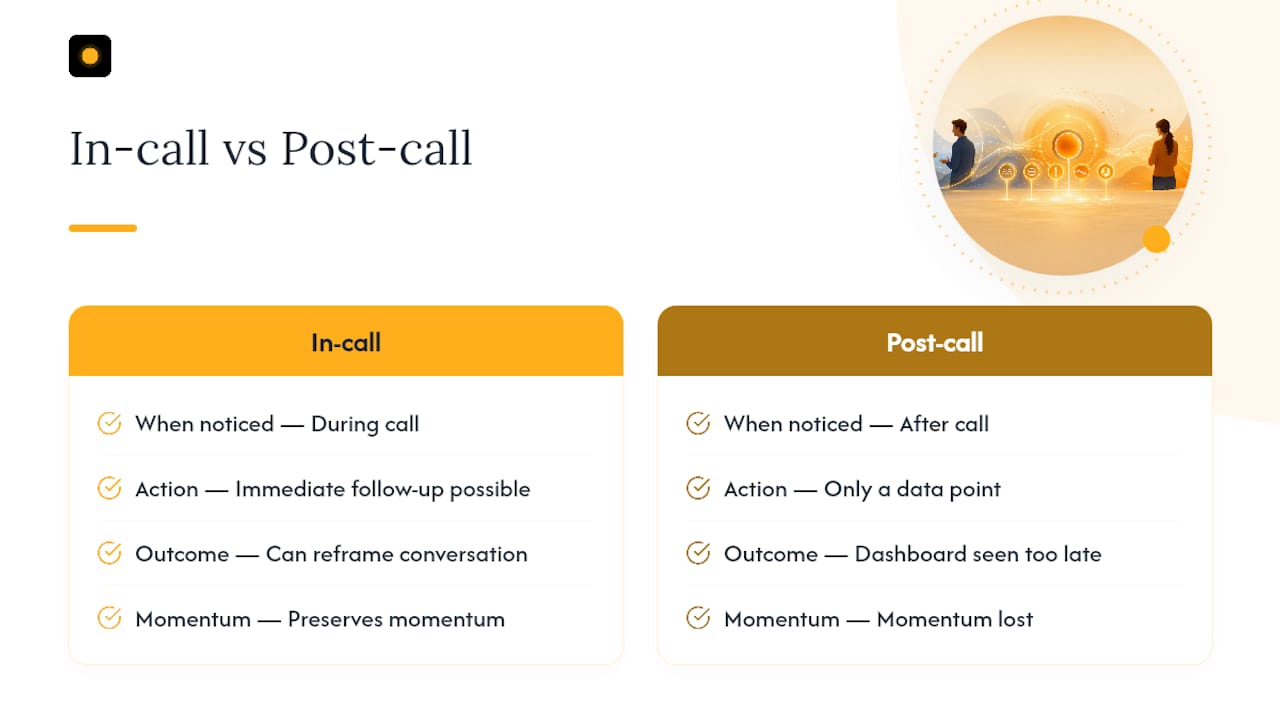
[brand_signal] Neil has watched enough renewal calls to notice a consistent pattern: the reps who save at-risk accounts aren’t the ones with better instincts. They’re the ones who react inside the window that still matters. A prompt delivered live, while the buyer is still talking, preserves momentum in a way that a post-call summary never can.
This doesn’t replace judgment. It extends it. A live coaching layer can’t read a room the way an experienced rep can, but it can make sure that experienced rep never misses the moment because they were too busy typing notes to actually listen.
— Neil
Get Real-Time Prompts on Every Renewal Call With OffBook
OffBook listens to your renewal and review calls and puts the right prompt on your screen the moment a signal appears, structured around frameworks like MEDDIC and MEDDPICC so you’re probing pain and confirming commitment instead of guessing what to say next. It builds a pre-call brief on the people you’re about to talk to, then drafts a post-call summary and follow-up so the signal, the quote, and the next step are already logged before you’ve closed the tab.
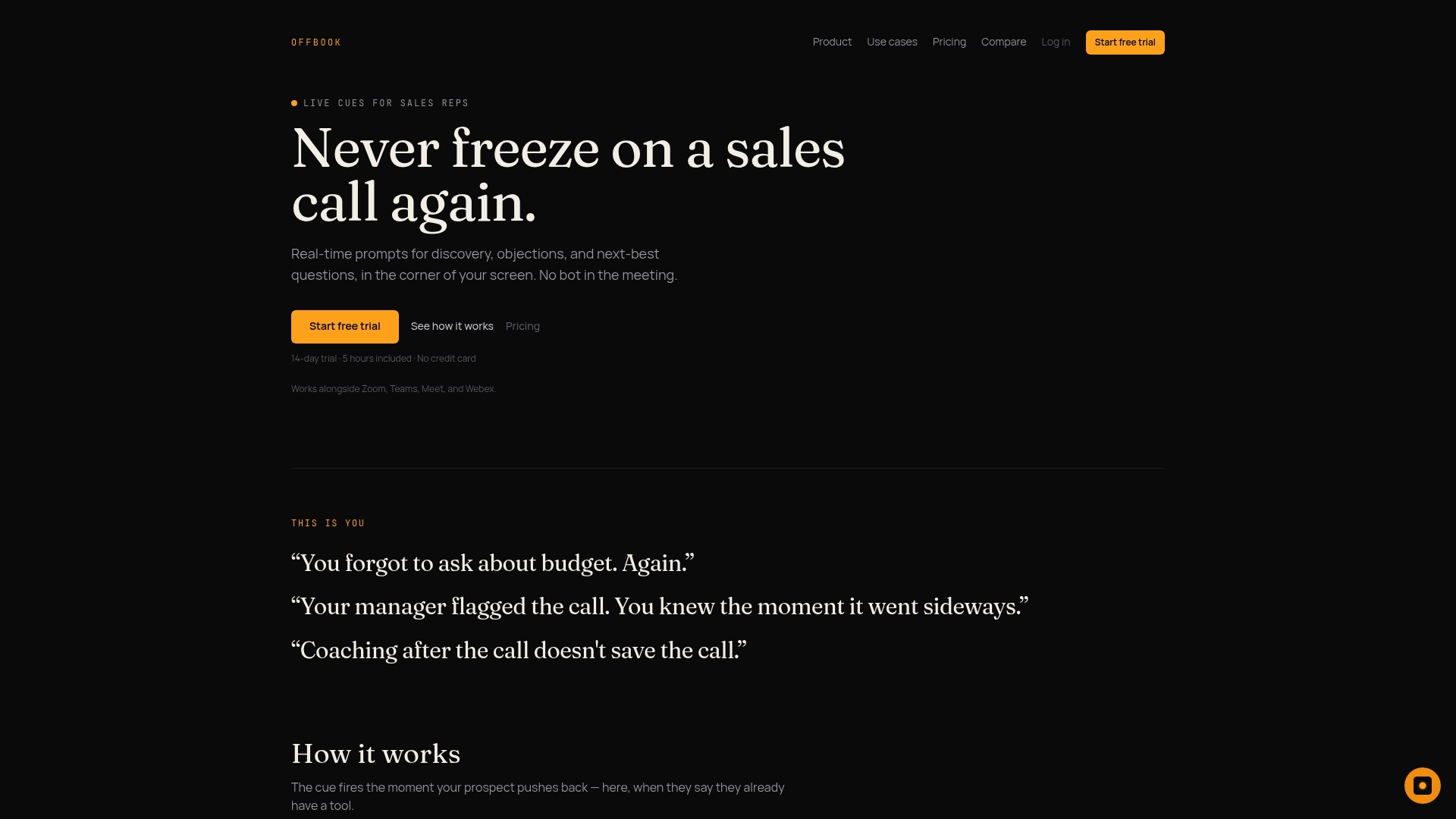
If you run customer-success calls specifically, the customer-success coaching page shows how the same live-prompt engine maps to renewal conversations. Plans start with the Power tier at $59 a month or $590 a year, and team pricing runs $1,000 per seat annually for larger CS and sales organizations. Start a trial and run your next renewal call with a coach that never joins the meeting but never misses a signal either.
Sources
- At-Risk Customer Identification: The Conversational Signals That Beat Usage Data Alone | Perspective AI
- How to Spot Churn Signals in Customer Conversations (2026) | BuildBetter
FAQ
What Counts as a Renewal Risk Signal on a Call?
It’s any specific language pattern, sentiment shift, hesitation, competitor mention, deferral, or sponsor change, that a rep can hear and act on in real time during the conversation itself. It’s distinct from usage or billing data reviewed after the fact.
How Many Signals Justify a Save Play?
The trend rule calls for two distinct signal types across two consecutive touchpoints, or a single signal scored at the highest severity level, before you escalate to a formal save play. One mild signal on its own usually doesn’t warrant escalation.
Can OffBook Help Me Catch These Signals Live?
Yes. OffBook listens during the call and surfaces on-screen prompts tied to MEDDIC and MEDDPICC the moment a risk signal like hesitation or a competitor mention appears, without a bot joining the meeting. Pricing starts at $59 per month for the Power plan.
Why Do Conversational Signals Matter More Than Usage Data Alone?
Conversational cues often surface risk 60 to 180 days before usage metrics decline, and they explain the cause behind the risk rather than just flagging a score. That earlier, richer detail gives reps time to actually intervene.
How Often Should I Review Renewal Risk Signals?
Quarterly reviews work for most standard accounts, while strategic or enterprise accounts warrant a monthly check. Any account should get an immediate review the moment a sponsor changes or a support escalation occurs.