90 Second Intake to Qualify Deals Faster for Founder Led B2B
Speed playbook for founder led B2B teams: a 90 second intake, automated fit and intent routing, and live coaching to qualify deals faster.
Published: September 3, 2026
Author: OffBook Editorial Team

Gate every discovery call behind a 90-second intake that captures consequence, authority, and timeline, then route the lead immediately into one of three lanes: book, nurture, or archive. Automate the scoring and routing wherever the volume justifies it, and keep the human touch only where judgment actually changes the outcome. Speed is the qualification strategy now, not a nice side effect of one.
TL;DR:
- Waiting even 30 minutes to contact an inbound lead significantly decreases the chance of qualifying it, increasing the risk of missed opportunities.
- Focus qualification on five key data points: urgency, decision authority, budget, prior attempts, and fit, adjusting complexity based on deal size and cycle length.
- Implement a 90-second intake process capturing the prospect’s problem, consequence of inaction, and prior attempts to determine whether to book, nurture, or archive immediately.
- Automate lead scoring and routing with AI to classify prospects as hot, warm, cold, or disqualified, thereby increasing qualified-to-book rates beyond 60 percent.
- Regularly review qualification criteria and feedback to recalibrate your process, ensuring it adapts to market changes and improves deal success over time.
Table of Contents
- Why Speed Matters to Qualify Deals Faster
- Data Points and Fast Frameworks to Qualify Deals Faster
- The 90-Second Intake That Gates Every Call
- Automating Fit, Intent, and Timing Without Losing Conversion Quality
- How to Qualify Out Bad Deals Fast
- Stage Gates: The Minimum Evidence to Advance a Deal
- Real-Time Collaboration That Speeds Up Qualification
- Using CRM Data to Spot High-Probability Deals
- Feedback Loops That Keep Qualification Sharp
- Neil’s Perspective: What Actually Scales at Founder-Led Teams
- How Offbook Helps You Qualify and Close Faster
- Sources
Why Speed Matters to Qualify Deals Faster
Every hour you sit on an inbound lead, your odds of ever qualifying it drop. Harvard Business Review’s research on online sales leads found conversion rates fall off sharply the longer a rep waits to make contact. That is not a soft nudge toward “faster is better.” It is a conversion cliff, and most sales teams are standing right on the edge of it without knowing.
The internal cost is just as real, even if it never shows up on a dashboard. A rep who spends 30 minutes on discovery with someone who was never going to buy has burned time that a qualified prospect needed. Multiply that across a team of five reps doing this five times a week, and you have a quiet leak draining hours that should be going toward deals with a real shot at closing.
Three numbers are worth tracking if you want proof this is working:
- Time spent in discovery calls with leads that get disqualified in the first ten minutes (target: near zero)
- Qualified-to-booked-call rate (this should climb as intake friction drops)
- Pipeline health, meaning the ratio of deals with a confirmed economic buyer and timeline versus deals still floating in “maybe”
None of these require a new platform to start measuring. They require deciding, today, that a call only gets booked once a lead clears a bar.
Data Points and Fast Frameworks to Qualify Deals Faster
Every deal worth pursuing shares a small set of traits, and you can usually confirm or rule out most of them before a call ever happens. The trick is knowing which five or seven data points actually predict outcome, and which are just comforting noise.
Here is the shortlist that matters, in the order most reps should check it:
- Urgency and consequence. What happens if this problem stays unsolved for another quarter? A prospect who can name a specific cost of inaction (lost revenue, a compliance deadline, a churn risk) is worth ten prospects who say “we’re just exploring.”
- Decision authority. Are you talking to someone who can sign, or someone who has to walk this up a chain? Ask directly: “Who else needs to sign off before this moves forward?”
- Budget reality. Not “do you have budget,” which invites a polite lie, but “has budget already been allocated for this category, or would this require a new line item?”
- Prior attempts. Has this prospect tried to solve the problem before, and what happened? A prospect who has already evaluated and rejected two competitors is either a fast yes or a fast no, rarely a slow maybe.
- Fit. Does the prospect’s company size, tech stack, and use case match what you actually solve well? A high-precision signal here is whether they can describe their current workflow in the exact terms your product addresses.
Choosing between a fast rubric and a deep one depends on your deal size and cycle length. BANT (Budget, Authority, Need, Timeline) works well for shorter cycles and lower-complexity products, where a rep needs a yes/no answer in minutes, not a multi-week evaluation. MEDDIC (Metrics, Economic Buyer, Decision Criteria, Decision Process, Identify Pain, Champion) earns its extra overhead on complex, multi-stakeholder deals where a wrong qualification call costs weeks, not minutes.
Pro Tip: Don’t force MEDDIC onto a self-serve motion, and don’t force BAN Tonto an enterprise deal with six stakeholders. Match the framework’s depth to the deal’s complexity, or you’ll either over-qualify simple deals into oblivion or under-qualify complex ones into a wasted proposal cycle.
The real value of these frameworks shows up when you turn them into a routing rule instead of a scorecard you fill out and forget. If a lead clears urgency, authority, and fit, book the call immediately. If it clears two of three but budget is unconfirmed, route to nurture with a specific follow-up trigger. If it fails urgency and fit both, archive it and move on. The framework only earns its keep once it maps to an action.
The 90-Second Intake That Gates Every Call
The fastest teams do not skip qualification, they compress it. A short intake sequence, run either through a form or a quick human touch, can produce a reliable go/nurture/archive decision in about 90 seconds, according to OperatorIQ’s qualification method. You don’t need to score every dimension to act; a handful of high-precision questions gets you there.
Three fields belong in every intake, no exceptions:
- The problem, stated in the prospect’s own words. Vague answers (“we want to improve efficiency”) are a yellow flag. Specific ones (“we’re losing three hours a week reconciling CRM entries manually”) are a green light.
- The consequence of inaction. Ask directly: “What happens to your team if this doesn’t get solved in the next quarter?” A prospect with no answer here usually has no urgency, and no urgency means no deal.
- Prior attempts to solve it. “What have you already tried, and why didn’t it work?” This single question often reveals budget history, internal politics, and fit all at once.
For authority, a simple, low-friction check works better than an interrogation: “Besides you, who else will be involved in evaluating this?” You are not asking permission, you are mapping the room before you walk in.
Routing rules turn these answers into action without a debate:
- Clears all three fields with a specific, time-bound consequence: calendar link fires instantly, and the AE gets a prep brief before the call.
- Clears the problem and prior-attempts fields but timeline is vague: route into a nurture sequence with a check-in scheduled for 30 to 60 days out.
- Fails on consequence or fit entirely: archive with a note, and set a recontact cadence for six months rather than deleting the lead.
This is the sequence that keeps unqualified prospects off your calendar without making them feel dismissed. It also means every call an AE takes has already cleared a real bar, which changes how they show up. A rep who knows the prospect has urgency and authority prepares differently than one walking in blind.
Automating Fit, Intent, and Timing Without Losing Conversion Quality
Once your intake questions are settled, the next lever is speed of routing. AI-based scoring can evaluate Fit, Intent, and Timing on an inbound lead and route it in seconds rather than hours, according to implementation guidance from Onsa. Fit measures whether the company and role match your ideal customer profile. Intent captures behavioral signals like page visits, content downloads, or the specificity of the intake answers themselves. Timing looks at stated urgency and budget cycle.
Score bands typically map to four routing tiers:
- Hot: high fit, high intent, near-term timing. Instant calendar link, AE notified with a prep brief.
- Warm: strong fit but unclear timing or intent. Goes into a nurture track with a scheduled follow-up.
- Cold: weak fit or intent, but not disqualifying. Low-touch nurture, longer cadence.
- Disqualify: fails fit outright. Tagged and archived, no rep time spent.
Removing the manual review queue and showing prospects a calendar the moment they submit a qualifying form measurably raises qualified-to-book rates. RevenueHero reports top performers hitting a 62% median qualified-to-booked rate, with the best teams clearing 78% or higher, once that review gap disappears.
Getting there without breaking conversion quality takes a deliberate rollout, not a flip of a switch:
- Feed the model clean inputs: firmographic data, intake answers, and behavioral signals from your CRM and marketing stack.
- Run the AI or rule-based score in parallel with your existing manual process for a calibration period, typically a couple of weeks, before trusting it alone.
- Compare where the model and your reps disagree, and adjust thresholds before cutting over to full automation.
Three pitfalls sink most rollouts. Over-trusting a score before it is calibrated sends bad-fit leads straight to your best AE’s calendar. Unclear CRM ownership between marketing and sales creates fights over who gets credit for a routed lead, which slows adoption. And edge cases, the deals that don’t fit your model cleanly, need a human escalation path or they get silently mishandled.
How to Qualify Out Bad Deals Fast
Qualifying out is just as valuable as qualifying in, and most reps are too slow to do it because disqualifying feels like giving up. It isn’t. It’s protecting the hours you need for deals that will actually close.
Watch for these red flags, and act on them immediately rather than hoping they resolve themselves:
- No named consequence for inaction. If a prospect can’t articulate what happens if the problem stays unsolved, there is no urgency to build a deal around.
- Repeated rescheduling with no stated reason. This usually signals the prospect isn’t the real decision-maker, or priorities shifted and nobody told you.
- Budget described as “we’d need to find it.” Not confirmed, not allocated. Treat this as a nurture signal, not a live opportunity.
- Evaluation without a decision process. “We’re just looking around” with no named timeline or stakeholder list rarely turns into a closed deal within a normal sales cycle.
- Champion goes silent after one call. If your internal advocate disappears, the deal is very likely dead internally too.
A short, respectful script keeps the relationship intact while you disengage: “Based on what you’ve shared, it sounds like this isn’t a priority right now. I’d rather not take up your time until it is. Would it make sense for me to check back in [three or six months]?” This close is honest, costs you nothing, and often gets a warmer response than a hard pitch would.
In your CRM, tag disqualified leads with the specific reason (no budget, no urgency, wrong fit) rather than a generic “closed lost.” That tag drives an automated nurture cadence built around the actual objection, so the lead stays usable instead of disappearing into a dead list.
Stage Gates: The Minimum Evidence to Advance a Deal
Not every deal that clears initial qualification deserves equal AE attention. Stage gates decide which ones get it.
Minimum entry criteria to advance a deal past discovery should include a confirmed economic buyer (not just a champion), a stated decision process with a rough timeline, and a quantified pain or ROI case the prospect can defend internally. Deals missing any of these three aren’t dead, they’re just not ready for the next stage of investment.
Score bands make the next action obvious instead of a judgment call:
- Advance: all three entry criteria confirmed. Full AE engagement, proposal work begins.
- Conditional advance: two of three confirmed, one in progress (commonly the economic buyer, still being identified). Continue engagement but flag for a check-in before the next stage.
- Return to qualification: none or one criterion confirmed. Send back to the intake stage rather than letting it drift in the pipeline.
For ranking deals within the “advance” tier, weigh win probability against expected time-to-close rather than deal size alone. A $40,000 deal closing in three weeks with a confirmed economic buyer often deserves more immediate attention than a $150,000 deal stuck in a six-month procurement cycle with no named buyer yet. Warm-intro orchestration and mapping the executive buyer early are two of the highest-leverage moves for compressing that cycle further, according to Boomerang’s research on pipeline acceleration. Ranking by expected time-to-close, not just contract value, is what actually protects a limited AE’s calendar.
Real-Time Collaboration That Speeds Up Qualification
Qualification slows down most often at the handoff, not the intake. A lead clears the initial bar, then sits for two days waiting for an AE to notice it in a shared inbox. Fixing that gap matters more than almost any framework tweak.
Shared visibility beats sequential handoffs every time. When SDRs and AEs work off the same live view of intake answers, scoring tier, and stage, nobody has to reconstruct context from a forwarded email thread. A quick Slack or Teams channel tied directly to CRM updates, where a hot-tier lead posts automatically the moment it’s scored, cuts the handoff delay from hours to minutes.
Set a team-wide response SLA and treat it the way you’d treat a customer-facing deadline. Fifteen minutes for hot-tier leads, same-day for warm, is a reasonable starting bar for most early-stage teams. Post the SLA somewhere visible, and review misses in your weekly pipeline call rather than letting them go unaddressed.
Pre-call prep briefs also belong in this collaboration layer. When an AE walks into a call already knowing the prospect’s stated consequence, prior attempts, and named stakeholders, the call itself does less qualifying and more selling. That prep should travel with the lead automatically, not get rebuilt from scratch by whoever picks up the call.
Using CRM Data to Spot High-Probability Deals
Your CRM already holds the answer to which deals are worth chasing first. Most teams just aren’t looking at the right fields.
Start with activity velocity: deals where the prospect opens every email, attends every meeting, and responds within hours tend to close faster than deals with the same stated budget but sluggish engagement. That pattern is visible in standard CRM activity logs without any additional tooling.
Look next at deal-stage duration compared to your historical average. A deal sitting in “proposal sent” twice as long as your median close time is a warning sign worth flagging in your next pipeline review, not a deal to keep hoping will move. Gartner’s guidance on lead scoring and intent signals points to combining firmographic fit with behavioral intent data as the more reliable predictor than either signal alone, which is exactly what a properly configured CRM scoring model should be doing under the hood.
Segment your win-rate data by the qualification criteria you’re actually capturing, urgency, authority, budget confirmation, rather than by generic firmographics like company size alone. You’ll often find that a specific combination (confirmed economic buyer plus a named consequence) predicts close rate far better than industry or headcount ever did. That insight should reshape your scoring weights, not just sit in a quarterly report nobody rereads.
Feedback Loops That Keep Qualification Sharp
A qualification process built once and never revisited decays fast. The market shifts, your product changes, and the questions that predicted a good-fit deal last year start missing signals this year.
Build a monthly review where sales and whoever owns the qualification criteria (often a founder or RevOps lead at early-stage companies) look at closed-won and closed-lost deals side by side. Ask specifically: which intake answers correlated with a fast close, and which “green light” signals turned out to be false positives? This is where a scoring model earns its recalibration.
Rep feedback matters just as much as the data. The reps on the calls hear objections and hesitations the CRM never captures. Give them a fast, low-friction way to flag “this qualification question isn’t catching the right thing” so it makes it into the next review instead of getting lost in a Slack message nobody revisits.
Treat your intake script and scoring thresholds as living documents, not a one-time setup. A quarterly adjustment cycle, informed by real close-rate data rather than gut feel, keeps your qualification bar calibrated to what’s actually converting right now rather than what converted eight months ago.
Neil’s Perspective: What Actually Scales at Founder-Led Teams
Most qualification advice assumes you have a RevOps team to build the scoring model and an SDR bench to run the intake. Founder-led teams at seed stage rarely have either. What scales there isn’t automation first, it’s discipline first: a founder or first rep manually running the 90-second intake on every single lead until the patterns are obvious enough to codify.
The mistake I see most often is teams reaching for AI scoring before they’ve run even 50 deals through a consistent manual process. You can’t calibrate a model on intuition. Series A teams with real deal volume are exactly where parallel scoring and automated routing start paying for themselves.
The bigger gap, though, is what happens on the call itself once qualification is right. A rep can nail the intake and still fumble the discovery call by forgetting to ask about the economic buyer or missing a budget objection they should have caught. That’s the moment live coaching earns its place, not before the call, but during it, when the qualification gap is still fixable.
— Neil
How Offbook Helps You Qualify and Close Faster
Everything in this playbook works better when the person on the call has the right prompts in front of them at the right second. Offbook listens to your live sales calls and surfaces on-screen cues built around MEDDIC and MEDDPICC, the exact frameworks this article walks through, so a rep never misses an authority check or a consequence question mid-conversation.
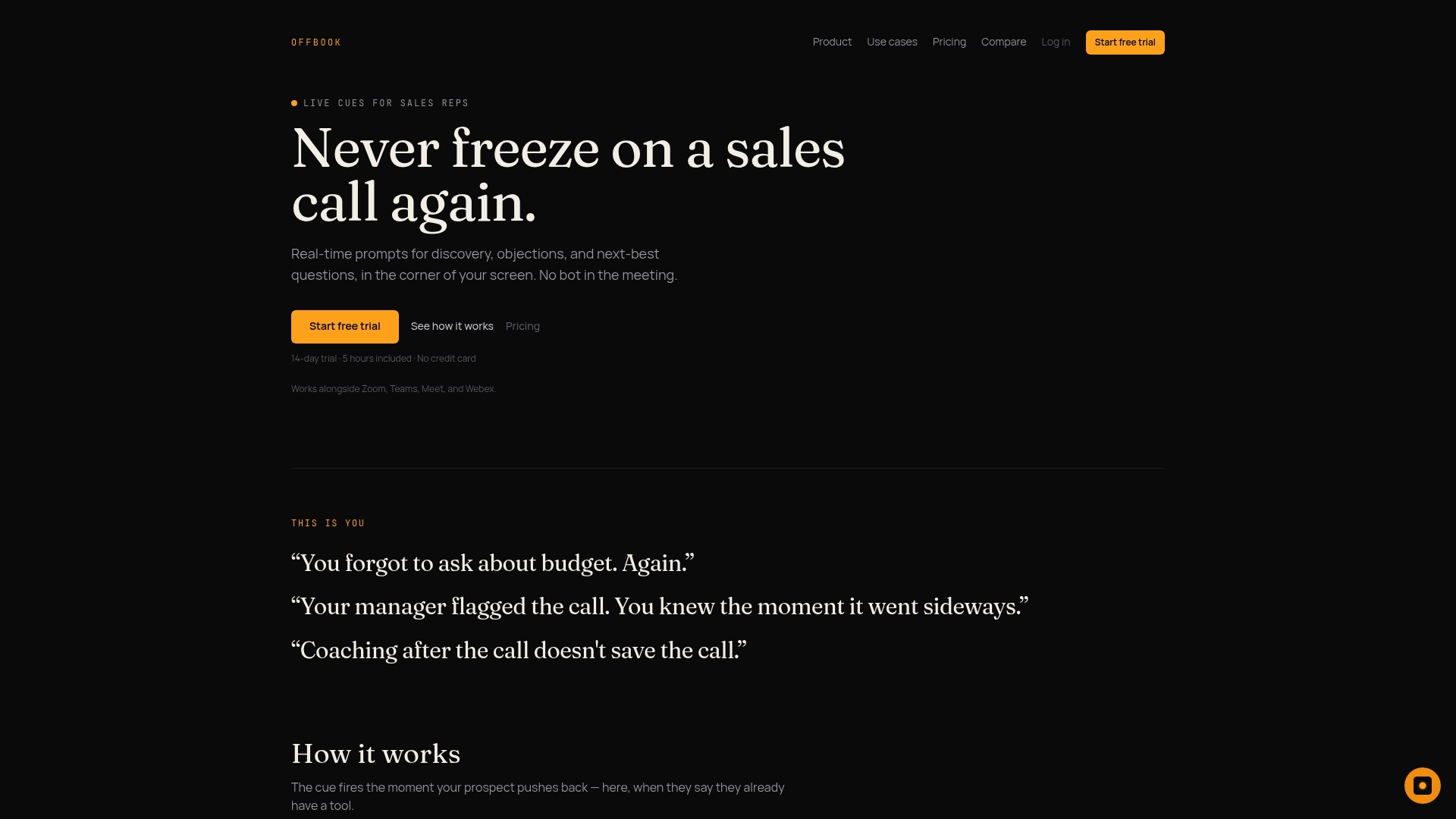
Before the call even starts, Offbook generates a pre-call brief on the company and people you’re about to meet, so the qualification groundwork from your intake carries straight into the discovery conversation instead of getting rebuilt from memory. During the call, it flags qualification gaps live: an unconfirmed budget, a missing stakeholder, an objection the rep glossed over. After the call, it drafts a debrief and follow-up so nothing from that 90-second intake gets lost between stages.
If your team is still running qualification manually and hitting a ceiling on rep bandwidth, that’s the moment to test a tool rather than keep tuning process alone. Explore OffBook’s platform or see how it fits founder-led sales teams, and start a trial to see what it catches on your next call.
Sources
- The Short Life of Online Sales Leads — Harvard Business Review
- The 90-second lead qualification an AI agent runs before you ever pick up the call | OperatorIQ
- Onsa
- How to Qualify Inbound Leads Automatically — RevenueHero
- 20 pipeline acceleration tactics that actually close deals — Boomerang