Launch Privacy Compliant Sales Coaching in 30 to 90 Days
Launch privacy compliant sales coaching in 30 to 90 days. This U.S. playbook maps FTC and NIST to live AI consent, retention rules, access controls, and...
Published: October 4, 2026
Author: OffBook Editorial Team

Sales coaching can be privacy compliant when you implement consent and transparency, minimize and protect coaching data, set clear retention rules, require vendor assurances, and train your staff. That means mapping your coaching program to frameworks like the FTC’s guidance on protecting personal information and the NIST Privacy Framework, then choosing tools built around consent by default. The checklist below turns that into action.
TL;DR:
- Separating coaching types allows tailored consent, retention, and access rules for live AI coaching, call recordings, and transcripts to minimize privacy risks.
- Ensuring vendor contracts include signed data processing agreements, encryption commitments, and restrictions on training models on call data is essential for compliance.
- Implementing explicit, session-specific consent with timestamp logging and clear language helps build trust and adhere to privacy regulations during live coaching.
- Using strong encryption for data at rest and in transit, with role-based access controls and audit logs, significantly reduces breach notification obligations.
- Starting with minimal data collection, short retention periods, and a focused pilot improves privacy management and provides a foundation for scalable, compliant sales coaching programs.
Table of Contents
- Your 30 to 90 day privacy checklist for sales coaching
- Which U.S. privacy rules actually apply to sales coaching
- How to design consent for live AI coaching and recordings
- What technical safeguards actually protect coaching data
- Turning controls into policy, training, and incident response
- What a privacy first coaching rollout looks like in practice
- Privacy is a sales advantage, not just a compliance cost
- How OffBook supports privacy compliant sales coaching
- FAQ
- Sources
Your 30 to 90 day privacy checklist for sales coaching
Start by separating your coaching types. Live, in-call AI coaching that listens to conversations in real time carries different risk than post-call recordings or transcripts, so each needs its own consent flow, retention window, and access rule.
- Classify your coaching workflows. Map every tool touching customer conversations: live coaching, call recording, transcription, and analytics each get separate privacy treatment.
- Build a consent flow. Capture opt-in or opt-out decisions before the call starts and log them with a timestamp tied to the account, not just the rep.
- Minimize what you collect. Avoid capturing full names, financial details, or health information in coaching notes unless the deal genuinely requires it.
- Set retention windows. Default to deleting raw audio and transcripts after a fixed period, a fixed period, often used is between about one to three months, and automate the deletion rather than relying on someone remembering.
- Lock down vendor contracts. Require a signed data processing agreement, proof of SOC 2 attestation, encryption commitments, and a clause barring the vendor from training models on your private call data.
- Restrict access by role. Give managers and analysts only the access level their job requires, and log every time someone views or exports coaching data.
Pro Tip: Run the first 30 days with one team and one data type, live coaching only, before expanding to recordings or analytics across the whole sales org.
The role of technology in sales coaching for B2B teams shapes how fast you can move through this list, since tools built with consent and retention controls baked in save you months of custom engineering.
Which U.S. privacy rules actually apply to sales coaching
Most sales organizations are not regulated like hospitals or banks, but that doesn’t mean privacy law stays out of the picture. Three sources matter most for a sales leader building a coaching program.
- The FTC’s guide for business lays out five principles: take stock of what personal data you hold, scale down collection, lock the data you keep, pitch what you no longer need, and plan ahead for incidents.
- The NIST Privacy Framework organizes a privacy program around five functions: Identify, Govern, Control, Communicate, and Protect, giving you a structure to audit your coaching stack against.
- If your buyers include financial institutions or their customers, GLBA-style obligations can extend to how you handle their data in a sales context, which is a reason to loop in legal before scaling a coaching pilot.
The FTC’s Safeguards Rule analysis notes that strong encryption can remove the obligation to notify customers after a breach, provided the encryption keys themselves were never exposed. That single fact changes how you prioritize technical controls: encrypting coaching data at rest is not just good practice, it can be the difference between a quiet fix and a public notification.
Bring in legal or a privacy specialist once you’re handling recorded calls at scale, especially if you plan to formalize a privacy impact assessment or sign contracts that reference GLBA or state privacy statutes.
How to design consent for live AI coaching and recordings
Live, AI-driven coaching raises a different consent question than a recorded call stored for later review. A rep getting on-screen prompts during a conversation isn’t the same, legally or ethically, as a company archiving the audio for months.
- Ask for explicit, per-session consent before any live coaching tool listens in, separate from any blanket recording disclosure baked into your terms of service.
- Keep a timestamped log of every consent decision, tied to the account and the specific call, not a single annual acknowledgment.
- Offer granularity: let a prospect agree to live coaching cues without agreeing to long-term storage, and let managers see coaching prompts without seeing raw transcripts.
- Build the consent language into your opening script, not just a popup, so reps say it out loud and prospects hear it clearly.
Pro Tip: Treat consent as part of the sales script, not a compliance afterthought. A rep who says “I use a live coaching tool that listens for context, is that okay?” builds trust instead of eroding it.
A documented consent process, like the one outlined in Zoom recording consent for seed-stage teams, gives reps a repeatable script instead of forcing them to improvise disclosure language call by call.
What technical safeguards actually protect coaching data
Consent and policy mean nothing if the underlying systems leak data. A handful of technical controls do most of the work.
- Require TLS encryption for data in transit and AES-level encryption for data at rest, and ask vendors to confirm both in writing, not just in marketing copy.
- Manage encryption keys separately from the data they protect, since a compromised key defeats the encryption entirely.
- Use role-based access control and multi-factor authentication so a sales manager, an analyst, and a rep each see only what their role needs.
- Isolate sessions so one account’s coaching data never mixes with another’s, which matters most for teams selling to multiple competing clients.
- Log access and changes to coaching data, and keep those logs long enough to support an audit, typically 12 months, without logging more personal detail than the audit actually needs.
- Favor vendors that explicitly commit not to train their AI models on your private conversation data unless it’s segregated and separately consented to.
Encryption at rest also connects back to breach notification. As the FTC’s Safeguards Rule analysis notes, properly encrypted data that’s exposed in a breach may not trigger the same notification burden as unencrypted data, which makes encryption both a security control and a liability reducer.
Sales teams adopting AI tools often underestimate how much a vendor’s model training policy matters. A platform that trains on customer conversations by default, even anonymized, creates exposure that’s hard to unwind later. The impact of AI cues on sales performance only holds up if the underlying data handling is sound.

Turning controls into policy, training, and incident response
Technical controls degrade without governance behind them. A written policy, regular training, and a tested incident response plan keep the program alive past the pilot phase.
- Write a coaching data policy. Document what’s collected, how long it’s kept, who can access it, and how deletion happens, then review it every two quarters.
- Train reps and managers separately. Reps need consent scripts and basic data-handling habits; managers need to understand access logs, retention settings, and when to escalate a concern.
- Vet vendors on a checklist, not a sales call. Require a signed DPA, a current SOC 2 attestation, a right-to-audit clause, and a summary of recent penetration tests.
- Build an incident response plan specific to coaching data. Define who gets notified, within what window, and whether encryption status changes your notification obligation.
- Run phishing and credential hygiene training regularly, since most coaching data leaks trace back to compromised credentials rather than sophisticated attacks.
How AI changes sales management for B2B teams includes guidance on structuring secure adoption, which pairs well with a structured sales training program that builds data handling into new-hire onboarding rather than treating it as a one-time memo.
What a privacy first coaching rollout looks like in practice
OffBook’s design illustrates how several of these controls come together in a live coaching product. It surfaces AI cues on a rep’s screen during a call without a bot joining the meeting, which narrows the data surface area considerably: there’s no separate meeting participant collecting its own recording or transcript outside the call itself.
- Per-session consent is built into the workflow rather than buried in a terms-of-service page, so reps and prospects both know when live coaching is active.
- Pre-call briefs prepare reps on the company and people they’re about to meet, which reduces the need to collect extra personal detail mid-call since the rep already has context.
- Retention settings and role-based profiles let a team configure how long coaching data persists and who on the team can see it.
Pro Tip: When piloting a live coaching tool, start with one rep, one consent script, and a 30 day retention window, then expand once the team has reviewed the access logs.
A practical pilot checklist looks like this: write the consent script first, set retention to the shortest workable window, assign access roles before the first call, and schedule a 30 day review of who actually used the access they were granted. Background on AI sales coaching basics is a useful primer for a team running this for the first time.
Privacy is a sales advantage, not just a compliance cost
Most sales leaders treat privacy as a tax on speed. I’d argue the opposite: a rep who can say “this call is coached by a tool that doesn’t store your data by default” closes more cleanly with privacy-conscious buyers, especially in B2B SaaS where the prospect’s own legal team will eventually ask the same questions.
Measure this with two numbers that avoid storing raw personal data: coaching adoption rate among reps, and anonymized outcome lift, win rate or qualified meeting volume, tracked in aggregate rather than tied to a specific prospect’s identity. Start with one team, prove the lift, then expand.
— Neil
How OffBook supports privacy compliant sales coaching
OffBook was built around the exact controls this guide walks through: live AI cues that reach a rep’s screen without a bot joining the call, per-session consent instead of a blanket disclosure, pre-call briefs that reduce the need to collect extra data mid-conversation, and configurable retention with role-based profiles for managers, reps, and analysts.
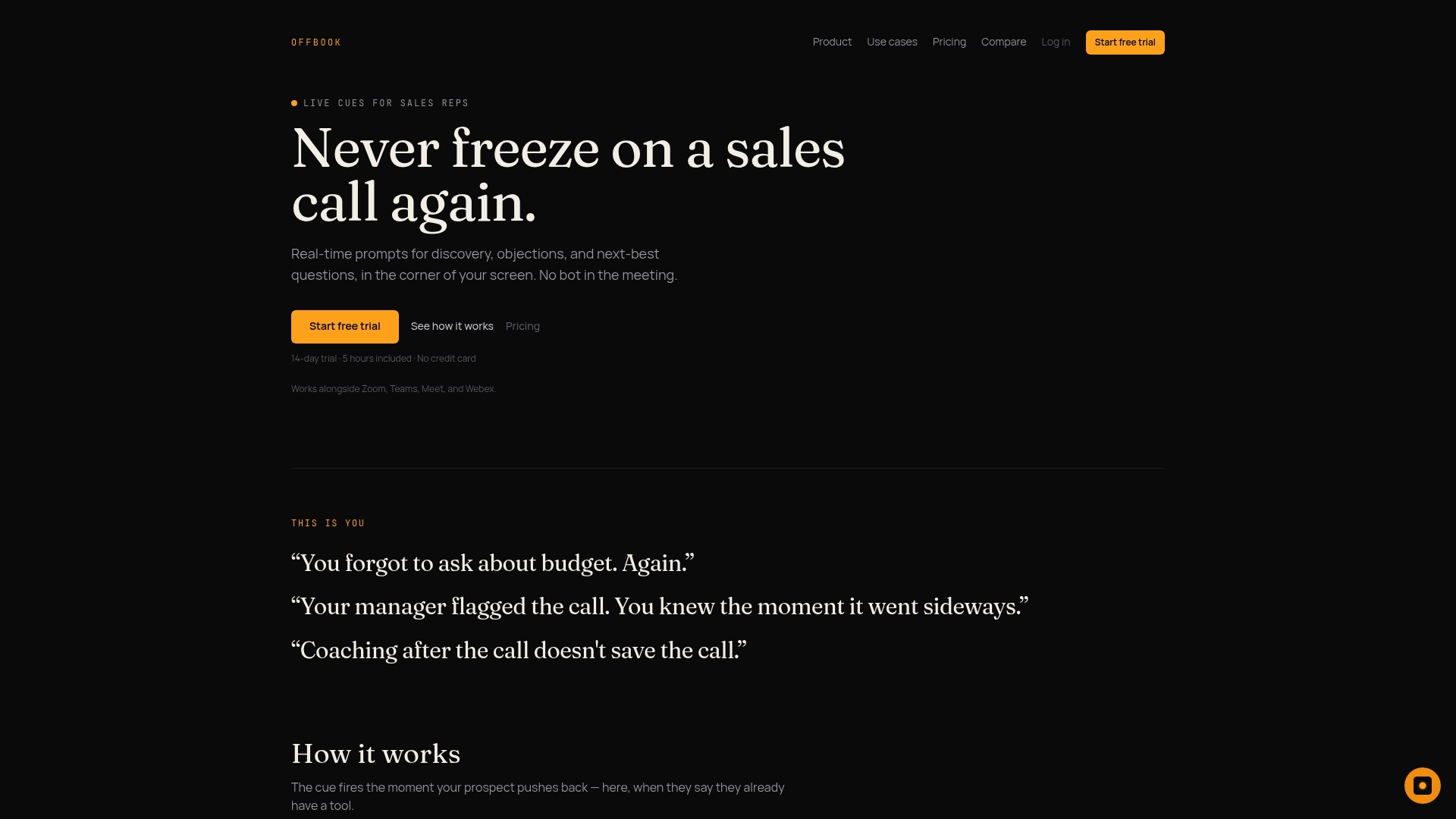
That combination lets a founder-led B2B SaaS team run disciplined, MEDDIC-style coaching on live calls without building a custom privacy program from scratch. Plans start at $59 per month or $590 per year on the Power plan, with a Team plan at $1,000 per year per seat for larger sales orgs. Check OffBook’s sales coaching page for feature details, or head to pricing to start a trial.
FAQ
How much does sales coaching typically cost?
Pricing varies widely by format and provider, ranging from free internal programs run by sales managers to paid software subscriptions or outside coaching engagements. For software-based live coaching, OffBook’s Power plan is $59 per month or $590 per year, with a Team plan at $1,000 per year per seat, available on OffBook’s pricing page.
What are the five pillars of sales enablement?
Definitions vary across the industry, so there’s no single universally cited list. Common frameworks group sales enablement around content, training and coaching, tools and technology, data and analytics, and cross-functional alignment between sales, marketing, and product.
How do I get explicit consent for live AI sales coaching?
Ask for consent at the start of the call, separate from any general recording disclosure, and state clearly that a coaching tool is listening for context. Log the decision with a timestamp tied to the specific call, and offer the option to decline without ending the meeting.
What’s the difference between consent for live coaching and for call recording?
Live coaching consent covers a tool listening in real time to surface prompts, while recording consent covers storing the audio or transcript afterward. A privacy compliant program treats these as separate decisions, since a prospect may accept live coaching but decline long-term storage.
Does encryption really reduce breach notification requirements?
Under FTC Safeguards Rule guidance, properly encrypted customer data that’s exposed in a breach can reduce or eliminate notification obligations, provided the encryption keys weren’t also compromised. That’s detailed in the FTC’s Safeguards Rule analysis.
Sources
- Protecting personal information: a guide for business | Federal Trade Commission
- Frequently asked questions | NIST Privacy Framework