3 Actions to Secure Enterprise Discovery: Hold, Map, Prep
Maps Rule 26(f) duties to technical tasks. Issue tailored holds, map custodians and ESI, use pre call discipline to reduce discovery risk.
Published: October 1, 2026
Author: OffBook Editorial Team

The three actions that make an enterprise discovery response defensible are issuing a tailored litigation hold, mapping custodians and ESI sources, and assembling a discovery response team ready for the Rule 26(f) conference. Skip any one of these and you risk sanctions, blown timelines, or scope disputes that drag on extensively. Do them early and everything downstream gets faster and cheaper.
TL;DR:
- Building a discovery response team requires clear ownership, with lead counsel, IT custodians, and records managers coordinating through a single decision point to avoid scope disputes.
- Preparing for Rule 26(f) involves gathering initial disclosures, custodian lists, data retention policies, and proposed search terms, emphasizing proportional scope and phased approaches.
- Effective preservation mandates timely, specific notices to custodians, regular re-evaluation, and preservation of native electronic messages, with justification for excluding inaccessible sources.
- Targeted, phased collection and early data assessment improve defensibility, reduce costs, and prevent scope creep by focusing on priority custodians and validation of search terms.
- Structured pre-call preparation for custodian interviews and Rule 26(f) calls, supported by tools like OffBook, helps identify gaps, enhance efficiency, and prevent common operational breakdowns.
Table of Contents
- Building the discovery response team and its governance
- How to prepare for the Rule 26(f) conference
- Preservation and litigation-hold best practices
- Collection, search, review, and production controls
- Timeline, phasing, and cost controls that protect the budget
- Reducing discovery risk through disciplined pre-call preparation
- Where enterprise discovery efforts actually break down
- Where OffBook fits into discovery preparedness
- Sources
- FAQ
Building the discovery response team and its governance
A discovery response team fails most often at the handoff between legal and IT, not inside either department. Assign clear ownership before the first custodian interview happens.
- Lead counsel sets legal strategy and signs discovery certifications under Rule 26(g).
- E-discovery liaison translates legal requests into technical tasks and vice versa.
- IT custodian owner manages system access, holds, and collection logistics.
- Records manager tracks retention schedules and disposition holds.
- Vendor manager scopes outside review or hosting providers and their contracts.
Escalation should run through a single decision point, usually lead counsel, so conflicting instructions never reach custodians directly. For larger matters, split the team into offensive (requesting) and defensive (responding) functions, with separate deposition and expert-discovery tracks once the matter grows past a single dispute.
Pro Tip: Put one person’s name on every hold notice and every custodian map update so accountability never gets lost between departments.
How to prepare for the Rule 26(f) conference
The Rule 26(f) conference requires parties to confer in good faith and typically produce a written discovery plan shortly after the meeting. Walking in unprepared costs you leverage on scope and cost allocation.
Before the conference, gather:
- Draft initial disclosures and a preliminary custodian list.
- Current data retention and deletion policies for relevant systems.
- A sample inventory of likely ESI sources, including third-party and SaaS platforms.
- A proposed date range and search term list, even if only a starting point.
- A position on production format, phasing, and privilege review procedures.
During the conference itself, the Minnesota federal courts’ e-discovery guide recommends counsel come ready to discuss custodians, non-party sources, early Rule 34 requests, and burden assessments. Use proportionality actively: propose narrower date ranges or a phased approach tied to the highest-value custodians first, then expand only if the other side shows a specific need. Courts increasingly expect this kind of scoped opening position rather than an open-ended request for everything.
Preservation and litigation-hold best practices
The duty to preserve triggers when litigation is reasonably anticipated, not when a complaint is filed. Waiting for service papers is a common way to lose data you needed.
- Scope the hold to specific custodians, systems, and date ranges rather than issuing a blanket freeze on everything.
- Send written notice to every custodian and track acknowledgment individually.
- Re-issue or re-scope the hold as new custodians or facts emerge, and re-evaluate it every 60 to 90 days on active matters.
- Document the rationale for excluding sources like disaster-recovery backups when they are not reasonably accessible.
The Department of Justice’s guidance on electronic communications recommends preserving substantive messages in native format and moving them to a secure location promptly to prevent loss from auto-deletion, a step DOJ’s memo on electronic communications treats as standard practice in preservation.
Collection, search, review, and production controls
Collection choices set the tone for everything that follows in a matter. Targeted, phased collection focused on priority custodians beats a single bulk pull almost every time, both on cost and on defensibility.
- Capture metadata alongside content during collection so chain of custody stays intact.
- Use early data assessment (EDA) to cut volume before committing to full review.
- Apply keyword search with sampling to validate hit rates before expanding terms.
- Consider technology-assisted review (TAR) or continuous active learning for high-volume matters, with documented validation steps.
- Produce in native format where the requesting party agrees, or as searchable static images with load files when required.
Pro Tip: Run a small sample review before committing to a full keyword list. It catches over-broad or under-inclusive terms while they are still cheap to fix.
Document every collection method, search protocol, and production format decision as you go. If privilege review becomes a bottleneck, negotiate a clawback agreement early so inadvertent disclosure does not become a separate fight.
Timeline, phasing, and cost controls that protect the budget
Phasing keeps discovery from becoming an open-ended cost center. A workable sequence starts narrow and expands only where the facts justify it.
- Collect from priority custodians and highest-value sources first.
- Run EDA to cut volume before full review begins.
- Move to bulk review with sampling checkpoints along the way.
- Roll out productions on a schedule rather than waiting for one final batch.
When scoping vendors, ask for flat-fee EDA engagements where possible and get clear triggers for any additional fees tied to volume growth. The ABA Litigation Journal’s discovery playbook recommends starting with a team huddle to set priorities, staffing the matter with deputies who can scale up or down, and proposing realistic interim deadlines tied to the trial schedule. When a request still feels disproportionate after negotiation, a proportionality-based motion or a request for a court conference is often faster than continued back-and-forth with opposing counsel.
Reducing discovery risk through disciplined pre-call preparation
Custodian interviews and Rule 26(f) prep calls fail for the same reason sales calls fail: the person running them walks in without a structured plan for what to ask. A checklist built before the call, not improvised during it, catches gaps that otherwise surface weeks later.
- Use a pre-interview checklist to confirm systems, retention periods, and non-party contacts before the custodian ever sits down.
- Build the litigation hold notice, custodian map, and Rule 26(f) checklist as living templates, not one-time documents.
- Borrow structured interview formats, the same discipline behind question frameworks used in B2B discovery calls, to make sure custodian interviews cover every required field on the first pass.
OffBook, built for live sales coaching, is a useful illustration of what this discipline looks like in practice: it generates pre-call briefs so a rep walks into a conversation with the right questions already queued, rather than reconstructing them mid-call. The same principle, preparing the questions before the conversation starts, applies directly to custodian intake and Rule 26(f) prep sessions.
Where enterprise discovery efforts actually break down
Three failure modes show up again and again: legal and IT operating in separate silos, preservation notices going out weeks after they should have, and custodian maps that miss a key non-party system entirely. Each one is fixable within 72 hours if someone owns the fix.

For siloed teams, mandate one joint planning session before any interviews start. For late preservation, issue a narrower interim hold immediately rather than waiting for a perfect scope. For missing custodians, re-run intake questions with anyone who touched the relevant systems, including departed employees. Brief executives early with a one-page cost and timeline estimate. Resources appear faster when leadership sees the number before the problem becomes urgent.
Pro Tip: A 30-minute joint legal-IT call in week one prevents most of the custodian gaps that show up in week six.
— Neil
Where OffBook fits into discovery preparedness
None of this requires new software to get right, but the discipline behind it, showing up to every interview and planning call with the right questions already prepared, is exactly what OffBook was built to support in a different context. It generates pre-call briefs on the people and organizations involved in a conversation and surfaces live prompts during the call itself, which maps directly onto the kind of structured custodian interviews and Rule 26(f) prep sessions described above.
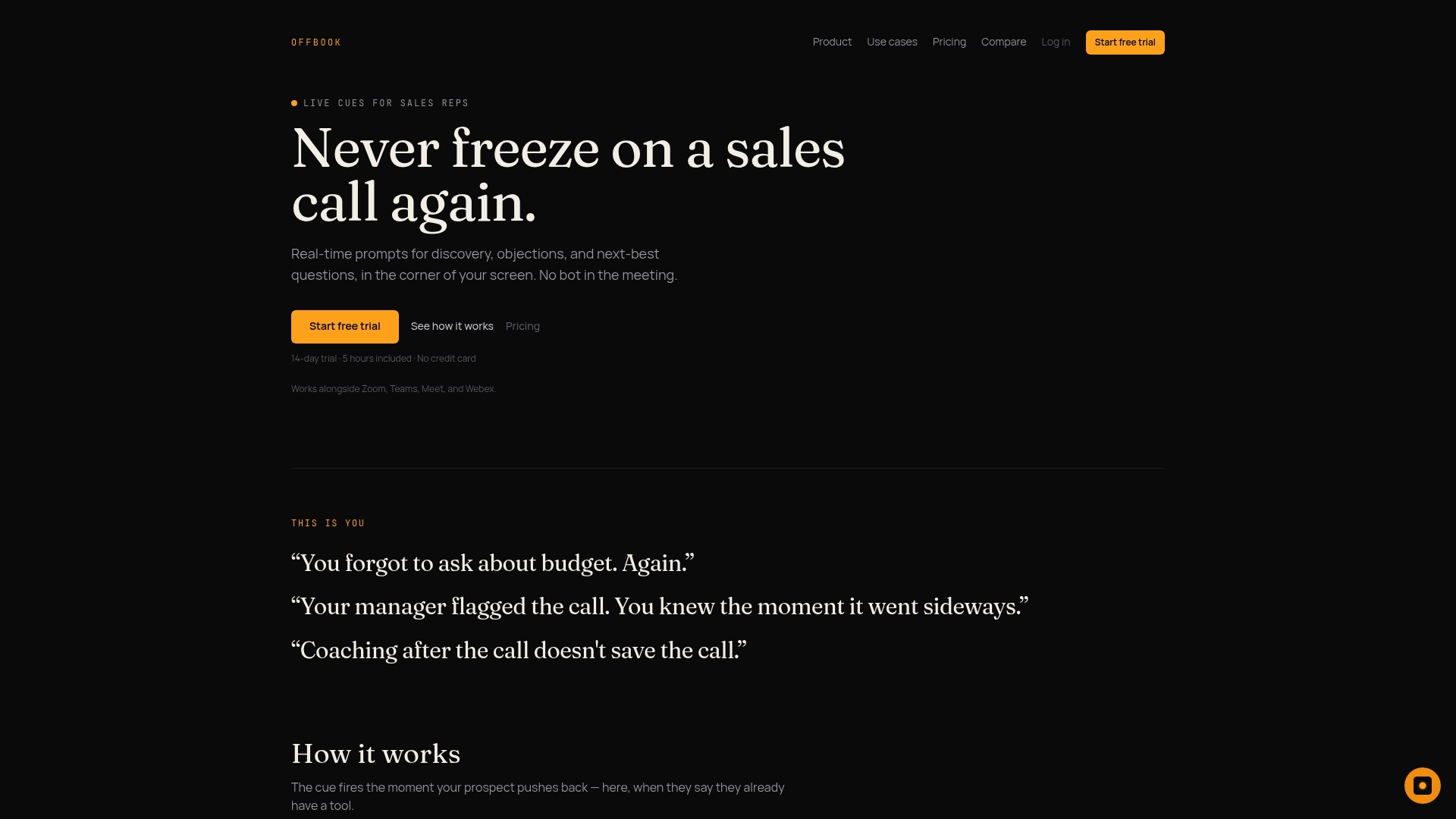
OffBook is not a discovery platform, and this is not a claim that it replaces e-discovery software or outside counsel. It is a practical aid for the planning calls that happen before the formal process starts, the kind of prep work that determines whether a custodian map is complete or a Rule 26(f) conference goes smoothly. Teams that want to see how the live coaching and pre-call brief features work can check OffBook’s pricing plans, including the Power plan and the Team plan for larger groups.
Sources
A custodian map is the single fastest way to avoid a chaotic, expensive collection later. Build it before you commit to any collection vendor or timeline.
Inventory every relevant system: email, chat platforms, collaboration tools, SaaS applications, and backup or archive systems, including those run by third-party vendors. The Justice Department’s Antitrust Division questionnaire on electronic data offers a workable template for capturing system, retention, and backup details in a consistent format across custodians.
For each custodian, capture:
- Federal Rules of Civil Procedure, Rule 26
- Discussion of Electronic Discovery at Rule 26(f) Conferences (Minnesota E-Discovery Guide)
- Deputy Attorney General memo: Use and preservation of electronic communications
Prioritize custodians by proximity to the core dispute, then widen the map only as new names surface in interviews or document review.
FAQ
What are the four phases of discovery?
Most practitioners describe discovery in four stages: preservation and identification of ESI, collection, review and analysis, and production. Each phase feeds the next, so a mistake in custodian identification during phase one tends to surface as a scope dispute much later.
What are good discovery questions to ask custodians?
Effective custodian interviews ask which systems and apps a person uses daily, whether they communicate through personal devices or third-party platforms, and what date ranges connect to the relevant events. Following a structured format, similar to the discovery call question frameworks used in sales intake, helps ensure no system gets missed.
How does enterprise search work during discovery?
Enterprise discovery search typically starts with keyword terms validated through sampling, then narrows or expands based on hit rates and relevance. Larger matters often add technology-assisted review to prioritize documents most likely to be responsive before human reviewers see them.
What are the steps in the business discovery process?
The process generally follows preservation, custodian mapping, Rule 26(f) conferral, collection, review, and phased production. Proportionality arguments, tied to custodian priority and date ranges, run through nearly every step to keep cost aligned with the case’s actual scope.
When does the duty to preserve documents begin?
The duty to preserve begins when litigation is reasonably anticipated, which is often well before a complaint is filed. Waiting for formal service risks losing data to routine deletion policies that a timely litigation hold would have stopped.