Onboard Quickly at a Startup Sales Role: 30/60/90 Plan
Accelerate your startup sales onboarding with a structured 30/60/90 plan that boosts productivity and prepares reps for success.
Published: August 11, 2026
Author: OffBook Editorial Team

You can get a new startup sales rep to productive, repeatable activity in 30–90 days — if you run a focused ramp plan, flight-simulator practice, and certification gates instead of just throwing them into live calls. The key word is structured. Forrester cautions that quality and demonstrated readiness beat arbitrary speed every time, and readiness checks before reps touch live revenue are non-negotiable.
The first 72 hours set the tone. Before Day 1, ship hardware, provision CRM and email access, assign a buddy, and send a short pre-read packet covering your ICP and top three customer stories. Day 1 itself should be shadow-heavy: two to three recorded calls, a product walkthrough, and a 90-second teach-back assignment due by Friday.
Here is what this playbook delivers:
- A week-by-week 30/60/90 ramp timeline with checkpoints
- A documented sales playbook framework (ICP, messaging, battlecards, scripts)
- A flight-simulator practice regimen (role-play, teach-back, call review)
- Ramp metrics and KPIs to track progress and diagnose problems early
- A concrete first-30-day checklist with owners and pass criteria
- Common pitfalls and red flags to catch before a hire becomes expensive
Key Takeaways
Structured onboarding with certification gates and flight-simulator practice is the fastest safe path to a productive startup sales rep, producing measurably higher retention and win rates than unstructured programs.
| Point | Details |
|---|---|
| Pre-board before Day 1 | Ship hardware, provision accounts, assign a buddy, and send the pre-read packet at least one week early. |
| Set a Day-14 product cert | Require a written quiz plus a scored verbal walkthrough before any live prospecting begins. |
| Run daily 15-minute call clinics | Drill one skill per session in weeks 2–6 rather than relying on long weekly training blocks. |
| Gate live activity on readiness | Use scored role-play pass thresholds, not time-based cutoffs, to determine when a rep goes live. |
| Offbook for live call coaching | Offbook surfaces real-time on-screen prompts during video calls to close the gap between training and live performance. |
Table of Contents
- How to onboard quickly at a startup sales role: the 30/60/90 plan
- What your startup sales playbook must contain
- How to build a flight simulator for your sales team
- Teach product as story, not as a feature list
- What to measure during ramp: KPIs that actually matter
- First-30-day checklist for managers and new reps
- Common mistakes that slow down sales onboarding
- How managers should structure coaching after formal ramp ends
- What actually matters when you onboard quickly
- Real-time call coaching cuts the gap between training and live performance
- Sources
How to onboard quickly at a startup sales role: the 30/60/90 plan
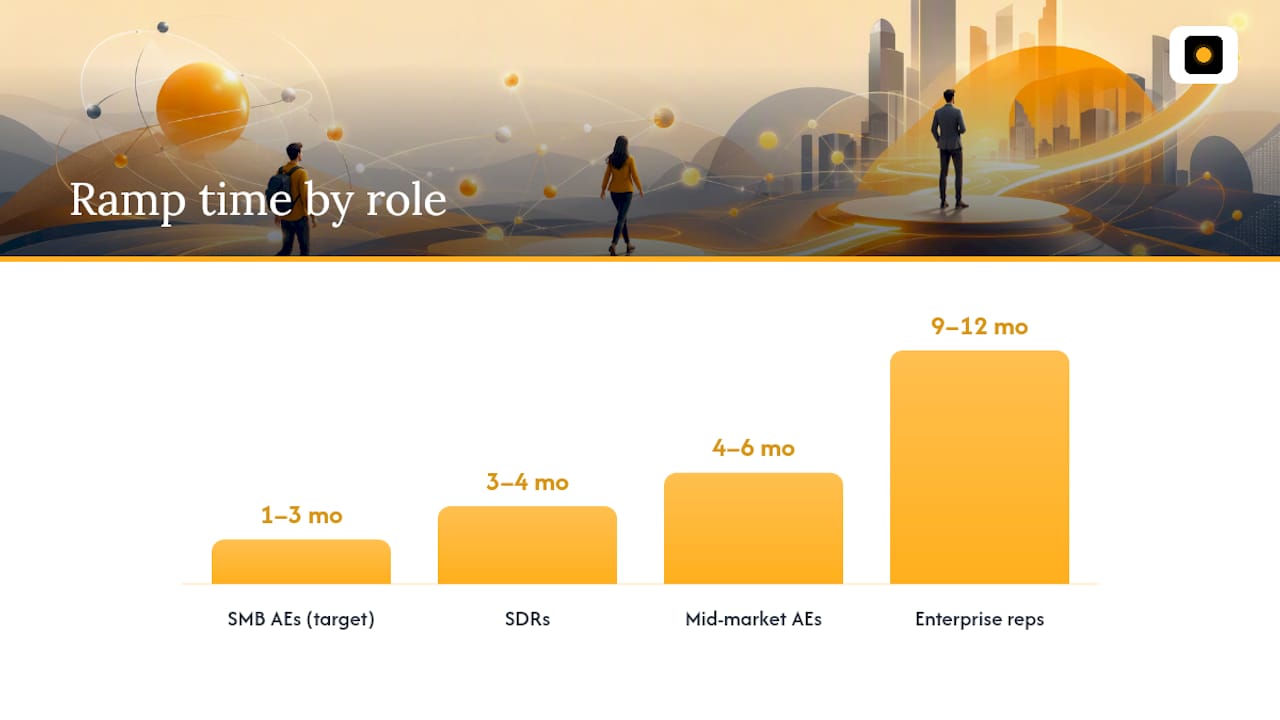
Role-based timelines matter. CheckFlow’s structured onboarding research puts SMB AEs at 1–3 months to full productivity, SDRs at 3–4 months, mid-market AEs at 4–6 months, and enterprise reps at 9–12 months. The plan below targets SMB AEs and full-cycle reps at seed and Series A startups — the most common early hire profile.
Pre-boarding (1–2 weeks before Day 1)
Most founders skip this phase entirely. That is a mistake. Use it to:
- Ship hardware and provision all accounts (CRM, email, Slack, video-conferencing, call recording).
- Assign a buddy — a senior rep or the founder — who owns the new hire’s first two weeks of shadow scheduling.
- Send a pre-read: your one-page ICP, three customer stories, and a link to your top five recorded calls.
- Schedule the first week’s shadow sessions and role-play blocks before the rep arrives.
Week 1 / Days 1–7: foundations
The goal is orientation, not information overload. Keep it tight.
- Day 1: HR paperwork, tool access verification, product overview (problem→solution framing, not feature list), and first shadow call.
- Days 2–4: Five to eight shadowed calls with the founder or a senior rep; rep takes notes and submits a one-paragraph observation after each.
- Day 5: First teach-back — rep delivers the company positioning in 90 seconds. Pass threshold: covers the buyer problem, the solution, and why it matters. No jargon.
- Days 6–7: Basic CRM logging practice using real deal examples; rep enters five mock opportunities with correct stage and field data.
Days 8–30: learn
Product narrative, ICP personas, and methodology basics (MEDDIC or MEDDPICC if you use them) go here. Discovery and demo role-plays start in week two. A product knowledge certification is due by approximately Day 14 — written quiz plus a five-minute verbal walkthrough scored against a rubric.
Days 31–60: apply
First solo discovery call happens in week five, with the manager listening live or reviewing the recording within 24 hours. Pipeline logging becomes a daily habit. The milestone for this phase: one qualified opportunity created and logged with full MEDDIC fields by Day 45. Manager call reviews run three times per week in weeks five and six, then drop to twice weekly as quality improves.
Days 61–90: accelerate
The rep operates with increasing autonomy. Pipeline coverage targets kick in. A full sales-cycle certification (end-to-end: discovery, demo, objection handling, close attempt) is required before the manager reduces coaching intensity. A readiness review at Day 90 determines whether the rep moves to a standard monthly coaching cadence or needs an extended support period.
What your startup sales playbook must contain
A playbook is not a slide deck. It is a searchable, living document that transfers founder knowledge to a rep in days rather than months. CheckFlow and Exec both recommend discrete certification gates with role-specific criteria — and those gates only work when the playbook gives reps something concrete to certify against.
The core sections every startup playbook needs:
- ICP and customer segmentation: firmographics, technographics, buying triggers, and a tiered prioritization framework (Tier 1 = close now, Tier 2 = nurture, Tier 3 = ignore for now).
- Value props and the one-minute story: three sentences — what you do, who you serve, why it matters — plus persona-specific variations for each buyer role.
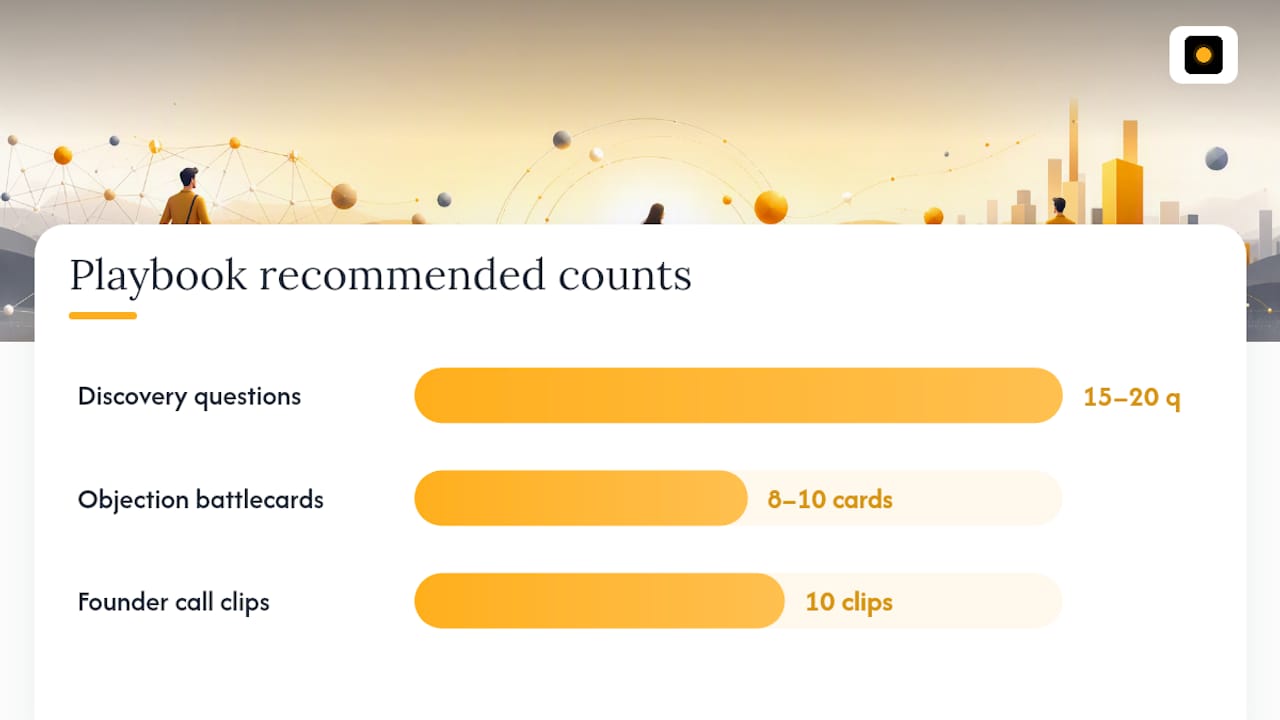
- Discovery question library: 15–20 questions organized by stage (situation, problem, implication, need-payoff) with example follow-ups.
- Demo flows: story-driven, not feature-driven. Each demo flow maps to a specific persona’s pain and shows the before/after, not the product menu.
- Objection battlecards: the 8–10 objections your reps will hear most, with a recommended response and a “do not say” column. Keep each card to one page.
- Qualification checklist: MEDDIC or MEDDPICC fields with definitions and example answers from real deals.
- Deal progression rules: what must be true for a deal to advance from stage to stage in your CRM, with example evidence.
- CRM stage definitions: field-by-field with required entries and example data so reps log consistently from day one.
Packaging matters as much as content. Panopto’s research on video-based training shows that searchable short clips improve retention and enable just-in-time rehearsal far better than long written documents. Aim for videos under five minutes, annotated with timestamps for key moments. Pair each video with a one-page summary and a template (email sequence, discovery agenda, follow-up draft).
Assign one owner for playbook maintenance. During your first three hires, update it weekly — every time a rep asks a question that is not in the playbook, that is a gap to fill before the next hire starts.
Pro Tip: Record the founder’s best 10 calls, clip them into two-to-three-minute segments, and tag each clip by objection type and persona. A rep who can watch “how the founder handled the ‘we already have a solution’ objection with a CFO” learns faster than one who reads a battlecard.
How to build a flight simulator for your sales team
Passive learning — reading the playbook, watching demos, sitting in on calls — is necessary but not sufficient. Exec Learn’s research on active onboarding is direct: reps who rehearse realistic buyer pushback before live calls ramp faster than those who consume content and then go live. The flight simulator is the practice environment that closes that gap.
Here is how to structure it:
- Design scenarios from real buyer behavior. Pull objections, ghosting patterns, and multi-threaded stakeholder dynamics from your actual lost deals. A role-play that mirrors a real prospect is worth ten generic ones.
- Use a role-play template. Assign roles (rep and buyer), set a scenario brief (persona, company size, pain point, known objection), timebox to 10–12 minutes, and score against a rubric covering: did the rep set an agenda, did they listen more than they talked, did they secure a clear next step?
- Give feedback immediately. The debrief happens within five minutes of the role-play ending. Delayed feedback loses most of its value.
- Layer the coaching. Peer review catches surface issues. Manager timestamped call annotations catch structural ones. Self-review recordings catch habits the rep does not know they have.
- Tie certification gates to practice outcomes. A rep does not advance to live discovery calls until they pass a scored role-play. A rep does not run solo demos until they pass a demo certification. Gates are pass/fail with a defined rubric, not manager judgment calls.
Highspot’s guidance on AI-enabled practice points to personalized learning paths and skill benchmarks as practical accelerants — particularly for early-stage teams where the manager cannot be in every practice session. Role-specific content delivery and AI-driven practice tools help scale coaching when bandwidth is tight.
The result of structured programs is measurable. CheckFlow reports that structured onboarding with certification gates produces 33% higher 12-month rep retention and 27% higher early-tenure win rates compared to unstructured programs.
Pro Tip: Schedule 15-minute “call clinic” sessions every morning in weeks 2–6. Pick one skill — handling a price objection, setting the next step, opening a discovery call — and drill it. Short, focused repetition beats a two-hour weekly training every time.
Teach product as story, not as a feature list
A rep who memorizes your product’s features will still lose deals. A rep who understands the buyer’s problem deeply enough to tell a story around it will win them. D2L’s research with sales leaders is consistent on this: teaching product through storytelling and use-cases produces reps who can adapt their pitch to context rather than recite a script.
The framework is simple:
- The three-sentence company story: “We help [buyer type] who struggle with [problem] to [outcome]. Unlike [alternative approach], we [key differentiator]. Our customers typically see [specific result] within [timeframe].” Require every rep to deliver this in 90 seconds by Day 5. No notes.
- Persona-driven problem→impact→value scripts: For each of your top two or three buyer personas, write a one-page script that opens with the problem they feel, describes the business impact of leaving it unsolved, and then introduces your product as the solution. The product enters the story third, not first.
- Real customer scenarios: Give reps three to five real customer stories (anonymized if needed) with the before state, the trigger that made them buy, and the after state. These become the backbone of every demo.
- Demo translation practice: After a discovery call debrief, require the rep to write a one-paragraph demo agenda that maps directly to the pain points the prospect mentioned. If the agenda does not reference the prospect’s specific words, it fails.
Short demo clips showing contextualized demos — not product tours — are the fastest way to model this. Two or three clips where a founder or senior rep tailors the demo to a specific persona’s pain teach more than any written guide.
What to measure during ramp: KPIs that actually matter
Vanity metrics — calls made, emails sent, meetings booked — tell you a rep is busy. They do not tell you a rep is ramping. The metrics below correlate with revenue and retention, which is the only standard that matters for an early-stage startup.
Outcome metrics (what you are building toward):
- Time to first qualified opportunity (target: by Day 45 for SMB AEs)
- Pipeline created in first 90 days (set a dollar target based on your average deal size and expected conversion)
- Stage conversion rates at discovery→demo and demo→proposal
- Quota attainment at 6 months and 12 months
Activity metrics by role:
- SDRs: touches per day (calls + emails + LinkedIn), connect rate, meeting set rate
- AEs: discovery calls per week, demos per week, CRM update frequency
Quality signals (leading indicators):
- CRM hygiene score (are required fields complete and accurate?)
- Call structure score from manager review rubric (agenda set, discovery depth, next step secured)
- Certification gate pass rates and date-to-certification
| Metric | Why it matters | Startup target |
|---|---|---|
| Time to first qualified opportunity | Measures real pipeline contribution, not activity | Day 45 for SMB AEs |
| Pipeline created in 90 days | Validates ramp trajectory against revenue goals | 3–5x monthly quota |
| Stage conversion: discovery→demo | Reveals discovery quality and ICP fit | 60% |
| Call structure score | Leading indicator of deal quality before outcomes appear | 70%+ by Day 30 |
| Cert gate pass rate | Tracks readiness progression | before live activity |
Track these at the cohort level, not just individually. If two reps hired in the same month both stall at the demo stage, the problem is probably the demo training, not the reps. Cohort-level data surfaces systemic gaps that individual tracking misses. For more on measuring sales call effectiveness, the scoring frameworks founders use are worth reviewing before you set your rubric.
First-30-day checklist for managers and new reps
This checklist is designed to be copied into your onboarding workflow and assigned to owners. Nothing here is optional.
Day 0–1 (Manager owns):
- Hardware delivered and all accounts provisioned (CRM, email, Slack, video, call recording).
- Buddy assigned and first week’s shadow schedule sent to the rep.
- Pre-read packet delivered: ICP one-pager, top three customer stories, five recorded calls.
- Intro meetings scheduled: founder, product lead, one customer success rep.
- First role-play session booked for Day 5 or 6.
Days 2–7 (Buddy and manager own):
- Five to eight shadow calls completed; rep submits written observation for each. Pass: observations reference buyer problem, not product features.
- 90-second teach-back delivered by Day 5. Pass: covers problem, solution, and why it matters with no jargon.
- Product narrative verified in a 10-minute verbal walkthrough with the manager. Pass: rep can answer “why do customers leave their current solution?” without prompting.
- CRM logging practice: five mock opportunities entered with correct stage and field data. Pass: zero required fields blank.
- First role-play completed with scored rubric. Pass: agenda set, at least two discovery questions asked, next step secured.
Days 8–30 (Manager owns with buddy support):
- Product knowledge certification completed by Day 14. Pass: 80%+ on written quiz plus verbal walkthrough scored at 70%+ on rubric.
- Discovery role-play certification completed by Day 21. Pass: two consecutive scored role-plays at 75%+ with no major structural errors.
- First live outreach sent by Day 20 with manager review before it goes out. Pass: message references a specific buyer problem, not a product feature.
- First qualified opportunity logged with complete MEDDIC fields by Day 45. Pass: all six MEDDIC fields populated with evidence from a real conversation.
Forbes highlights shadowing as one of the highest-leverage onboarding techniques for new sales hires — and the checklist above treats it as a structured activity with deliverables, not passive observation. The B2B sales tech stack checklist is worth running in parallel to make sure every tool the rep needs is live before Day 1.
Common mistakes that slow down sales onboarding
Speed is not the enemy. Unearned speed is. Here is where early-stage teams consistently go wrong when trying to compress ramp time.
- Sending reps live on a time-based cutoff instead of a readiness gate. “You’ve been here three weeks, start prospecting” is not a readiness standard. A rep who cannot pass a scored discovery role-play will not run a good live discovery call. Forrester’s guidance is explicit: readiness checks beat arbitrary timelines.
- Overloading with product detail in weeks 1–2. New reps do not need to know every feature. They need to know the three problems your product solves and how to ask about them. Save deep product training for after the first certification gate.
- Dropping the call review cadence after week 4. This is the training cliff. Managers ease off coaching just as reps start running live calls independently. The result is bad habits that calcify. Keep structured call reviews running through at least Day 60.
- Skipping CRM hygiene as a leading indicator. A rep who logs deals sloppily in week one will forecast inaccurately in month three. CRM hygiene is a proxy for deal discipline, and it is worth enforcing early.
- Red flags to watch: repeated low call structure scores after two weeks of coaching, pipeline with no clear next steps logged, manager disengagement from call reviews, and a rep who cannot articulate the buyer’s problem without referencing product features.
When you see these signals, the corrective action is targeted, not punitive: a focused coaching blitz on the specific failing skill, a temporary reduced quota expectation while the gap closes, and a re-certification requirement before the rep returns to full activity. Catching these early is far cheaper than a mis-hire at month four.
How managers should structure coaching after formal ramp ends
The formal 30/60/90 plan ends. The coaching does not. The reps who plateau at month three are almost always the ones whose managers stopped structured coaching at Day 90.
The coaching cadence by phase:
-
Weeks 1–2: Daily 10-minute check-ins. Not status updates — specific skill questions. “What was the hardest moment in yesterday’s call? What would you do differently?”
-
Weeks 3–8 (Apply phase): Three call reviews per week, each with timestamped, written feedback tied to the certification rubric. The manager listens to the recording, drops comments at specific moments, and the rep responds in writing before the next 1:1.
-
Weeks 9–12: Call reviews drop to twice weekly. 1:1s shift from skill-building to deal strategy. The rep begins peer-reviewing a junior colleague’s calls.
-
Post-Day 90: Weekly 1:1s focused on pipeline and deal strategy. Monthly product refreshes (30 minutes, new features or updated messaging). Quarterly competitive updates. A lightweight re-certification when there is a major product or go-to-market change.
Peer learning scales coaching without burning out the manager. Structured shadow-swaps — where two reps listen to each other’s calls and debrief using the same rubric — surface blind spots that managers miss and build team accountability. Building a scalable coaching program requires this kind of peer infrastructure, especially when the team grows past three or four reps.
Highspot’s framework for AI-enabled onboarding recommends personalized learning paths and skill benchmarks as a way to scale coaching when manager bandwidth runs thin — a real constraint at seed and Series A. Everboarding, the practice of treating training as continuous rather than front-loaded, is what separates teams that sustain ramp gains from those that watch new hires regress after month three.
Pro Tip: Block 30 minutes immediately after a rep’s call — not the next day, not at the weekly 1:1 — for a rapid micro-coaching debrief. The rep’s memory of the call is sharpest in that window, and the feedback lands harder when the conversation is still fresh.
What actually matters when you onboard quickly
Most onboarding programs fail for one reason: they are designed around content delivery rather than skill demonstration. Founders build decks, record product walkthroughs, and schedule a week of shadow calls — and then wonder why the rep still cannot run a clean discovery call at Day 30.
The certification gate is the mechanism that fixes this. Not because it is bureaucratic, but because it forces the program designer (usually the founder or first sales leader) to define what “ready” actually looks like before the rep starts. That definition is the hardest part of building an onboarding program, and most teams skip it.
If you are resource-constrained and need to prioritize, start here: CRM hygiene from Day 1, a 90-second teach-back by Day 5, and a scored discovery role-play before any live prospecting. Those three gates catch the most common failure modes early enough to correct them. Everything else in this playbook builds on that foundation.
The 30/60/90 structure with flight-simulator practice is not a theoretical framework. It is the fastest safe path to a rep who can run a repeatable sales motion without the founder on every call.
Real-time call coaching cuts the gap between training and live performance
The hardest part of any ramp plan is the moment a rep goes live. The playbook is in their head, the role-plays are done, and then a real prospect says something unexpected and the rep freezes. That gap between training and live performance is where deals are lost and confidence breaks.
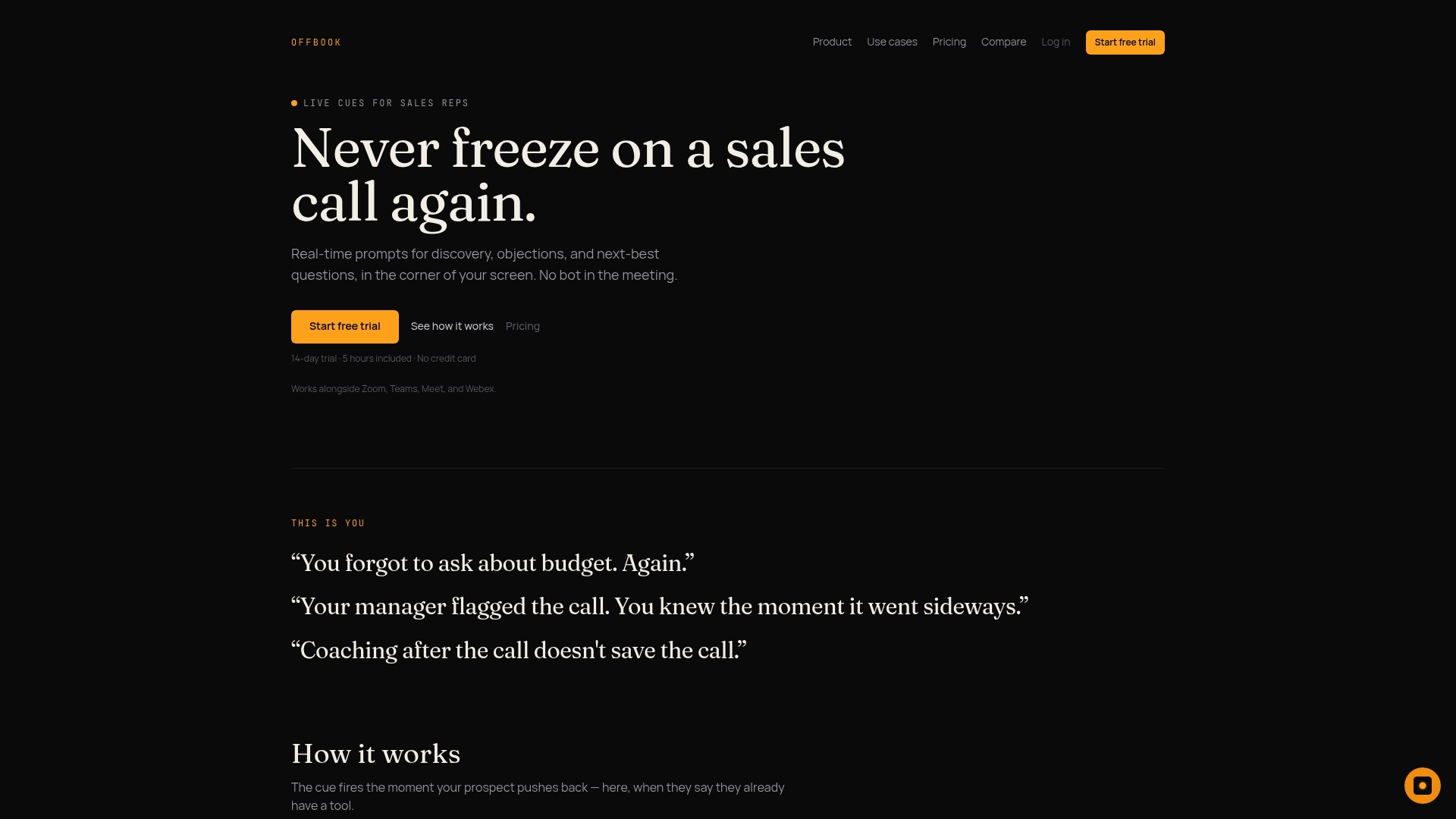
Offbook is built specifically for that moment. It listens to your rep’s video calls in real time and surfaces on-screen prompts — the right discovery question to ask next, the objection response from your battlecard, the MEDDIC qualification gap the rep just missed — without ever joining the call as a bot. The prospect never knows it is there. Before the call, Offbook generates a brief on the company and the people in the meeting so the rep walks in prepared. After the call, it produces an instant debrief and follow-up draft so nothing falls through the cracks.
For founders running the flight simulator, Offbook functions as a live coaching layer that extends the practice environment into real calls. When you are evaluating real-time call coaching for your sales team, check for four things: privacy and consent infrastructure, CRM integration, role-specific profiles, and call-level reporting tied to your certification rubric. Offbook covers all four, built specifically for seed and Series A B2B SaaS teams.
Start a free trial at Offbook and run it alongside your next new hire’s first live calls.
Sources
The following sources informed the recommendations in this article and are worth consulting for additional depth:
- Sales Onboarding Checklist: The Complete 30-60-90 Day Guide (2026) | CheckFlow
- Sales Onboarding Best Practices That Actually Cut Ramp Time | Exec Learn
- Sales Onboarding Strategies: A Practical Guide for L&D Leaders | Panopto Blog
- How Quickly Should A Sales Rep Be Onboarded? | Forrester