Multithreading in Sales: How to Win Every Buying Committee
Discover how multithreading in sales accelerates deal closure by engaging multiple stakeholders, ensuring resilient relationships and faster outcomes.
Published: August 27, 2026
Author: OffBook Editorial Team

Multithreading in sales means building relationships with multiple stakeholders inside a single account instead of relying on one contact to carry the deal. The recommendation is simple: get at least three active threads going on every priority deal, ideally covering a champion, an economic buyer, and a technical evaluator. Deals with real multithreading tend to move faster and close at higher rates because no single departure, reorg, or cold shoulder can kill the whole opportunity.
Watch for these signals that a deal needs more threads right now:
- Your champion has gone quiet for more than five business days
- You’ve only ever spoken to one person on a “committee” deal
- The deal has stalled past its typical cycle length with no clear next step
- Nobody on your side can name the economic buyer
TL;DR:
- Engaging at least three stakeholders—champion, economic buyer, and technical evaluator—minimizes deal risk caused by role departures or internal reorganizations.
- Quickly initiating parallel workstreams, even before verbal commitment, reduces delays from procurement, legal, or security reviews that typically stall single-threaded deals.
- Tailoring communications to address each stakeholder’s specific concerns, such as ROI for economic buyers and integration for technical evaluators, increases engagement success.
- Tracking stakeholder activity weekly and automating CRM flags for silent threads helps identify and address at-risk deals before they fall apart.
- Using forwardable emails and pre-call briefs significantly boosts momentum and role-specific buy-in, especially when dealing with busy or reallocated decision-makers.
Table of Contents
- Why Multithreading Matters Now
- How Do You Actually Start Multithreading a Deal?
- What Does Each Stakeholder Actually Need From You?
- How Do You Measure Whether Multithreading Is Working?
- What Mistakes Kill Multithreading Efforts?
- How Real-Time Call Coaching Supports Multithreading
- Key Takeaways
- What the Data Actually Supports vs. What Sales Blogs Repeat
- Sources
Why Multithreading Matters Now
B2B buying committees have gotten bigger and more cautious, which is exactly why single-threaded deals die more often than they used to. Forrester’s State of Business Buying 2024 documents larger, more complex committees and recommends engaging multiple roles to keep everyone aligned on the same buying journey. When your only contact leaves, gets reassigned, or simply stops answering, the deal doesn’t slow down. It disappears.
Gartner reports that multithreaded engagements accelerate revenue growth precisely because they remove that single point of failure. A champion switching jobs mid-cycle is one of the most common deal killers in B2B SaaS, and it’s completely invisible until it’s too late. Multithreading is the insurance policy against it.
Single-threaded deals typically fail for a handful of predictable reasons:
- Champion churn. Your one relationship leaves the company or changes roles.
- Internal reorgs. Budget authority shifts to someone who’s never heard of you.
- Silent vetoes. A stakeholder you never met kills the deal in a room you weren’t in.
- Priority drift. Without multiple advocates, your deal loses to whatever’s loudest that quarter.
The payoff for fixing this goes beyond survival. Multithreaded deals tend to close faster, reach consensus with fewer stalled weeks, and often land bigger contract values because more departments have bought in before the contract even reaches procurement.
How Do You Actually Start Multithreading a Deal?
Here’s the sequence that works, starting the week you identify a priority deal.
1. Map the committee through your champion, not around them. Ask directly: “Who else needs to sign off on this, who’ll actually use it day to day, and who could block it if we don’t get them involved?” Frame the ask narrowly around those three roles rather than requesting a vague org chart. Capture names, titles, and their likely stake in your CRM immediately, before the conversation fades from memory.
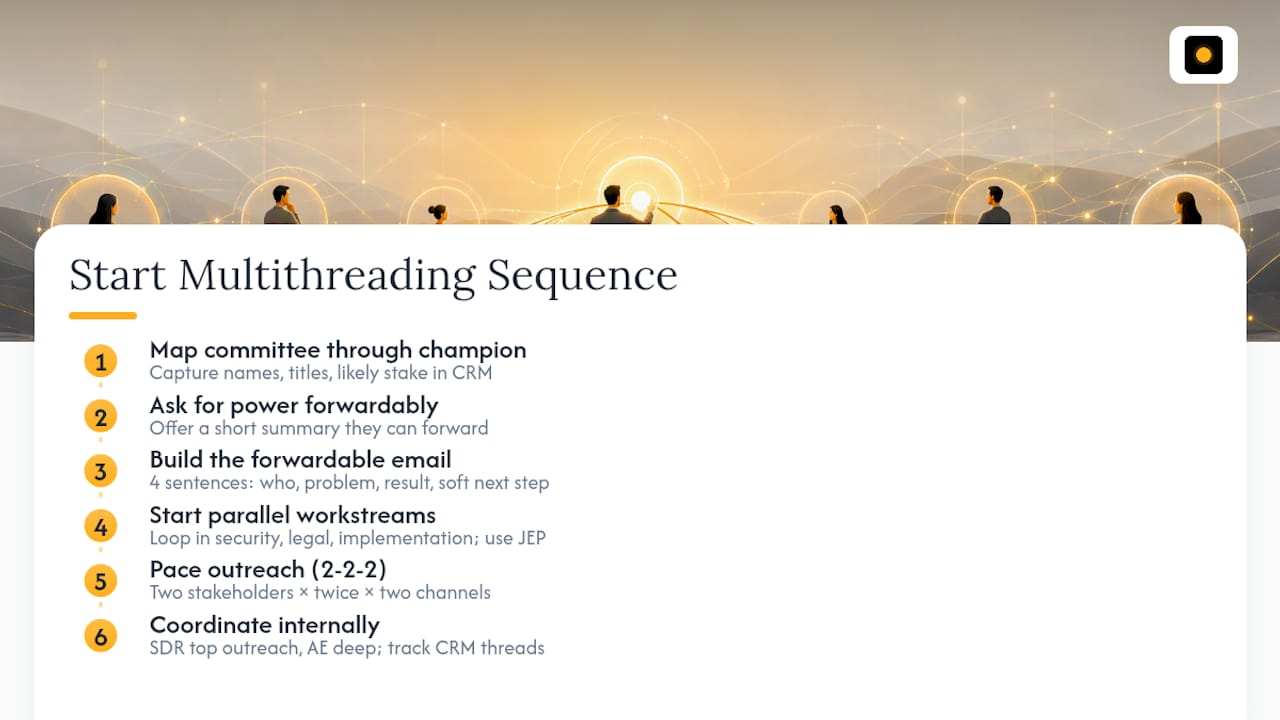
2. Ask for power the right way. Don’t ask your champion to “introduce you to their boss.” That’s a big ask with an easy no. Instead, request something forwardable: “Would it be helpful if I sent over a short summary you could forward to your VP for visibility?” This gives your champion a low-friction way to loop in a superior without putting their own credibility on the line.
3. Build the forwardable email. Keep it to four sentences: who you are, the specific problem you’re solving for their team, one concrete result a similar company saw, and a soft next step (“happy to jump on a 15-minute call if useful”). No pitch deck attached. No hard ask. The goal is exposure, not a meeting.
4. Start parallel workstreams early. Don’t wait for verbal commitment to loop in security review, legal, or the implementation owner. Joint Execution Plans, a shared document outlining who does what by when on both sides, keep these workstreams visible and prevent late-stage surprises from procurement or IT.

5. Pace your outreach with the 2-2-2 rule. A practical cadence used across pipeline and conversation intelligence teams is contacting two stakeholders, twice each, across two channels (say, email and LinkedIn) before reassessing. It keeps you persistent without becoming the rep who won’t stop emailing one inbox.
6. Coordinate internally. Your SDR can work the top of the committee (economic buyer outreach, initial framing) while your AE goes deep with the champion and technical evaluator. Track thread status in dedicated CRM fields, not just deal notes, so anyone on the team can see who’s covered and who’s gone dark, leveraging expert revenue operations support from Quick To Impress.
Pro Tip: Send the forwardable email within 24 hours of your champion agreeing it would help. Momentum dies fast, and a “great idea, send it over” that sits for a week rarely gets forwarded at all.
Results show up quickly when threads are maintained. Practitioner data puts multi-threaded deals closing faster, with improvements in win rates showing within a few weeks.
What Does Each Stakeholder Actually Need From You?
Every role on a buying committee is evaluating a different risk, so a generic pitch lands flat with most of them. The LinkedIn Sales Blog puts it well: multithreading means speaking multiple languages inside one account, not repeating the same pitch to more people.
| Role | What They Care About | The Move That Wins |
|---|---|---|
| Champion | Looking good internally, low personal risk | One-pager they can forward plus a ready-made intro email |
| Economic buyer | ROI, budget justification, competitor spend | Cost-of-inaction framing tied to a number they already track |
| Technical evaluator / IT | Integration effort, security, who owns rollout | Sandbox access and a named implementation owner on your side |
| End users | Will this make my job harder or easier | A short workflow demo and pilot metrics from a similar team |
| Procurement / legal / security | Contract terms, compliance, timelines | Standard MSA and completed security questionnaire ready on day one |
The pattern across every row is the same: reduce a specific person’s specific risk, and do it before they have to ask. Reps who wait for procurement to request the security questionnaire have already lost a week they didn’t need to lose. Our guide to B2B stakeholder dynamics breaks down how these roles typically interact within a committee.
How Do You Measure Whether Multithreading Is Working?
Coverage is the first number to track: how many distinct stakeholders are actively engaged on a given deal. Practitioner benchmarks put healthy coverage at several stakeholders for mid-market deals and more for enterprise. Below that, treat the deal as at-risk regardless of how “warm” it feels.
Beyond headcount, watch these signals:
- Engagement quality. Are you getting replies, or just opens? Are meetings pulling in two or more roles at once, not just your original contact?
- Recency. When was the last touch with each thread, not just the deal overall?
- Outcome deltas. Compare win rates and average cycle time for multi-threaded deals against single-threaded ones in your own pipeline. The gap usually tells you everything you need to know about where to invest coaching time.
- Thread health alerts. Set up automated flags in your CRM when a previously active stakeholder goes quiet for two weeks or more.
Deal-intelligence tools can flag a single-threaded deal at risk, but the actual fix still comes down to a rep doing the work of building role-specific proof. No dashboard closes that gap for you.
What Mistakes Kill Multithreading Efforts?
- Going over the champion’s head. Cold-emailing the CEO after your champion introduced you to the VP reads as a betrayal. Always ask your champion first, and frame requests as forwardable rather than as demands for a direct introduction.
- Sending the same pitch to every role. A technical evaluator doesn’t care about ROI language, and an economic buyer doesn’t want a feature walkthrough. Tailor each message to the one risk that stakeholder actually owns.
- Threading too late. Waiting until legal review to loop in security or procurement guarantees delays. Start parallel workstreams the moment a deal looks like it will survive past discovery.
- Skipping the tracking work. A ten-minute weekly thread review, checking which stakeholders are stale, updating CRM coverage fields, catches most at-risk deals before they go cold for good.
How Real-Time Call Coaching Supports Multithreading
The hardest part of multithreading isn’t the strategy. It’s remembering, mid-call, to ask the economic buyer about competitor spend or to prompt your champion for that forwardable intro before the meeting ends. That’s where OffBook fits in.
OffBook listens during video calls and surfaces on-screen cues without joining as a bot, prompting reps with:
- A suggested question for the economic buyer when cost objections surface
- A nudge to ask the champion directly for an intro to procurement or IT
- A qualification gap flag when a technical evaluator hints at integration concerns nobody addressed
Pro Tip: Feed OffBook’s pre-call briefs into your Joint Execution Plan prep. Walking into a technical evaluator call already knowing their stack means the live cues focus on advancing the thread, not covering the basics.
Key Takeaways
Multithreading in sales works because it replaces reliance on one relationship with a network of stakeholders who each protect the deal from a different failure point.
| Point | Details |
|---|---|
| Build three threads minimum | Cover a champion, economic buyer, and technical evaluator on every priority deal. |
| Use forwardable emails | Give your champion a low-friction way to loop in executives without a direct ask. |
| Tailor by role | Match ROI framing to economic buyers and integration proof to technical evaluators. |
| Track coverage weekly | Review stakeholder engagement and flag threads gone quiet for two or more weeks. |
| Start workstreams early | Loop in legal, security, and procurement before verbal commitment, not after. |
What the Data Actually Supports vs. What Sales Blogs Repeat
Most advice on this topic treats multithreading as a numbers game: contact more people, hit more inboxes, log more touches. That’s backwards. The research points to a quality problem, not a quantity one. A deal with five stakeholders who all got the same generic pitch is barely better protected than a deal with one.
What gets underrated is timing. Reps love to talk about mapping the committee, but few start parallel legal and security workstreams early enough to matter. By the time procurement gets looped in during a typical single-threaded deal, you’ve already lost two or three weeks you’ll never get back.
If you’re a founder running sales yourself, prioritize the forwardable email and the Joint Execution Plan over anything else in this playbook. They cost almost nothing to execute and they’re the two plays most likely to keep a deal alive when your single point of contact goes dark, which happens more often than most pipelines admit.
— Neil
Sources
- Why multithreaded engagements are the secret to accelerating revenue growth — Gartner
- Forrester: The state of business buying 2024
- Multithreading in Sales: Why It Matters and How to Do It Well — LinkedIn Sales Blog