8 Field MEDDPICC Template for Founder Led SaaS: Evidence & CRM Setup
Copy ready MEDDPICC template with eight fields, 0 to 3 scoring, strict evidence rules, and CRM setup steps. Plus adoption tips and when to add live coaching.
Published: September 2, 2026
Author: OffBook Editorial Team

8 Field MEDDPICC Template for Founder Led SaaS: Evidence & CRM Setup
Yes, ready-to-use MEDDPICC templates exist, and you can start using one this afternoon. A solid template captures eight fields, Metrics, Economic Buyer, Decision Criteria, Decision Process, Paper Process, Identify Pain, Champion, and Competition, plus a 0 to 3 scorecard for each one. The fastest path: copy a template into a Google Sheet or your CRM’s opportunity fields right now, then fill in one live deal to see where the gaps actually are.
TL;DR:
- Accurate scoring of the METDPICC fields requires documented evidence, with deals validated by confirmed buyer input scoring significantly higher.
- Embedding MEDDPICC directly into CRM opportunity records increases adoption and makes pipeline analysis more effective through automated gating and scoring.
- Focus on early-stage fields like Identify Pain, Champion, and Metrics during discovery, and save Paper Process, Decision Process, and Economic Buyer for procurement and closing.
- Rely on evidence-based scores and enforce strict review protocols to prevent assumption-based or inflated deal assessments.
- Using real-time coaching tools during calls helps uncover deal gaps immediately, improving the quality and discipline of your pipeline management.
Table of Contents
- The MEDDPICC Template Field by Field
- Which Template Format Should You Actually Use?
- How to Use the Template Through the Sales Cycle
- How the 0 to 3 Scoring Scale Works
- Putting the MEDDPICC Template Inside Your CRM
- Common Mistakes and Quick Fixes
- Who’s Behind This and Why It Works at Scale
- Templates Alone Don’t Fix Undisciplined Pipelines
- Where OffBook Fits Once Your Template Is Live
- Sources
The MEDDPICC Template Field by Field
Each MEDDPICC field earns its place because it answers a specific question a deal review will eventually ask anyway. MEDDPICC extends the older MEDDIC framework with two additions built for enterprise complexity: Paper Process, which covers legal and procurement, and Competition, which forces you to name whoever else is in the room, including “do nothing.”
Here’s what belongs in each field of your template:
- Metrics: the quantifiable business outcome the buyer expects. Record current state, target state, and how they measure it (e.g., “reduce onboarding time from 14 days to 5”).
- Economic Buyer: the person who releases budget. Record their name, title, and whether you’ve spoken with them directly or only heard about them secondhand.
- Decision Criteria: the formal and informal standards they’ll judge vendors against, ideally with a weight attached to each one.
- Decision Process: the steps and approvals between now and signature, including who signs off at each stage.
- Paper Process: procurement, legal review, security review, and average contract turnaround time.
- Identify Pain: the specific business problem driving urgency, tied to a cost or consequence if unsolved.
- Champion: the internal advocate with real influence, not just enthusiasm, who will sell on your behalf when you’re not in the room.
- Competition: every alternative under consideration, named specifically, including internal builds or the status quo.
A field only earns a score of 2 or 3 when there’s documented evidence behind it, a note from an actual conversation, a forwarded email, or written confirmation from the buyer, not a rep’s gut feeling.
Which Template Format Should You Actually Use?
Three formats dominate: a spreadsheet, native CRM fields, or a slide-based scorecard for exec reviews. A Google Sheet is fastest to launch and easiest to customize, but it lives outside your pipeline and rarely gets updated after week two. Native CRM fields take longer to set up but stay visible where reps already work. Slide decks work fine for board updates but make poor daily tools.
Whatever format you pick, your starter template needs these columns:
- Deal name and stage
- All eight MEDDPICC fields with a notes column each
- A 0 to 3 score per field
- Evidence link or reference (email, call recording, quote)
- Last updated date
If you’re migrating from a spreadsheet to a CRM, export as CSV and map each column to a custom field rather than a shared text block, so scores stay filterable and reportable later.
How to Use the Template Through the Sales Cycle
MEDDPICC works best when you don’t tackle it in alphabetical order. Prospeo’s stage-by-stage research recommends starting with Identify Pain, Champion, and Metrics during early discovery, since those three tell you whether a deal is real before you invest more time. Save Paper Process for procurement conversations, where it belongs naturally.
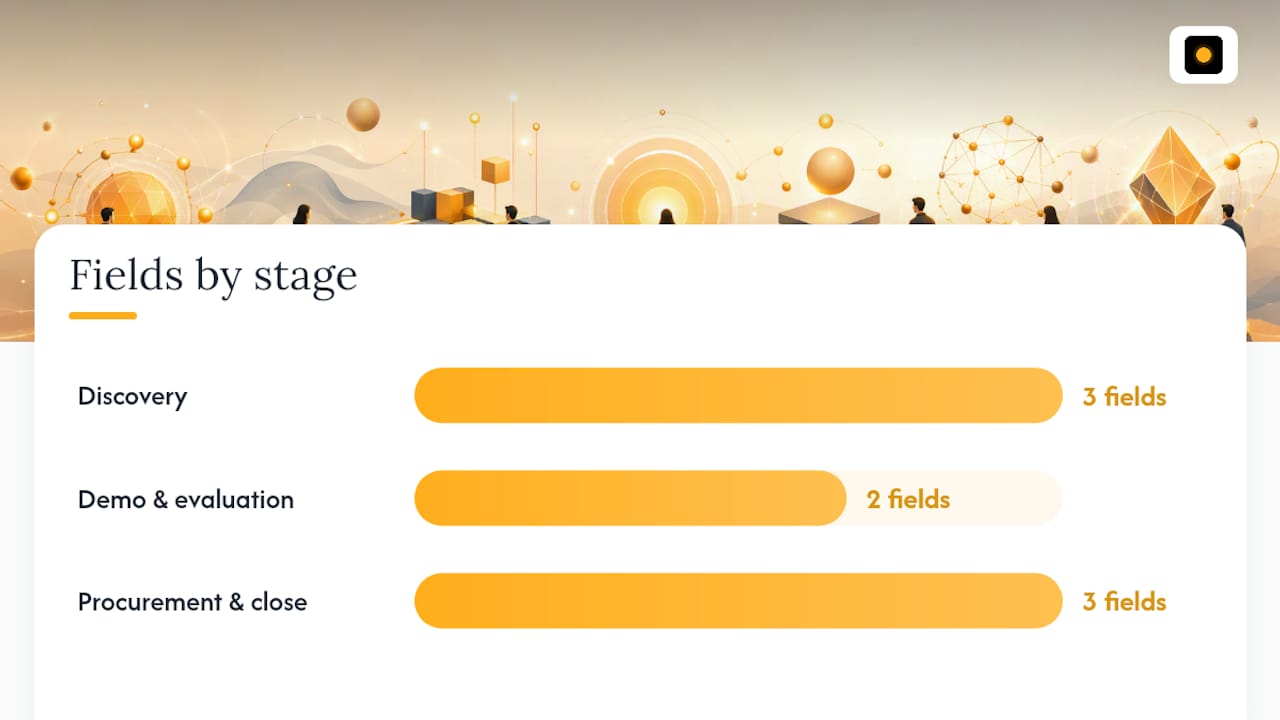
Here’s how the fields map to stages:
- Discovery: Identify Pain (“What happens if this doesn’t get solved this year?”), Metrics (“How would you measure success six months from now?”), early Champion signals.
- Demo and evaluation: Decision Criteria (“What does the evaluation scorecard look like?”), Competition (“Who else is in this process?”).
- Procurement and close: Decision Process, Paper Process, and Economic Buyer confirmation.
Structure your deal review around the scorecard itself: walk each field, state the score, and ask the rep to justify anything above a 1. Use simple triage rules: advance deals scoring 2 or higher across most fields, flag anything with an unscored Economic Buyer or Champion as stalled, and consider walking away from deals with three or more fields stuck at 0 past the demo stage.
Pro Tip: Ask “Who else has to say yes besides you?” early in discovery. It surfaces Decision Process and Economic Buyer gaps in one question instead of two separate conversations later.
How the 0 to 3 Scoring Scale Works
The scale is simple by design: 0 means unknown, 1 means assumed by the rep with no confirmation, 2 means confirmed by one source, and 3 means validated directly by the buyer. Prolifiq’s guidance puts a well-qualified deal at 20 or higher out of a possible 24, with no single element scoring below 2.
A deal scoring 22 with a confirmed Economic Buyer and a validated Champion behaves very differently in forecasting than one scoring 14 with three fields still at zero, even if both show the same close date on paper.
Two quick examples make the contrast clear:
- Strong deal: Metrics 3 (buyer stated the exact cost of the problem), Champion 3 (advocate has pushed for budget internally), Economic Buyer 2 (confirmed by champion but not yet met directly). Total trending well above 20.
- Weak deal: Metrics 1 (rep assumes ROI without buyer confirmation), Champion 0 (no internal advocate identified), Paper Process 0 (procurement never discussed). This is a “hope,” not a pipeline entry.
Managers should spot-check scores during review by asking reps to produce the evidence behind any 2 or 3. Scores without a linked note or quote get knocked back to 1 until proven otherwise.
Putting the MEDDPICC Template Inside Your CRM
Templates that live in a separate document tend to die quietly. Prolifiq’s research found that MEDDPICC fields embedded directly into opportunity records get used, while external trackers fall out of habit within a few weeks.
Here’s a simple build sequence:
- Add all eight MEDDPICC fields as custom fields on the opportunity object, each with a linked 0 to 3 score field.
- Require an evidence attachment or note before a rep can set any field above 1.
- Gate stage progression so a deal can’t move to “proposal” if Economic Buyer or Champion still sits at 0.
- Build a dashboard that flags deals above a stage threshold with an average MEDDPICC score under 12.
This turns your pipeline review from a status update into an actual audit. WithRealm’s guide covers similar automation patterns for teams wiring MEDDPICC into their existing stack.
Common Mistakes and Quick Fixes
Most MEDDPICC failures aren’t about the framework, they’re about enforcement. The biggest offenders:
- Keeping the template in a spreadsheet nobody opens after the first week.
- Scoring fields based on assumption instead of documented evidence.
- Confusing a friendly internal contact (a coach) with an actual Champion who has influence and skin in the game.
Watch for these red flags in any deal review: no path to the Economic Buyer, metrics that are vague (“save time and money”), or zero movement on Paper Process past the demo stage. The fix is usually simple: require one piece of evidence per score above 1, and make that a non-negotiable part of your review cadence, not a suggestion.
Pro Tip: If a rep can’t name the Champion’s specific motivation for winning internally, they don’t have a Champion. They have a friendly contact.
Who’s Behind This and Why It Works at Scale
This guide draws on practical work applying MEDDIC and MEDDPICC across sales teams, where the recurring failure point is always enforcement, not the framework itself. Offbook builds real-time coaching software that listens during live sales calls and surfaces on-screen prompts structured around MEDDPICC, without a bot joining the meeting.
That matters because most MEDDPICC breakdowns happen in the moment, not after:
- A rep forgets to ask for Economic Buyer access until the deal has already stalled.
- Champion questions get skipped because the call ran long and pain discovery ate the clock.
- Pre-call prep on the buyer’s company and stakeholders gets rushed or skipped entirely.
Offbook’s pre-call briefs and live prompts are built to close exactly these gaps as they happen.
Templates Alone Don’t Fix Undisciplined Pipelines
A template gives you structure, but it won’t stop a rep from inflating a score to make a deal look healthier than it is. Templates work when evidence rules are enforced consistently; they fail quietly otherwise. If you’re seeing inconsistent scoring across reps, low adoption past week two, or a growing enterprise pipeline where deal size makes bad qualification expensive, that’s your signal to invest in coaching or live tooling on top of the template, not instead of it.
— Neil
Where OffBook Fits Once Your Template Is Live
A spreadsheet or CRM field tells you what a rep believes about a deal after the call ends. Offbook tells them what to ask while the call is still happening. It listens in real time and surfaces on-screen prompts for exactly the gaps a MEDDPICC template is built to catch, an unconfirmed Economic Buyer, a Champion question that never got asked, a metric the buyer never actually quantified, plus pre-call briefs on the people and company you’re about to meet.
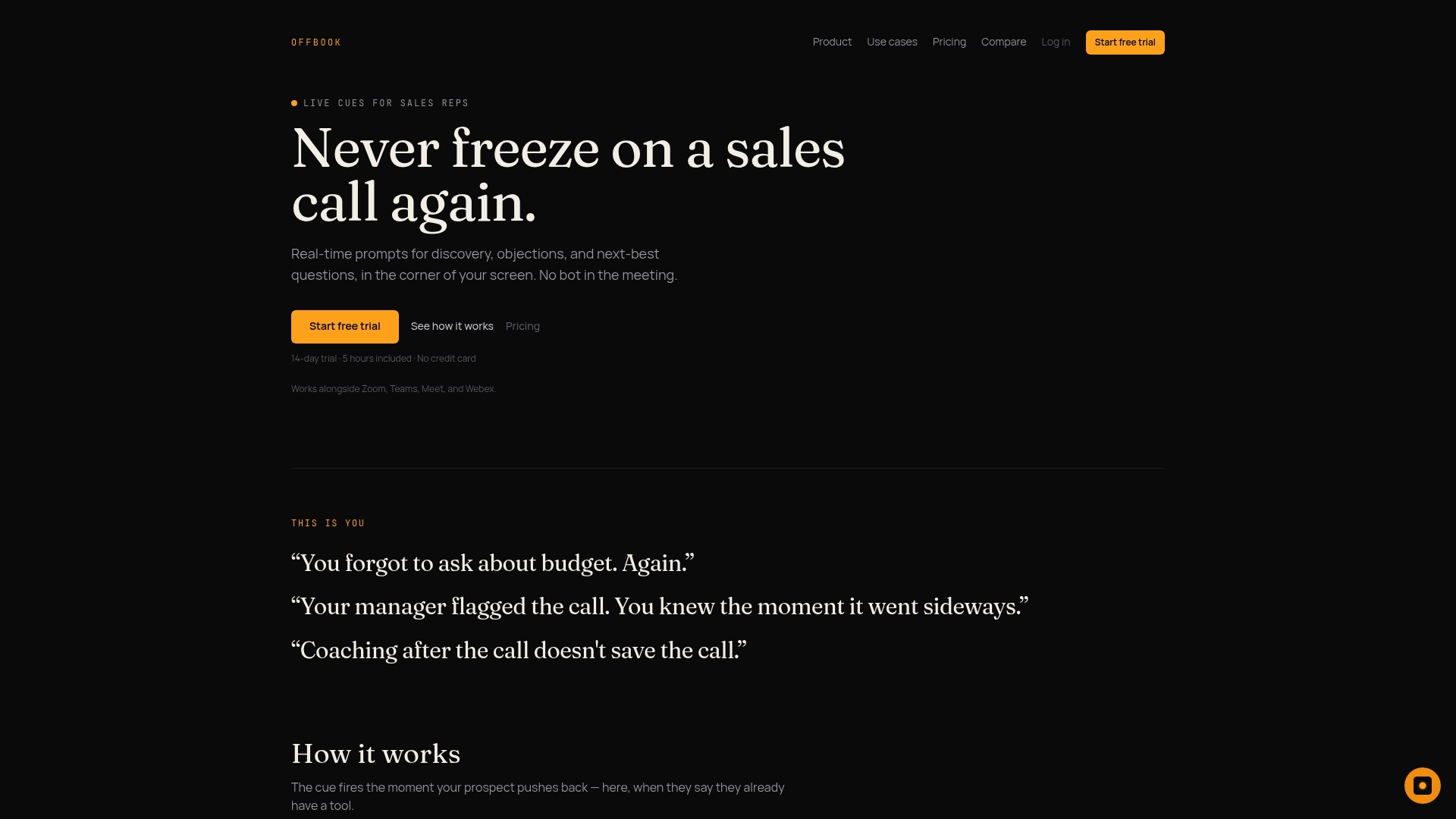
It’s built specifically for founder-led B2B SaaS teams at seed and Series A, where reps often run calls solo with no manager listening in to catch the gap in real time. If your template keeps showing 0s in the same fields deal after deal, that’s usually a discovery problem, not a scoring problem. See how AI call coaching for sales teams applies live during your next call, and start a trial to see it on your own pipeline.
Sources
For deeper walkthroughs and additional copyable material, Prolifiq’s MEDDPICC guide offers a full scorecard breakdown, Prospeo’s question library provides over 60 stage-mapped discovery questions, WithRealm’s implementation guide covers automation setup, and HubSpot’s MEDDPICC overview includes free sales-plan templates. For a broader process reference beyond MEDDPICC alone, The International Sales Handbook covers adjacent frameworks worth knowing.
- MEDDPICC Template: The Complete Guide for B2B Sales Teams | Prolifiq
- 60+ MEDDPICC Questions by Sales Stage (2026) | Prospeo
- MEDDPICC Guide: What It Is, How to Implement & Automate with AI | WithRealm