5–8 Questions Per Call: MEDDIC Questions for Sales Reps to Score Deals
Practical MEDDIC questions sales reps can use on discovery calls. Ask 5 to 8 per call, sequence naturally, then score each element in CRM.
Published: September 17, 2026
Author: OffBook Editorial Team

This page gives you a MEDDIC question bank organized by element, a call-sequencing rule to keep discovery natural, and a simple scoring method to turn answers into a deal map. Ask several questions per call spread across a few elements to keep discovery natural. Before your next call, pick 3 to 5 questions below, run them, and write down what you have as evidence versus what is still a guess.
TL;DR:
- Asking quantifiable metrics early establishes a solid business case and avoids relying on vague statements or opinions.
- Focus on confirming evidence for each MEDDIC element, especially for critical answers like budget approval and champion actions, to avoid inflated forecasts.
- Limit discovery questions to five to eight per call across two to three elements to maintain a natural conversation rather than sounding interrogative.
- Prioritize evidence-based scoring of deal elements as red, orange, or green to properly assess pipeline health and identify deals needing more validation.
- Tailor MEDDIC questions to the buyer persona and industry, and avoid asking irrelevant or out-of-sequence questions that may stall or stifle the conversation.
Table of Contents
- MEDDIC Questions by Element: What to Ask and Why
- How to Sequence MEDDIC Questions Without Sounding Like an Interrogation
- Turning MEDDIC Answers Into a Scored Deal Map
- How Offbook Supports MEDDIC in Real Time
- Three Things to Try This Week
- Common Mistakes When Asking MEDDIC Questions
- Adapting MEDDIC Questions by Industry and Buyer Persona
- Follow-Up Questions That Deepen the Initial Answer
- Coaching Sales Teams to Use MEDDIC Well
- Integrating MEDDIC Questions With CRM Tools and Other Methodologies
- The Gap Between Knowing MEDDIC and Actually Using It
- Sources
- FAQ
MEDDIC Questions by Element: What to Ask and Why
Every MEDDIC element answers a different risk in the deal. Metrics tell you if there is a business case. Champion tells you if anyone will fight for you when you leave the room. Below is a working set of MEDDIC discovery questions, organized by element, with a note on what each one is actually testing.
Metrics: quantify before you pitch
Metrics questions force a prospect to name numbers instead of adjectives. Vague answers like “it would help a lot” are not metrics. A real metric has a baseline, a unit, and a timeframe attached.
- “What does this process cost you today, in hours or dollars per month?”
- “If this works the way you hope, what specific number changes, and by how much?”
- “How do you currently measure success on this initiative, and who reports on it?”
- “What’s the target you’re being held to this quarter or fiscal year?”
Quantifying the prospect’s goals and current baseline is what makes an ROI conversation possible later. Without a number, you have an opinion, not a business case.
Economic buyer: find the person who signs
The economic buyer question set is about authority, not seniority. A VP title means nothing if someone else controls the budget line.
- “Who has to approve spending at this level, and who else weighs in?”
- “Has budget already been allocated for this, or would it need to be created?”
- “What does this person care about most this year, revenue, cost, risk, or something else?”
- “Would it help if I connected directly with them, or do you prefer to loop them in?”
That last question does double duty. It tests whether your contact has real access to the economic buyer, or whether they are guessing too.
Decision criteria: get the scorecard, don’t guess it
Decision criteria are the factors the prospect will use to judge every vendor, technical fit, price, implementation risk, support model. Most reps never ask for this directly and end up reverse engineering it from a lost deal.
- “What does the evaluation scorecard look like, formally or informally?”
- “Which three things would disqualify a vendor outright?”
- “Who on the technical side needs to sign off, and what are they checking for?”
- “Has anyone tried to solve this before? What made that attempt fail?”
Where possible, don’t just collect criteria, help shape them. Asking “would it matter if a solution could also do X” while the criteria are still forming is a legitimate influence tactic, not a manipulation.
Decision process: map the steps, not just the finish line
This is where reps confuse decision criteria with decision process, and it costs them. Criteria are what gets evaluated. Process is the sequence of steps, approvals, and paperwork between “we like it” and a signed contract, and distinguishing the two is one of the more consistently missed parts of MEDDIC.
- “Walk me through what happens after a vendor is chosen, step by step.”
- “Does legal or procurement need to review the contract, and how long does that usually take?”
- “Has a deal like this stalled before? What caused the delay?”
- “Is there a budget cycle or fiscal deadline this needs to align with?”
Identify pain: make the cost of inaction personal
Generic pain (“we want to be more efficient”) doesn’t close deals. Implicated pain, pain tied to a specific person’s goals, does.
- “What happens to your quarter if this problem isn’t solved?”
- “Who else on your team feels this, and how does it show up for them?”
- “If you solved this tomorrow, what would you personally stop worrying about?”
Champion: test for action, not enthusiasm
A champion is not someone who says “I love this.” A champion is someone who has already spent political capital moving it forward.
- “What have you done internally to move this project forward so far?”
- “Have you mentioned this to your boss or another stakeholder? What did they say?”
- “Could you set up time with the economic buyer, or introduce me to procurement?”
Practitioners recommend testing a champion by what they have already done, meetings booked, documents drafted, internal emails sent, rather than accepting a verbal promise at face value. A coach shares information. A champion spends effort.
How to Sequence MEDDIC Questions Without Sounding Like an Interrogation
Firing off fifteen qualification questions in one call feels like a deposition, not a conversation. The fix is pacing.
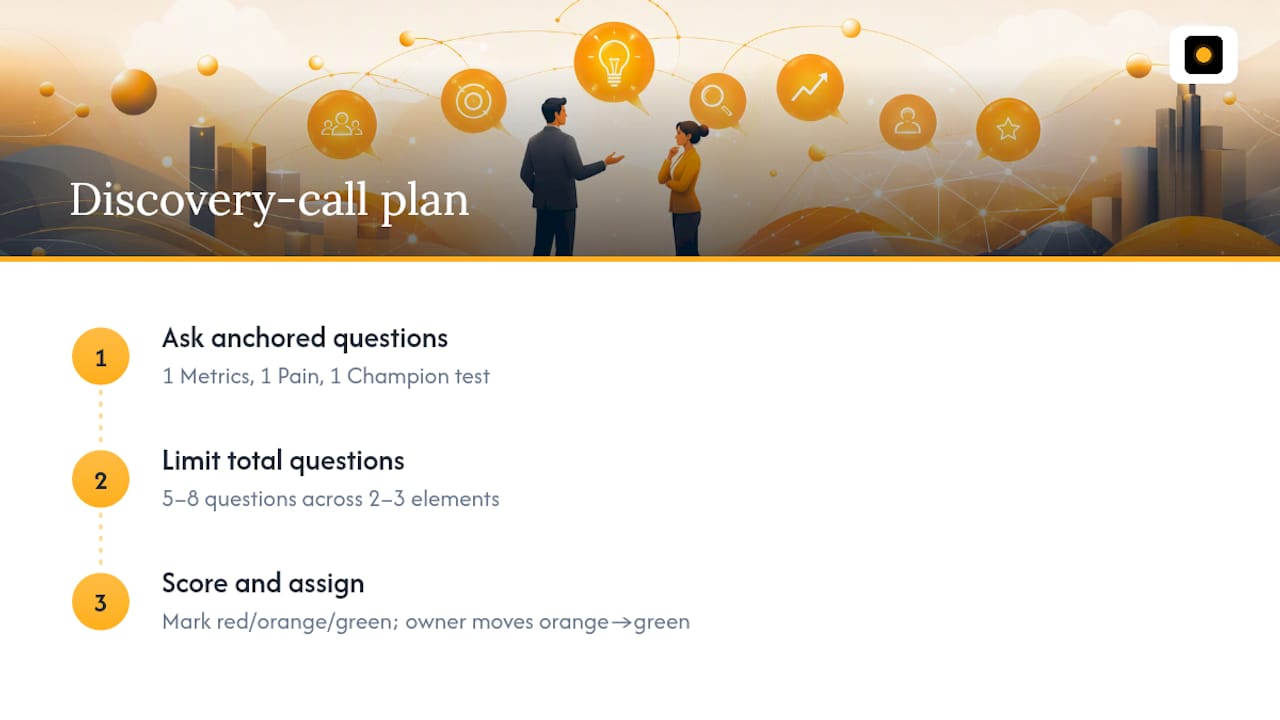
- Cap each call at 5 to 8 questions spread across 2 to 3 MEDDIC elements. This keeps the conversation from feeling like a checklist.
- Open with Pain and Metrics, they’re the most natural to ask early and give you the business case.
- Save Economic Buyer and Decision Process for the second or third call, once trust and context exist.
- Do pre-call research so you’re not asking questions you could answer yourself, confirm the prospect fits your ICP before spending discovery time on them at all.
- Hold Champion-testing questions for a moment when the prospect has shown initiative, not the first five minutes of call one.
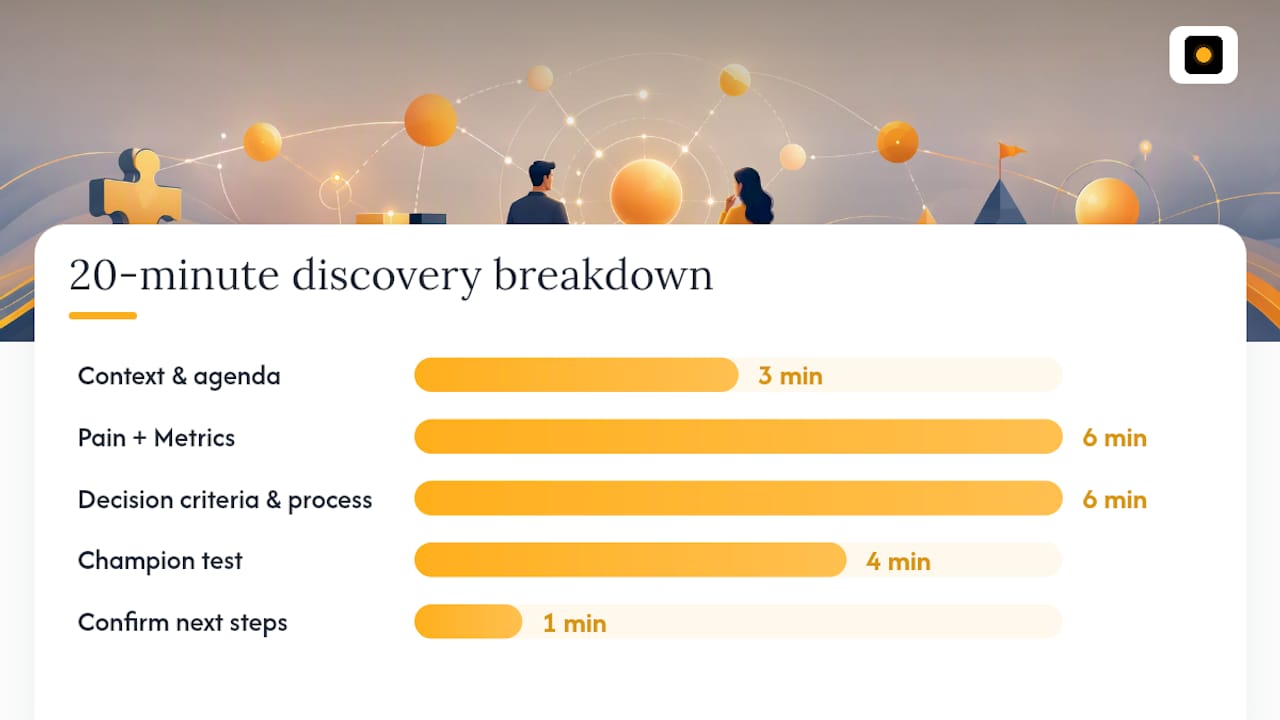
A sample 20-minute discovery call might run: 3 minutes on context and agenda, 6 minutes on two Pain questions and one Metrics question, 6 minutes on one Decision Criteria question and one Decision Process question, 4 minutes on a single Champion test, and 1 minute confirming next steps. That’s 6 questions, three elements, no interrogation.
Pro Tip: If a prospect answers a Champion question with a promise instead of a past action, don’t argue. Just ask “what would need to be true for you to make that introduction this week?” It turns a vague commitment into a testable one.
Turning MEDDIC Answers Into a Scored Deal Map
Collecting answers is only half the job. Untested MEDDIC fields marked “complete” because someone said something once are the single biggest reason forecasts blow up in pipeline review.
A workable scoring approach uses three bands per element:
- Red: no evidence, or the only source is the single contact you talk to.
- Orange: one piece of evidence exists (a quote, a document, an email) but hasn’t been confirmed independently.
- Green: confirmed by two or more sources, or backed by something concrete like a signed scorecard or a calendar invite with the economic buyer.
A scorecard approach like this helps teams triage which deals deserve more time in pipeline reviews instead of forecasting on hope. For each element, log three things in your CRM notes: the fact or hypothesis, who owns getting it confirmed, and what evidence would move it from orange to green. That single habit, treating MEDDIC fields as living data instead of static checkboxes, is what separates a real deal map from a wish list.
How Offbook Supports MEDDIC in Real Time
Pre-call briefs on the people and companies about to be met can be generated, followed by listening during the video call and surfacing on-screen prompts without joining as a visible bot, mapped to MEDDIC elements like Champion or Decision Process. That live cueing helps reps stay inside the 5 to 8 question guideline instead of drifting into either small talk or interrogation, and it captures evidence and gaps as the conversation happens rather than from memory afterward. A simple pilot: run pre-call prep on your next three calls, let the in-call prompts guide your question mix, then score each element the same day.
Three Things to Try This Week
Ask one Metrics question, one Pain question, and one Champion test question on your next call. Hold to 5 to 8 questions across 2 to 3 elements for your next three discovery calls. After each one, score every element red, orange, or green, and write down who owns getting the orange ones to green.
Common Mistakes When Asking MEDDIC Questions
The most common mistake is running MEDDIC on every prospect regardless of fit. If someone doesn’t match your ICP, MEDDIC questions waste their time and yours, confirm basic fit first, then qualify.
The second mistake is asking questions in interview order, straight down the MEDDIC acronym, instead of following the conversation. A prospect who brings up budget in minute two shouldn’t have to wait until you get to “E” to talk about it.
Third, reps often accept the first answer as fact. “My boss will love this” is a hypothesis until you’ve seen the boss respond. Mark it as such in your notes instead of treating it as confirmed.
Fourth, some reps ask Decision Criteria questions but never ask Decision Process questions, then get blindsided by a procurement step nobody mentioned. Both need airtime, and they are not the same thing.
Fifth, over-asking. Quiz a prospect on twelve qualification points in one call and you’ll get short, guarded answers instead of real ones. Fewer questions, asked with genuine curiosity, get better information than a long checklist read aloud.
Finally, many reps stop testing a champion once someone says “I’m in.” Keep asking for small actions, an intro, a forwarded email, a calendar hold. If those never materialize, you likely have a coach, not a champion.
Adapting MEDDIC Questions by Industry and Buyer Persona
MEDDIC’s structure holds across industries, but the phrasing needs to shift with the buyer.
In enterprise software sales, Decision Process questions carry more weight because procurement, security review, and legal sign off usually add weeks or months, ask about those steps earlier than you would in a smaller deal.
In healthcare or financial services, Decision Criteria questions often need a compliance angle built in: “What regulatory or audit requirements does this need to satisfy?” surfaces criteria a generic question would miss.
Selling to a technical buyer, an engineering lead or CTO, means leaning harder on Metrics and Decision Criteria, they respond to specifics and want to see the evaluation scorecard. Selling to a finance buyer means leaning on Economic Buyer and Metrics questions phrased in cost and payback terms, not features.
Selling to a founder at an early-stage company is different again. There may be no formal Decision Process at all, the founder often is the economic buyer. In that case, spend more time on Pain and Metrics, and treat Decision Process as “how fast can you move” rather than a multistep approval chain.
The elements don’t change. The words you use to ask about them should sound like they belong in that buyer’s world, not like they were copied from a script.
Follow-Up Questions That Deepen the Initial Answer
A first answer is rarely the real answer. When a prospect gives you a Metrics number, follow with “how confident are you in that number, is it measured or estimated?” That single follow-up separates a hard data point from a guess dressed up as one.
When someone names a Pain, push further: “how long has this been a problem, and what’s changed recently that makes it urgent now?” Pain that’s been tolerated for two years without action isn’t urgent, no matter how it’s described.
If a contact claims to be a Champion, follow their first answer with a specific ask: “given that, would you be comfortable setting up 15 minutes with your finance lead this week?” The response, not the original claim, is the real signal.
On Decision Criteria, once you have the list, ask “which of these matters most if you had to pick just one?” Forcing a ranking exposes what actually drives the decision versus what’s just on a checklist.
And on Decision Process, when someone mentions a step, ask “has that step ever caused a deal to stall before?” That question alone often surfaces the bottleneck that kills deals nobody flagged in the first pass.
Coaching Sales Teams to Use MEDDIC Well
Most MEDDIC coaching failures aren’t about the framework, they’re about reps memorizing questions without understanding what each one is testing for. Coach for intent, not script recall: ask a rep in a role-play “why did you ask that,” and if the answer is “because it’s next on the list,” that’s the gap to fix.
Review calls specifically for question density. A rep who asks fifteen qualification questions in one call needs coaching on restraint, not more questions to memorize.
Build calibration into pipeline reviews by asking reps to defend their scoring. If a deal is marked green on Champion, make the rep produce the evidence, a forwarded email, a scheduled meeting, not just a description of a good conversation. This habit alone catches most inflated forecasts before they become a quarter-end surprise.
Pair newer reps with a team implementation guide so the whole team scores the same way, inconsistent scoring standards across reps make pipeline reviews unreliable no matter how good any individual rep’s questions are.
Integrating MEDDIC Questions With CRM Tools and Other Methodologies
MEDDIC pairs naturally with CRM custom fields, most teams create a field per element (Metrics, Economic Buyer, Decision Criteria, Decision Process, Identify Pain, Champion) and require a note, not just a checkbox, before a field can be marked green.
Teams running MEDDPICC extend the same fields to include Competition and Paper Process, useful once deals involve multiple vendors or complex procurement. A broader MEDDPICC question set covers that extension if your deals routinely stall in legal or vendor comparison.
If your team already runs a methodology like Challenger or SPIN, MEDDIC doesn’t replace it, it sits underneath as the qualification layer. Challenger’s teaching and tailoring can happen inside a MEDDIC-structured call, especially around Decision Criteria, where reframing what the prospect should be evaluating is exactly where a Challenger-style insight lands hardest.
On the technical evaluation side, if Decision Criteria conversations involve integration requirements or platform architecture, a technology integration partner can help surface criteria a sales rep alone might miss, particularly for enterprise buyers running security or infrastructure reviews.
The Gap Between Knowing MEDDIC and Actually Using It
Most sales teams can recite the MEDDIC acronym. Far fewer can produce evidence for a single element on a random deal in their pipeline. That gap, not unfamiliarity with the framework, is what actually costs deals.
The conventional advice treats MEDDIC as a form to fill out after the call. That’s backwards. The framework only works as a live filter during the conversation, deciding what to ask next based on what the prospect just said, not running down a fixed script. Reps who treat it as a checklist end up with six green fields and zero real evidence, which is worse than an honest “I don’t know yet.”
The single highest-leverage fix isn’t asking more questions. It’s asking fewer, better ones, and immediately writing down whether the answer is a fact or a hope. A prospect who says “my boss will approve this” has told you nothing until someone confirms it independently. Score it orange, assign someone to turn it green, and move on. Reps who build that habit close more predictably than reps who ask twice as many qualification questions but never test a single answer.
— Neil
Sources
- MEDDIC Sales Qualification Process: All-In-One Guide | Yesware
- MEDDIC Discovery Questions | Tech Sales Playbook
FAQ
Is MEDDIC Still Relevant Today?
Yes. MEDDIC remains one of the more widely used B2B qualification frameworks because it forces specific evidence, metrics, named buyers, documented process, rather than vague optimism about a deal’s health.
Can You Give an Example of a Discovery Question?
A strong Metrics discovery question is: “What does this process cost you today, in hours or dollars per month?” It forces a number instead of a general statement about wanting improvement.
What Does MEDDIC Stand For?
MEDDIC stands for Metrics, Economic Buyer, Decision Criteria, Decision Process, Identify Pain, and Champion, six qualification elements used to assess deal health in B2B sales.
What Are Decision Criteria in MEDDIC?
Decision criteria are the specific factors, technical, economic, and relationship-based, a prospect uses to evaluate and choose between vendors. They’re distinct from decision process, which maps the steps and stakeholders from evaluation to signed contract.