13/18 Commit Floor: MEDDIC Cheat Sheet Sales Teams Use on Calls
One page MEDDIC cheat sheet for sales teams: use 1–3 scoring, a 13/18 commit floor, ask 5–8 questions per call, and map fields in CRM.
Published: September 14, 2026
Author: OffBook Editorial Team

A working MEDDIC cheat sheet is one page: six fields to capture, one prompt per field to ask live, and a 1 to 3 score that adds up to a forecast number. Use it by scoring every open deal from 6 to 18, treating 13 as your commit floor, and asking 5 to 8 discovery questions per call spread across two or three letters at a time. MEDDPICC just bolts on Paper Process and Competition for deals with procurement or a named rival in the room.
TL;DR:
- Deals should be scored on a 1 to 3 scale for each MEDDIC element, with a minimum full score of 13 out of 18 to qualify as a forecastable deal.
- Asking 5 to 8 targeted discovery questions per call across two or three MEDDIC elements prevents discovery fatigue and accelerates qualification progress.
- Regularly updating scores immediately after relevant calls ensures data remains accurate, with downward revisions providing essential warning signals.
- For complex deals involving procurement or competitors, adding Paper Process and Competition fields enhances qualification accuracy and pipeline integrity.
- Using CRM fields or scorecards calibrated to evidence and confirmed buyer input improves consistency and reduces reliance on memory during pipeline reviews.
Table of Contents
- What Each Letter Of The Meddic Cheat Sheet Means
- How To Score And Template A Meddic Deal
- How To Sequence Meddic Discovery Questions On Calls
- How To Map Meddic Fields Into Your CRM
- Rolling Out A Meddic Cheat Sheet Without Turning It Into A Checkbox
- The Research And Practitioner Support Behind This Cheat Sheet
- What A Meddic Scorecard Looks Like In A Real Deal
- Coaching A Team To Use Meddic Without Slowing Down Calls
- Where Meddic Fits Inside Your Broader Sales Process
- Keeping Meddic Data Accurate As The Deal Moves
- When Meddic Is Worth The Overhead
- Where OffBook Fits Into Your Meddic Process
- Sources
- FAQ
What Each Letter Of The Meddic Cheat Sheet Means
This is the reference version, the one you’d tape to your monitor or paste into a CRM field description. Each letter gets a fact to capture, a question to ask to get it, and a bar for what counts as buyer-confirmed rather than rep-assumed.
- Metrics. Capture the quantified business impact the buyer says they’ll get, in their own words and their own numbers. A “3” sounds like “our VP told me this would save 40 hours a month across the team,” not your own math on their website traffic. Ask: “If this works the way you’re hoping, what changes in a number you’d report to your boss?”
- Economic Buyer. Capture the name, title, and whether you’ve had a direct conversation with the person who can release budget. A “3” means you’ve spoken with them, not that your champion described them. Ask: “Walk me through who signs off once the team agrees this is worth doing.”
- Decision Criteria. Capture the specific, often written, list of requirements the buyer will score vendors against. A “3” is a document or a verbatim list read back to you, not a vague “it needs to be easy to use.” Ask: “What does the evaluation scorecard actually look like, and who built it?”
- Decision Process. Capture the steps, approvers, and timeline between “we like it” and a signed contract. A “3” includes named steps and dates, not “probably a few weeks.” Ask: “After your team picks a favorite, what happens next, step by step?”
- Identify Pain. Capture the specific, costed consequence of doing nothing, ideally tied to a deadline or event. A “3” is a quote like “if we don’t fix this before Q3, we lose the renewal,” not “they seem frustrated.” Ask: “What happens to your team if this stays broken for another two quarters?”
- Champion. Capture proof this person has personally spent political capital pushing your deal internally, not just enthusiasm on calls. A “3” is evidence they’ve looped in the Economic Buyer or defended you against an internal objection. Ask: “Has anyone pushed back on bringing us in, and how did you handle it?”
For deals that touch procurement, legal, or a named competitor, MEDDPICC adds two more rows worth scoring the same way:
- Paper Process. Capture what legal, security review, or procurement will require before a signature, and how long that typically takes at this company.
- Competition. Capture which other vendors are in the deal and, more importantly, who internally is championing each one.
Public MEDDIC cheat sheets and prompt lists follow roughly this same structure, and for good reason: it maps a fuzzy conversation to six or eight things you can check off or fail to check off.
How To Score And Template A Meddic Deal
The scoring system that actually gets used in pipeline reviews is a simple 1 to 3 red, yellow, green scale per letter, with an aggregate score out of 18 for full MEDDPICC or 12 for classic MEDDIC.
- Score 1 (red): no information. You genuinely don’t know, or you’re guessing based on the champion’s tone.
- Score 2 (yellow): partial or unverified. You have an answer, but it came from your champion secondhand, not from the Economic Buyer or a document.
- Score 3 (green): buyer confirmed. You can quote the source. “Our CFO said budget is approved for Q1” beats “I think budget’s fine.”
A practical worksheet approach uses this exact scale and pairs it with a rough commit threshold around 13 out of 18, which gives reviews a number instead of a gut feeling. Many teams add one hard rule on top of the raw total: a deal cannot be called a commit if either Economic Buyer or Champion sits at a 1, no matter how high the other letters score. A deal can hit 15/18 and still be fake if nobody has actually talked to the person who signs the check.
| Field | What you record | Where it lives |
|---|---|---|
| Letter score (1 to 3) | Red/yellow/green per element | CRM picklist or scorecard column |
| Evidence text | The buyer’s actual words or a document reference | CRM text field or notes |
| Aggregate total | Sum of all scored letters | Auto-calculated field or spreadsheet formula |
| Lowest two letters | Flagged automatically as next actions | Pipeline review dashboard |
Free templates built around this format, including interactive MEDDIC scorecards, typically add decision-process mapping and mutual action plan fields alongside the score. Re-score every deal after each substantive call, not on a fixed weekly schedule. A score that hasn’t moved in three weeks is itself a signal, usually that the deal has gone quiet.
How To Sequence Meddic Discovery Questions On Calls
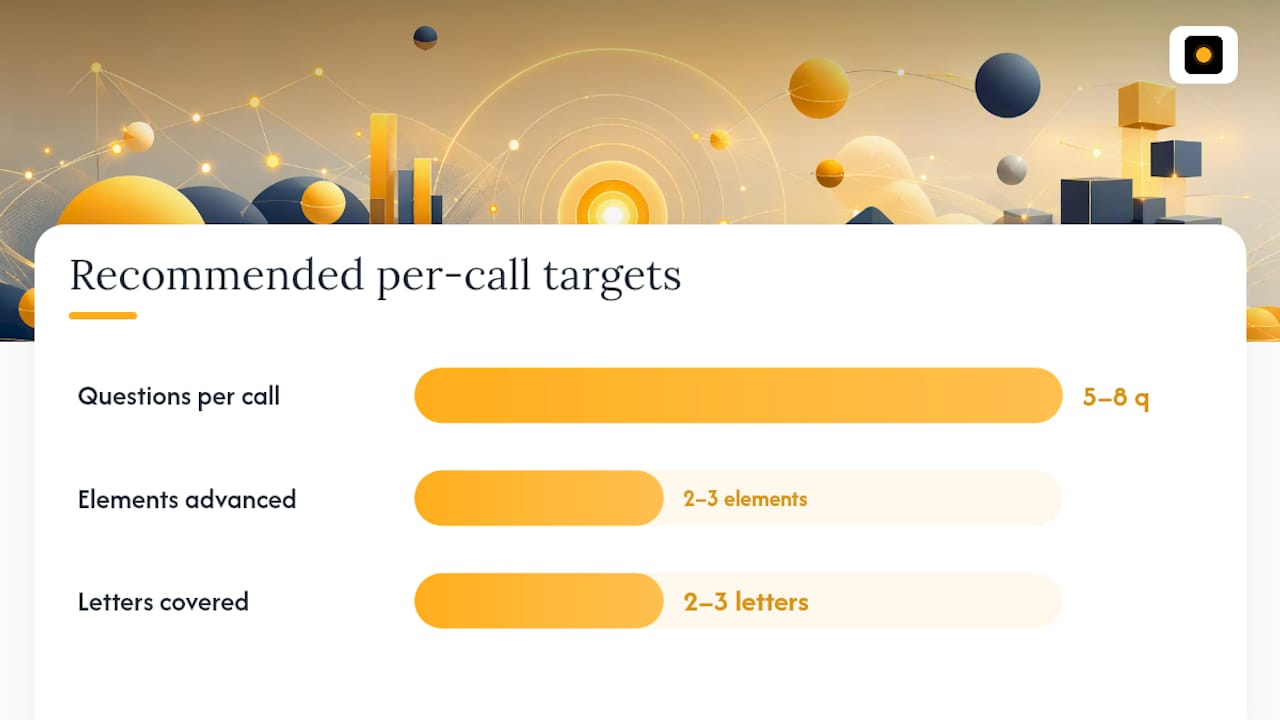
Ask 5 to 8 questions per call, not 15. Practitioners consistently land on this range because it avoids discovery fatigue while still moving 2 to 3 elements forward per session, rather than skimming across all six or eight letters and confirming none of them well.
Spread your questions across two or three letters at a time, and sequence which letters you chase by call. Early calls are for Identify Pain and Metrics, because buyers talk about those freely before trust is built. Later calls, once you have a champion, shift to Economic Buyer and Decision Process, which require more social capital to ask about directly.
Pack 1: Early discovery (Pain, Metrics)
- What’s the actual cost of leaving this problem unsolved through the year?
- Whose budget would this come out of if you moved forward?
- What number would you report up if this project succeeds?
- How is this handled today, and who’s frustrated by that?
- What triggered you to start looking now instead of six months ago?
- If nothing changes, what happens to your team’s targets?
Pack 2: Qualification follow-up (Decision Criteria, Decision Process)
- What does your evaluation scorecard actually include?
- Who else needs to sign off before this becomes final?
- What’s the timeline between a favorite vendor and a signed contract?
- Has your team run a process like this before, and what slowed it down?
- What would disqualify a vendor outright at this stage?
- Who owns the final recommendation internally?
Pack 3: Pre economic buyer meeting (Champion, Economic Buyer)
- What does your VP care most about when reviewing a purchase like this?
- Has anyone raised objections internally, and how were they resolved?
- What’s the best way to frame this for your Economic Buyer?
- Who has final budget authority, and have they weighed in yet?
- What would make your Economic Buyer say no?
- Can you walk me through how you’d present this internally?
Battle-tested question sets built for each MEDDIC element and call stage follow this same logic: match the question to what the buyer is actually willing to reveal at that point in the relationship.
Pro Tip: Replace “so it sounds like budget’s approved” with “can you send me the email where your CFO confirmed that?” The first is hearsay. The second either produces evidence or exposes that you don’t actually have a 3.
How To Map Meddic Fields Into Your CRM
A cheat sheet on a sticky note dies the moment the deal gets handed to a new rep. Put the same six or eight fields into your CRM as custom fields on the opportunity record, not buried in a notes box nobody rereads.
- Per-letter score field: a picklist with values 1, 2, 3, tied to the opportunity, updated after every call that touches that element.
- Evidence text field: a short free-text box next to each score, where the rep pastes the buyer’s actual quote or document reference.
- Aggregate score: an auto-calculated roll-up field so managers see the out-of-18 total without doing math in a review.
- Lowest-two flag: a formula or dashboard filter that automatically surfaces the two weakest letters for every open deal above a certain stage.
For pipeline reviews, build a dashboard around three KPIs: average MEDDIC score by stage, count of deals below the 13/18 floor still marked “commit,” and score movement over the last two calls. A five-minute review script sounds like: “Pull up the score. What’s your lowest letter. What’s the next question that moves it.” Teams that push MEDDIC into a CRM or shared workspace get measurably more consistent reviews than teams relying on rep memory.
Smaller teams can start with a spreadsheet or a collaborative deal workspace before investing in custom CRM fields, and OffBook’s guide to setting up an 8-field MEDDPICC template walks through the exact field structure.
Rolling Out A Meddic Cheat Sheet Without Turning It Into A Checkbox
The fastest way to kill MEDDIC adoption is treating it as a form to fill out after the call instead of a set of questions to ask during it. A pilot before a full rollout catches that problem early.
- Pilot on 15 to 20 active deals for one full quarter before mandating it team-wide.
- Assign an owner (usually sales ops or a frontline manager) responsible for weekly score audits.
- Require quoted evidence for every score of 3. No exceptions, even for your best rep.
- Rescore after every call that touches a scored element, not on a weekly batch.
Managers should ask three things in every pipeline review: “What’s the quote behind that score?” “What’s your lowest letter, and what’s the next action?” “What changed since last week?” The most common failure modes are cramming ten questions into one call, optimism bias on Champion scores, letting scores go stale for weeks, and ignoring Paper Process until it blows up a “closed” deal in legal review. Each of those has a clear owner: the rep owns question pacing and evidence quality, the manager owns catching stale scores, and sales ops owns flagging Paper Process risk before late stage. OffBook’s rollout guide for sales teams covers the pilot structure in more depth.
The Research And Practitioner Support Behind This Cheat Sheet
The rules in this cheat sheet aren’t arbitrary. The 5 to 8 question guidance and CRM field mapping both come from practitioner guidance published by DemandFarm, and the 1 to 3 scoring scale with a 13/18 forecast floor mirrors the copy-paste worksheet format documented by Laxis. Question packs organized by call stage follow the same structure Prospeo uses in its own discovery playbooks, and collaborative scoring templates from Dock reflect the same shared-workspace approach recommended here.
None of this replaces sales skill. MEDDIC is a qualification layer that sits on top of your existing process, not a substitute for it. OffBook builds toward the same standard: live coaching prompts during calls, a growing library of qualification templates, and a repository of discovery questions reps can pull from mid-conversation rather than reconstructing from memory after the call ends.
What A Meddic Scorecard Looks Like In A Real Deal
Picture a $60,000 ACV deal for a workflow tool sold into a 200-person operations team. On call one, the rep asks about pain and gets a real number: “Our team loses about 12 hours a week on manual reconciliation.” That’s a 3 on Metrics and a 3 on Identify Pain, both buyer-quoted.
Call two surfaces a champion, an ops manager who says she’s already mentioned the tool to her VP. That’s only a 2 on Champion until she confirms the VP actually reacted, not just heard about it. Call three, she reports back: “My VP asked why we haven’t already switched.” That moves Champion to a 3, evidence intact.
The deal stalls at Economic Buyer for three weeks. The champion keeps saying “budget should be fine,” but nobody has spoken to the VP directly. Score stays at 1. The rep, coached to treat that as a red flag rather than a rounding error, asks the champion directly: “Would it help if I got fifteen minutes with your VP before we finalize the proposal?” That single question moves the deal from a hopeful “probably closing” to an actual verified opportunity, or it exposes that the champion has less influence than the rep assumed. Either outcome is more useful than another week of guessing.
This is the pattern across most real MEDDIC saves: the score doesn’t manufacture progress, it exposes exactly where the deal is still fiction.
Coaching A Team To Use Meddic Without Slowing Down Calls
The mistake most managers make is teaching MEDDIC as a memorization exercise: six letters, recite them back. Reps who can define Champion in a training session still won’t ask the follow-up question that actually tests it on a live call.
Coach against the score, not the acronym. In one-on-ones, pull up a rep’s weakest letter on their top three deals and ask, “What’s the next question that moves this from a 1 to a 2?” That’s a concrete, answerable coaching prompt, unlike “work on your qualification.”
Role-play the awkward questions specifically, the ones reps avoid because they feel pushy. “Who signs off on this besides you?” feels blunt the first ten times a rep asks it. Practicing the phrasing in a low-stakes setting, before the buyer call, is what makes it sound natural instead of interrogative.
Review calls together and flag the moment a rep accepted a vague answer instead of pushing for the buyer’s own words. That’s the single habit that separates a 2 from a 3 across every letter, and it’s the easiest thing to catch when listening to a recording or watching live prompts flag a soft answer in real time.
New reps should shadow scored deals before they run their own, watching how a champion’s “I think we’re good on budget” gets followed up with “good, can you connect me with whoever confirms that?” That one follow-up habit, repeated across a full pipeline, does more for forecast accuracy than any amount of framework theory in a training deck.
Where Meddic Fits Inside Your Broader Sales Process
MEDDIC isn’t a replacement for your sales process. It’s the qualification layer that sits inside whatever process you already run, whether that’s a simple stage-gated pipeline or a more structured methodology built around buyer psychology.
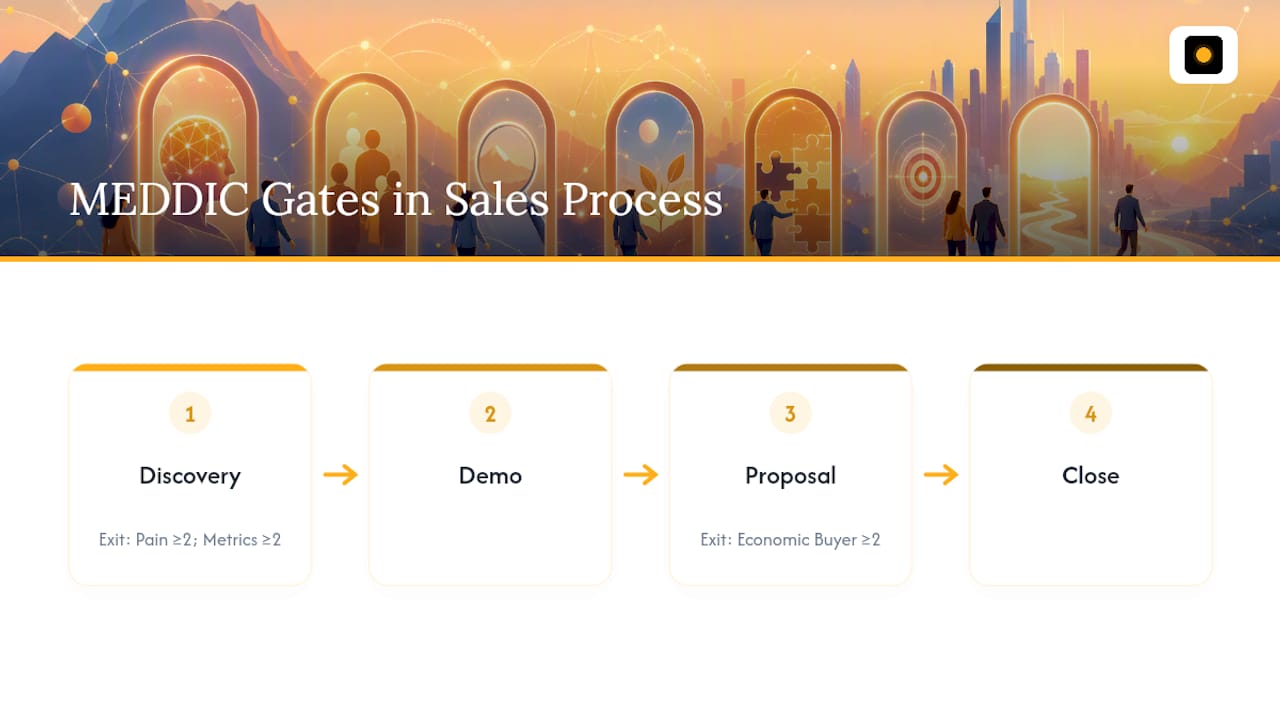
Think of it this way: your sales process defines the stages a deal moves through, discovery, demo, proposal, close. MEDDIC defines what has to be true, and verified, before a deal is allowed to advance from one stage to the next. A deal shouldn’t move from qualification to proposal if Economic Buyer and Decision Process are both still sitting at a 1, regardless of how good the demo went.
This is where MEDDIC and broader methodology frameworks work together rather than compete. A structured sales methodology gives you the shape of the conversation; MEDDIC gives you the evidence bar for moving forward within that shape. Teams that skip this integration end up with two disconnected systems: a pipeline stage that says “proposal sent” and a MEDDIC score that says the deal has no confirmed champion. When those two systems disagree, trust the score.
The practical fix is simple: define stage-exit criteria in terms of minimum MEDDIC scores. No deal exits qualification below a 2 on Identify Pain and Metrics. No deal exits proposal below a 2 on Economic Buyer. That turns MEDDIC from a side document into the actual gatekeeper of your pipeline.
Keeping Meddic Data Accurate As The Deal Moves
A MEDDIC score is only as useful as its last update. The single biggest reason teams abandon the framework isn’t the scoring logic, it’s stale data: a Champion score of 3 recorded in week two that nobody revisited by week eight, even after the champion went quiet.
Rescore immediately after any call that touches a scored element, not on a fixed weekly cadence. If a call surfaces new information about Decision Process, update that field before moving to the next task, while the buyer’s exact words are still fresh.
Treat a downgrade as normal, not a failure. A Champion score dropping from 3 to 2 because the champion stopped responding is useful information, not a rep mistake to hide. Deals that only ever go up in score are usually being scored optimistically rather than accurately.
Set a hard rule for evidence expiration: a score of 3 based on a quote from two months ago, with no confirming activity since, should default back down to a 2 until it’s reconfirmed. Buyer situations change, budgets get reallocated, and champions get reassigned. A scorecard that never decays doesn’t reflect a stable deal, it reflects a rep who stopped checking.
When Meddic Is Worth The Overhead
Full MEDDIC or MEDDPICC earns its keep on complex deals, typically above the range where a lighter framework like BANT stops giving you enough signal. If your average deal size sits comfortably under $15,000 with a single decision maker and a short cycle, MEDDIC’s overhead usually outweighs its benefit, and a simpler qualification gate makes more sense, a distinction covered in more detail in OffBook’s BANT versus MEDDIC breakdown. Above that threshold, once multiple stakeholders and a real procurement process enter the picture, the discipline pays for itself. The leadership takeaway is simple: MEDDIC doesn’t make your team sell better on its own. It makes it much harder for a rep, or a manager, to keep believing a deal is healthy once the evidence says otherwise.
— Neil
Where OffBook Fits Into Your Meddic Process
A cheat sheet tells you what to ask. It doesn’t help mid call when a buyer mentions a budget number and you’re too busy typing to catch it. That’s the gap between having a MEDDIC template and actually using one under pressure.
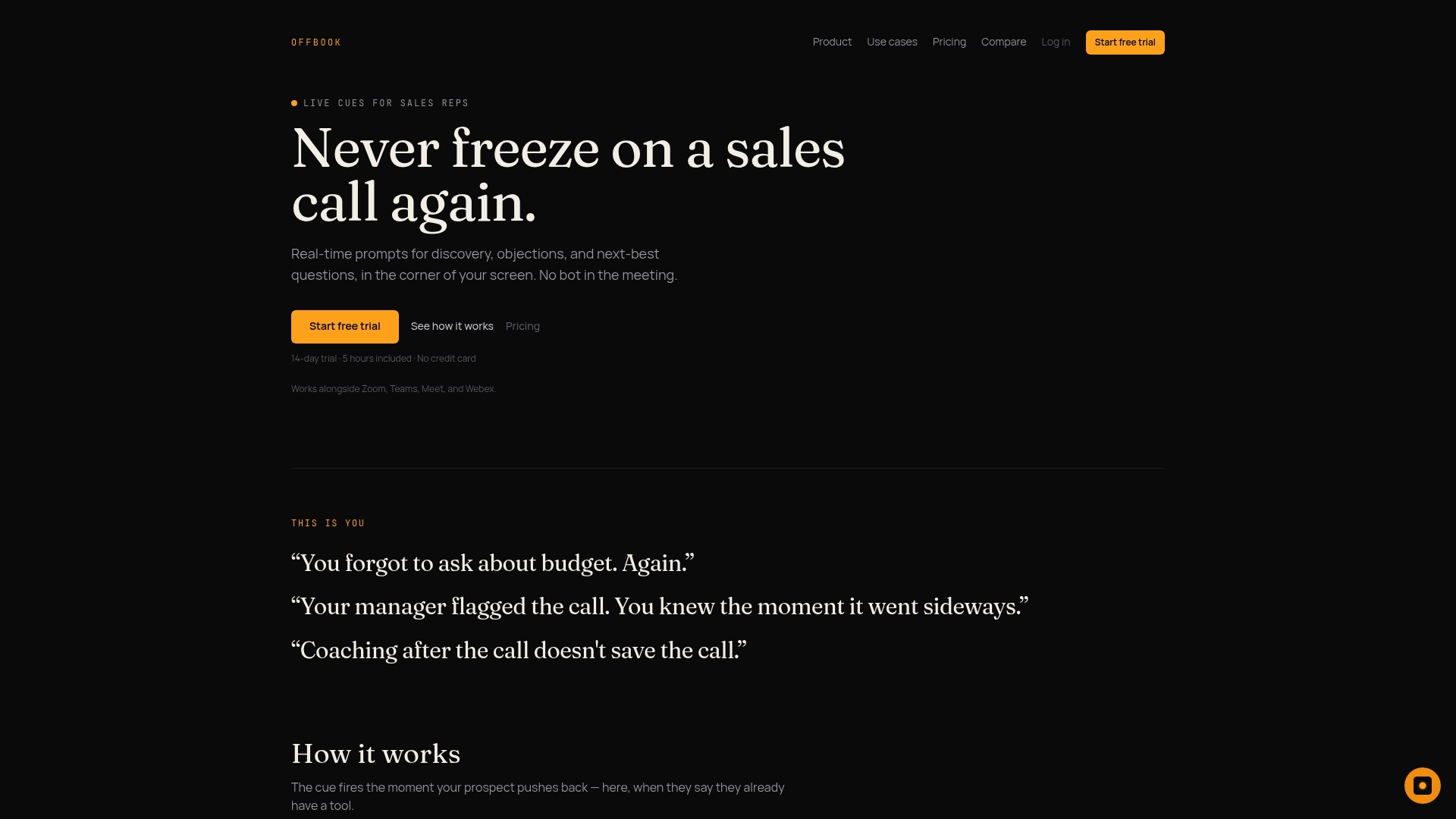
OffBook listens to your live sales calls and surfaces on-screen cues tied to the exact letters in this cheat sheet, flagging when a buyer drops a Metric, hints at Economic Buyer access, or shows Champion behavior, without a bot joining the meeting. It doesn’t replace your judgment on the call. It catches the quote you’d otherwise paraphrase from memory an hour later, which is usually the difference between a 2 and a defensible 3 on your scorecard. Pre-call briefs on the people you’re about to meet mean you walk in already knowing who the Economic Buyer likely is, instead of discovering it on call four. If you’re running MEDDIC or MEDDPICC across a founder-led sales team, start a trial on the OffBook sales product page and see what it flags on your next live call.
Sources
- How to implement MEDDIC in Salesforce | DemandFarm
- MEDDIC Template: A Copy-Paste Deal Qualification Worksheet | Laxis
- MEDDIC Sales Template | Dock
- MEDDIC Discovery Questions: 2026 Playbook | Prospeo
FAQ
What Is A Meddic Cheat Sheet Used For?
It’s a one-page reference reps use during live calls to remember what fact each MEDDIC letter needs and what question gets a buyer to confirm it, then score afterward on a 1 to 3 scale.
What’s The Difference Between Meddic And Meddpicc?
MEDDPICC is MEDDIC plus two fields, Paper Process and Competition, added for deals involving procurement review or a named competing vendor.
How Many Discovery Questions Should I Ask Per Call?
Ask 5 to 8 questions per call, spread across two or three MEDDIC elements, rather than trying to cover all six or eight letters at once.
What Forecast Score Should I Use As A Commit Floor?
A common practice is a 13 out of 18 floor on the full aggregate score, with a hard rule that Economic Buyer and Champion can never sit at a 1 for a deal marked commit.
Can Software Help Capture Meddic Evidence During Calls?
Yes. Some real-time sales coaching tools surface live MEDDIC prompts on screen during calls, flagging metrics, champion signals, and qualification gaps as the buyer says them, helping reps capture verifiable evidence instead of reconstructing it from memory afterward.