In-Call Sales Guidance: What B2B SaaS Reps Need
Discover what in-call sales guidance is and how it empowers B2B SaaS reps with real-time coaching for more effective sales conversations.
Published: June 18, 2026
Author: OffBook Editorial Team

In-call sales guidance is defined as real-time AI technology that listens to live sales conversations and delivers on-screen prompts to reps in under one second, covering objection responses, discovery questions, and qualification gaps. Unlike post-call analytics, which review what went wrong after the deal is already lost, in-call guidance changes the outcome while the conversation is still happening. Tools like Aircall AI Assist Pro and platforms like Offbook represent this category. For B2B SaaS founders and reps running high-stakes discovery and demo calls, this technology is the difference between winging it and running a disciplined, structured conversation every time.
What is in-call sales guidance and how does it work?
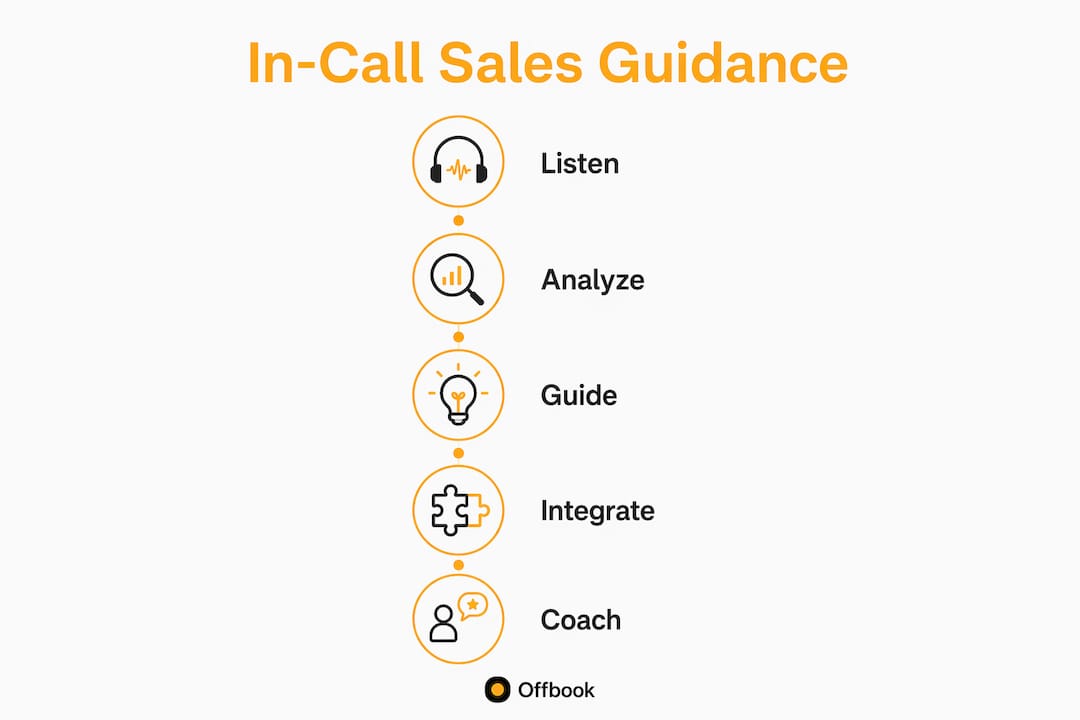
In-call sales guidance, also called real-time sales coaching, is a three-layer process: listen, analyze, and guide. The AI listens to the live conversation through your audio feed, analyzes what is being said against trained sales frameworks, and surfaces a prompt on your screen before the moment passes.
Speed is the defining technical requirement. Modern platforms surface guidance in under one second, which means the prompt appears while the prospect is still speaking. That latency benchmark separates genuine in-call tools from systems that process audio in batches and deliver feedback minutes later.
The prompts themselves fall into three categories:
- Objection handling cues — a suggested response when a prospect raises a pricing concern or competitor comparison
- Discovery question prompts — a follow-up question when the rep has not yet uncovered a key qualification signal
- Battle cards — competitive intelligence surfaced when a rival product is mentioned by name
Traditional call monitoring requires a manager to listen in and either whisper coach or debrief afterward. That model depends on manager availability and memory. AI-driven in-call support removes both constraints. It is always present, always consistent, and never forgets to flag a missed MEDDIC qualification step.
Pro Tip: Set your in-call guidance tool to surface prompts only when a trigger phrase is detected, not on a timer. Trigger-based prompts feel natural; timed prompts interrupt your flow.
Integration with CRM platforms like Salesforce or HubSpot adds another layer. When the AI detects a qualification gap, it can log the missing field automatically, so post-call CRM hygiene improves without any extra rep effort.

What are the key features and benefits for b2b SaaS teams?
The core feature set of any credible in-call sales guidance platform covers four areas: real-time prompts, objection libraries, competitive intelligence, and discovery question cues. Each one addresses a specific failure mode in live sales calls.
Aircall AI Assist Pro analyzes call context live and delivers tailored advice to improve communication and outcomes. That is the standard the category is now measured against. Offbook goes further by structuring prompts around MEDDIC and MEDDPICC frameworks, which means every cue is tied to a qualification methodology, not just a generic script.
The benefits for B2B SaaS teams are direct and measurable:
- Faster rep ramp-up. Real-time AI coaching reduces ramp-up time from the typical 3–6 months down to 4–8 weeks. New reps learn on the job with live support instead of relying solely on classroom training.
- Higher call structure consistency. Every rep follows the same framework on every call, regardless of experience level or nerves.
- Stronger rep confidence. Knowing a prompt will surface if you miss something reduces the anxiety of complex enterprise conversations.
- Ongoing skill reinforcement. Effective coaching is continuous and data-driven, focused on individual skill gaps rather than one-time training events. In-call guidance delivers that reinforcement automatically.
Pro Tip: Build your objection library before you go live. The more specific your objection responses are to your product and market, the more useful the prompts will be during real calls.
Here is how in-call guidance compares to the alternatives:
| Feature | In-Call Guidance | Post-Call Analytics | Traditional Training |
|---|---|---|---|
| Timing of feedback | Live, during the call | After the call ends | Before the call, in sessions |
| Impact on current deal | Direct and immediate | None | Indirect |
| Rep skill reinforcement | Continuous, contextual | Retrospective | Periodic |
| Consistency across reps | High, methodology-driven | Varies by manager review | Varies by trainer |
| Ramp-up acceleration | Significant | Minimal | Moderate |
Post-call analytics is, as one source puts it, an autopsy. In-call guidance acts as a co-pilot during the conversation itself. For seed and Series A SaaS teams where every deal counts, the timing difference is not a minor detail. It is the entire value proposition.
How do you integrate in-call guidance into your sales strategy?
Integrating in-call sales guidance into your workflow requires more than installing software. The technology performs best when it is aligned with a structured call plan before the conversation starts.
A well-prepared sales call plan balances structure with flexibility, including prioritized questions, a clear agenda, and defined next steps. When your in-call tool is configured to match that structure, the prompts reinforce the plan rather than interrupt it. Offbook handles this by generating pre-call briefs on the company and contact you are about to meet, so the rep walks in with context and the AI prompts align with what matters for that specific deal.
Here are the steps to embed in-call guidance into your sales call strategy effectively:
- Align your call framework first. Define the stages of your call, whether that is discovery, demo, or negotiation, and configure your prompts to match each stage.
- Train reps to glance, not stare. Prompts should be peripheral, not the center of attention. Reps who read prompts word-for-word sound scripted. Reps who glance and paraphrase sound natural.
- Use structured call flows as the foundation. In-call guidance amplifies a good structure. It cannot replace one.
- Combine in-call and post-call review. Use in-call prompts to improve the live conversation and post-call data to refine your prompt library over time.
- Review prompt trigger accuracy weekly. If prompts are firing on irrelevant phrases, they become noise. Tune the triggers regularly.
Structured sales call frameworks supported by real-time coaching keep reps on track and responsive to unpredictability instead of improvising under pressure. The combination of preparation, live prompts, and post-call review creates a feedback loop that compounds over time.
What are the common misconceptions about in-call sales guidance?
The most persistent misconception is that in-call guidance replaces the sales rep. It does not. The technology surfaces options. The rep decides what to say and how to say it. The judgment, the tone, and the relationship are still entirely human.
A second concern is distraction. Reps worry that watching a screen for prompts will pull their attention away from the prospect. In practice, the opposite tends to happen. Proactive real-time coaching reduces the likelihood of fumbling or losing the thread during complex discussions, which means reps are more present, not less. When you know a safety net exists, you stop mentally rehearsing your next line and start actually listening.
A third misconception is that the technology creates script rigidity. This is a configuration problem, not a product problem. Prompts designed as rigid scripts produce robotic calls. Prompts designed as question cues or objection frameworks produce flexible, natural conversations. The difference is in how you build your prompt library.
Finally, some teams assume that in-call guidance is only useful for junior reps. That misses the point. High-impact coaching maintains a regular cadence and personalized feedback for every rep, regardless of experience. Senior reps benefit from competitive intelligence prompts and qualification gap alerts just as much as new hires benefit from objection handling cues.
The AI in B2B sales conversations category is still maturing, and early skepticism is understandable. The teams that move past the misconceptions and adopt the technology thoughtfully are the ones building a durable performance advantage.
Key takeaways
In-call sales guidance delivers its full value only when it is paired with structured call frameworks, a tuned prompt library, and a coaching culture that treats real-time support as a skill multiplier, not a crutch.
| Point | Details |
|---|---|
| Definition is precise | In-call guidance delivers live AI prompts during calls, not after them. |
| Speed is the core requirement | Effective platforms surface prompts in under one second to stay relevant. |
| Ramp-up time drops significantly | Real-time coaching can cut new rep ramp-up from months to weeks. |
| Configuration determines quality | Prompts built around MEDDIC or MEDDPICC outperform generic script libraries. |
| Misconceptions slow adoption | In-call guidance supports reps; it does not replace their judgment or voice. |
Why i think most sales teams are still coaching too late
I have watched a lot of sales teams invest heavily in call recording and post-call review programs, and the results are almost always the same. Managers find patterns, run a training session, and then watch reps revert to old habits on the very next call. The feedback loop is too slow. By the time a rep hears what they should have said, the deal is already gone.
The shift to real-time coaching is not just a technology upgrade. It is a fundamentally different theory of how people learn. Adults learn best when feedback arrives in the moment, tied to a specific situation they are actively experiencing. That is what in-call guidance does. It turns every live call into a coached repetition, not just a performance to be graded later.
What I find most underrated is the confidence effect. Reps who know they have live support stop hedging. They ask harder questions, push back on weak objections, and hold the call structure more firmly. That behavioral shift shows up in deal quality, not just win rates.
My practical advice: do not wait until you have a full sales team to adopt this technology. Founders running their own sales calls at the seed stage benefit just as much. You are still learning your ICP, your objections, and your best discovery questions. Having a system that prompts you in real time accelerates that learning faster than any amount of post-call journaling.
— Neil
See in-call coaching work in a live conversation
If you have read this far, you already know that post-call review is not enough. The question is what you do about it.
Offbook is built for exactly this problem. It listens to your video calls, surfaces live AI prompts on your screen without a bot joining the meeting, and structures every cue around MEDDIC and MEDDPICC so your qualification never slips. It also generates pre-call briefs so you walk into every conversation prepared. For B2B SaaS founders and reps at the seed and Series A stage, Offbook’s AI call coaching is the fastest way to run more disciplined calls and close more deals starting with your next conversation.
FAQ
What is in-call sales guidance in simple terms?
In-call sales guidance is AI technology that listens to a live sales call and displays on-screen prompts to the rep in real time, covering objections, discovery questions, and qualification gaps. It operates without joining the call as a visible participant.
How is in-call guidance different from call recording tools?
Call recording tools capture conversations for post-call review, which cannot change the outcome of the call already completed. In-call guidance intervenes during the live conversation, giving reps the right prompt at the right moment.
Does in-call sales guidance work for founders, not just sales reps?
Yes. Founders running their own sales calls at the seed stage benefit from live prompts on objection handling and qualification gaps, especially when they are still refining their sales motion and ICP. Offbook is specifically built for founder-led sales teams.
What sales methodologies do in-call guidance tools support?
Most platforms support structured frameworks like MEDDIC and MEDDPICC, which define the qualification criteria a rep must uncover on every call. Prompts tied to these frameworks are more useful than generic script suggestions.
How quickly do in-call guidance prompts appear during a call?
Platforms process live inputs and surface guidance in under one second, which keeps the prompt relevant to the moment in the conversation when it is needed most.