30/60/90 to Fix Discovery to Demo: Fit Checks + Live AI for B2B SaaS
A practical 30/60/90 playbook for B2B SaaS sales: cut routing delays, embed scheduling, teach fit checks, and pilot live AI to lift discovery to demo...
Published: September 26, 2026
Author: OffBook Editorial Team

The fastest way to improve discovery to demo conversion is to stop treating the demo as automatic. Make it earned: route the lead in minutes, let the prospect book instantly on a personalized page, and qualify hard enough during discovery that only the right people show up. HubSpot’s sales research ties speed and tailored follow-up directly to conversion, and OffBook exists precisely to make that qualification stick in real time. This piece covers the tactics, the metrics, and a 30/60/90 plan to get there.
TL;DR:
- Routing leads instantly and automating scheduling at the request stage can increase discovery-to-demo conversion rates by reducing delays and friction.
- Applying structured qualification frameworks like MEDDIC or BANT ensures demos are booked only when there’s a clear fit, significantly improving opportunity quality.
- Focusing on improving the quality of discovery calls, rather than increasing their volume, yields higher win rates and shorter sales cycles.
- Using live-call coaching tools like OffBook during discovery can reinforce qualification discipline and boost demo-to-opportunity conversion.
- Regularly measuring lead-to-demo, time-to-first-touch, no-show, and demo-to-opportunity metrics helps identify operational leaks and track improvement progress.
Table of Contents
- What Discovery-to-Demo Conversion Means and Why It Matters
- Where Teams Lose Prospects Between Discovery and Demo
- Frameworks That Turn Qualification Into an Earned Demo
- Operational Fixes That Move the Needle Fast
- Where Technology Actually Helps (and Where It Doesn’t)
- What to Measure and What Good Looks Like
- A 30/60/90-Day Plan for Revenue Teams
- Training Reps to Diagnose, Not Just Pitch
- What Improvement Actually Looks Like in Practice
- Getting Marketing and Sales on the Same Page
- Handling the Edge Cases That Quietly Leak Prospects
- Why Discovery Quality Beats Discovery Volume
- Turn Discovery Discipline Into a Live-Call Habit With OffBook
- Sources
- FAQ
What Discovery-to-Demo Conversion Means and Why It Matters
Discovery to demo conversion measures the share of qualified discovery calls that turn into a booked and attended demo. It sits in the middle of the funnel, right after form fill or inbound inquiry and right before the deal becomes a real opportunity. A weak version of this metric quietly inflates every number downstream: bloated pipeline, longer sales cycles, and reps burning hours on demos that never had a shot at closing.
Strong qualification during discovery does the opposite. It filters out poor fits early, so the demos that do happen convert to opportunities at a noticeably higher rate, and reps spend their limited hours on deals that can actually close.
Benchmark check: Conversion from discovery call to demo commonly lands in the 20 to 40 percent range for B2B SaaS teams, though the number swings hard based on lead source and how strict qualification is upstream. Teams that route leads instantly and qualify by outcome rather than feature interest tend to sit at the top of that band, according to RevenueHero’s demo funnel data.
Where Teams Lose Prospects Between Discovery and Demo
Most of the leakage happens in four predictable spots, and none of them require new headcount to fix.
- Routing delays. Every hour between a discovery request and first contact erodes intent. HubSpot’s research links fast follow-up directly to higher conversion outcomes, and leads that sit in a queue for a day rarely book with the same enthusiasm they showed when they first reached out.
- Premature or shallow qualification. Reps who jump to “let’s get you on a demo” before understanding the buyer’s actual problem end up pitching features nobody asked for. Buyers today have already researched your category using AI tools, so a discovery call that just repeats your website copy signals the rep did no homework.
- Scheduling friction. Back-and-forth emails to find a time kill momentum. Every extra step between “yes, I’m interested” and a calendar invite is a chance for the prospect to lose urgency or get pulled into another fire.
- No-show causes. Generic reminders, no context on why the meeting matters, and demos scheduled a week out all raise no-show rates.
- Generic pre-call prep. Reps who walk in without knowing the company’s tech stack or the attendee’s role end up running a one-size-fits-all pitch that feels like it wasn’t built for that buyer.
Frameworks That Turn Qualification Into an Earned Demo
Structured qualification is what separates a demo the prospect actually wants from one they accepted out of politeness. MEDDIC (Metrics, Economic Buyer, Decision Criteria, Decision Process, Identify Pain, Champion) works well for complex, multi-stakeholder deals because it forces reps to confirm there’s a real budget owner and a defined process before booking anything. MEDDPICC adds Competition and Paper Process for deals where procurement or a rival vendor could stall things later. BANT (Budget, Authority, Need, Timeline) is lighter and fits faster-moving, lower-touch SaaS motions where a full MEDDIC pass would slow the deal down.
Whichever framework you use, the moment that actually earns the demo is the fit check: a short, explicit statement of why a demo makes sense for this specific prospect and who should be in the room. Something like, “Based on what you’ve told me about your onboarding bottleneck, I want to show you the automated routing piece specifically, and it’d help to have your ops lead on the call too.” That sentence alone filters out half the tire-kickers.
A workable live-call checklist:
- Confirm the business problem in the prospect’s own words, not yours.
- Identify the economic buyer and confirm they’re aware the call is happening.
- Ask what “success” looks like in measurable terms.
- Confirm timeline and any competing initiatives or budget cycles.
- State the fit check out loud before proposing the demo.
- Name exactly who should attend and why.
Operational Fixes That Move the Needle Fast
Most of the highest-leverage fixes here are process changes, not headcount additions.
- Set a hard SLA for time-to-first-touch, ideally under 15 minutes for inbound requests, and automate lead routing so no rep has to manually claim a lead.
- Embed scheduling directly at the point of demo request instead of sending a separate calendar link by email. RevenueHero’s funnel guide treats this as one of the single highest-impact changes a revenue team can make.
- Automate reminders across email, SMS, and calendar notifications, and make rescheduling a one-click action instead of a reply-all thread.
- Send a short pre-demo brief and be deliberate about who attends. A technical buyer needs a solutions engineer in the room; a single decision maker often doesn’t.
- Combine discovery and demo into one call only for short sales cycles or small deal sizes. Keep them separate whenever multiple stakeholders or a real budget process is involved.
Pro Tip: Route the demo scheduling link based on lead score, not just company size. A high-intent SMB lead deserves the same 15-minute SLA as a high-ACV enterprise lead, because both are most persuadable in the first hour.
Where Technology Actually Helps (and Where It Doesn’t)
Interactive, personalized demos let prospects explore a product asynchronously before ever getting on a call, and personalization is what makes them work. Walnut’s research shows decision-stage interactive demos lift conversion meaningfully, and the effect compounds when the demo content is tailored to the specific account rather than generic.
Conversation intelligence and real-time coaching solve different problems, and mixing them up wastes budget. Conversation intelligence platforms analyze calls after the fact, useful for coaching retros and pipeline forecasting, but useless in the moment a rep is fumbling an objection. Real-time coaching, the category OffBook operates in, surfaces cues while the call is happening, when there’s still a chance to change the outcome.
A short integration checklist before rolling either out:
- Wire demo engagement signals back into the CRM so reps see what a prospect actually clicked on.
- Automate follow-up sequences triggered by demo attendance or no-show status.
- Confirm any AI listening tool has explicit per-session consent built in, not a buried opt-out.
What to Measure and What Good Looks Like
Five metrics tell you almost everything: lead-to-demo rate, time-to-first-touch, no-show rate, demo-to-opportunity rate, and win-rate delta between qualified and unqualified demos. Track them together, because improving one in isolation, like booking more demos without tightening qualification, often drags the others down.
- Lead-to-demo rate shows whether your funnel is converting interest into booked meetings.
- Time-to-first-touch is the single fastest lever to move, since faster follow-up correlates directly with conversion.
- No-show rate flags scheduling and reminder problems before they hide in your pipeline math.
- Demo-to-opportunity rate tells you if qualification is actually working or just adding friction.
- Win-rate delta confirms whether tighter qualification produces better deals, not just fewer of them.
Run changes as a controlled test for 30 to 90 days against a comparable cohort before declaring victory. A realistic target after fixing routing and scheduling alone is a meaningful lift in demo attendance rates, per RevenueHero’s benchmark data.
A 30/60/90-Day Plan for Revenue Teams
- Days 1 to 30: Cut time-to-first-touch with automated routing, embed scheduling at the point of request, and measure your current baseline for every metric above. Owner: RevOps.
- Days 31 to 60: Roll out the fit check language and qualification checklist across the team, run coaching sessions on live calls, and start segmenting demo attendance by lead source. Owner: sales enablement and AE managers.
- Days 61 to 90: Pilot interactive demos or real-time coaching tooling on one segment, wire engagement data into the CRM, and compare the pilot cohort’s demo-to-opportunity rate against the control group. Owner: sales leadership and RevOps jointly.
Training Reps to Diagnose, Not Just Pitch
The biggest coaching gap on most teams isn’t product knowledge. It’s that reps default to pitching the moment a prospect shows interest, instead of staying in diagnostic mode long enough to earn the right demo. Fixing that takes deliberate practice, not a slide deck.
Run live-call shadowing where a manager or senior rep listens in and flags the exact moment a rep should have asked one more question instead of jumping to “let me show you.” Role-play the fit check phrasing until it sounds natural instead of scripted. Reps who read it off a card lose the credibility it’s supposed to build.
Build a short library of good and bad discovery calls, pulled from your own team’s recordings, and review them in group sessions. Hearing a peer nail a qualification question lands differently than reading it in a discovery question list.
Tie coaching to the metrics that matter. If a rep’s demo-to-opportunity rate is low but their lead-to-demo rate is high, that’s a qualification problem, not a scheduling one, and the coaching should target that specifically. Real-time prompts during the call, rather than feedback delivered days later in a one-on-one, close that gap faster because the correction happens while the habit is forming, not after it’s already set.

What Improvement Actually Looks Like in Practice
The pattern across teams that meaningfully raise discovery-to-demo conversion isn’t a single silver-bullet tactic. It’s stacking two or three fixes at once. A team that cuts time-to-first-touch from hours to minutes and pairs it with embedded scheduling typically sees the biggest single jump, because the two problems compound each other: a slow response plus a clunky booking process loses far more prospects than either alone.
Teams that add a strict fit check on top of faster routing tend to see a second, smaller lift specifically in demo-to-opportunity rate, because the demos that do get booked are better matched to what the product actually solves. That’s the qualification piece doing its job. Pair that structured discovery with a personalized interactive demo experience for the prospects who need to loop in additional stakeholders, and the conversion lift compounds further, since asynchronous review lets a champion sell internally before the actual call happens.
The common thread is sequencing: fix the operational leaks first (routing, scheduling, reminders), then layer in qualification discipline, then add personalization technology. Teams that try to personalize their way out of a slow routing problem usually see disappointing results, because no amount of tailored content fixes a lead that went cold waiting three hours for a callback.

Getting Marketing and Sales on the Same Page
A lot of demo-conversion problems are actually handoff problems. Marketing hands off a lead the moment a form is filled, but sales treats that lead as unqualified until proven otherwise, and the gap between those two definitions is where prospects go cold.
Fix that by agreeing on one shared definition of a sales-ready lead before either team builds anything else. That means marketing and sales jointly define what “qualified” means, ideally using the same criteria reps use in the framework they follow on calls, whether that’s MEDDIC or something lighter. Gartner’s research on B2B buying behavior makes the case that buyers self-educate across many channels before ever talking to a rep, which means marketing’s job increasingly is to make sure discovery calls start from real insight rather than restating a landing page.
Buyer personas help here too, particularly for personalizing outreach before the discovery call even happens. Building detailed buyer personas that both teams actually use, rather than a slide that lives in a shared drive nobody opens, keeps the messaging consistent from the first touch through the demo.
Close the loop by feeding demo outcomes back to marketing. If a particular campaign consistently produces leads that fail the fit check, that’s marketing targeting data sales should be sharing every week, not quarterly.
Handling the Edge Cases That Quietly Leak Prospects
Not every discovery call fits the standard playbook, and pretending it does creates leaks nobody notices until pipeline reviews.
Multi-stakeholder deals where the initial contact isn’t the decision maker need a different fit check: confirm who else needs to be in the demo before scheduling it, rather than discovering that gap mid-demo when the champion admits they can’t approve anything alone.
Inbound leads from low-intent channels, like a content download instead of a pricing page visit, deserve a lighter qualification bar. Applying full MEDDIC rigor here often kills leads that just needed a lower-friction next step, like a shorter intro call before a full demo.
Re-engaged or dormant leads need context restated explicitly. A rep who picks up a six-month-old lead and jumps straight to scheduling without acknowledging the gap loses credibility immediately.
Referral and warm-intro leads often skip discovery entirely because the referrer already vouched for fit. That’s a mistake. Skipping qualification here just moves the leak downstream to a demo that never should have happened.
Build explicit rules for each of these cases into your playbook, rather than leaving it to individual rep judgment, and revisit them quarterly as your lead mix shifts.
Why Discovery Quality Beats Discovery Volume
Most teams chase more discovery calls when the real ceiling is qualification quality. A rep running 10 tightly qualified discovery calls a week will out-convert one running 25 loose ones, every time, because the demos that follow actually match what the buyer needs.
The trade-off leaders underestimate: fewer, better-qualified demos initially look like a pipeline slowdown on a dashboard, even while win rates and deal velocity improve underneath. Measure ROI on demo-to-opportunity and win-rate delta, not raw demo count, or you’ll punish the exact behavior that’s fixing your funnel.
— Neil
Turn Discovery Discipline Into a Live-Call Habit With OffBook
Everything above depends on reps actually running consistent, well-qualified discovery calls, and that’s the part most teams struggle to sustain once the initial training fades. OffBook keeps the fit check, MEDDIC prompts, and qualification gaps visible on-screen during the live call itself, without a bot joining the meeting, so the discipline doesn’t rely on memory or a checklist taped to a monitor.
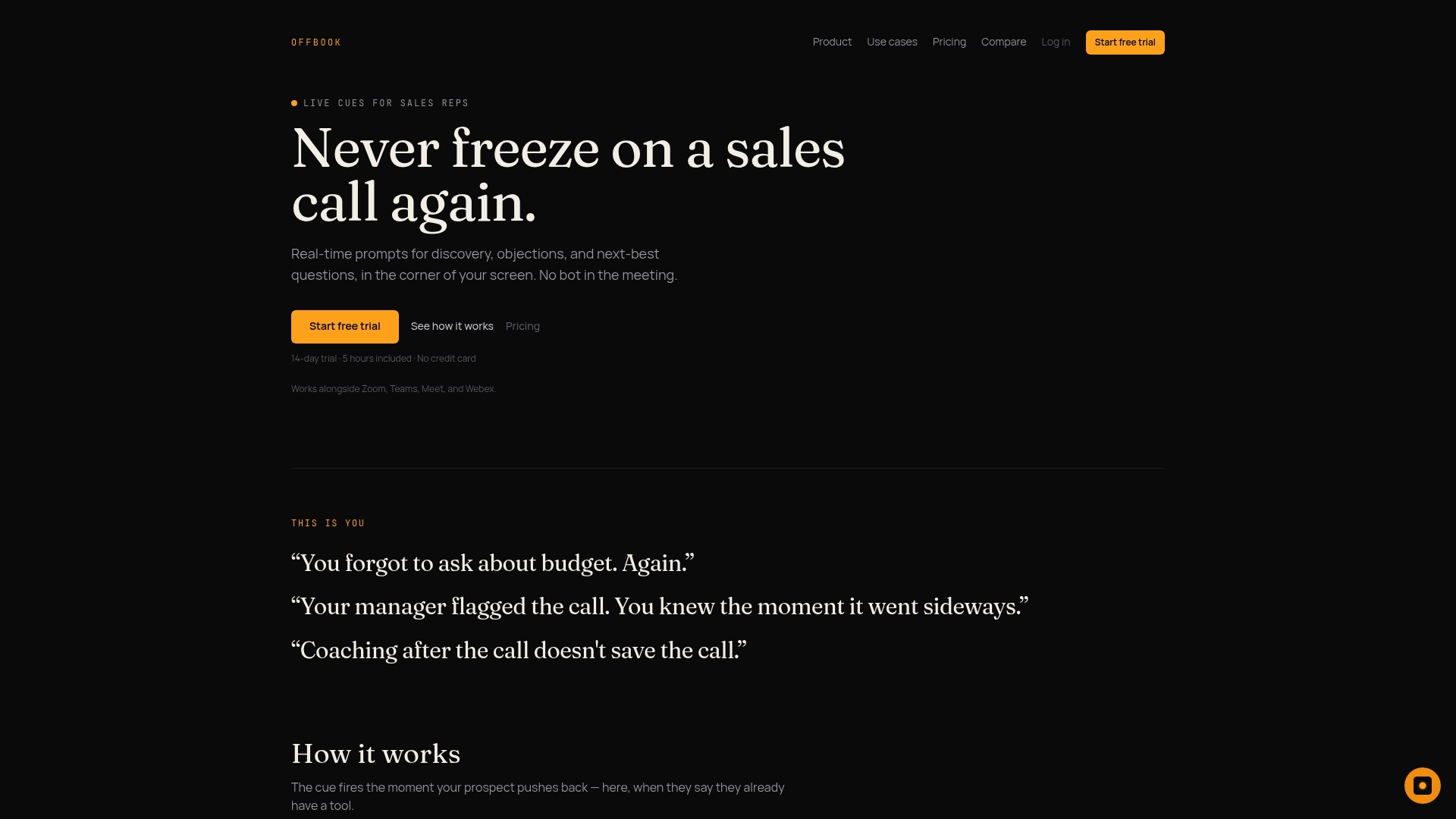
For a founder-led B2B SaaS team, a useful pilot looks like this: pick one segment of inbound leads, run 20 to 30 discovery calls over 30 days with OffBook’s live cues active, and track demo-to-opportunity rate against a control group running calls the old way. OffBook also generates pre-call briefs on the company and attendees, so reps walk into every call already knowing who’s in the room. Plans start at $59 per month on the Power plan, with a Team plan available at $1,000 per year per seat for revenue teams scaling coaching across multiple reps. Check the full pricing details or explore the sales coaching product page to see what a pilot would look like for your team.
Sources
For deeper benchmarks and tactics behind this playbook: HubSpot’s sales statistics cover follow-up speed and prospecting data. Walnut’s interactive demo research quantifies personalization’s impact. McKinsey’s B2B buyer research covers omnichannel behavior, and RevenueHero’s demo funnel guide breaks down routing and scheduling fixes in detail.
- 97 key sales statistics to help you sell smarter in 2025
- Interactive Demos & B2B Conversion Rates | Walnut
- The State of Demo Conversion Rates in 2025
FAQ
What Are the Biggest Demo Mistakes Reps Make?
The most common mistake is proposing a demo before confirming the prospect’s actual problem, budget authority, or timeline, which fills calendars with low-intent meetings. A close second is running a generic, unpersonalized demo instead of tailoring it to what came up in discovery, which signals the rep wasn’t listening.
How Can I Improve My Demo Conversion Rate?
Start with the operational fixes: faster lead routing, embedded scheduling, and automated reminders, since these typically produce the fastest measurable lift according to RevenueHero’s funnel research. Layer in stricter qualification with a framework like MEDDIC or BANT, and use a fit check before booking any demo. Tools like OffBook can help reps hold that discipline consistently during live calls.
Is a 2.5% Conversion Rate Good for Demos?
A 2.5% rate typically refers to overall lead-to-demo or visitor-to-demo conversion across a full top-of-funnel motion, not discovery-to-demo specifically, so it depends heavily on which funnel stage you’re measuring. Discovery-to-demo conversion, measured strictly from qualified discovery call to booked demo, commonly runs far higher, often in the 20 to 40 percent range for teams with disciplined routing and qualification.
Is a 20% Conversion Rate Good for Discovery-to-Demo?
Teams with fast routing, embedded scheduling, and a consistent fit check tend to land closer to the higher end of the 20 to 40 percent band cited in RevenueHero’s benchmark data.
What Does OffBook Cost?
OffBook’s Power plan is $59 per month or $590 per year, and the Team plan runs $1,000 per year per seat for revenue teams coaching multiple reps at once. Full details are available on the pricing page.