3 Behavioral Tests Sales Leaders Use to Confirm a True Champion
Stop confusing coaches with champions. For sales leaders: three behavioral tests, CRM controls, retest rules, and forwardable assets to win approvals.
Published: September 15, 2026
Author: OffBook Editorial Team

A sales champion is a contact who has real influence inside the account, a personal stake in your win, and actively sells on your behalf when you’re not in the room. The single most reliable way to confirm one exists: ask them to introduce you to the economic buyer or to present your solution at an internal meeting. If they do it without hesitation, log it in your CRM as a confirmed champion. If they stall, deflect, or say they’ll “loop someone in later,” you have a coach, and your forecast should reflect that.
TL;DR:
- A true champion must have organizational credibility, personal stake, actively advocate for your solution, and connect you to the economic buyer, with all four traits present.
- Finding champions involves analyzing public signals like job postings, recent hires, and workarounds rather than relying solely on titles or responsiveness.
- Validating champions requires behavioral tests such as requesting direct introductions, assessing personal benefits, and observing their willingness to present internally.
- Transitioning a champion into a deal closer depends on providing simple, tailored assets and rehearsing specific pitches rather than vague requests.
- Regular re-testing and structured tracking in your CRM are essential to confirm champion strength, prevent forecast inaccuracies, and avoid relying on unverified labels.
Table of Contents
- What Actually Makes Someone a Sales Champion?
- Where to Find Sales Champions Before the First Call
- How Do You Test Whether Someone Is a Real Champion?
- How to Turn a Champion Into a Deal-Closer
- Building Champion Evidence Into Your Pipeline Reviews
- Coach or Champion? A Quick Reference
- Why Most Sales Teams Get Champion Testing Backward
- How Offbook Supports Champion Identification and Testing
- Sources
- FAQ
What Actually Makes Someone a Sales Champion?
MEDDIC and MEDDPICC treat the champion as an internal seller, not a friendly contact who answers your emails. That distinction matters because a warm relationship and a working champion are not the same thing, and mixing them up is how deals stall in the final quarter.
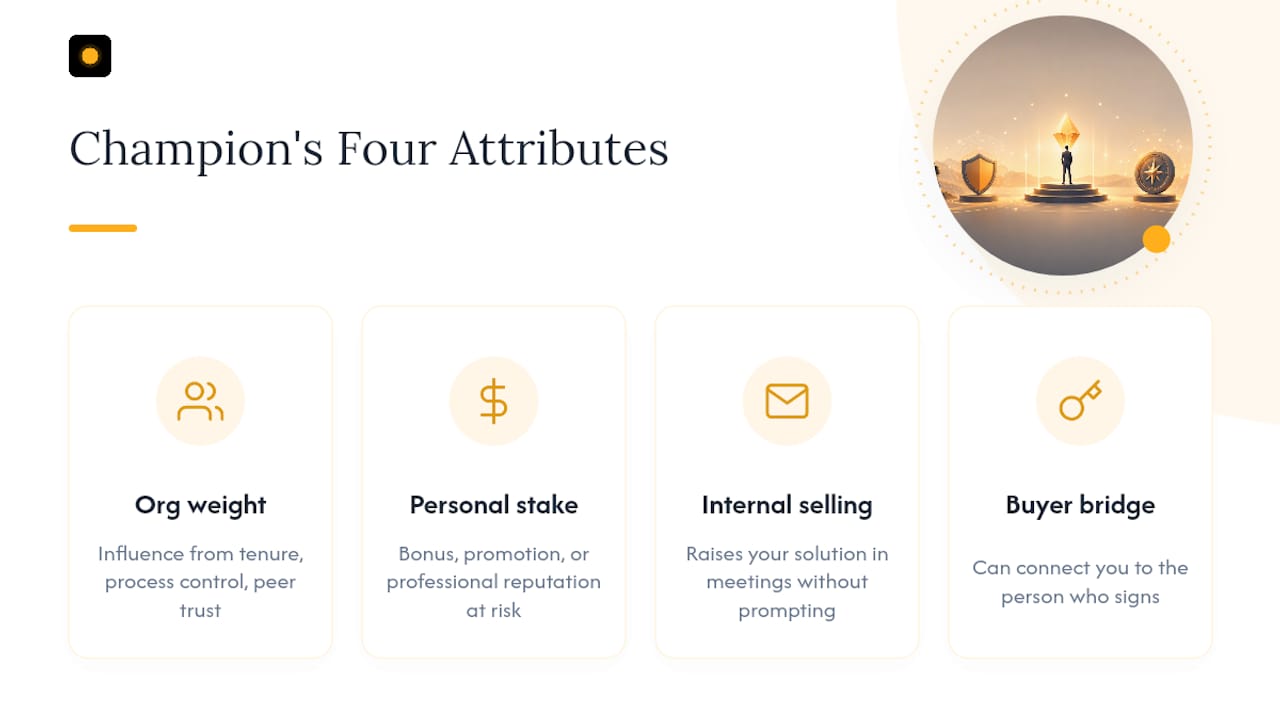
Four attributes have to co-exist. Miss one, and the label doesn’t hold.
Organizational weight. This isn’t about title. A five-year technical lead with cross-functional credibility often carries more real influence than a newly hired VP. Champions don’t always have senior titles; weight comes from tenure, control of a process, or peer trust.
Personal stake. The contact needs something to win or lose. If your product doesn’t touch their bonus, promotion path, or professional reputation, they have no reason to fight for it when budget gets tight.
Active internal selling. A true champion brings up your solution in meetings you’re not in. A coach only talks about you when you ask them to.
A bridge to the economic buyer. Champions can get you in front of the person who signs. If a contact can’t or won’t make that connection, they’re capped at coach status, no matter how enthusiastic they sound on calls.
A true champion combines all four at once. The failure mode is common: a rep finds someone with two of the four traits, mentally upgrades them to champion, and builds a forecast on a foundation that isn’t there.
Where to Find Sales Champions Before the First Call
Champions rarely raise their hand and announce the role. You have to go looking, and the highest-yield research happens before you ever get on a call.
Start from the problem, not the org chart. Map who owns the pain your product solves, then work backward to names. Public signals like job postings and visible workarounds tell you more than a title search ever will.
A short list of what to check before outreach:
- LinkedIn activity: posts, comments, or shares about the problem category (not just job changes) signal someone thinking about the issue publicly.
- Recent hires: someone brought in within the last six to nine months to fix a specific problem often has a mandate and something to prove.
- Job ads: a new role description that matches your category suggests the company is formalizing ownership of the problem, which usually means someone internal is already pushing for a solution.
- Public statements: conference talks, podcast appearances, or internal blog posts where someone owns the pain point publicly.
- Visible workarounds: spreadsheets, manual processes, or homegrown tools mentioned in job ads or case studies point to frustrated owners looking for a better answer.
Prioritize your outreach by deal size. For larger accounts and higher contract values, expect the champion and economic buyer to be different people, and budget time to find both. In smaller accounts, one person may hold both roles, so a single strong contact can carry the whole deal.
Pro Tip: Before your first outreach email, check whether the target company’s buying group shows signs of internal disagreement. Gartner’s research on B2B buyer teams found high rates of unhealthy conflict during decisions, which means a champion willing to navigate that friction is worth more than usual.
How Do You Test Whether Someone Is a Real Champion?
Self-assessment doesn’t work here. Nobody tells you “I’m just a coach,” so you have to run behavioral tests that force a real answer instead of a comfortable one.
- The access test. Ask directly: “Can you introduce me to [economic buyer name] before our next call?” A champion sets it up within days. A coach says they’ll “check” or offers to relay information themselves instead of making the introduction.
- The personal-win test. Ask what happens for them personally if this project succeeds, and whether they’d be comfortable raising it in a leadership meeting. Champions answer in specifics: a metric they own, a initiative they’re accountable for. Coaches answer in generalities about “the team” or “the company.”
- The internal-selling test. Ask for an example of how they’ve already discussed your solution internally, or request they present it at an upcoming meeting. Champions follow through on these asks because they’ve already been selling for you without being asked.
The language gap between the two is usually obvious once you’re listening for it.
That’s a champion. Compare it to: “Let me see who might be the right person to talk to.” That’s a coach, however friendly the tone.
Capture the exact response in your CRM notes, not just a checkbox. “Introduced to EB within 48 hours, cited specific cost metric” tells your manager something a “Champion: Yes” field never will.
How to Turn a Champion Into a Deal-Closer
Finding a champion is half the job. The other half is making it easy for them to fight for you internally, because most champions want to help but don’t have the ammunition to do it well.
Give them forwardable assets, not a slide deck they have to translate themselves:
- A one-paragraph business case they can paste into an email or Slack message without editing.
- A three-line internal pitch written in their company’s language, not yours.
- Comparable customer examples and success metrics relevant to their specific situation, not generic case studies.
Rehearse before the moment matters. Role-play the internal pitch with your champion the way you’d rehearse a big client presentation. Practice a single, specific ask rather than a vague “let’s see what happens.” Give them an objection cheat-sheet for the two or three pushbacks you know are coming from finance or IT.
Pre-call preparation and live coaching during your own calls speed this whole process up. When a rep walks into a call already knowing the champion’s likely objections and the right qualifying questions to ask, validation happens faster and the champion sees a partner who’s prepared, not someone fumbling through a pitch. A tool like Offbook can surface those cues in real time so the rep spends the call building the champion’s confidence instead of scrambling for the next question.
Building Champion Evidence Into Your Pipeline Reviews
Wishful labeling is the biggest threat to forecast accuracy. A rep marks someone “champion” in week two because the call went well, and that label sits there uncontested for months.
Fix it with mandatory fields and a re-testing cadence:
- Make the champion field required in your CRM after stage two of any deal. No name, no advance.
- Track a last substantive contact date for that champion specifically, not just any activity on the account.
- Use a three-tier score: confirmed (passed at least two of the three behavioral tests), developing (identified but untested), and at-risk (no response to an access or internal-selling ask in two or more weeks).
Champion strength carries heavy weight in MEDDPICC scoring because verified champions close at meaningfully higher rates than deals riding on a coach alone.
Weekly review checklist for managers: confirm economic buyer access, check the champion’s last substantive activity, and flag any deal overdue for a re-test. Multi-thread into a second potential champion whenever a deal size justifies it. Relying on one person, however strong, creates a single point of failure that a competing priority or a resignation can wipe out overnight.
Coach or Champion? A Quick Reference
| Champion | Coach | |
|---|---|---|
| Introduces you to the economic buyer | Yes, promptly | Delays or deflects |
| Talks about your solution internally, unprompted | Yes | Only when you ask |
| Has a personal stake in the outcome | Specific and named | Vague or absent |
| Language pattern | “We’re doing this,” concrete next steps | “I’ll check,” hedged commitments |
MEDDPICC practitioners treat champion verification as one of the most predictive qualification signals in the entire framework, which is exactly why a coach masquerading as a champion does so much damage to a forecast.
If a coach is genuinely all you have, forecast conservatively and don’t advance the stage on their word alone. Look for a backup advocate in a different function, finance, ops, or IT often surface a second potential champion you haven’t tried yet. Escalate your own access efforts rather than depending on the coach to make an introduction they’ve already avoided twice.
Why Most Sales Teams Get Champion Testing Backward
Most reps treat champion identification as a feeling. Someone’s responsive, they seem to like you, the call goes well, so the label gets applied. That instinct is exactly backward. The reps who forecast accurately treat champion status as a claim that has to survive a test, the same way you’d treat a prospect’s stated budget or timeline.
I’ve seen the access test alone reverse a deal’s trajectory. A rep who’d been calling someone a champion for six weeks finally asked directly for an economic buyer introduction. The silence that followed told the whole team more than six weeks of “great call” notes had.
Teams that build this testing discipline into their process, rather than leaving it to individual judgment, catch the mislabeling early enough to fix it. That’s the gap between a forecast that holds up in the boardroom and one that doesn’t.
— Neil
How Offbook Supports Champion Identification and Testing
Running these tests well takes preparation and timing, and that’s exactly where most reps lose the thread mid-call. Offbook is built for the moment the test actually happens, not just the debrief afterward.
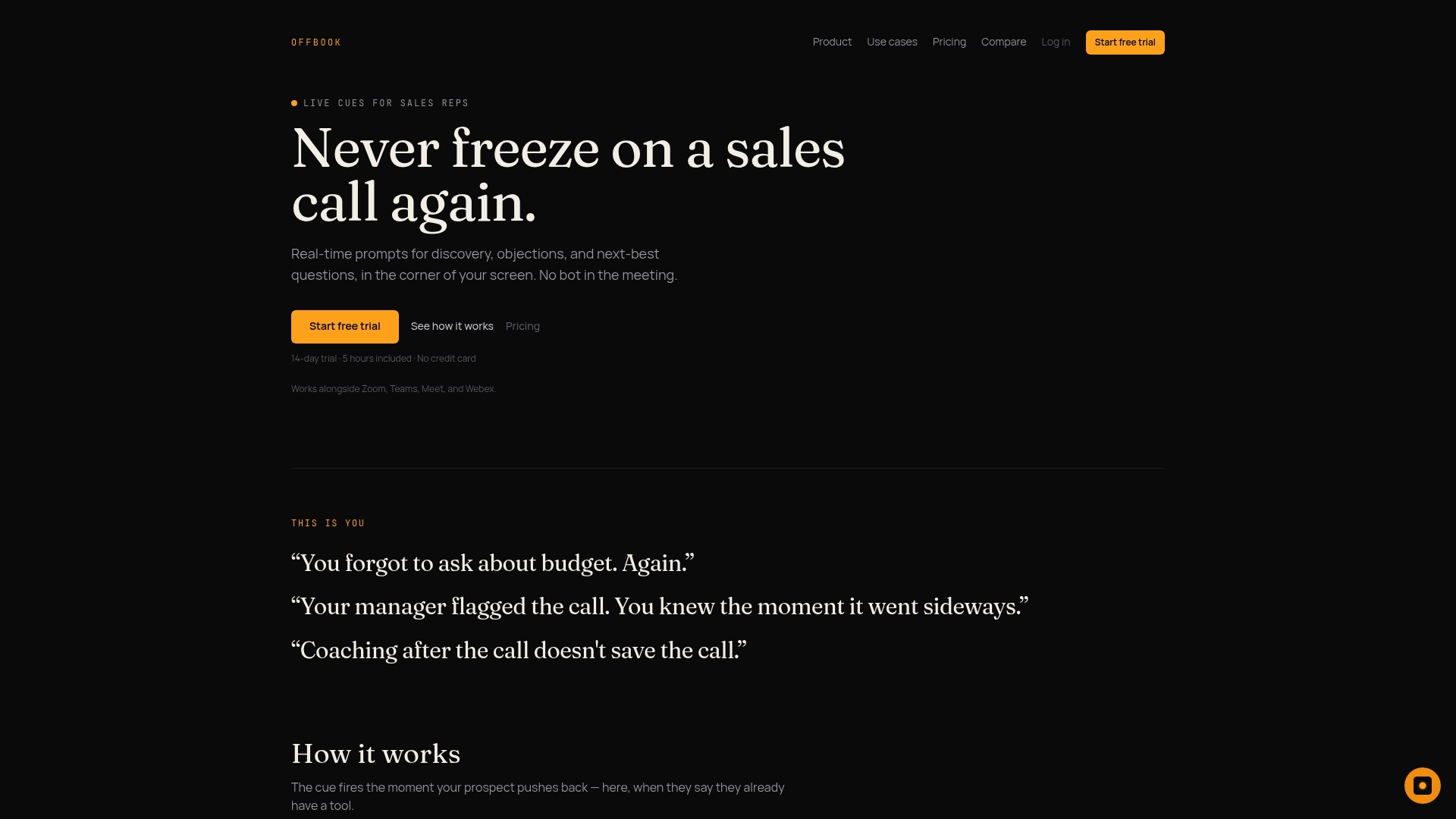
Before the call, Offbook generates a brief on the company and the person you’re about to meet, so you already know their likely mandate and role before you ask for economic buyer access. During the call, it listens in the background and surfaces on-screen prompts, the exact qualifying question to ask next, an objection response, a reminder to request the internal-meeting ask, structured around MEDDIC and MEDDPICC. After the call, it drafts your follow-up and debrief automatically, so the champion’s specific commitment gets logged instead of forgotten. No bot joins the meeting; it just listens and coaches in real time. If you want to see how it handles a live qualification call, visit the Offbook sales page and start a trial.
Sources
- Coaches vs Champions: Know the difference | Force Management
- MEDDPICC Champion: How to Know If Your Rep Actually Has One | CRO Report
- How to find internal champions in your target accounts | Alfa
- How to Identify and Develop Champions in Enterprise Sales | Account Map Blog
FAQ
What Is a Sales Champion?
A sales champion is an internal contact with organizational influence, a personal stake in your solution’s success, and a track record of actively selling it inside their own company, including getting you access to the economic buyer.
What Are the Core Traits of a Champion?
The core traits are organizational weight or credibility, personal stake in the outcome, active internal advocacy, and the ability to bridge you to the economic buyer. All four must be present; a contact missing even one is functioning as a coach, not a champion.
What Are the Qualities of a Good Salesperson Working With a Champion?
Reps who develop champions well tend to share a few habits: they run behavioral tests instead of assuming, they give champions forwardable materials instead of asking them to improvise, and they use tools like Offbook to prepare specific, methodology-aligned questions before every call.
How Is a Champion Different From a Coach?
A champion actively sells your solution internally and provides economic buyer access; a coach shares information but hesitates or fails to follow through when asked to take real action, like making an introduction or presenting internally.
How Often Should You Re-Test a Champion?
Re-test at every major deal stage change and any time two or more weeks pass without a substantive response to an access or internal-selling request; tracking a last substantive contact date in your CRM makes this easy to enforce.