How to Build a Sales Process From Scratch: A Founder's Playbook
Discover how to build a sales process from scratch in just 60–90 days. Learn essential steps and tools to ensure success and boost your CRM adoption!
Published: August 7, 2026
Author: OffBook Editorial Team

How to Build a Sales Process From Scratch: A Founder’s Playbook
You can build a repeatable B2B sales process from scratch in 60–90 days by defining five core stages, writing observable entry and exit criteria for each, and enforcing them in your CRM before you touch anything else. Here is the short checklist of what you need to create first:
- Ideal Customer Profile (ICP): measurable firmographic and behavioral filters
- Stage map: 5–7 buyer-milestone stages with named objectives
- Entry/exit criteria: observable evidence required before a deal moves
- Lightweight playbook: what reps need to know, say, and send at each stage
- CRM enforcement: required fields and automation that make skipping a stage impossible
- KPIs: stage conversion rates, average time in stage, win rate, and forecast accuracy
You will know the launch worked when CRM adoption hits 90%+ within 30 days, stage-to-stage conversion rates are measurable (even if not yet good), and new reps reach their first close in under 60 days.
Table of Contents
- What is a sales process, and how does it differ from a methodology?
- Why process and methodology are different — and why you need both
- What business outcomes does a structured sales process actually deliver?
- What are the five essential steps to build a repeatable sales process?
- How to build your sales process step by step
- What templates and stage frameworks can you copy right now?
- Which KPIs and dashboards tell you if the process is working?
- What does a realistic rollout timeline look like?
- What are the most common mistakes teams make when building a sales process?
- Which tools should you use, and how do you choose them?
- How does live call coaching accelerate adoption and ramp?
- Key Takeaways
- Why the conventional wisdom on sales process gets the order wrong
- Offbook gives your new process a live enforcement layer from day one
- Useful sources and further reading
What is a sales process, and how does it differ from a methodology?
A sales process is a documented, repeatable, stage-based framework that maps a deal from first contact to closed-won. Each stage has a clear objective, observable entry criteria (what must be true for a deal to enter), and exit criteria (what evidence must exist before it moves forward). The process answers what happens and when.
A sales methodology is different. It answers how reps behave inside those stages: the principles, questioning techniques, and decision frameworks they use. MEDDIC, MEDDPICC, and Challenger are methodologies. They tell a rep how to run a discovery call; the process tells them when discovery is complete and what comes next.
A playbook sits one level below both. It is the tactical layer: the specific talk tracks, email templates, objection responses, and collateral attached to each stage. Think of it as the rep’s field guide for executing the methodology inside the process.
Getting these three terms confused is not just a semantic problem. When a team treats methodology as process, stages get defined by rep activities (“sent proposal”) rather than buyer milestones (“champion confirmed budget range”). That distinction destroys forecast accuracy. For a deeper look at how these layers fit together, the B2B team guide to sales process from Offbook breaks it down with practical examples.
Why process and methodology are different — and why you need both
The clearest way to see the difference: your process is a map of buyer milestones and qualification gates; your methodology is the set of selling behaviors and principles reps use to move a buyer through those gates. One is structural, the other is behavioral.
When teams conflate them, two things break. First, pipeline data becomes unreliable. If a stage is defined as “demo scheduled” (a rep activity), a deal can sit there for 45 days with no real buyer progress and still look healthy in the forecast. Second, coaching becomes impossible. A manager cannot tell whether a stalled deal is a process problem (wrong stage, missing criteria) or a methodology problem (rep is not asking the right discovery questions) if the two are tangled together.
Pro Tip: Design the process first, then layer the methodology on top. During onboarding, teach the stage map in week one and the methodology in week two. Reps who learn both simultaneously tend to conflate them the same way their managers do.
What business outcomes does a structured sales process actually deliver?
The outcomes are measurable, and they arrive in a predictable sequence. Stage conversion rates and average time in stage improve within the first 30–60 days of adoption, because the process makes bottlenecks visible for the first time. Win rate and forecast accuracy improve later, typically after one full quarter of clean data.
Specific outcomes a structured process delivers:
- Higher win rates: formal qualification frameworks can double close rates compared with teams that rely on intuition
The single most important buy-in statistic for internal presentations: teams with a formal, documented sales process consistently outperform those without one on win rate, ramp time, and forecast accuracy. The process is not a management tool. It is a revenue infrastructure decision.
What are the five essential steps to build a repeatable sales process?
These five steps are the skeleton. Every section that follows expands one of them into a practical build task.
- Write entry and exit criteria — for each stage, specify the observable evidence a rep must record before a deal enters or advances. Buyer-centered staging with measurable criteria reduces stalled deals and improves forecast accuracy.
The order matters. Founders who skip to step four (playbook) before completing step two (stage map) end up with tactics that have no structure to attach to. The playbook becomes a document nobody uses.
On the 5-step vs. 7-stage question: a 5-step process works well for shorter sales cycles (under 30 days) and smaller deal sizes. A 7-stage model adds granularity for complex enterprise deals where multiple stakeholders and a formal evaluation phase exist between discovery and proposal. If your average deal involves more than two decision-makers or takes longer than 45 days, start with 7.
How to build your sales process step by step
Start by reverse-engineering your best wins
Pull your last 10–20 closed-won deals and map each one: what happened first, what the buyer did at each inflection point, what evidence existed before the deal moved, and how long each phase took. Documenting what already works is the fastest path to a repeatable process because you are codifying real behavior, not inventing an ideal one.
Look for patterns: which discovery questions consistently surfaced the economic buyer? Which deals stalled at the same point? What collateral appeared in every winning deal? Those patterns become your stage definitions and your first playbook entries.
CRM setup checklist
Enforcing entry and exit criteria in CRM is what separates a process that lives in a document from one that actually runs the business. Configure:
- Custom stage names that match your stage map exactly
- Required fields per stage (the evidence fields from your exit criteria)
- Automation rules that prevent stage movement without required fields populated
- A pipeline view that shows time-in-stage so managers can spot stalled deals at a glance
- Activity logging requirements (call notes, next steps, follow-up date) as mandatory, not optional
Owner and role matrix
| Task | Owner | Approver |
|---|---|---|
| Stage map design | Sales leader / founder | CEO or VP Sales |
| Playbook content | Sales enablement or top rep | Sales leader |
| CRM configuration | Sales ops or RevOps | Sales leader |
| Training design | Enablement or manager | Sales leader |
| Adoption tracking | Sales ops | VP Sales |
Pro Tip: If you do not have a dedicated sales ops function, assign CRM configuration to the most technically capable rep or hire a fractional RevOps consultant for a two-week sprint. Misconfigured CRM is the single most common reason a new process fails within 90 days.
What templates and stage frameworks can you copy right now?
5-step vs. 7-stage blueprint
| Stage | 5-Step Model | 7-Stage Model | Objective |
|---|---|---|---|
| 1 | Prospecting | Prospecting | Identify and qualify ICP-fit leads |
| 2 | Discovery | Qualification | Confirm ICP fit and surface pain |
| 3 | Presentation | Discovery | Map pain to economic consequence |
| 4 | Proposal/Close | Solution Presentation | Demonstrate value against confirmed pain |
| 5 | Handoff | Proposal | Deliver scoped, priced solution |
| 6 | — | Negotiation/Commit | Align on terms and secure verbal commit |
| 7 | — | Closed-Won/Handoff | Transfer to customer success with MAP |
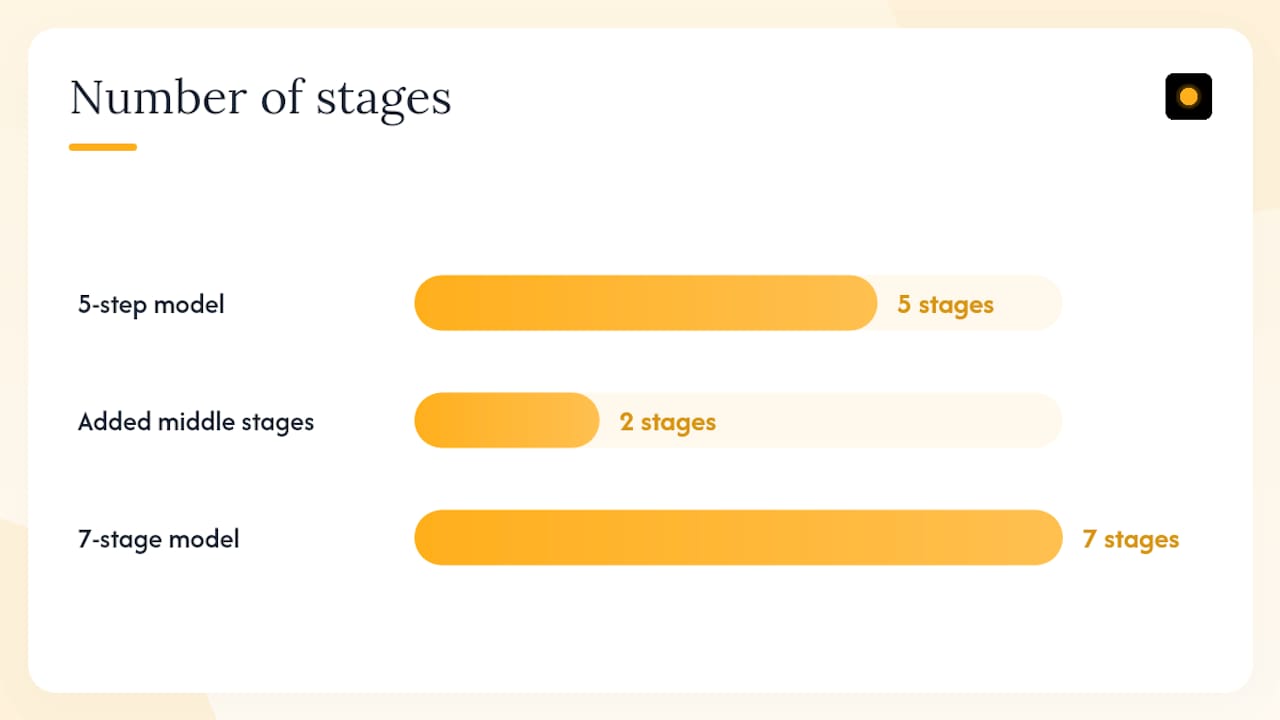
Use the 5-step model when your average deal cycle is under 30 days or involves a single decision-maker. Add the two middle stages when deals regularly involve procurement, legal review, or a formal evaluation committee.
Mutual action plan (MAP) template
A MAP is a shared document between the rep and the buyer’s champion that lists every step required to reach a decision. Hand it to the champion after discovery, not after the proposal.
| Field | Example |
|---|---|
| Goal | “Signed contract and implementation kickoff by [date]” |
| Champion | [Name, title] |
| Economic buyer | [Name, title] |
| Key milestones | Security review, legal review, board approval |
| Rep actions | Send security questionnaire, schedule legal call |
| Buyer actions | Confirm budget, schedule stakeholder demo |
| Decision date | [Specific date] |
| Success metric | [What changes for the buyer after go-live] |
Discovery question bank
Map these questions to the MEDDIC/MEDDPICC framework. The goal is to surface the economic consequence of the problem, not just the problem itself.
- “Walk me through how this problem shows up in a typical week for your team.”
- “What does it cost you — in time, revenue, or headcount — when this breaks down?”
- “Who else feels the impact of this problem besides you?”
- “What have you tried before, and why did it fall short?”
- “What would a successful outcome look like in 90 days?”
- “Who else needs to be involved in a decision like this?”
- “What does your evaluation process typically look like for a purchase at this level?”
- “Is there a budget allocated for solving this, or would that need to be approved?”
- “What happens if you do nothing for the next six months?”
- “What would make you confident enough to move forward?”
- “Is there a date by which this needs to be solved?”
- “What does your champion need to see to feel comfortable recommending this internally?”
Sample discovery call opener and follow-up email
Call opener (first 60 seconds): “Thanks for making time. I did some prep on [company] before this call. I want to make sure we use your time well, so I have a few questions about how your team currently handles [pain area]. If it turns out we are not a fit, I will tell you directly. Sound good?”
Follow-up email (same day, within two hours):
Subject: Next steps from today’s call
“[Name], appreciate the conversation. Based on what you shared, the core problem is [pain in their words]. The next step we agreed on is [specific action] by [date]. I have attached [relevant resource]. Let me know if anything changes on your end.”
Short, specific, and tied to what the buyer actually said. No generic “great speaking with you” opener.
Which KPIs and dashboards tell you if the process is working?
Measure stage conversion rates first. They are the most diagnostic metric for locating structural leaks in the process, because a drop between two specific stages tells you exactly where reps are losing deals or where criteria are misconfigured.
Core KPI table
| KPI | Target / Benchmark | Red Flag |
|---|---|---|
| Stage-to-stage conversion rate | Varies by stage; track trend | Any stage with low conversion consistently |
| Average time in stage | Set baseline in first 30 days | Deals sitting 2x the baseline in any stage |
| Overall win rate | Establish baseline; improve quarter-over-quarter | Declining for two consecutive quarters |
| Forecast accuracy | Within 10–15% of called number | Consistent miss above 20% |
| Ramp time to first close | Under 60 days for a trained rep | Over 90 days after process launch |
| MAP adoption rate | 80%+ of deals in proposal stage | Low conversion after 60 days |
For a practical framework on how founders track call-level performance alongside pipeline metrics, the guide to measuring sales call effectiveness from Offbook covers the specific signals worth watching.
Dashboard wireframe
Your CRM dashboard needs four views from day one:
- Pipeline by stage: deal count and total value per stage, filterable by rep
- Time in stage: average and max days per stage, with alerts for deals above threshold
- Stage conversion funnel: week-over-week conversion rate between each stage pair
- Forecast roll-up: weighted pipeline by stage, compared to quota
Required CRM fields to make these reports reliable: ICP qualification score, economic buyer name, budget range confirmed (yes/no), decision date, next step with date, and MAP link. Without these fields populated, the dashboard is decorative.
Diagnostic checklist when the process is not working:
- Check stage conversion rates first. Where does the biggest drop occur?
- Pull time-in-stage data. Are deals stalling at a specific stage consistently?
- Review required field completion rates. If fields are empty, the criteria are not being enforced.
- Run a win/loss analysis on the last 10 closed-lost deals. What stage did they stall in?
- Check pipeline management fundamentals to confirm your hygiene practices match the diagnostic signals you are seeing.
What does a realistic rollout timeline look like?
Phase 1: Build (Days 1–30)
The first 30 days are design and pilot. Keep the team small: one sales leader, one ops person, and two to three reps who closed the deals you reverse-engineered. Do not roll out to the full team yet.
Milestones:
- Week 1: ICP defined, stage map drafted, criteria written
- Week 2: CRM configured, required fields live, playbook v1 complete
- Week 3: Pilot reps trained, first deals entered under new process
- Week 4: First pipeline review under new process, criteria gaps identified and fixed
Phase 2: Team rollout (Days 31–90)
Roll out to the full team with a structured training program. Building a sales coaching program alongside the process rollout significantly improves adoption speed.
Milestones:
- Day 31–45: Full team trained, all active deals migrated to new stage map
- Day 46–60: Weekly pipeline reviews using new dashboard, manager coaching on criteria enforcement
- Day 61–90: First full-cycle deals closed under new process, ramp time tracked for new hires
Phase 3: Quarterly reviews (Day 90+)
Salesforce recommends scheduling regular process reviews using CRM analytics to find bottlenecks. Schedule a formal process review every quarter. Pull stage conversion data, run a win/loss analysis, and update playbook content based on what is actually working in calls.
Resource checklist and ballpark costs
| Resource | Role | Estimated Time |
|---|---|---|
| Sales leader / founder | Stage design, criteria, approval | 20–30 hours |
| Sales ops / RevOps | CRM configuration, reporting | 15–20 hours |
| Enablement or top rep | Playbook content creation | 10–15 hours |
| Manager | Training delivery, coaching | Ongoing (2–3 hrs/week) |
| Product marketer | Collateral and case studies | 8–12 hours |
Tooling costs for a lean stack (CRM, sales engagement, call coaching) range from a few hundred to a few thousand dollars per month depending on team size and tool tier. A pilot with two to three reps can run on existing tools if you already have a CRM. The real cost is time, not software.
For guidance on hiring the right reps to run the new process, the SaaS sales interview questions list from Cornerstone Search is a practical resource for evaluating candidates against your ICP and process requirements.
What are the most common mistakes teams make when building a sales process?
Most process failures are not design failures. They are adoption failures caused by a handful of predictable mistakes.
- Buying tools before defining the process: a CRM configured around a tool’s default stages instead of your stage map will fight you for years. Define the process first, then configure the tool to match it. The Capterra CRM shortlist is useful for comparing options once your requirements are defined.
Pro Tip: The manager’s weekly pipeline review is the single most powerful enforcement tool you have. If a manager accepts a deal moving stages without the required evidence, the process is effectively optional. Train managers on criteria enforcement before you train reps on the stage map.
Which tools should you use, and how do you choose them?
The guiding principle: tools should enforce the process, not define it. Every tool decision should start with the question “does this make it easier or harder to follow our stage criteria?”
Tool categories and their role
CRM (foundation): the system of record for stage movement, required fields, and pipeline reporting. Choose one that allows custom stages, required fields per stage, and automation rules. Configure it to match your stage map exactly.
Sales engagement platform: manages outbound sequences, email tracking, and call logging. Useful for prospecting and follow-up stages. Select based on CRM integration quality and reporting depth.
Call recording and coaching: captures call content for review, coaching, and playbook updates. The category has grown significantly, with G2’s Winter 2026 report showing rising adoption of call coaching and AI-enabled sales enablement tools. Look for tools that surface methodology gaps, not just transcripts.
Analytics and forecasting: separate from CRM reporting when deal volume justifies it. Useful for cohort analysis, rep performance benchmarking, and forecast modeling.
Proposal and contract tools: reduce friction at the proposal and negotiation stages. Choose based on e-signature capability, template management, and CRM integration.
Selection criteria checklist
- Does it enforce stage gates, or does it allow reps to bypass them?
- Does it integrate with your CRM without a manual sync?
- Can it generate the four dashboard views described in the metrics section?
- What is the admin overhead to maintain it as the team grows?
- Can you pilot it with two to three reps before full deployment?
For a full checklist of how these categories fit together, the B2B sales tech stack checklist from Offbook walks through the sequencing and integration requirements.
Pro Tip: Pilot every tool with a two-rep cohort for 30 days before purchasing team licenses. The only question that matters at the end of the pilot: did it make the process easier to follow, or did it create a parallel workflow that reps had to maintain alongside the CRM?
How does live call coaching accelerate adoption and ramp?
The hardest part of any process rollout is not design. It is behavior change at the rep level, in the moment of a live call. A rep who knows the discovery question bank intellectually will still revert to comfortable habits under pressure unless something prompts them in real time.
That is the gap live call coaching fills. Tools like Offbook listen to a video call as it happens and surface on-screen prompts for the rep: a qualification gap that has not been addressed, a discovery question mapped to the current conversation, an objection response from the playbook. The rep sees the cue; the buyer never does. No bot joins the meeting. No recording notification changes the conversation dynamic.
This is why Forrester’s analysis of B2B sales disruption points toward buyer-aligned motions and adoption of coaching and enablement technologies as the next competitive lever. Post-call review is valuable for playbook updates. It does not change what happened on the call.
Key Takeaways
A structured B2B sales process built on buyer milestones, observable exit criteria, and CRM enforcement is the single most reliable lever for improving forecast accuracy, shortening ramp time, and increasing win rates at an early-stage company.
| Point | Details |
|---|---|
| Start with your wins | Reverse-engineer 10–20 closed deals before designing any stage or criteria. |
| Evidence, not activity | Every exit criterion must describe something the buyer confirmed, not something the rep sent. |
| Playbook stays lean | Structure each stage around what reps need to know, say, and send — nothing longer. |
| Measure conversion first | Stage-to-stage conversion rates are the most diagnostic metric for finding process leaks. |
| Offbook accelerates adoption | Live call coaching surfaces qualification gaps in real time, shortening ramp and improving stage discipline from the first pilot week. |
Why the conventional wisdom on sales process gets the order wrong
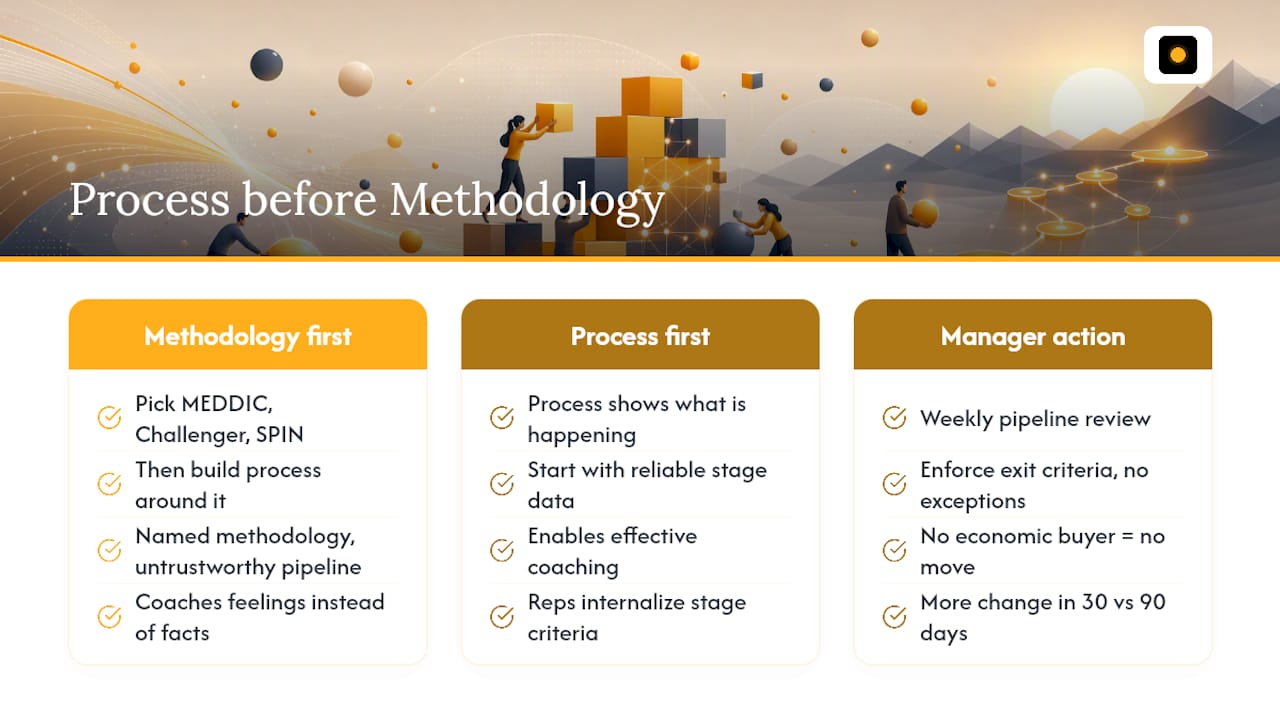
Most advice tells founders to pick a methodology first — MEDDIC, Challenger, SPIN — and then build a process around it. That is backwards, and it explains why so many early-stage teams have a methodology they can name and a pipeline they cannot trust.
The methodology tells reps how to behave. The process tells the business what is actually happening. If you do not have reliable stage data, you cannot coach the methodology effectively, because you cannot tell whether a stalled deal is a behavior problem or a structural one. You end up coaching feelings instead of facts.
The other thing most guides understate: the process is a management tool as much as a rep tool. The real leverage is in the weekly pipeline review. A manager who enforces exit criteria in that review, every week, without exception, will see more behavior change in 30 days than any training program delivers in 90. The process does not run itself. It runs through the manager’s willingness to say “this deal does not have an economic buyer named, so it does not move.”
What success looks like in the early months is not a clean win rate. It is reps who can tell you, without looking at their notes, exactly what stage a deal is in and what evidence they need to advance it. That behavioral signal, reps internalizing the criteria, is the leading indicator that the process is actually working. The win rate follows.
Offbook gives your new process a live enforcement layer from day one
Most teams spend 60 days building a process and another 90 watching reps ignore it on calls. The gap is not motivation. It is that no one is in the room when the behavior needs to change.
Offbook sits inside every video call without joining as a bot, surfacing live on-screen prompts when a rep misses a qualification gap, skips a discovery question, or needs an objection response. Pre-call briefs give reps ICP and stakeholder context before the meeting starts. Post-call debriefs generate a structured summary and draft follow-up automatically. The entire coaching loop is built around MEDDIC and MEDDPICC, so it maps directly to the stage criteria and playbook you just built.
For founders and sales leaders who want to cut ramp time and see stage discipline improve in the first 30 days of rollout, start your Offbook pilot for sales teams and run it alongside your process launch. The pilot design from the coaching section above applies directly: two to three reps, 30 days, measure MAP adoption and stage conversion. The data will tell you exactly where the process is holding and where it needs work.
Useful sources and further reading
The sources below informed this guide. Each one adds something specific that is worth consulting directly as you build.
- How to Build a Sales Process: 5 Steps to Predictable Revenue
- How to Develop a Sales Process: Step by Step (2026) | SyncGTM | SyncGTM
- What Is a Sales Process? The Complete Guide
- How to Build a Sales Playbook From Scratch + Adoption guide (2026)
- 7 Steps to Building A Winning Sales Process | Salesforce
- Capterra CRM shortlist
- With B2B sales disruption on the doorstep — what’s next? | Forrester
Single next read: start with The Sales Collective’s five-step framework, then move to SellCrafter’s playbook guide. Those two, read in sequence, cover 80% of what you need to build a working process in the first 30 days.