A Deal Qualification Checklist That Tells You When to Walk
Discover how a deal qualification checklist can help you identify qualified prospects and improve your sales strategy effectively.
Published: August 22, 2026
Author: OffBook Editorial Team

Use this rule: if you can’t quantify the pain, name the economic buyer, and point to a compelling event, the deal isn’t qualified. Pursue it further, sure, but don’t call it forecastable yet. Here’s the copy-ready version for your next call:
- Quantified pain: the prospect can put a number on the cost of doing nothing
- Budget confirmed: money is allocated or a plausible path to funding exists
- Champion identified: someone internal is willing to sell on your behalf
- Economic buyer access: you’ve spoken with, or have a path to, the person who signs
- Decision process mapped: you know the steps, players, and approval chain
- Compelling event: there’s a real deadline forcing a decision by a specific date
Run through these six gates before your next call ends, and mark each one “yes” or “not yet” in your CRM notes before you hang up.
Key Takeaways
A deal is only qualified when quantified pain, budget, champion, economic buyer access, decision process, and a compelling event are all confirmed, not assumed.
| Point | Details |
|---|---|
| Six non-negotiable gates | Quantified pain, budget, champion, economic buyer, decision process, and timeline all need a “yes,” not a guess. |
| Match framework to deal size | Use BANT or CHAMP under $50,000, MEDDIC for mid-market, and MEDDPICC above $250,000. |
| Score deals numerically | Rate each criterion 0 to 2 and calibrate your SQL threshold against actual closed-won data. |
| Enforce walk-away rules | Move deals stalled past twice your average cycle into nurture or archive them. |
| Run the checklist live | Offbook prompts reps on missing qualification gates during the call itself, not after it ends. |
Table of Contents
- What Is a Deal Qualification Checklist, and How Does It Differ From Lead Qualification?
- Which Qualification Framework Fits Your Deal?
- What Does a Stage-by-Stage Deal Qualification Checklist Look Like?
- How Do You Score a Deal and Know When to Disqualify It?
- Which Framework Should You Use by Deal Size?
- How Do You Operationalize the Checklist in Your CRM?
- When Should You Walk Away From a Stalled Deal?
- What Templates Can You Use on Your Next Call?
- How Does Live Call Coaching Help You Run This Checklist?
- Why Discipline Beats Enthusiasm in Deal Qualification
- Run the Checklist Automatically With Offbook
- Frequently Asked Questions
- Sources
What Is a Deal Qualification Checklist, and How Does It Differ From Lead Qualification?
A deal qualification checklist is a set of deal-level checks that determine whether a specific opportunity is close-ready, not whether the account is a good general fit. That’s the distinction most reps blur, and it costs them forecast accuracy every quarter.
Lead qualification happens earlier and answers a narrower question: does this person or company match your ideal customer profile? It looks at firmographics, role, and intent signals like a visited pricing page or company size. Deal qualification happens after that filter, once you’re in active conversations, and it asks something harder: can this specific deal actually close, and on what timeline?
Here’s the gap in practice. A mid-market SaaS company might be a perfectly qualified lead, right industry, right headcount, right tech stack, but the deal itself isn’t qualified if nobody internally owns the budget decision and the champion you’re talking to has no execution authority. You can have a great lead and a terrible deal at the same time.
The criteria that separate the two show up throughout this checklist:
- Budget (confirmed or plausible, not assumed)
- Authority (who actually signs, not who’s friendliest)
- Pain (quantified in dollars or hours, not vague dissatisfaction)
- Timeline (tied to a real event, not “sometime this year”)
- Champion (someone who will act, not just someone who likes you)
- Decision process (mapped steps, not a guess)
Get these six right and you have a sales qualification checklist worth trusting in a forecast call.
Which Qualification Framework Fits Your Deal?
Match framework complexity to deal size and buying-committee size. A single-stakeholder deal under $10,000 doesn’t need MEDDPICC. An enterprise deal with eight stakeholders and a procurement office absolutely does.
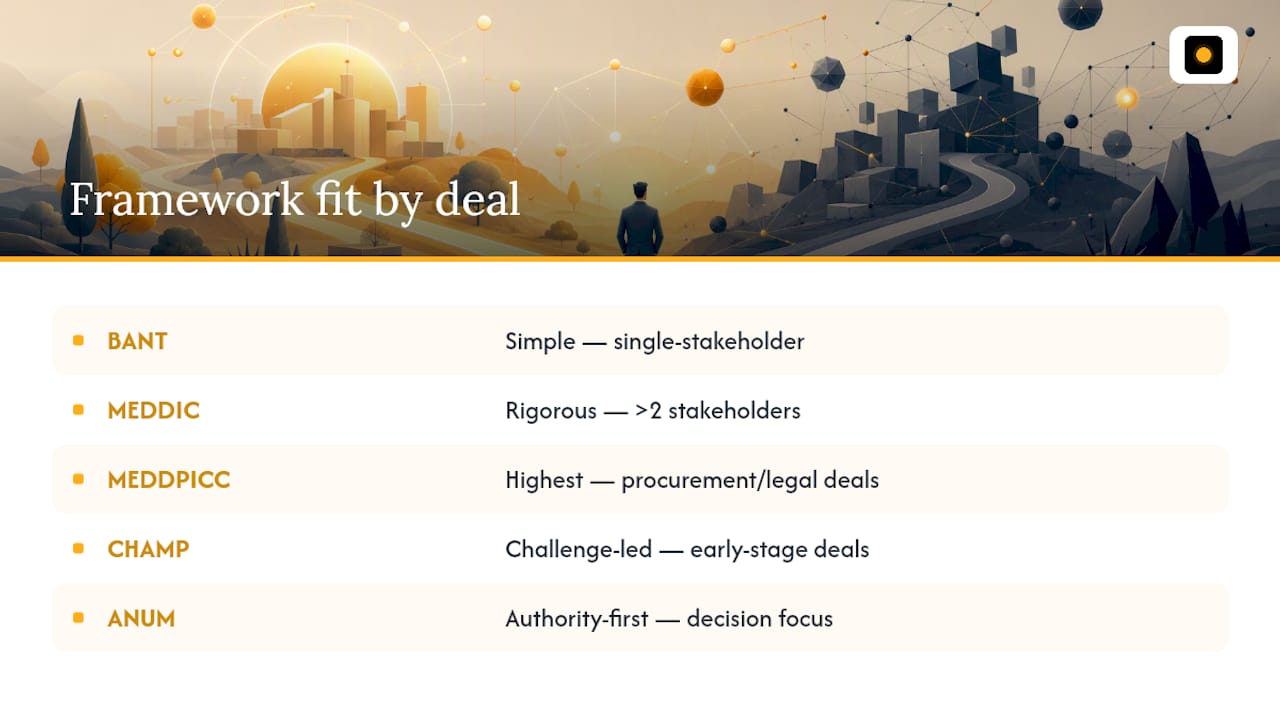
BANT (Budget, Authority, Need, Timeline) is the simplest and oldest of the bunch, and it still works for transactional, single-threaded deals where the buying process is short. It struggles the moment multiple stakeholders enter the picture, because it has no mechanism for mapping political dynamics.
MEDDIC (Metrics, Economic Buyer, Decision Criteria, Decision Process, Identify Pain, Champion) adds the rigor BANT lacks. Use it once a deal involves more than two stakeholders or a formal evaluation process. MEDDPICC extends MEDDIC with Paper Process and Competition, which matters most for regulated industries or any deal that will pass through legal and procurement review.
CHAMP (Challenges, Authority, Money, Prioritization) leads with the prospect’s challenges before authority, which suits earlier-stage or founder-led sales motions where the pain conversation needs to happen before you know who signs. ANUM (Authority, Need, Urgency, Money) front-loads authority, useful when you’re routinely getting routed to non-decision-makers and need a framework that forces that check first.
Picking the wrong framework has a real cost. Too much process on a small deal burns rep hours on paperwork nobody needed. Too little process on a large deal means you miss a stakeholder or a paper-process delay that kills the deal in week eleven.
Pro Tip: Pilot a new framework on ten live deals before rolling it out team-wide. Compare the readiness-to-win ratio, how many deals you called “qualified” that actually closed, against your old method before you commit.
What Does a Stage-by-Stage Deal Qualification Checklist Look Like?
Each pipeline stage has its own gate, and skipping one is how deals stall in month three with nobody able to say why.
Discovery. The goal is confirming quantified pain and initial fit. You’re listening for a specific cost, a specific frequency, a specific consequence, not “we’ve been meaning to fix this.”
Ask: “What does this problem cost you in a typical month?” “What have you tried already, and why didn’t it work?” “What happens if this stays unsolved for another year?”
Champion. The goal is finding someone who will act on your behalf when you’re not in the room. A true champion doesn’t just say nice things, according to decision process research from WGU; they take a concrete action, like introducing you to the economic buyer or sharing internal usage data.
Ask: “Can you introduce me to the person who owns this budget?” “Would you be willing to share this business case internally before our next call?”
Economic buyer. The goal is direct access, or a clear path to it, to whoever controls the spend. This is where most deals quietly die, because reps mistake a champion’s enthusiasm for buyer commitment.

Ask: “Who signs off on a purchase this size?” “Has anyone at that level seen what we’ve discussed so far?”
Decision criteria. The goal is knowing how the prospect will actually evaluate vendors, not what you assume matters. Ask: “What does a successful outcome look like in six months?” “What would disqualify a vendor outright?”
Paper process. The goal is understanding legal, procurement, and security review timelines before they surprise you. Ask: “Walk me through what happens after we agree on terms.” “Does security review typically add weeks or months?”
Compelling event / timeline. The goal is a real deadline, not a soft target. Ask: “What happens on your end if this isn’t solved by [date]?” “Is there a specific event that is driving that date?”
| Stage | Must-have signal | Sample question |
|---|---|---|
| Discovery | Quantified cost of inaction | “What does this cost you monthly?” |
| Champion | Willingness to take internal action | “Can you introduce me to your VP?” |
| Economic buyer | Confirmed identity and access | “Who signs off on this size of purchase?” |
| Decision criteria | Documented evaluation standards | “What would disqualify a vendor?” |
| Paper process | Known legal/procurement timeline | “What happens after we agree on terms?” |
| Timeline | Date tied to a real event | “What happens if this slips past [date]?” |
Pro Tip: Pressure-test the timeline by asking what specifically happens on the stated date. If the answer is vague, “we’d just like to have it done,” the deadline is soft and your forecast should treat it that way.
How Do You Score a Deal and Know When to Disqualify It?
Score each criterion 0, 1, or 2, sum them, and set a threshold that separates real pipeline from wishful thinking. A 12-point checklist scored this way, out of a possible 24, commonly uses 16/24 as a starting SQL handoff threshold, then gets recalibrated against actual win rates.
| Criterion | 0 points | 1 point | 2 points |
|---|---|---|---|
| Budget | Unconfirmed, no history | Plausible, unconfirmed | Confirmed and allocated |
| Champion | No internal advocate | Advocate, no action taken | Advocate has taken concrete action |
| Economic buyer | No contact | Indirect awareness | Direct engagement |
| Pain | Unquantified | Estimated | Quantified in dollars |
| Timeline | No deadline | Soft target | Hard date tied to an event |
A closing readiness scorecard covering twelve dimensions grouped into stakeholder, value, process, and risk works the same way: score, sum, threshold, decide.
Five red flags should trigger action every time, no exceptions:
- Prospect can’t quantify cost of inaction → nurture with ROI content until they can
- No budget history for this category → disqualify or timebox to next fiscal year
- Unknown approvers past 30 days into the deal → disqualify, you’re talking to the wrong person
- Champion takes no action after repeated asks → recycle, they aren’t a champion
- Timeline stays vague past discovery → timebox, set a decision deadline or move on
Pro Tip: Enforce a binary “must be true” gate on quantified pain and economic buyer access. Rating either a 1 out of 2 to feel optimistic is the happy-ears trap, and it wrecks forecast accuracy faster than any other habit reps develop.
Which Framework Should You Use by Deal Size?
Deal size and buying-committee size should decide your framework, not personal preference or habit.
- Under $50,000: BANT or CHAMP. Single or dual-stakeholder deals rarely justify heavier process.
- $50,000 to $250,000: MEDDIC. You’ll usually face three to six stakeholders and a real decision-criteria conversation.
- Over $250,000: MEDDPICC. Procurement, legal, and security review are near-certain, and Paper Process becomes its own qualification gate.
Buying groups now drive most complex B2B outcomes, which means the moment you spot more than two stakeholders in a deal, your checklist needs multi-threading built in regardless of deal size. A $40,000 deal with five approvers behaves like a $200,000 deal procedurally.
Pro Tip: Upgrade a deal to a heavier framework the moment a new stakeholder surfaces mid-cycle. If a “simple” BANT deal suddenly involves legal review, treat that as a signal to add MEDDPICC’s Paper Process check immediately, not after the deal stalls.
How Do You Operationalize the Checklist in Your CRM?
Add five required fields at stage entry: readiness score, champion name, economic buyer contact, paper-process ETA, and red-flag count. Make all five mandatory before a deal can move from Discovery to Champion stage, and your CRM data stops lying to your forecast.
- Rep completes discovery and logs quantified pain plus initial readiness score.
- Deal can’t advance past Champion stage without a named champion and one logged champion action.
- AE confirms economic buyer contact before the deal enters Decision Criteria stage.
- Sales ops reviews red-flag count weekly; anything above two flags gets a manager review.
- Deals crossing your SQL threshold route automatically to forecast; deals below it route to nurture.
Ownership matters as much as the fields themselves:
- SDRs own initial lead qualification and hand off once firmographic and intent signals clear
- AEs own deal qualification from Discovery through Paper Process
- Sales ops owns threshold calibration, reviewed quarterly against closed-won data
- Managers own red-flag escalation review
Your pipeline hygiene practices should reflect this same structure so a deal’s status in the CRM always matches what actually happened on the call.
When Should You Walk Away From a Stalled Deal?
Set the rule before you need it, not while you’re staring at a stalled deal wondering whether to keep chasing it.
- Three failed attempts to reach the economic buyer → move to 60-day nurture
- Deal stalled longer than twice your average sales cycle → recycle out of active pipeline
- Champion goes silent for three weeks with no response → archive and re-engage in a quarter
- Timeline slips twice without a new hard date → timebox one final follow-up, then archive
- Budget gets cut or reallocated mid-cycle → disqualify immediately, don’t wait for confirmation
If your average cycle is 60 days and a deal has been “in progress” for 150, it isn’t in progress. It’s dead weight in your forecast, and every hour spent on it is an hour not spent on a deal you can actually advance.
What Templates Can You Use on Your Next Call?
Copy these questions directly into your discovery notes or CRM call template:
- Company context: “What changed recently that made this a priority now?”
- Pain: “What’s the cost of this problem if it goes unsolved another six months?”
- Budget/timing: “Has budget been set aside, or would this need new approval?”
- Decision process: “Who else needs to sign off before you can move forward?”
- Tech fit: “What are you using today, and what’s not working about it?”
- Competition: “Who else are you evaluating, and what matters most in that comparison?”
For demo request forms, use tiered logic: 8 to 10 must-ask questions at submission (company size, role, use case, timeline), conditional follow-ups for larger accounts, and save deeper qualification for the live call itself. Paste the six-gate BLUF checklist from the top of this article directly into a CRM note field, and you have a one-call, reusable qualification snippet.
How Does Live Call Coaching Help You Run This Checklist?
Reading a checklist off a sticky note during a call rarely works, because the moment gets away from you. That’s the gap Offbook was built to close.
Offbook listens to the live call and surfaces on-screen prompts when a qualification gap opens up, a missing economic buyer, an unquantified pain point, without a bot joining the meeting. It works from:
- Pre-call briefs on the company and people you’re about to meet
- Live nudges structured around MEDDIC and MEDDPICC gates as the conversation unfolds
- Post-call debriefs that score the call against your readiness criteria automatically
A rep working a stalled mid-market deal might get a live prompt flagging that no economic buyer had been named after three calls. Asking the direct question in that moment, instead of realizing it two weeks later, is the difference between a deal that closes and one that quietly dies in a forecast column.
Why Discipline Beats Enthusiasm in Deal Qualification
The reps who forecast accurately aren’t the ones with better instincts. They’re the ones who refuse to mark a gate “yes” until it’s actually true, even when the deal feels good. Most forecast misses trace back to one skipped question, usually “who signs this,” asked too late or not at all.
The checklist matters less than the discipline to enforce it every single call, including the ones that feel like sure things. Those are exactly the deals where happy ears do the most damage.
Run the Checklist Automatically With Offbook
You’ve got the checklist. The harder part is remembering to run it on every call, especially the ones where the prospect is friendly and you want to believe it’s going well. Offbook closes that gap by prompting you live, in the moment, when a gate like economic buyer access or quantified pain hasn’t been satisfied yet.
Teams that adopt Offbook for checklist enforcement typically see:
- Fewer unqualified demos reaching AEs, since gaps surface earlier in the call
- Faster demo-to-close cycles, because reps ask the missing question in real time instead of a week later
- Post-call scorecards that match what actually happened, not what the rep remembers
If you’re a founder-led B2B SaaS team running your own sales calls, start a trial and see how Offbook’s AI call coaching for founders surfaces these gaps on your very next call.
Frequently Asked Questions
What’s the difference between a sales qualification checklist and a deal qualification checklist? A sales qualification checklist often covers the whole process, from first contact through close. A deal qualification checklist focuses specifically on whether an active opportunity is close-ready right now, using deal-level signals like champion action and paper-process status.
How many criteria should a qualification checklist include for demos? Most effective checklists for demo qualification use 8 to 10 must-ask items on the initial form, with conditional follow-ups for larger accounts and deeper discovery questions reserved for the live call.
What score should trigger a disqualify or nurture decision? A common starting point is 16 out of 24 on a 12-point, 0 to 2 scored checklist for SQL handoff, then recalibrated after 50 to 100 closed deals against your own win-rate data.
How do I know if someone is a real champion versus just friendly? Ask them to take a concrete action, introduce you to the economic buyer, share your business case internally, or schedule a procurement meeting. A real champion acts; a friendly contact just talks.
Should the qualification checklist change for enterprise versus small deals? Yes. Small, single-stakeholder deals under $50,000 rarely need more than BANT or CHAMP, while deals above $250,000 with multiple approvers usually need MEDDPICC’s added Paper Process and Competition checks.
Sources
- Deal Qualification Checklist for B2B Sales Teams
- Lead Qualification Checklist for B2B Sales Teams | Sendspark
- Closing Readiness Assessment: The 12-Point Deal Qualification Checklist - 2026 Guide
- Lead Qualification Process: The 2026 Sales Checklist