How to Create a Repeatable Sales Motion for B2B SaaS
Learn how to create a repeatable sales motion for your B2B SaaS. Unlock measurable success with a simple checklist and key templates.
Published: August 15, 2026
Author: OffBook Editorial Team

A repeatable sales motion is a documented, measurable sequence of stages, each with a single exit criterion, plus five templated documents a non-founder can execute. That’s the whole definition. Everything else is elaboration.
Here’s your start-today checklist:
- Pull your recent closed deals from the CRM and read every note, email, and call log
- Extract the steps that appeared in most wins (not all, most)
- Name several stages and write one exit criterion per stage (a verifiable fact, not a feeling)
- Create the five minimum playbook documents: cold email template, three-question qualification script, a discovery question bank, one-page proposal with a success metric, and close email with a clear payment path
- Pilot with one new AE across 30–50 conversations before declaring the motion proven
According to Causo Hub’s 2026 guide, the trigger is a sufficient number of closed deals with a clear close cadence, not a calendar date or a funding milestone. Once you hit that threshold, transcribe what actually happened into named stages with single exit gates and hand those five documents to a rep.
Key Takeaways
A repeatable sales motion requires 15–30 closed deals as the build trigger, five minimum playbook documents, one exit criterion per stage, and a 30–60–90 pilot with one AE before scaling to a team.
| Point | Details |
|---|---|
| Deal-count trigger | Formalize the motion after 15–30 closed deals, not a calendar date or funding event. |
| Five minimum documents | Cold email, qualification script, discovery bank, one-page proposal, and close email are the non-negotiable starting set. |
| One exit criterion per stage | Each stage needs one verifiable fact, not a feeling, before a deal advances in the CRM. |
| 30–60–90 pilot | 30 days to build, 60 days to pilot with one AE across 20–30 conversations, 90 days to review and revise. |
| Offbook for live enforcement | Offbook surfaces live in-call prompts and post-call debriefs to enforce qualification gates during the pilot, shortening ramp time. |
Table of Contents
- What is a repeatable sales motion, and what isn’t one?
- When should you build a repeatable motion?
- How do you build the playbook from your own closed deals?
- What KPIs prove your motion is actually repeatable?
- How do you scale from one AE to many?
- What mistakes kill repeatability before it starts?
- How does live call coaching accelerate repeatability?
- How do you get the team to actually adopt the new motion?
- How do sales, marketing, and customer success stay aligned?
- How do leaders communicate the sales motion to stakeholders?
- How do you adapt the motion for different buyer personas or segments?
- What founders usually get wrong about building a repeatable motion
- Offbook cuts ramp time while your motion is still being proven
- Sources
What is a repeatable sales motion, and what isn’t one?
A repeatable sales motion is a documented sequence of stages with observable, verifiable entry and exit criteria that a non-founder can execute without asking the founder what to do next.
A sales motion is not repeatable until a new hire can run it from a document on day one without shadowing the founder for six weeks.
What “not repeatable” looks like in practice: the founder closes deals through intuition and relationship, the CRM has stage names but no gates, and the team hires a new AE to “figure out growth.” That hire fails, not because they’re weak, but because they’re inventing a process instead of executing one.
Two frameworks anchor the qualification layer of any repeatable motion. MEDDIC (Metrics, Economic Buyer, Decision Criteria, Decision Process, Identify Pain, Champion) and its extension MEDDPICC (which adds Paper Process and Competition) give every stage a structured set of questions to answer before advancing a deal. CRM enforcement is the operational standard that makes those frameworks stick: required fields at each stage gate mean reps can’t advance a deal without confirming the criterion. SyncGTM’s step-by-step framework shows that teams enforcing observable entry and exit criteria in the CRM see markedly better conversion than those treating stages as labels.
When should you build a repeatable motion?
Most founders formalize too early or too late. The right trigger is deal count, not ARR.
GTM maturity stages:
- Founder-led R&D (0–15 closed deals): the founder sells everything, learns what works, and documents nothing formally. This is intentional. You’re still finding the pattern.
- Documented repeatable motion (15–30 closed deals, roughly one close every 1–2 weeks): you have enough signal to transcribe. This is when you build.
- Scalable pods (post-first-AE validation): once one non-founder can execute the motion, you hire a second, then a third, and the motion scales.
Diagnostic checklist — you’re ready to formalize when:
- You’ve closed 15–30 deals with a consistent close cadence
- The same 4–6 steps appear in most of your wins
- You can describe your ideal customer profile (ICP) in two sentences without hedging
- You know which objections come up in every deal and how you handle them
- You’ve run at least 30–50 sales conversations total during the iteration phase
Worklife’s founder guide recommends completing 30–50 conversations while documenting every email template and objection handler before hiring. The hire should execute a proven process, not invent one.
Ramp timeline: most seed-stage B2B SaaS founders stay founder-led through $500K–$1M ARR before bringing on a first AE. The 30–60–90 pilot runs like this: 30 days to document and build playbook assets, 60 days to pilot with one AE across 20–30 conversations, 90 days to review conversion data and decide what to fix before scaling.
How do you build the playbook from your own closed deals?
The five-step transcription process turns founder intuition into a document a rep can follow.

Step 1: Pull your last closed deals. Read the actual emails, call notes, and Slack threads. You’re looking for recurring patterns, not best-case stories.
Step 2: Find the pattern. What question did you always ask in discovery? What did the champion say before they pushed for a signature?
Step 3: Name multiple stages. Common stage names for B2B SaaS: Prospecting, Qualification, Discovery, Demo/Evaluation, Proposal, Negotiation, Closed Won/Lost. Name them after what the buyer does, not what the rep does.
Step 4: Write one exit criterion per stage. This is the hardest part and the most important. The criterion must be a verifiable fact. Examples:
- Qualification exit: “Prospect confirmed budget range and identified the economic buyer.”
- Discovery exit: “Written success metric agreed upon by the prospect.”
- Proposal exit: “Prospect confirmed proposal sharing with economic buyer.”
Step 5: Template the five minimum documents.
| Document | What it contains |
|---|---|
| Cold email template | Subject line, 3-sentence body, one clear CTA |
| Qualification script | Three core questions: budget range, decision process, urgency driver |
| Discovery question bank | 5–8 open questions mapped to your ICP’s top pain points |
| One-page proposal | Product scope, success metric, price, and signature block |
| Close email | Summary of agreed terms, payment link or order form, next step |
Allston Labs’ seven-step motion adds discovery architecture, demo engineering, and multi-threading as layers on top of this base, and recommends founder-led selling through specific ARR bands before the AE transition. Start with the five documents above, then layer in demo engineering and multi-threading once the base motion is proven.
Pilot plan: assign one new AE, give them the five documents, and run 20–30 conversations over 60 days. At the 30-day checkpoint, review qualification conversion. At the 60-day checkpoint, review win rate and average sales cycle. Adjust the exit criteria and templates before adding a second rep.
Pro Tip: Document the close email and qualification script first. Those two assets are what make handoff possible. Discovery questions and demo structure can be refined during the pilot; the close path and qualification gate cannot.
For a deeper walkthrough of the build sequence, the OffBook founder’s guide to building a sales process from scratch covers the full template set and stage design.
What KPIs prove your motion is actually repeatable?
Repeatability shows up in the numbers before it shows up in the narrative. Track these:
| KPI | What it measures |
|---|---|
| Outreach-to-meeting rate | Top-of-funnel efficiency |
| Qualification conversion | Gate enforcement |
| Demo-to-proposal rate | Discovery quality |
| Win rate | Overall motion health |
| Average sales cycle | Predictability |
| Pipeline coverage | Forecast reliability |
| Ramp time | New rep effectiveness |
HubSpot’s sales plan guide recommends building a forecast from stage conversion rates and reviewing it monthly at minimum. The formula is straightforward: you need sufficient demo-stage pipeline coverage based on your demo-to-close rate and average deal size to reach your revenue goals.
Pipeline coverage at about three times quota is a reasonable seed-stage floor. Coverage targets should be adjusted by segment depending on deal cycles and complexity.
Monthly pipeline reviews should answer three diagnostic questions: Which stage has the highest drop-off? Are deals stalling at the same stage for the same reason? Are new reps converting at the same rate as the founder? If the answer to the third question is no after 60 days, the playbook needs revision, not the rep.
How do you scale from one AE to many?
The move from one repeatable AE to a team of them is an operations problem, not a hiring problem.
Hiring checklist:
- First AE: hire at $500K–$1M ARR, after the pilot proves one non-founder can execute the motion
- AE profile for SMB: high activity tolerance, strong qualification discipline, comfortable with short cycles
- AE profile for enterprise: multi-threader, comfortable with 6–12 month cycles, strong at executive presence
- Never hire a second AE before the first one has hit quota for two consecutive months
Coaching cadence (manager actions):
- Weekly 1:1: review one deal in detail, score the qualification gate, identify the next coaching action
- Bi-weekly call shadow: listen to one live or recorded call per rep, score against the playbook
- Monthly scorecard review: compare each rep’s stage conversion rates against the team baseline
- Quarterly playbook update: incorporate what’s working from top performers into the shared templates
Comp alignment matters here. Misaligning quota with ramp produces inaccurate forecasts and early attrition.
Tooling sequence (process first, tools second):
- CRM with required fields enforcing stage gates (Salesforce, HubSpot)
- Sales engagement platform for sequenced outreach (Apollo, Outreach, Salesloft)
- Conversation intelligence for call scoring and coaching (see Section 8)
- Playbook storage accessible during calls (Notion, Guru, or a purpose-built tool)
The B2B sales tech stack checklist from OffBook covers sequencing decisions in detail, including which tools to buy first and which to defer until the motion is proven.
What mistakes kill repeatability before it starts?
Most repeatable motions fail before they’re tested. Here are the patterns that cause it.
Anti-pattern 1: Renaming CRM columns without adding gates. Calling a stage “Qualified” without a required field confirming what qualified means produces a pipeline full of wishful thinking. Fix: add one required CRM field per stage before moving on.
Anti-pattern 2: Hiring before the pattern exists. A new AE can’t invent a motion and execute it simultaneously. Fix: run 30–50 conversations yourself, document what works, then hire.
Anti-pattern 3: Too many stages. Eight-stage pipelines with overlapping definitions confuse reps and produce inconsistent forecasts. Fix: collapse to 5–7 stages with clear, non-overlapping exit criteria.
Anti-pattern 4: Over-automating before the process is validated. Automating a broken sequence just produces broken outreach at scale. Fix: validate the cold email and qualification script manually across 20 conversations before building sequences.
Building too early means you’re documenting guesses. Building too late means you’ve already hired people who are improvising. The deal-count trigger (15–30 closed deals) exists precisely to avoid both.
Pro Tip: When you catch a rep skipping a stage gate, don’t correct the behavior — correct the CRM field. If the field isn’t required, the gate doesn’t exist.
How does live call coaching accelerate repeatability?
Gartner projects that 80% of B2B sales interactions will occur in digital channels, and recommends designing sales strategy so sellers and digital channels work together. That shift makes what happens inside a call more consequential, not less, because fewer touchpoints means each one carries more weight.
Conversation intelligence closes the gap between what the playbook says and what reps actually do on calls. The use cases are specific:
- Pre-call brief: a structured summary of the prospect’s company, role, recent news, and open qualification gaps from the CRM, delivered before the call starts
- Live in-call prompts: on-screen cues that surface when a rep misses a qualification question, hears a known objection, or reaches a stage where a specific question is required by the playbook
- Post-call debrief: an instant summary of what was covered, what gaps remain, and a draft follow-up email the rep can send in under two minutes
The practical effect is shorter ramp time. A new AE with live prompts runs a more disciplined call on day 30 than most reps run on day 90 without them. The playbook stops being a document they read before the call and becomes something that surfaces during it.
Pro Tip: Structure call-coaching feedback loops so the manager reviews the AI-scored call summary, not the full recording. Flag calls where qualification gaps were missed and use those as the weekly 1:1 coaching case. That way coaching scales without requiring the manager to listen to every call.
The OffBook guide to measuring sales call effectiveness covers the specific metrics to track at the call level, including talk ratio, question frequency, and objection-handling scores.
How do you get the team to actually adopt the new motion?
A documented motion that reps ignore is worth nothing. Adoption is a change management problem, and it has a known solution: involve reps in building the thing they’re being asked to use.
The highest-leverage tactic is co-authorship. When you pull the 15–30 closed deals and extract the pattern, do it with your best rep in the room. Let them name the stages. Let them write the first draft of the qualification script. Reps who helped build a process defend it; reps handed a process from above find workarounds.
After launch, track adoption through CRM field completion rates, not rep self-reporting. That’s a system problem, not a culture problem.
Two other adoption levers: tie the playbook to comp (reps who skip gates don’t get pipeline credit) and make the first win under the new motion visible to the whole team. A public win story from a rep who followed the process exactly is worth more than any training session.
How do sales, marketing, and customer success stay aligned?
A repeatable sales motion breaks down at the handoffs. The three most common failure points are: marketing generating leads that don’t match the ICP the sales motion was built for, sales closing deals that customer success can’t onboard, and customer success surfacing expansion signals that sales never acts on.
The fix is a shared ICP document that all three teams sign off on. It defines the company profile, the buying roles, the urgency drivers, and the success metric the customer agreed to at close. Marketing uses it to target campaigns. Sales uses it to qualify. Customer success uses it to set onboarding expectations.
A monthly revenue alignment meeting (30 minutes, standing agenda) keeps the three teams calibrated. The agenda: marketing reports on lead quality against ICP criteria, sales reports on qualification conversion and the most common disqualification reason, customer success reports on the top reason new customers struggle in month one. That last item is the most valuable signal for improving the sales motion itself.
Gartner’s sales strategy guidance frames this as a one-page strategic plan that lists top initiatives, urgency drivers, and measurable KPIs, kept current through regular review cadences. The plan is the artifact that forces alignment.
How do leaders communicate the sales motion to stakeholders?
Investors and board members don’t need to understand every stage gate. They need to see that the motion is measurable and that you know what to fix when it breaks.
The communication plan is simple: one slide per quarter that shows stage conversion rates, pipeline coverage, win rate, and ramp time for new hires. When a metric drops, the slide shows what changed and what you’re doing about it. That’s the whole story.
Internally, the motion needs a single owner. At seed stage, that’s usually the founder or VP of Sales. That person runs the monthly pipeline review, owns the playbook update cycle, and is the one who decides when a stage gate needs to change. Distributed ownership of the motion produces drift.
For board communication, the most credible signal is a new AE hitting quota. That’s the proof point that the motion is repeatable by someone other than the founder. Until that happens, frame the motion as a hypothesis being tested, not a system that’s proven.
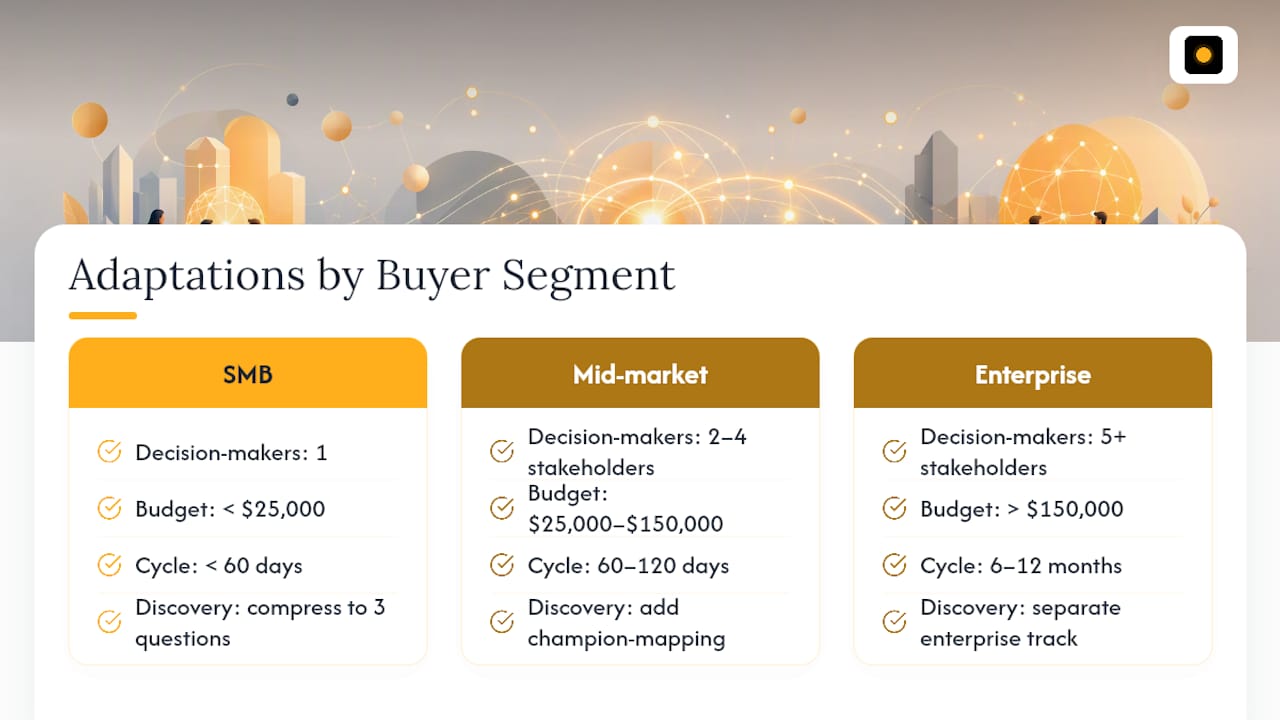
How do you adapt the motion for different buyer personas or segments?
The core motion stays the same. The qualification questions, discovery bank, and close email adapt by segment.
For SMB buyers (typically one decision-maker, budget under $25,000, cycle under 60 days): compress the discovery question bank to three questions, skip multi-threading, and move the proposal to a self-serve order form. The urgency driver is usually operational pain, so the qualification script leads with “what’s the cost of not solving this in the next 30 days?”
For mid-market buyers (2–4 stakeholders, budget $25,000–$150,000, cycle 60–120 days): add a champion-mapping step after discovery, build a multi-threaded email sequence that reaches the economic buyer directly, and use MEDDIC to structure the qualification gate. The proposal needs a business case section, not just a scope and price.
For enterprise (5+ stakeholders, budget above $150,000, cycle 6–12 months): the motion needs a separate track. Paper process, security review, and legal approval are stages in their own right. MEDDPICC is the right framework here because it explicitly tracks Paper Process and Competition as gating criteria.
The practical rule: build one motion for your primary segment first, prove it, then create a variant for the next segment. Running two unproven motions simultaneously produces data you can’t interpret.
Unusual’s field guide recommends documenting who uses and buys, why they buy, and mapping buying roles as the first step after product-market fit, before designing any motion. That buyer-role map is what makes segment-specific adaptation possible.
What founders usually get wrong about building a repeatable motion
The conventional wisdom says: document your process, hire great reps, and the motion will replicate itself.
What founders consistently underestimate is how much of their close rate lives in their personal credibility and relationships, not in the process itself. When a founder closes a deal, the prospect is partly buying the founder’s conviction. A new AE doesn’t have that. The playbook has to compensate for it with better qualification (so the AE only works deals that are actually winnable), better discovery (so the prospect articulates their own urgency), and better call discipline (so the AE doesn’t rely on charisma to paper over gaps).
The second thing founders get wrong: they hand off prospecting and qualification too late and keep closing too long. The right sequence is the opposite. Hand off prospecting and qualification early, because those are process-dependent and can be templated. Keep closing yourself until you’ve watched a new AE close two or three deals successfully. The close is where the most institutional knowledge lives, and it’s the hardest thing to transfer without direct observation.
The third surprise: the playbook will be wrong. Not slightly wrong, materially wrong in at least two places. That’s not a failure of the documentation process; it’s what the 30–50 conversation pilot is for. The founders who treat the first draft as a hypothesis and update it based on what the AE actually encounters are the ones who end up with a motion that scales.
Offbook cuts ramp time while your motion is still being proven
The hardest part of the 30–60–90 pilot isn’t building the playbook. It’s watching a new AE miss a qualification gate on a live call and not being able to do anything about it until the debrief.
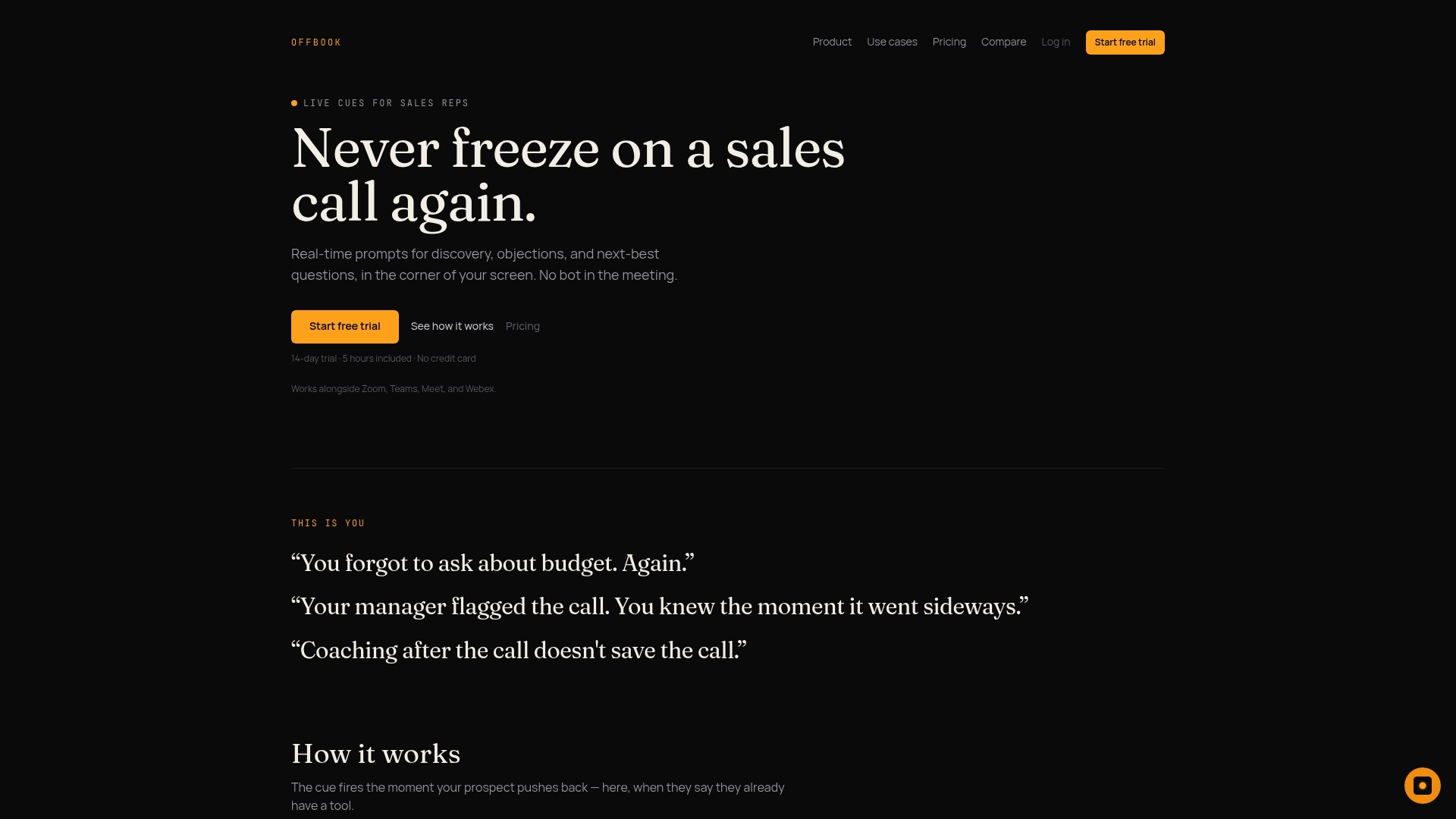
Offbook solves that specific problem. It listens to video calls without joining as a bot, surfaces live on-screen prompts when a rep misses a MEDDIC qualification question or hits a known objection, and generates an instant post-call debrief with a draft follow-up email. Before the call, it delivers a structured brief on the prospect’s company and role so the rep walks in prepared. The result: reps run more disciplined calls from week one, qualification gates get enforced in the moment rather than corrected after the fact, and managers spend coaching time on strategy instead of basic playbook compliance.
For founders running the pilot phase, Offbook’s AI call coaching for founders includes a free trial with privacy and consent infrastructure built in. Start the trial during your first 20 pilot conversations and you’ll have call-level data to inform your first playbook revision before the 60-day checkpoint.
Sources
The sources below are the primary references behind this guide. Each is linked directly to the claim it supports in the article above.
- Repeatable B2B sales process at seed (2026) | Causo Hub
- The Founder’s Guide to Building a Repeatable Sales Motion · Worklife Blog
- Ultimate guide to creating a sales plan (HubSpot)
- How to Develop a Sales Process: Step by Step (2026) | SyncGTM
- Sales Motion Setup — From Discovery Call to First AE — Allston Labs
- Gartner: Sales strategy