Competitor Mention Handling: In-Call Scripts for Live Sales Calls
Master competitor mention handling in sales calls. Learn how to engage prospects effectively and drive meaningful conversations.
Published: August 25, 2026
Author: OffBook Editorial Team

When a prospect names a competitor, reply immediately with acknowledgment, ask one clarifying question, then reframe to a business outcome. That sequence stops the reflex most reps default to: defending features nobody asked about. It also opens the door to real discovery instead of a pricing standoff.
Here’s the immediate move, broken down:
- Acknowledge: “Yeah, we come up against them a lot.” No flinching, no scripted panic.
- Ask: “What’s drawing you to look at them specifically?”
- Reframe: Tie the answer to a business outcome the competitor can’t credibly own.
A competitor mention often signals real in-market intent rather than a threat to survive, and reps who treat it that way tend to accelerate the deal instead of stalling it. Tools like Offbook exist specifically to surface this sequence live, on-screen, the moment the name drops.
Key Takeaways
Competitor mention handling works when reps acknowledge the name without flinching, ask one clarifying question, and reframe toward a business outcome the competitor can’t credibly claim.
| Point | Details |
|---|---|
| Follow the five-step sequence | Acknowledge, ask, reframe, evidence, advance in that order, skipping a step usually costs the deal. |
| Map mentions into MEDDPICC | Who raised the name and why often reveals Metrics, Decision Criteria, and Economic Buyer signals directly. |
| Keep scripts to 3–4 lines | Longer battlecards fail under pressure; short acknowledgment, question, and proof point lines survive live use. |
| Follow up within 24 hours | Send a short, stakeholder-specific asset addressing the exact concern raised, not a generic recap. |
| Use real-time coaching to remove the freeze | Offbook surfaces the acknowledge-ask-reframe sequence on-screen the moment a competitor’s name is detected, mapped to MEDDPICC. |
Table of Contents
- What Is the Right Framework for Competitor Mention Handling?
- What Should You Actually Say When a Prospect Names a Competitor?
- What Should You Prepare Before the Call?
- What Happens After the Call Ends?
- How In-Call Coaching Changes What Reps Actually Do
- How Do You Catch Competitor Mentions Nobody Says Out Loud?
- Should You Change Your Response Based on Who You’re Talking To?
- What Do You Say When the Competitor Actually Wins on Paper?
- How Does This Fit Into Broader Objection Handling?
- How Do You Actually Practice This Before It Happens Live?
- Can a Competitor Mention Reveal More Than the Prospect Meant to Share?
- Competitor Mention Handling: In-Call Scripts and Prep for Live Sales Calls
- Turn Every Competitor Mention Into a Live Advantage
- Sources
What Is the Right Framework for Competitor Mention Handling?
The five-step sequence, acknowledge, ask, reframe, evidence, advance, gives reps a repeatable structure instead of a gut reaction. Each step has one job, and skipping a step is usually what turns a normal mention into a lost deal.
Acknowledge buys you three seconds and preserves credibility. Saying “sure, we hear that name a lot” costs nothing and signals confidence rather than threat. Ask is where the real work starts: a single clarifying question, not three, surfaces why the name came up now. Reframe shifts the axis of comparison, usually from feature parity to outcome ownership: speed to value, total cost over 12 months, or the fact that a human isn’t required to sit in the meeting. Evidence backs the reframe with a specific metric or a short case reference, not a feature list. Advance proposes a concrete next step: a technical call, a stakeholder intro, a pilot scope.
The mapping into MEDDPICC is what separates this from generic objection handling. When a prospect says “we’re also looking at [Competitor],” that single sentence usually contains signal for several fields at once:
- Metrics — ask what result they’re measuring the competitor against; that number becomes your Metrics field.
- Decision Criteria — the reason they mention a name (price, integration, support) often is their decision criteria, stated out loud.
- Economic Buyer — who brought the competitor up matters; a champion raising it differs from a CFO raising it.
- Champion — if your internal champion mentions a rival unprompted, that’s a coaching gap worth flagging before the next call.
Tone reveals stage. A flat, factual mention (“we’re evaluating three vendors”) usually means early-stage comparison shopping. A tense or apologetic mention (“I have to ask about [Competitor], sorry”) usually means someone internally is pushing hard for the incumbent, and you’re fighting a bias, not a feature gap.
Pro Tip: If the mention comes with a specific number attached, a price, a seat count, a renewal date, treat that number as a gift. It tells you exactly what the buying committee is measuring, and you can build your reframe directly around it.
What Should You Actually Say When a Prospect Names a Competitor?
Scripts only work if they’re short enough to recall under pressure. Real-time coaching platforms lean on this constraint deliberately: effective in-call cards run three to four lines, one acknowledgment, one reframing question, one proof point, because anything longer fails the moment a rep actually needs it.
Acknowledgment lines (pick one, say it flat, move on):
- “Yeah, they come up in most of our deals.”
- “Good, that means you’re doing real diligence.”
- “We respect them. Different bet, though.”
Clarifying questions come in two flavors. The first surfaces stated criteria: “What’s the main thing you’re comparing us on?” The second surfaces unstated bias: “Has anyone on the team used them before?” That second question, tied to prior-vendor history, often reveals a stakeholder with an unspoken loyalty problem.
Reframing templates, matched to what usually drives the comparison:
- Integration concern: “Most teams ask us that because [Competitor] requires a bot in the meeting. We don’t, so adoption doesn’t depend on people remembering to invite one.”
- Speed-to-value: “The real question is how fast your reps see a behavior change. What’s your timeline for that?”
- Total cost: “Beyond the license, what’s it cost you if reps ignore the coaching prompts entirely?”
Evidence, kept to one line: “Teams using live, in-call prompts report fewer stalled discovery calls because reps ask the qualifying question in the moment instead of after the call ends.”
Advance close: “Worth putting your SE and their SE on a 20-minute technical call this week?”
What Should You Prepare Before the Call?
Battlecards fail when they’re built for reading rather than glancing. A one-page card should carry three or four live lines: the competitor’s most common pitch angle, your sharpest reframe, one proof point, and the objection that trips up your reps most often.
Before the call, run a fast checklist:
- Pull CRM history: has this account evaluated the competitor before, and how far did it get?
- Check LinkedIn job history on the buying committee, past employment at a competitor is a real bias signal, not paranoia.
- Note recent intent signals: G2 comparison page visits, review site activity, a competitor’s recent pricing change.
- Flag which stakeholder is most likely to raise the name, based on role and history.
Stakeholder mapping matters here specifically because a committee member who previously worked at the competitor carries a bias risk worth surfacing early, not discovering mid-deal. Store these triggers where your pre-call preparation tooling can surface them automatically.
Pro Tip: Refresh battlecards monthly, not quarterly. Competitor pricing and messaging shift faster than most sales teams update their internal docs, and a stale card is worse than no card.
What Happens After the Call Ends?
The follow-up window is short, and what you send matters more than how fast you send it, though speed still counts. Personalized follow-up sent within 24 hours, addressing the exact competitor concern raised on the call, measurably improves the odds of advancing the deal.
- Pick the format. A two-minute Loom or Vidyard walkthrough works better than a wall of text for feature comparisons; a tight two-paragraph email works better for pricing or contract-term questions.
- Match the asset to the stakeholder. A CTO wants an integration diagram or security doc. A CFO wants total cost over 12 to 24 months. An end-user wants a screenshot of the actual workflow change.
- Update the CRM immediately. Log who raised the competitor, the exact criteria they stated, and the next step you proposed, while it’s still fresh.
- Feed it into team ops weekly. A living battlecard document that tracks win and loss patterns against specific competitors turns one rep’s mention into the whole team’s advantage.
Skip any of these four and the mention becomes a one-off save instead of a repeatable motion.
How In-Call Coaching Changes What Reps Actually Do
Most reps freeze for a beat when a competitor’s name lands mid-call, then either overcorrect into a feature dump or go quiet and hope the moment passes. Both responses cost deals. Real-time coaching removes the freeze entirely by putting the acknowledge, ask, reframe sequence on-screen the instant the name is detected, so the rep says the right thing on instinct rather than reconstructing a script from memory.
Offbook builds this around a specific mechanic: it listens to the call and surfaces cues without a bot joining the meeting, structured on MEDDIC and MEDDPICC fields, so a competitor mention doesn’t just get a good verbal response. It gets logged against the right qualification gap in real time. The platform also generates pre-call briefs on the people and companies a rep is about to meet, which matters more than most teams assume:
- Reps walk in already knowing who on the committee has a competitor’s product on their resume.
- On-screen prompts reduce the gap between hearing the name and saying the reframe.
- Post-call debriefs capture what triggered the mention, feeding the next battlecard refresh.
That’s the difference between coaching that happens in a review meeting three days later and coaching that happens while the deal is still live.
How Do You Catch Competitor Mentions Nobody Says Out Loud?
Not every competitive threat gets named. A prospect who says “we already have something that does most of this” or “our current process works fine for now” is often describing an incumbent tool without naming it, and reps who wait for the explicit mention miss the signal entirely.

Listen for three patterns. First, feature shadowing: when a prospect describes a capability in oddly specific detail, “does it flag deals that stall for more than two weeks,” that phrasing usually comes from a tool they already use, not a hypothetical. Second, defensive hedging: phrases like “we’re not really looking to switch anything right now” often mean a switch is exactly what’s being evaluated, quietly, and the prospect is protecting a relationship with an incumbent vendor or internal champion. Third, comparative silence: a buyer who won’t answer “what are you using today” directly is frequently avoiding naming a competitor they don’t want to seem disloyal to.
The fix is the same clarifying-question move from the core framework, just aimed earlier. Ask “what does your current process look like for this?” before a name ever surfaces. That question does two things: it surfaces the incumbent without forcing an awkward admission, and it gives you the decision criteria you’d otherwise only get after a direct mention.
A structured competitor analysis approach helps here too, because knowing your competitors’ common weak points in advance lets you recognize implicit references to them faster than waiting for a name to land.
Should You Change Your Response Based on Who You’re Talking To?
A CFO who name-drops a cheaper competitor is not making the same argument as a technical lead who name-drops a more feature-rich one, and treating both mentions the same way wastes the opening each one creates.
For economic buyers, the mention is almost always a cost or risk signal. The reframe should move toward total cost of ownership and time-to-value, not feature comparison; a CFO rarely cares that your product has three more integrations. For technical evaluators, the mention usually means a specific capability gap they’ve identified, real or assumed, and the reframe needs a concrete technical answer, not a business-outcome pivot; vague reframing reads as evasive to this persona specifically.
Champions who raise a competitor are often testing your response to bring back to the committee, so the reframe should be quotable, something they can repeat accurately in an internal Slack thread without you in the room.
Industry sector shifts this too. In regulated industries (healthcare, financial services), a competitor mention often carries a compliance subtext, “they’re already SOC 2 certified,” for instance, and the reframe needs to address that directly rather than pivot to outcomes. In fast-moving sectors like consumer SaaS, speed-to-value reframes land better than compliance-heavy ones. Matching the reframe dimension to the persona in front of you, rather than running one universal script, is what separates reps who close competitive deals from reps who lose them on the same call every time.
What Do You Say When the Competitor Actually Wins on Paper?
Sometimes the competitor genuinely is cheaper, or genuinely does have a feature you don’t. Pretending otherwise in the moment destroys trust faster than losing the feature comparison would.
The honest move is to concede the specific point and immediately widen the frame. “You’re right, their per-seat price is lower” costs you nothing if the next sentence is “the question is what that seat actually does for you day to day.” This works because buyers already suspect the gap exists; confirming it plainly, rather than dodging, is what keeps you credible enough to make the next argument land.
Evidence-based positioning, rather than disputing the competitor’s claim, keeps the conversation productive. If a competitor has more integrations, don’t argue the number, ask which specific integration matters to this buyer, then show whether that one integration is actually in active use or a checkbox nobody touches. Feature lists lose to actual usage patterns almost every time.
Price is the toughest version of this. When a competitor is genuinely cheaper, the reframe has to move to a dimension price doesn’t capture: adoption rate, implementation time, or what a lower-priced tool costs in reps who ignore it because nobody coaches them on using it live. Discounting immediately to match a competitor’s price, before understanding why price came up, signals desperation and usually costs margin without winning the deal anyway.
How Does This Fit Into Broader Objection Handling?
Competitor mentions aren’t a separate skill from objection handling, they’re a specific flavor of it, and treating them as an isolated category is a common mistake that fragments a rep’s training.
The Acknowledge, Qualify, Differentiate, Advance pattern maps almost directly onto standard objection-handling structure: validate the concern, dig for the real qualifying detail behind it, differentiate on substance rather than volume, then move the deal forward. A price objection and a competitor mention about pricing are, functionally, the same objection wearing a different name.
The practical benefit of merging the two skill sets: reps who are already strong at general objection handling adapt to competitor mentions faster, because the underlying discipline, don’t get defensive, ask before answering, back claims with evidence, is identical. Teams that train these as entirely separate modules tend to produce reps who handle a price objection smoothly but freeze the instant a specific competitor’s name enters the sentence, even though it’s the same underlying move.
How Do You Actually Practice This Before It Happens Live?
Reading a script and saying it under pressure are two different skills, and most reps never close that gap because practice sessions default to generic role-play instead of rehearsing the exact moment that trips people up.
The highest-value drill is narrow: one person plays the prospect and drops a competitor’s name mid-sentence, unannounced, mid-conversation about something unrelated. The rep has to recover in real time, not after a pause to think. Running this drill with the actual competitors your team faces most, not hypothetical ones, matters more than volume of reps.
Recording these sessions and reviewing the acknowledgment line specifically, not the whole call, sharpens the moment that actually decides outcomes. Reps who rehearse their acknowledgment line until it’s boring to say tend to deliver it flat and confident live, instead of hesitant. Live call guidance built around real-time prompts effectively runs this rehearsal on every real call, since the on-screen cue reinforces the same acknowledge-ask-reframe sequence until it becomes automatic without a practice room at all.

Managers coaching this skill should watch for one specific failure mode: reps who answer the clarifying question themselves instead of waiting for the prospect’s answer. Silence after the question is the hardest part to coach, and the easiest to fix once someone names it.
Can a Competitor Mention Reveal More Than the Prospect Meant to Share?
The reflex is to treat a competitor mention as a defense to survive. The sharper move is to treat it as free market research the prospect just handed you, unprompted, about how they think and what they don’t yet understand.
Every mention implies a gap. If a prospect says “[Competitor] can do X,” ask directly what problem X solves for them, and you’ll often find the actual problem is adjacent to what they described, not identical to it. Buyers frequently misjudge what a competitor’s feature actually accomplishes, and the clarifying question that surfaces the real need also surfaces where their current understanding is incomplete.
This works both directions. If they name a competitor you rarely lose to, that’s a data point for your own team: either that competitor is showing up in more evaluations than your win/loss reports capture, or your messaging is triggering unnecessary comparisons that a small phrasing change could avoid. Either way, feed it back into the living battlecard so the next rep who hits the same mention starts from a sharper position than you did.
The gap a competitor mention reveals is frequently bigger than the feature comparison itself, it’s a window into what the buying committee actually believes they need, which is not always the same thing they’ll ask for by name.
Competitor Mention Handling: In-Call Scripts and Prep for Live Sales Calls
The conventional advice on this topic tends to stop at “don’t badmouth the competitor,” which is true but useless on its own. It tells a rep what not to do without giving them anything to say in the three seconds after a name lands. That gap, between knowing the principle and having the phrasing ready under pressure, is where most competitive deals actually get lost.
What the research here actually supports is narrower and more useful: the acknowledge-ask-reframe sequence works because it buys time without looking like it’s buying time, and because it turns a threat into a qualifying question. The MEDDPICC mapping is what makes this a repeatable sales motion instead of a personality trait some reps happen to have.
Prioritize the acknowledgment line first. It’s the smallest piece and the one most reps skip straight past on their way to defending features nobody asked about yet. Get that line automatic, and the rest of the sequence follows naturally.
— Neil
Turn Every Competitor Mention Into a Live Advantage
Offbook puts the acknowledge-ask-reframe sequence directly on your screen the instant a competitor’s name comes up, so you’re not relying on memory or a printed battlecard buried in a tab you forgot to open.
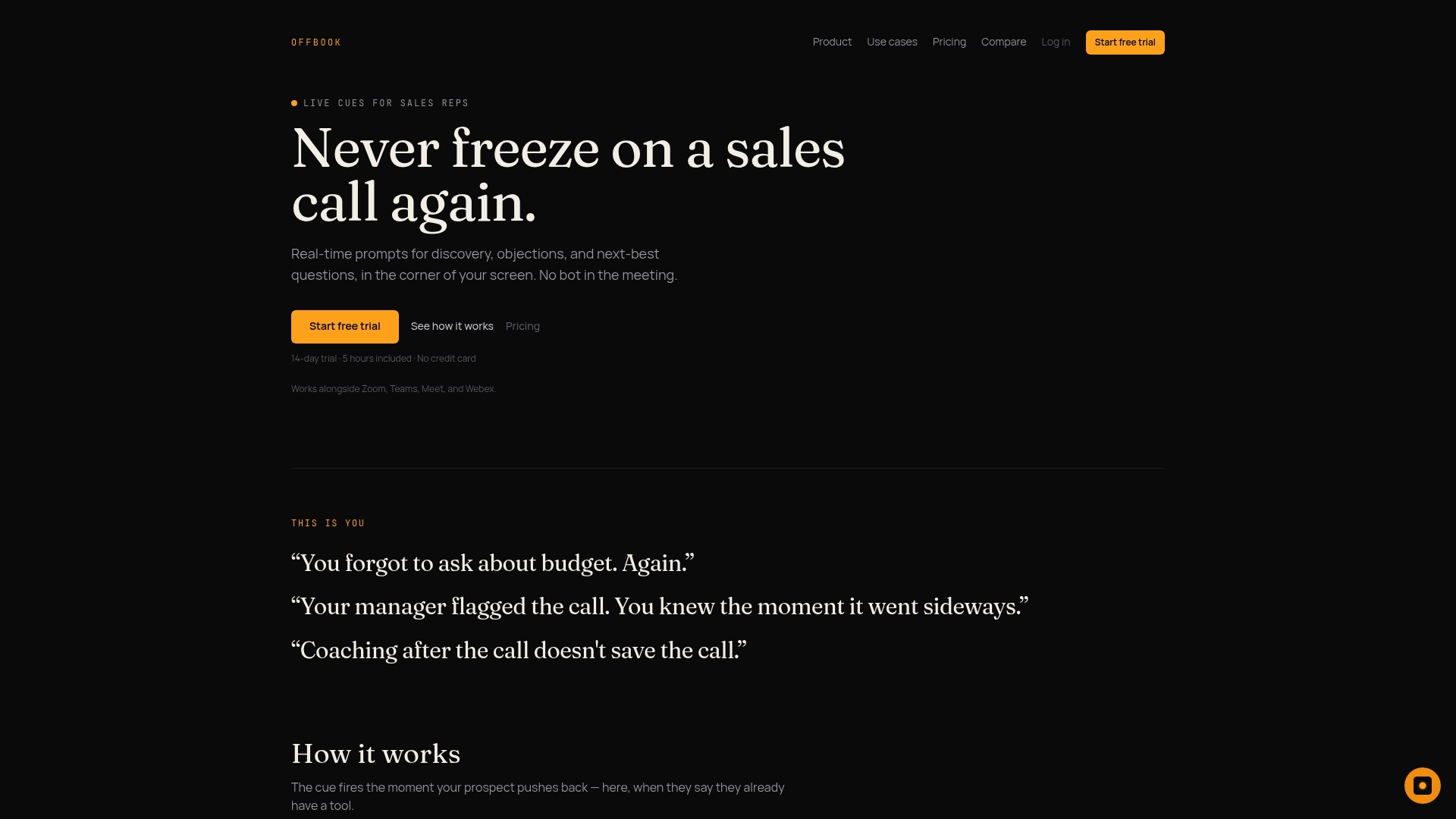
It listens to the call without a bot in the meeting, structures its cues around MEDDIC and MEDDPICC so a competitor mention gets logged against the right qualification gap automatically, and generates a pre-call brief on the people you’re about to meet, including signals worth flagging before the name even comes up. After the call, it drafts a debrief so the follow-up asset goes out fast, matched to whoever raised the concern.
If you’re tired of reconstructing the right response after the call ends instead of during it, start a trial of Offbook’s real-time coaching for sales teams and see what your next competitive call looks like with the reframe already on-screen.
Sources
- What is your process for handling a prospect who brings up a…
- Competitor Mentions: That Name Drop Isn’t a Threat — It’s the Best Signal You’ll Get All Quarter