Cold to Warm Call Conversion Tips That Book More Meetings
Discover cold to warm call conversion tips that boost your meetings. Use proven strategies to engage leads and book more appointments!
Published: August 6, 2026
Author: OffBook Editorial Team

Warm calls yield 3–5x more meetings per dial than cold ones. The fastest way to close that gap is a short, trigger-led pre-call touch sequence combined with calling within minutes of a prospect’s engagement signal. Do that consistently, and your call-to-meeting rate climbs without adding a single dial to your day.
Here are the highest-impact moves you can run today:
- Reference a fresh trigger. Find one recent event (funding round, new hire, product launch, conference appearance) and open with it. “Saw you just closed your Series A” beats any generic opener.
- Use a 15-second value statement. State who you help, what problem you solve, and what outcome you drive. One sentence. No pitch.
- Ask for a micro-commitment, not a sale. “Does it make sense to spend 15 minutes on this?” is easier to say yes to than “Can I show you a demo?”
- Send a personalized email and LinkedIn note 2–4 days before you dial. A passive download or site visit alone does not warm a lead; explicit, contextual touches do.
- Call within 5 minutes of an email open. Practitioners report 2–3x higher connect rates when you dial while the prospect is actively engaged.
Two benchmarks to set expectations: across industries, 56% of calls reach a live person, and 42% of phone leads convert on the call. Your baseline answer rate and call-to-meeting rate give insight into where the leak is.
Pro Tip: Set a browser alert or CRM trigger for email opens. The moment a prospect opens your pre-call email, stop what you are doing and dial. That five-minute window is worth more than 50 cold dials later in the day.
Table of Contents
- What should you research before you pick up the phone?
- How do you open a cold call so the prospect actually stays on?
- How do you run discovery that actually qualifies the prospect?
- How do you handle objections without killing the call’s momentum?
- What does a follow-up sequence look like after a cold dial?
- When is the best time to call, and how many times should you try?
- What tools and metrics should you track to improve call conversion?
- Copy-ready scripts and templates you can use today
- How do you roll out these tactics and measure progress over 90 days?
- How Offbook closes the gaps that kill cold-to-warm conversion in real time
- Key Takeaways
- What top-performing reps actually do differently
- Offbook gives your reps live coaching when it changes the outcome
- Sources and further reading
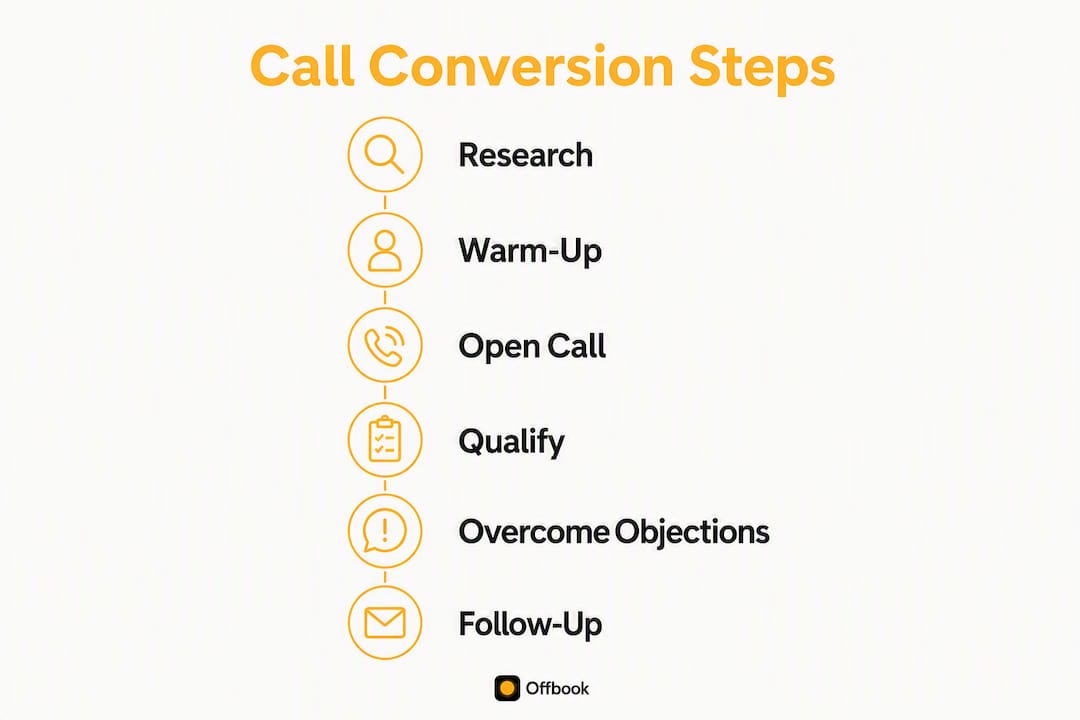
What should you research before you pick up the phone?
Pre-call research does not mean spending 30 minutes on LinkedIn. It means building a 60-second micro-brief that gives you one sharp, relevant reason to call. That specificity is what separates a warm outreach from a cold interruption.
Which trigger events actually create relevance
Not all triggers are equal. Prioritize these in order:
- Funding announcements (Series A, B, or seed): the company has money and a mandate to grow fast.
- New executive hires (VP Sales, CTO, Head of Revenue): new leaders buy new tools in the first 90 days.
- Product launches or major feature releases: they are selling harder, which means they need better sales infrastructure.
- Conference attendance or speaking slots: they are visible and in motion.
- Recent job postings in your buyer’s function: headcount growth signals budget and urgency.
The 60-second micro-brief template
Copy this into your dialer notes or CRM before every call:
Company thesis: [One sentence on what they do and who they sell to] Contact role + validation detail: [Title + one specific thing about their background or recent activity] Trigger + timestamp: [Event + when it happened, ideally within 30 days] Desired call outcome: [Specific next step you want to secure]
Pre-call checklist before you dial:
- Confirm you have a direct number (not a switchboard).
- Check CRM notes for any prior touches or conversations.
- Scan for recent email opens or link clicks in your sequencing tool.
- Review the prospect’s LinkedIn activity from the last two weeks.
- Update the micro-brief if anything has changed since you built it.
Warming a prospect requires multi-channel touches 2–4 days before the call. If you skipped that step, your “warm call” is still cold.
Pro Tip: Build the micro-brief the night before, then re-read it 60 seconds before dialing. Stale research is almost as bad as none. A trigger that happened six weeks ago lands flat; one from last week lands sharp.
How do you open a cold call so the prospect actually stays on?
The opening goal is not to sell. It is to earn 10–15 more seconds by giving the prospect a reason to stay on the line. That means securing a micro-commitment: permission to continue or a quick confirmation that the timing is not terrible.

Three opener patterns, each with copy-ready examples:
Trigger reference opener
Lead with something specific about them, then tie it to your value in one breath.
- “Hey [Name], I saw [Company] just announced [trigger]. We work with a lot of teams going through that exact phase. Got 30 seconds?”
- “Congrats on the Series A. We help B2B SaaS teams build out their sales motion right after a raise. Is now a terrible time for 2 minutes?”
Referencing a recent announcement and immediately linking it to a timing-based need is one of the most reliable ways to create relevance without sounding scripted.
Question-hook opener
Open with a question that makes them think before they hang up.
- “Quick question before I explain why I’m calling: is scaling your outbound motion on your radar for this quarter?”
- “Do you have a process for coaching reps on live calls, or is that still mostly post-call review?”
The question does two things at once: it creates a pause and it starts qualifying. If they answer, you have a conversation.
Value-contrast opener
State who you help and what changes for them, in one sentence.
- “We help early-stage SaaS founders run tighter discovery calls so they stop losing deals they should be winning.”
- “We work with SDR teams that are dialing hard but not converting. We cut the gap between dials and booked meetings.”
The 3 P’s framework gives you a clean structure for any opener: Purpose (why you called), Process (how the next two minutes will run), Payoff (what they get from staying on). Keep it under 20 words total.
After the opener, move immediately to a qualifying question. Example: “We’re calling because [trigger]. Quick question: is [problem area] something you’re actively working on, or is it more of a back-burner thing right now?”
Pro Tip: Avoid sounding like you are reading. Internalize the trigger and the value statement, then say it the way you would to a colleague. The moment a prospect hears a script, they check out. The moment they hear a person, they stay.
How do you run discovery that actually qualifies the prospect?
Aim for a talk-to-listen ratio where the prospect speaks 55–60% of the time. On a cold-to-warm call, that ratio is a signal: if you are talking more than they are, you have shifted into pitch mode and the call is losing heat.

High-impact diagnostic questions for the first 90 seconds
Move through these layers quickly:
- Situation: “How are you currently handling [problem area]?”
- Problem: “What’s the biggest friction point in that process right now?”
- Impact: “What does that cost you in terms of [time, revenue, deals lost]?”
- Timing: “Is this something you’re actively trying to fix in the next quarter, or is it further out?”
Layered questioning from situation to desired outcome converts informational calls into committed next steps far more reliably than a pitch-first approach.
Rapid qualification: what to ask, what to skip
On a first call, you need three things: fit, urgency, and access to a decision. Ask:
- “Who else would typically be involved in a decision like this?”
- “Is there budget allocated for this, or would that need to be found?”
- “What would need to be true for you to move on this in the next 60 days?”
Skip the deep technical requirements for now. You are qualifying for a next meeting, not closing a contract. If fit, urgency, and decision access are all present, you have a qualified prospect. If one is missing, probe it before you invest in a full demo.
Pro Tip: Mirror the prospect’s own language back to them. If they say “we’re bleeding deals at the demo stage,” use that phrase when you frame the next step: “It sounds like the demo stage is where we could make the biggest difference. Would it be worth 20 minutes to show you exactly how we address that?” Their words, your close.
How do you handle objections without killing the call’s momentum?
Always validate first. Jumping straight to a rebuttal signals that you were not listening. Validation costs you nothing and buys you the credibility to probe deeper.
The three-step objection flow:
- Validate: Acknowledge the concern without agreeing that it ends the conversation. “That makes complete sense” or “I hear that a lot from teams at your stage.”
- Probe: Ask an open question to find the root cause. “Is it more about timing, or is the budget piece the real blocker right now?” Never assume you know which objection is underneath the surface one.
- Respond with a targeted next step: Offer something small and low-risk. Not a full demo. A 15-minute call, a one-page summary, a specific question answered by email.
Top practitioners consistently find that reflexively resolving objections fails. The reps who convert more validate, probe to root cause, and then respond with a tailored next step.
Quick scripts for the top four objections
“We don’t have budget right now.” “That makes sense. Is it a timing thing, or is this just not a priority yet? I ask because if the problem is real, there’s usually a path. If it’s not a priority, I’d rather not waste your time.”
“We’re happy with what we have.” “Good to hear. Out of curiosity, what does your current process look like for [specific problem]? I’m not trying to sell you anything today. I just want to understand if there’s a gap worth a quick look.”
“Send me some information.” “Happy to. What would be most useful: a one-pager on how we work, or a short example of what results look like for a team your size? That way I can send something worth reading.”
“Not interested.” “Fair enough. Can I ask what made you say that? Is it the timing, or is [problem area] just not on your radar?”
Pro Tip: The goal of every objection response is a micro-commitment, not a win. You are not trying to overcome the objection. You are trying to get one more yes that keeps the conversation alive.
What does a follow-up sequence look like after a cold dial?
A single dial rarely books a meeting. The sequence around the call is what converts. Multi-channel warm sequences combining trigger references, email, LinkedIn, and calls produce 2–3x higher meeting yields than single-channel cold dialing.
Two cadence options:
Fast trigger path (2–3 touches in 48 hours)
Use when a prospect just triggered a high-intent signal (opened your email, visited your site, downloaded something).
- Hour 0: Call immediately. Leave a voicemail if no answer.
- Hour 1: Send a short follow-up email referencing the voicemail.
- Hour 24–48: LinkedIn connection request with a one-line note.
Standard warm-up cadence (3–7 touches over 7–14 days)
Use for outbound prospecting where no live signal has fired yet.
- Day 1: Personalized email with trigger reference.
- Day 2: LinkedIn note (connection or InMail).
- Day 4: First call + voicemail.
- Day 7: Follow-up email referencing the voicemail.
- Day 10: Second call attempt.
- Day 14: Final email with a clear opt-out option.
Multi-channel pre-call engagement 2–4 days before the call is what separates a warm dial from a cold interruption.
Voicemail recipe
Keep it under 20 seconds. State your name, one specific trigger, one outcome, and your number twice.
Reference the voicemail explicitly in your follow-up email subject line: “Following up on my voicemail” outperforms generic subject lines because it creates continuity.
When is the best time to call, and how many times should you try?
Timing matters more than volume. Calling at the right moment with a warm signal beats 50 cold dials at random hours.
Best windows for B2B outbound:
- 7:30–9:00 AM local time: Decision-makers are at their desks before the day fills up.
- 4:00–6:00 PM local time: End-of-day window when gatekeepers are less active and executives are wrapping up.
- Tuesday through Thursday: Avoid Monday mornings (planning mode) and Friday afternoons (mentally checked out).
How to sequence repeated dials:
- Attempt 1: First call with voicemail.
- Attempt 2: 48 hours later, no voicemail (just hang up; two voicemails in a row reads as desperate).
- Attempt 3: One week later, reference a new touch (email, LinkedIn) in the voicemail.
- After 3 attempts with no response: pause for 2–3 weeks, then re-enter with a new trigger if one appears.
Volume versus quality: for deals above $20K ACV, one well-researched warm touch outperforms five cold dials. Below that threshold, higher volume with lighter research can work, but the cadence still needs a trigger reference to avoid sounding generic.
Pro Tip: Use behavioral signals to time your calls. If your sequencing tool shows a prospect opened your email at 8:47 AM, call at 8:50 AM. That two-minute window, while the email is still on their screen, is when connect rates are highest.
What tools and metrics should you track to improve call conversion?
Without measurement, you are optimizing by feel. The minimal tech stack and the right metrics give you a feedback loop that compounds over time.
Core tool categories
- Call tracking with dynamic number insertion (DNI): Ties inbound calls to the specific campaign or channel that drove them. Without DNI, you cannot tell which touches are generating conversations.
- Conversation intelligence: Records and scores calls against criteria (talk ratio, objection handling, next-step ask). Surfaces patterns across reps.
- CRM with activity timestamps: Logs every touch with a timestamp so you can measure speed-to-lead and sequence completion rates.
- Email open signals: Triggers real-time alerts when a prospect engages, enabling the speed-to-lead plays described above.
Fixing call attribution, improving intake scripting, and applying AI-driven call scoring routinely produces 30–50% more revenue from the same ad spend.
Key metrics dashboard
| Metric | What it measures | Target range |
|---|---|---|
| Answer rate | % of dials that reach a live person | 30–56% (industry avg: 56%) |
| Call-to-meeting rate | % of answered calls that book a next step | 5–10% warm; 1–3% cold |
| Lead-to-conversion rate | % of phone leads that convert on the call | ~42% (industry benchmark) |
| Speed-to-lead | Time from engagement signal to first dial | Under 5 minutes for hot signals |
| Cost per converted call | Total outreach cost divided by booked meetings | Varies by ACV; track trend, not absolute |
Leverage payment and behavioral data to personalize which prospects get the fast trigger path versus the standard cadence.
Attribution setup checklist
- Assign a unique tracking number to each channel (email, LinkedIn, paid).
- Log call outcomes in CRM within 5 minutes of hanging up.
- Tag each call with the trigger that prompted it.
- Review answer rate and call-to-meeting rate weekly, not monthly.
Copy-ready scripts and templates you can use today
Trigger-based opener (30 seconds)
15-second value statement
Discovery question opener
20-second voicemail
Top 5 rebuttal scripts (validate → probe → solve)
- “Not interested”: “Totally fair. Is it the timing, or is [problem] just not a priority right now? I want to make sure I’m not missing something.”
- “Send me info”: “Of course. What’s most useful: a one-pager or a quick example of what results look like for a team your size?”
- “We already have a solution”: “Good to know. What does that process look like today? I’m curious whether there’s a gap worth a quick look.”
- “No budget”: “Makes sense. Is it a budget issue or a timing issue? Those are pretty different problems and I’d rather understand which one I’m dealing with.”
- “Call me next quarter”: “Happy to. Can I ask what changes next quarter? That way I can come back with something actually relevant.”
Follow-up email: no answer
Subject: Following up on my voicemail
Hi [Name], left you a quick voicemail earlier. Reaching out because [trigger]. We help [ICP] [outcome]. Worth 15 minutes? [Calendar link]
Follow-up email: spoke but no next step
Subject: Quick follow-up from our call
Hi [Name], good talking earlier. Based on what you shared about [specific thing they said], I think [outcome] is worth a closer look. Here’s [one specific resource]. Open to a 15-minute call [day]?
A/B testing prompts to log in CRM
- Test one variable per sprint: opener type, voicemail length, email subject line, or call timing.
- Log the variant used in a CRM custom field on every call record.
- Measure call-to-meeting rate by variant after 50 calls per arm.
How do you roll out these tactics and measure progress over 90 days?
A phased rollout prevents teams from changing too many variables at once and losing the signal in the noise.
30/60/90 day plan
Days 1–30: Pilot
- Select 2–3 reps to test the new pre-call brief and opener framework.
- Define baseline metrics: answer rate, call-to-meeting rate, speed-to-lead.
- Run one A/B test on opener type (trigger reference vs. question hook).
- Hold a 15-minute weekly call review to score calls against the framework.
- Log all outcomes in CRM with variant tags.
Days 31–60: Scale
- Roll out the winning opener and brief template to the full team.
- Add the multi-channel cadence (email + LinkedIn + call sequence).
- Start tracking cost per converted call alongside meeting rate.
- Run a second A/B test on voicemail length or follow-up email subject line.
- Use sales team collaboration tools to share call recordings and scoring notes across the team.
Days 61–90: Coach
- Identify the top and bottom quartile reps by call-to-meeting rate.
- Shadow two calls per rep per week and score against the objection-handling framework.
- Run a third A/B test on cadence timing (fast trigger path vs. standard warm-up).
- Set a target: call-to-meeting rate at or above 5% for warm-sequenced prospects.
A/B test structure
- One variable per test, always.
- Minimum 50 calls per arm before drawing conclusions.
- Track: answer rate, call-to-meeting rate, and time-to-book.
Manager’s weekly coaching loop
- Pull 3 calls per rep from the week.
- Score each on: opener quality, talk-to-listen ratio, objection handling, and next-step ask.
- Spend 10 minutes on the lowest-scoring call: replay, diagnose, and roleplay the fix.
- Share one “call of the week” (best example) with the full team.
How Offbook closes the gaps that kill cold-to-warm conversion in real time
Most cold-to-warm conversion breakdowns happen in the moment: a rep forgets to ask the qualifying question, misses the objection signal, or ends the call without locking a next step. Post-call coaching catches these patterns after the damage is done. Offbook addresses them while the call is still live.
What Offbook does during the call
Offbook listens to your video call and surfaces on-screen cues in real time, without joining as a bot or appearing to the prospect. When a prospect raises a budget objection, Offbook prompts the validate-probe-solve flow. When discovery stalls, it surfaces the next diagnostic question. When the call is nearing its end, it flags the closing ask before the rep lets the prospect off the hook without a commitment.
The live AI cues are structured around MEDDIC and MEDDPICC, so every prompt maps to a qualification gap the rep needs to close, not just a generic reminder to “ask more questions.”
Pre-call briefs and post-call drafts
Before the call, Offbook generates a brief on the company and contact: role, recent activity, and the trigger that makes this call relevant. That brief feeds directly into the micro-brief template described earlier in this article. After the call, Offbook produces an instant debrief and a draft follow-up email, so the rep sends a personalized message within minutes rather than hours.
Where Offbook closes the conversion gaps
| Gap | What typically happens | How Offbook addresses it |
|---|---|---|
| Weak discovery | Rep pitches before qualifying | Live prompt surfaces next diagnostic question |
| Missed closing ask | Call ends without a next step | End-of-call cue flags the commitment ask |
| Delayed follow-up | Follow-up email sent hours later | Post-call draft ready within minutes |
| Inconsistent objection handling | Each rep improvises | Validate-probe-solve flow prompted live |
| Poor pre-call prep | Rep dials without a trigger | Pre-call brief generated before every meeting |
Teams using live call coaching and structured scoring consistently target a 30–50% more revenue from the same ad spend, consistent with the conversion lift benchmarks seen when call scoring and attribution are applied together. For AI-assisted sales conversations, the lift comes from closing the gap between what reps know they should do and what they actually do under pressure.
To integrate Offbook into the 30/60/90 rollout: add it in Day 1 for pilot reps, use the post-call debriefs as the source material for the weekly coaching loop, and compare call-to-meeting rates between Offbook-coached calls and uncoached calls as your primary A/B signal.
Key Takeaways
Converting cold calls into warm meetings requires trigger-led pre-call preparation, a micro-commitment opener, disciplined discovery, and a multi-channel follow-up sequence executed within 48 hours of first contact.
| Point | Details |
|---|---|
| Warm calls outperform cold | Warm sequences yield 3–5x more meetings per dial; prioritize trigger-led touches before dialing. |
| Speed-to-lead is decisive | Call within 5 minutes of an email open for 2–3x higher connect rates. |
| Opener secures the next 15 seconds | Use a trigger reference or question hook to earn a micro-commitment, not to pitch. |
| Measure answer rate first | Industry average is 56%; if yours is lower, fix your list quality and timing before changing scripts. |
| Offbook coaches in the moment | Live on-screen cues close the discovery and closing-ask gaps while the call is still live. |
What top-performing reps actually do differently
The conventional wisdom says great reps are great talkers. The evidence says the opposite. The reps who consistently convert cold contacts into booked meetings tend to talk less, prepare more, and treat every call as a qualification exercise rather than a performance.
A few habits that separate them from the pack:
They use email-open signals as a starting gun. Average reps check their sequencing tool at the end of the day. Top reps have it open in a browser tab and dial the moment an alert fires. That behavioral discipline, not charisma, is what drives their connect rates.
They frame the first question around the prospect’s situation, not their product. Instead of “Can I tell you what we do?”, they open with “How are you currently handling X?” That single shift changes the dynamic from interruption to consultation within the first 20 seconds.
Their micro-commitment language is specific. They do not ask “Would you be open to a call?” They ask “Does Thursday at 2 PM work, or is Friday morning better?” The specificity of the ask signals confidence and makes it easier to say yes than to negotiate.
Daily habits worth building:
- Block 30 minutes each morning for pre-call research before the first dial.
- Review the previous day’s call outcomes in CRM before starting new outreach.
- Send follow-up emails within 10 minutes of hanging up, while the conversation is fresh.
- Score your own calls once a week against the opener, discovery, and closing-ask criteria.
The mindset shift that matters most: every call is a qualification call. You are not trying to close on the first dial. You are trying to find out whether this prospect is worth a second conversation. That reframe removes the pressure to perform and replaces it with the discipline to listen.
Offbook gives your reps live coaching when it changes the outcome
Real-time coaching is the one advantage post-call tools cannot replicate. By the time a manager reviews a recording, the deal moment has passed. Offbook puts the coaching cue on screen while the rep still has the prospect on the line.
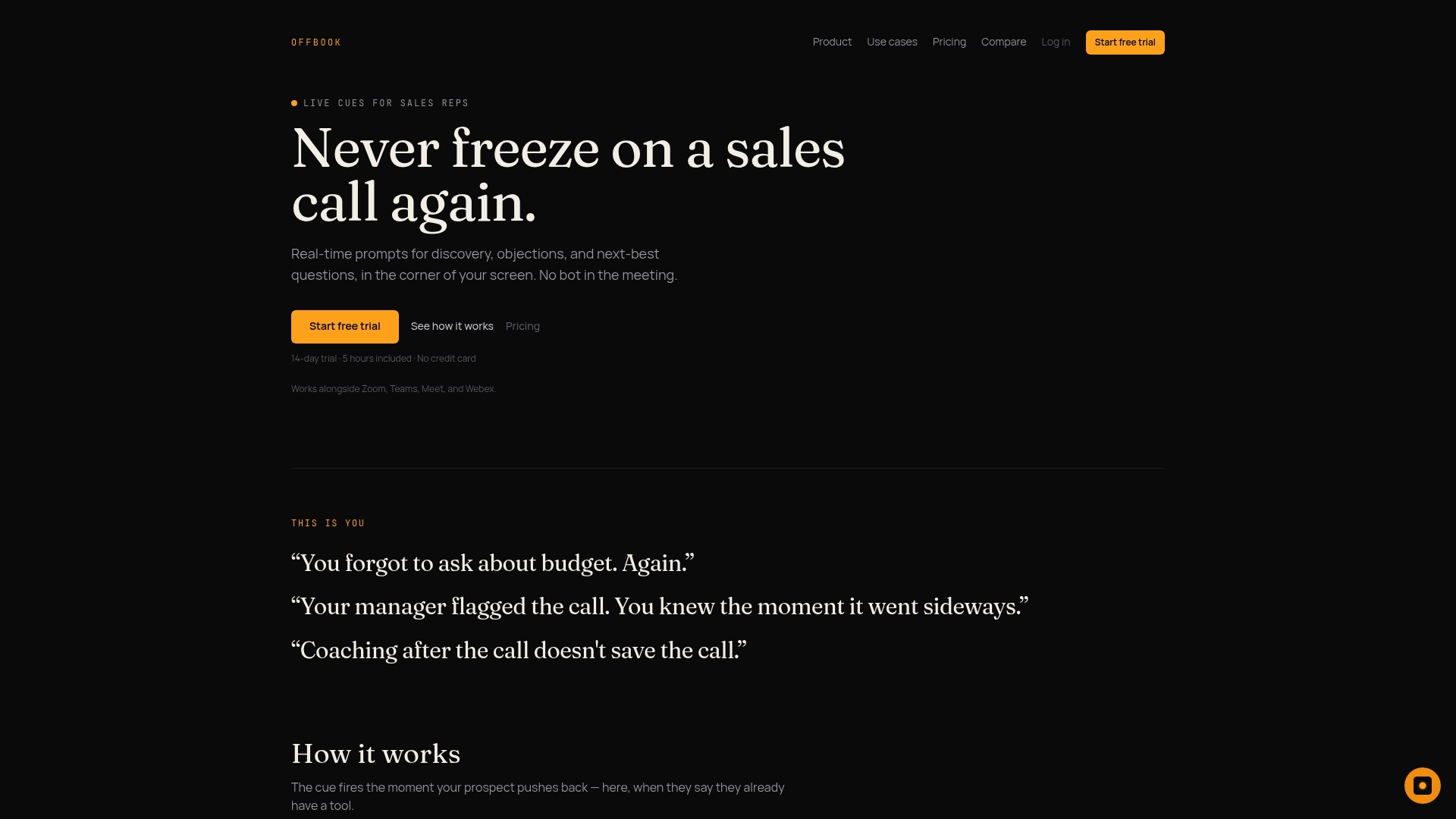
For founder-led B2B SaaS teams and early-stage SDR squads, Offbook solves the three problems that kill cold-to-warm conversion: reps who skip discovery, calls that end without a next step, and follow-ups that arrive too late to matter. The pre-call brief means every rep walks in with a trigger and a thesis. The live cues mean they ask the right question at the right moment. The instant post-call draft means the follow-up email goes out in minutes, not hours.
Two use cases where the lift is most visible: a founder running their own sales calls who needs a MEDDIC-structured prompt to stay disciplined under pressure, and an SDR team where call quality varies widely rep-to-rep and managers cannot shadow every call. In both cases, Offbook acts as the coach in the room without disrupting the conversation.
See how it works for your team at Offbook for sales or explore the use cases page to find the scenario closest to yours. If you run a consulting practice with high-stakes calls, the Offbook for consultants plan is worth a look.
Sources and further reading
The benchmarks, frameworks, and tactical guidance in this article draw from the following sources. Each covers a different part of the cold-to-warm conversion problem:
- 5 insights from 60 million phone conversations — Invoca’s large-scale call data; use this for answer rate and lead conversion benchmarks.
- Cold calling vs warm calling: the facts — connect rate and meeting-rate comparisons between cold and warm approaches; use for setting team targets.
- B2B warm calling guide 2026 — multi-channel pre-call warming cadence and the distinction between passive signals and true warm touches.
- Warm calling wiki — speed-to-lead data and timing guidance for calling within minutes of engagement signals.
- Sales call structure to close deals faster — opening framework, micro-commitment structure, and objection-handling guidance.
- Cold calling: master purpose, process, payoff — the 3 P’s framework for structuring openers and agenda-setting language.
- Sales call best practices: the playbook for high-ticket — layered discovery questioning and closing-ask structure.
- Turn your cold calls into warm calls — trigger-reference tactics and name-drop phrasing patterns.
- Call conversion optimization — call attribution, DNI setup, and the revenue impact of call scoring.
- How AI cues improve sales performance — Offbook’s approach to live coaching and its effect on call outcomes.
- How AI assists sales conversations for B2B teams — practical examples of AI-assisted discovery and objection handling during live calls.