Fix Calls Within 24 Hours: Call Recording vs Live Coaching for Sales Managers
Manager playbook: use recordings as the data source and live coaching, human plus in call AI, to fix sales calls fast with feedback within 24 hours.
Published: August 29, 2026
Author: OffBook Editorial Team

Live coaching wins on behavior change; call recording wins on documentation and scale. Recordings show you what already happened, which makes them essential for audits, onboarding libraries, and trend spotting. Live coaching, whether from a manager or real-time AI prompts, corrects a rep mid-conversation, before a deal slips. If your goal is faster, durable change in how reps sell, prioritize live coaching and treat recordings as its raw material, not its replacement.
TL;DR:
- Call recordings are useful for compliance, dispute resolution, and building a training library, but they do not facilitate immediate skill improvement.
- Live coaching, whether human or AI-driven, corrects behaviors during the call, helping reps improve faster and more durably.
- AI prompts work best when used to reinforce a coach’s deep training, especially for high-value or high-stakes calls.
- Prioritize real-time coaching for small, high-stakes, or distributed teams, and use recordings mainly for monitoring and onboarding.
- Implement a coaching cadence with immediate feedback, short verification clips, and clear ownership to ensure behavior change persists.
Table of Contents
- Call Recording vs Live Coaching: The Terms Sales Teams Confuse
- Where Call Recording Actually Helps
- What Live Coaching Delivers That Recordings Never Will
- When to Lean on Recordings, When to Prioritize Live Coaching
- Building a Coaching Cadence That Actually Sticks
- How to Know It’s Working: Metrics and Timelines
- Combining Recordings and Coaching Instead of Choosing One
- Why Timing Beats Documentation in Sales Coaching
- The Bottom Line on Call Recording vs Live Coaching
- Get Live Coaching Cues on Every Call, Not Just the Ones You Sit In On
- Sources
Call Recording vs Live Coaching: The Terms Sales Teams Confuse
Sales teams throw around “call recording,” “conversation intelligence,” and “coaching” like they’re interchangeable. They’re not, and mixing them up leads managers to buy the wrong tool for the problem they actually have.
Call recording and monitoring captures the raw material: audio, video, a transcript, maybe an automated scorecard flagging talk ratios or keyword hits. It’s a record. Nothing more.
Conversation intelligence sits one layer up. It’s software that mines recordings for patterns, surfacing which reps talk too much, which deals mention a competitor, which calls skipped discovery questions. Still after the fact.
Human live coaching is a manager or peer working with a rep in real time or shortly after, correcting technique, running role-play, and holding the rep accountable over weeks.
Real-time AI coaching (also called live AI prompts or in-call assist) listens to a conversation as it happens and surfaces cues on screen, the objection-handling line to use, the qualification question the rep forgot, without a bot ever joining the call.
The distinction matters because each layer answers a different question:
- Recording answers “what happened?”
- Conversation intelligence answers “what’s the pattern?”
- Human coaching answers “how do we fix it?”
- Real-time AI prompting answers “what should I say right now?”
Where Call Recording Actually Helps
Recordings earn their place in every serious sales stack. They document what was said for compliance and dispute resolution, they’re searchable when you need to pull every call that mentioned a specific competitor, and they build the training library new hires binge before their first live call.
The limits show up once you ask recordings to do more than document. Monitoring identifies problems but doesn’t build skills by itself; a scorecard flagging that a rep talked 80% of the call doesn’t teach them to talk less. And most recordings never get reviewed at all. Managers drowning in pipeline reviews and forecast calls simply don’t have hours to sit through hundreds of recorded conversations looking for teachable moments.
Statistic Callout: Reps who get feedback within 24 hours of a call are dramatically more likely to change their behavior than reps who wait days or weeks for a review. A recording sitting untouched in a library for two weeks has already lost most of its coaching value.
What recordings are genuinely good for:
- Compliance documentation and dispute resolution
- Building a searchable library of best-call and worst-call examples
- Spotting macro trends across dozens or hundreds of calls
- Onboarding new reps on tone, pacing, and objection patterns
What they can’t do on their own: change behavior before the next call happens.
What Live Coaching Delivers That Recordings Never Will
A recording tells you a rep fumbled the budget question. Live coaching is what stops them from fumbling it again next week, and ideally on the very next call.
Human coaches bring something no transcript can replicate: they read tone, hesitation, and the twenty things happening between the lines that a keyword-tagging tool misses entirely. Real-time, person-to-person coaching adapts to nuance and builds accountability in a way that static content, whether that’s a recorded call or a slide deck, simply cannot. A good manager doesn’t just point out the mistake. They practice the fix with the rep, then check the next three calls to see if it stuck.
Real-time AI coaching plays a different but complementary role. It listens live and surfaces the exact prompt a rep needs in the moment: the discovery question they’re about to skip, the qualification gap opening up, the objection-handling line that fits a MEDDIC or MEDDPICC framework. It also generates pre-call briefs so a rep walks in knowing who they’re meeting and what matters to that buyer, closing the preparation gap before the call even starts.

The smartest teams sequence the two rather than picking one. Live human coaching handles the deep skill lift, awareness, judgment, habit change, while AI coaching reinforces and scales that behavior across every call a rep takes, not just the ones a manager happens to sit in on.
Pro Tip: Don’t ask AI prompting to replace manager coaching for your newest reps. Use it to extend what your best coach already taught, so the lesson holds up on the fortieth call, not just the one the manager watched.
When to Lean on Recordings, When to Prioritize Live Coaching
Not every team needs the same mix. Here’s a working rubric.
- Small team, one overloaded manager: Prioritize real-time AI coaching. A manager coaching eight reps can’t sit in on every call, but live prompts can cover every rep on every call without adding headcount.
- Compliance-heavy industry (finance, healthcare, regulated B2B): Keep recording non-negotiable for audit trails, and layer live coaching on top for skill development. Recording alone satisfies legal exposure, not performance.
- Founder-led startup ramping first SDRs: Prioritize live coaching immediately. New reps need correction inside the call, not a debrief two weeks later when the habit is already set.
- Enterprise team with wide performance variance: Use recordings and conversation intelligence to flag which reps and which calls need attention, then send a human coach to the flagged conversations, not every conversation.
- High-stakes calls (six-figure deals, exec buyers, competitive takeaways): Live coaching wins outright here. A missed qualification question on a $200,000 deal can’t wait for Friday’s call review.
- Distributed team across time zones: Rely more heavily on real-time AI prompting, since it works whether or not a manager is awake and on the call.
Building a Coaching Cadence That Actually Sticks
Most coaching programs fail not because the tool is wrong, but because there’s no cadence. Pick one behavior. Just one. Trying to fix discovery, objection handling, and closing language all in the same week guarantees none of it lands.
Set a shared scorecard so the rep and the coach agree on what “good” looks like before the call starts, not after. Then run the loop:
- Pre-call brief: Rep reviews a short prep note on the company and buyer before dialing in.
- Live assist or shadow: A manager listens live, or real-time AI prompts surface the right question or objection response as the call unfolds.
- Debrief within 24 hours: Feedback happens the same day, tied to the one behavior being worked on.
- Verification clip the following week: Coach pulls a short clip from a later call to confirm the fix held.
That verification step matters more than most managers realize. Clipping 15 to 30 second evidence moments from recorded calls and saving them to a review playlist turns a vague “did the coaching work?” into a concrete before-and-after comparison anyone on the team can watch in under a minute.
Before rolling this out, define three things in writing: who owns coaching (frontline manager, not just a sales enablement team), what tooling handles consent and retention (most states require notifying participants that a call is recorded), and how transcripts get tagged so they’re searchable later. OffBook’s take on where technology fits alongside human judgment is worth reading before you lock in a stack.
Pro Tip: If you only have bandwidth to fix one thing this quarter, fix time-to-feedback. A mediocre coaching topic delivered within 24 hours beats a great coaching topic delivered two weeks late.
How to Know It’s Working: Metrics and Timelines
Track two tiers of metrics, and don’t confuse them. Leading indicators tell you whether the coaching is actually happening; lagging indicators tell you whether it’s paying off in revenue.
Leading metrics to watch weekly:
- Behavior adherence: is the rep actually doing the thing you coached, on the next call?
- Time-to-feedback: how many hours between the call and the coaching conversation?
- Playbook or prompt usage: are reps engaging with real-time prompts or ignoring them?
Lagging metrics to watch monthly or quarterly:
- Conversion rate from qualified opportunity to closed deal
- Ramp time for new reps to hit quota
- Appointment-set or meeting-held rate for outbound teams
Statistic Callout: Pairing training with ongoing coaching has been shown to multiply productivity gains several times over compared with training alone. A single onboarding week without reinforcement rarely holds.
Expect leading indicators to move within one to two weeks of a coaching change. Lagging indicators, especially conversion rate, take a full sales cycle to reflect the shift, so don’t panic if pipeline numbers look flat after week one. To A/B a coaching approach cheaply, split your team: half get live AI prompts on every call, half get standard post-call review, then compare adherence and conversion after 30 days. A practical pilot guide for AI call analytics walks through structuring a small test like this without overbuilding the process.
Combining Recordings and Coaching Instead of Choosing One
The best-run sales teams don’t pick a side in this debate. They build workflows where recordings feed the coaching, and coaching turns recordings into proof.
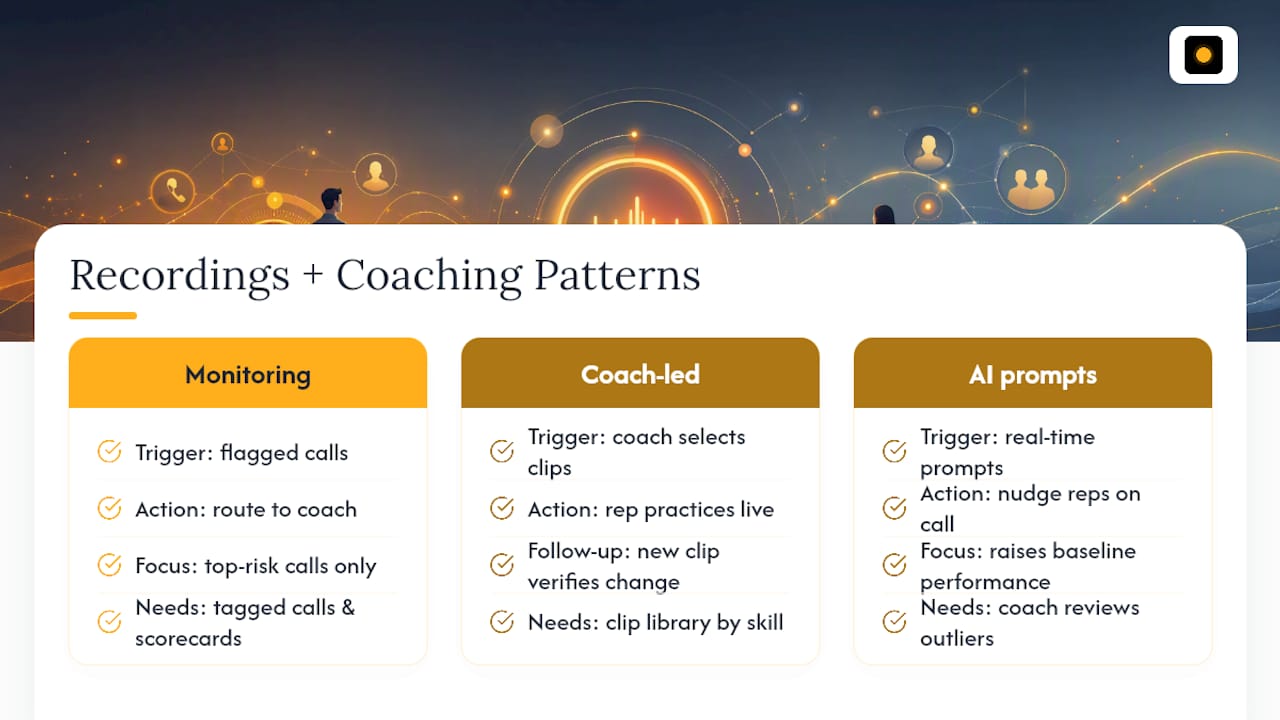
Pattern A: Monitoring triggers coaching. Conversation intelligence flags calls with red flags, a competitor mention, a stalled qualification, a compliance risk, and routes only those calls to a human coach. This keeps a manager’s limited hours pointed at the calls that matter most instead of spread evenly across all of them.
Pattern B: Coach-led review with clip libraries. A coach pulls short clips from recorded calls to demonstrate a specific technique, then has the rep practice it live, then pulls a new clip the following week to verify it stuck.
Pattern C: AI prompts raise the floor. Real-time prompting on every call raises the baseline performance of the whole team, so coaches spend their limited time on genuine outliers instead of repeating the same basic correction fifty times.
None of this works without data hygiene. Tag calls by deal stage and behavior, keep a running clip library organized by skill (not just by rep), and cross-reference scorecards so a coach can see, in seconds, which reps need which intervention this week.
Why Timing Beats Documentation in Sales Coaching
Most sales organizations still treat call recording as the finish line of their coaching program instead of the starting point. That’s backwards, and it’s the single biggest reason coaching initiatives stall out after a strong first month.
Recordings are patient. They’ll sit in a library for six months waiting to be reviewed, and most of them do exactly that. Deals don’t wait. A rep who misqualifies a prospect on Tuesday and doesn’t hear about it until the Friday call review has already burned the opportunity to course-correct in real time, and possibly burned the deal itself. Real-time AI coaching closes that gap by design, not by promising to review the call later, but by surfacing the right MEDDIC qualification question or objection response while the rep is still talking to the buyer.
This is where OffBook’s approach earns its place in the conversation, and where it fits the decision rubric from earlier in this piece: founder-led B2B SaaS teams at seed and Series A stage, running high-stakes calls with lean teams, no bandwidth for a dedicated sales enablement function, and every deal too valuable to lose to a missed qualification question. Live cues surface on screen during the call, pre-call briefs replace the ten minutes a rep would spend scrambling on LinkedIn, and post-call debriefs turn every conversation into a coaching artifact automatically. The use cases OffBook actually serves map directly onto the teams that need in-call support most.
— Neil
The Bottom Line on Call Recording vs Live Coaching
Keep recording. It’s cheap insurance and a genuinely useful training archive. But if you’re choosing where to spend your coaching hours and budget, put them into correction that happens close to the moment it matters, whether that’s a manager on the call or real-time AI prompts guiding the rep live.
Three moves to make this week: pick one behavior to coach across the whole team, enforce a 24-hour feedback rule without exception, and pilot live prompts on your ten highest-value calls this month to see the difference directly. If you want a faster way to test that last step, OffBook’s sales coaching platform is built for exactly this pilot.
Get Live Coaching Cues on Every Call, Not Just the Ones You Sit In On
Recordings and post-call reviews tell you what went wrong after the deal’s already at risk. Offbook works differently: it listens live during the call and puts the right question, objection response, or qualification prompt on the rep’s screen while they’re still talking to the buyer, no bot joining the meeting, no waiting for Friday’s review.
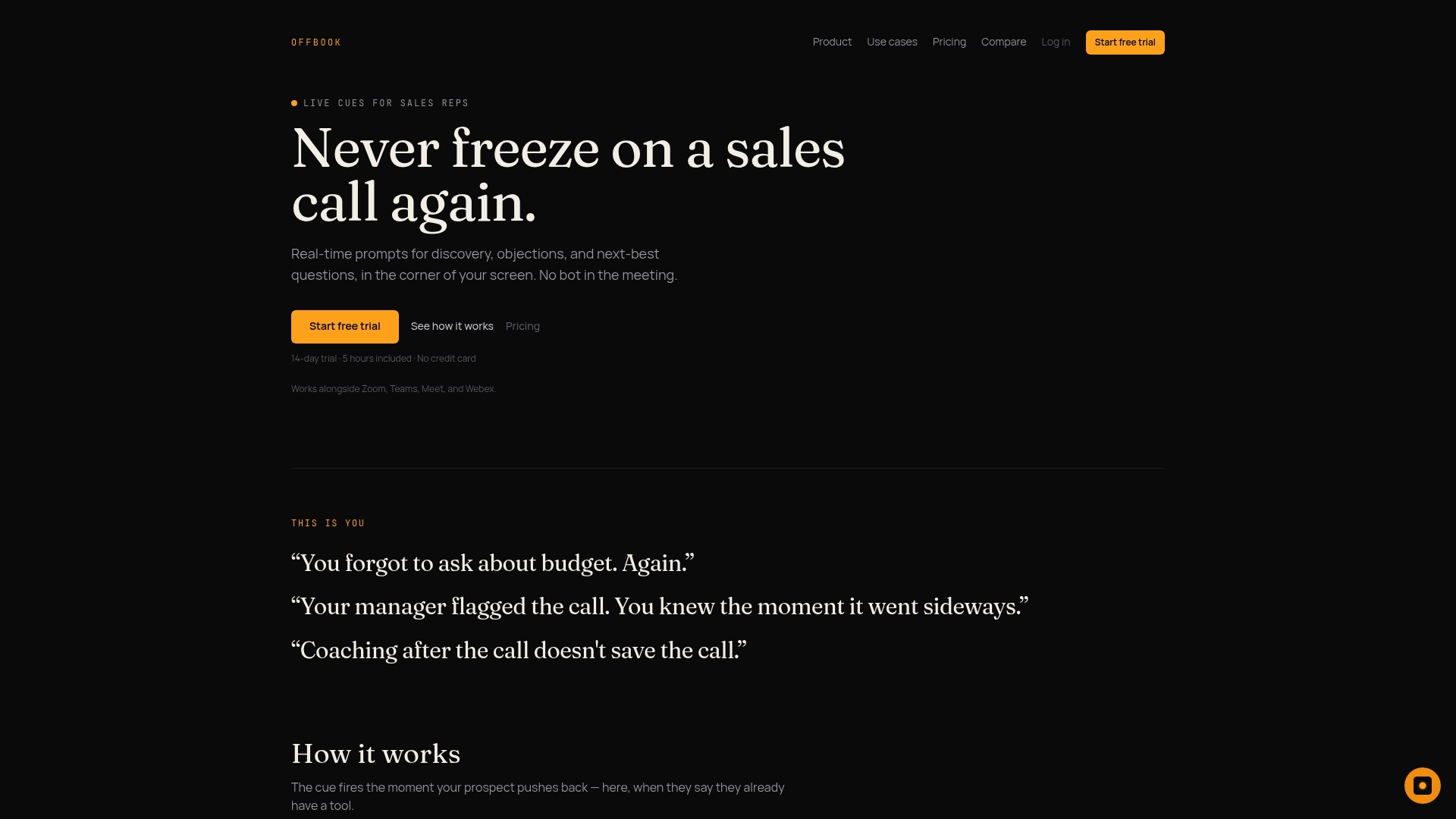
It’s built for founder-led B2B SaaS teams at seed and Series A stage, the exact teams juggling too many high-stakes calls and not enough coaching bandwidth to sit in on all of them. Offbook layers in pre-call briefs so reps walk in prepared, structures its prompts around MEDDIC and MEDDPICC, and generates a post-call debrief automatically so every conversation still becomes a coaching artifact, even without a manager on the line. Consultants and advisory teams running high-stakes client calls get the same live support through Offbook for consultants. If you’re ready to see what live coaching looks like on your own calls, start with Offbook for sales teams and run it on your next ten high-value conversations.
Sources
- What Real-Time Coaching Can Do Better Than Self-Paced Learning — Forbes Coaches Council
- Call Coaching vs Call Monitoring: What Actually Improves Performance? — PhoneNinjas
- Live Coaching vs. AI Coaching: Which is Better? — 2Win Global