Buying Signals on Calls: What B2B Reps Should Act On
Unlock the key buying signals on calls that B2B reps must act on to close deals faster. Learn strategies for success and next steps.
Published: August 20, 2026
Author: OffBook Editorial Team

The signals that reliably predict a close are pricing questions, timeline questions, requests for a demo or pilot, possessive language (“when we roll this out”), and any request to loop in a decision-maker. Hear a pricing question? Send a scoped proposal within the hour. Hear a timeline reference tied to a real date? Ask directly for the decision date and calendar the next step before the call ends. Possessive language means the prospect has mentally bought in, so shift from pitching to planning. A request to add a technical buyer or budget holder means the deal has cleared an internal hurdle, so move fast to get that person on the next call.
- Pricing or contract question → send a tailored proposal same day, ideally within the hour.
- Specific timeline or date mentioned → confirm the decision date out loud and lock a follow-up meeting before hanging up.
- Demo or trial request → schedule it promptly to maintain momentum.
- Possessive language (“our rollout,” “when we start”) → shift the conversation to implementation planning.
- Decision-maker or technical buyer requested → propose a joint call within 48 hours.
Not every signal deserves the same urgency. Pricing and timeline cues need minute-level follow-up. Everything else can wait a day without much risk.
Key Takeaways
Buying signals only translate into closed deals when reps recognize them instantly, confirm them with a probing question, and act within the window the signal’s strength demands.
| Point | Details |
|---|---|
| Strong signals need minute-level speed | Pricing, timeline, and decision-maker requests deserve same-hour follow-up, not a queued email. |
| Confirm before you act | Use a probing question to separate genuine intent from polite positivity before escalating a deal. |
| Score signals to triage consistently | A simple 3/2/1 point system across strong, moderate, and weak signals keeps prioritization objective. |
| Digital and verbal signals compound | A pricing-page visit paired with a timeline question on a call is a stronger combined signal than either alone. |
| Live coaching closes the detection gap | Offbook surfaces signals and qualification gaps on-screen during the call, when a rep can still act on them. |
Table of Contents
- What Are Buying Signals on Calls?
- Which Buying Signals Matter Most on a Call?
- How Do You Confirm a Signal Instead of Assuming It?
- What Digital Signals Should You Track Between Calls?
- How Do You Score and Prioritize Buying Signals?
- How Do Live Coaching Tools Improve Signal Detection?
- What Should You Do the Moment You Hear a Signal?
- A Coaching Drill for Spotting Signals in Real Time
- Coach Reps Live Instead of Reviewing Calls After the Fact
- Frequently Asked Questions
- Sources
What Are Buying Signals on Calls?
A buying signal is any word, behavior, or digital action that suggests a prospect is moving toward a purchase decision rather than just gathering information. Sales teams generally sort them into three buckets: verbal, non-verbal, and digital. Knowing which bucket a cue falls into changes how fast and how you should respond.
Verbal signals happen in the words a prospect chooses. Questions about pricing, contract terms, integration timelines, or “what happens after we sign” all fall here. HubSpot’s research on decision-stage language groups these into categories like purchasing questions, delivery-date questions, and risk-minimization questions, each phrased differently but pointing the same direction.
Non-verbal signals are harder to catch on a call, but they’re there. On video, that’s a camera staying on past the first five minutes, leaning toward the screen, or taking visible notes. On audio-only calls, watch for tone shifts, faster speech when a topic excites them, or a longer pause before answering a qualifying question.
Digital signals happen between calls, inside your CRM and marketing tools. A repeat visit to your pricing page, a demo or trial signup, or three clicks on the same case-study email all register as intent markers. HubSpot’s broader buying-signals guide recommends treating high-intent digital actions as triggers for immediate outreach, not queued nurture emails.
- Verbal: “What’s included in the enterprise tier?”
- Non-verbal: camera stays on, prospect starts typing notes mid-call
- Digital: three visits to your pricing page in one week
Which Buying Signals Matter Most on a Call?
Not all signals carry equal weight, and treating a mild “sounds interesting” the same as “can you send a contract” wastes your fastest-moving deals. Storylane’s framework for classifying buying signals sorts them into strong, moderate, and weak tiers, each with a different expected response speed.
1. Strong signals. These mean the prospect is actively evaluating whether to buy, not whether the product works.
- Demo or trial request: “Can we get a trial set up for my team?” Script: “Absolutely, let’s get you access today. Who else needs a login?” Next step: provision access within hours, not days.
- Pricing or contract questions: “What would this cost for 20 seats?” Script: “I’ll put together exact numbers for your seat count. Can I send that today?” Next step: send a scoped quote same day.
- Explicit timeline or next-step request: “We need this live by Q2.” Script: “Let’s map backward from that date. When would you need to sign to hit it?” Next step: build a mutual close plan on the spot.
- Decision-maker involvement: “Can you also talk to our CFO?” Script: “Happy to. What matters most to them in this decision?” Next step: schedule that call within 48 hours.
2. Moderate signals. These show genuine interest but not yet a commitment to move.
- Detailed product questions: “How does this handle SSO?” Script: “Great question, let me walk you through it.” Next step: follow up with documentation, not a hard close.
- Possessive language: “When we implement this…” Script: “Let’s talk about what that rollout would look like.” Next step: introduce an implementation guide or onboarding overview.
- Implementation questions: “How long does setup take?” Script: “Typically two to three weeks depending on integrations.” Next step: offer a technical call with your implementation team.
- Case study requests: “Do you have examples from companies our size?” Script: “Yes, let me send one that matches your industry.” Next step: send within 24 hours, then check in.
3. Weak signals. These indicate awareness, not intent, and rushing them tends to backfire.
- Social follows or content downloads: no direct script needed. Approach: add to a nurture sequence, don’t call immediately.
- Single email open: monitor only. Approach: wait for a second engagement before reaching out.
- Generic “just looking” comments: Script: “No pressure, what prompted you to take this call today?” Approach: probe gently, then let them lead the pace.
Context can upgrade or downgrade any of these. A vague “we’re interested” tied to a named budget cycle or a specific stakeholder becomes far more credible than the same phrase floating with no date attached. Prospeo’s phrase-by-deal-stage breakdown makes a similar point: the strength of a phrase depends heavily on what surrounds it, not just the words themselves.
How Do You Confirm a Signal Instead of Assuming It?
“Happy ears” is what sales coaches call the habit of hearing mild positivity and mistaking it for readiness to buy. Sandler’s coaching material on happy ears recommends training reps to listen for concrete, action-oriented language over vague enthusiasm; “this looks great” is not the same as “let’s get this in front of procurement.”
The fix is a short probing question that forces specificity.
- “When you say ‘get started,’ what does that look like on your end?”
- “Who else would need to sign off before this moves forward?”
- “What would need to be true for this to happen this quarter?”
- “Is there a budget cycle this needs to fit into?”
| Signal heard | Probing question | What a validating answer sounds like |
|---|---|---|
| “This looks great” | “What’s the next step from here?” | A named date, person, or process |
| “We’re interested” | “What’s driving the interest right now?” | A business reason tied to a deadline |
| “Sounds like what we need” | “Who else needs to be involved?” | A specific title or name |
Vague answers mean you’re still in the consideration stage. Specific ones mean you’ve found a real signal.
What Digital Signals Should You Track Between Calls?
Pricing-page visits, demo or trial signups, and repeated clicks on the same email all correlate strongly with active evaluation. HBR’s analysis of online sales leads found that lead value decays fast, which is exactly why response speed on digital signals matters as much as the signal itself.
- Pricing page visit → reach out within minutes if a call is already scheduled, or same day otherwise.
- Demo or trial signup → follow up within an hour. SalesIntel’s tracking research found this window matters most for demo and pricing inquiries specifically.
- Repeated email clicks on the same asset → follow up within 24 hours, referencing the exact asset they viewed.
- Competitor review activity or comparison content → treat as a 48 to 72 hour window; reference the specific concern directly.
A message like “I noticed you checked out the enterprise pricing page. Happy to walk through what that would look like for your team” converts far better than a generic check-in.
How Do You Score and Prioritize Buying Signals?
A simple point system keeps triage consistent across a team instead of relying on gut feel. Assign strong signals 3 points, moderate signals 2, and weak signals 1, then add them up across a single call or across a prospect’s full touch history.
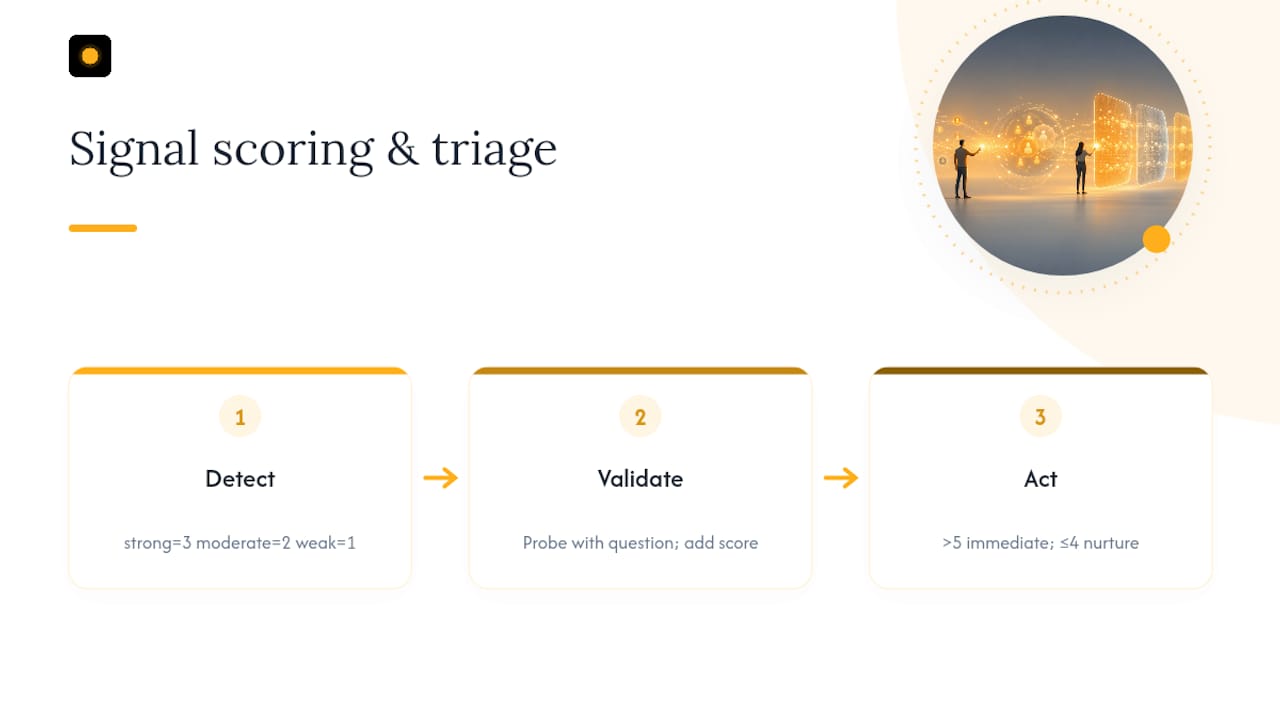
A score above 5 usually justifies immediate action. Four or below fits a nurture sequence. The workflow underneath is simple: detect the signal, validate it with a probing question, then act, whether that’s an immediate proposal, a scheduled follow-up, or a nurture email. Forrester’s guidance on buying signals points to the same principle: signals only pay off when a workflow turns them into fast, prioritized action rather than sitting unused in a CRM field.
How Do Live Coaching Tools Improve Signal Detection?
Reps miss signals constantly, not from lack of skill but because they’re juggling notes, objections, and pitch structure in real time, which is why tools like the RevRing AI Predictive Dialer & Calling Platform for Sales Teams can be invaluable. Live call intelligence closes that gap by surfacing cues as they happen instead of during a post-call review when the moment has passed.
The window to act on a buying signal is often measured in minutes, not days. A signal caught mid-call and acted on immediately behaves very differently than the same signal noticed a day later in a transcript.
Integrating this into a team’s workflow usually follows four steps: build a pre-call brief on the company and stakeholders, surface in-call prompts when a signal fires, generate a post-call debrief that flags what was said, and feed that into manager coaching cycles so reps improve session over session.
Offbook fits directly into that loop. It listens during the call and prompts reps on-screen when a qualification gap opens or a MEDDIC-relevant signal appears, without a bot joining the meeting. Pre-call briefs prepare reps on who they’re meeting before the call starts, and post-call debriefs capture what happened for coaching afterward.

Pro Tip: Review debriefs as a team weekly, not just individually. Patterns across five calls reveal more about missed signals than any single call ever will.
What Should You Do the Moment You Hear a Signal?
- Confirm it out loud. “So budget’s approved for this quarter, is that right?” Template: repeat the signal back as a question.
- Propose a concrete next step immediately. Don’t end the call on “let’s stay in touch.” Template: “Let’s get a pilot scoped for your team, does next Tuesday work?”
- Involve the decision-maker before the call ends. Template: “Can we get [name] on a 20-minute call this week?”
- Scope a pilot or trial right then. Template: “Based on what you’ve described, here’s what a 30-day pilot would look like.”
- Send a tailored proposal promptly to maintain momentum. Template: “Attached is a proposal built around the seat count and timeline we discussed.”
- Calendar the follow-up before hanging up. Template: “I’ll send an invite for Thursday to review the proposal together.”
Speed and personalization compound. A generic follow-up sent in three days loses most of the momentum a strong signal creates; a specific one sent within the hour keeps the deal moving at the pace the prospect set.
A Coaching Drill for Spotting Signals in Real Time
The best reps I’ve watched coach say less and listen more. Silence is where prospects reveal ownership language and real timelines, the kind of detail that gets buried when a rep is busy filling airtime with features.
Run this drill in your next team meeting. Pull two real call snippets, ideally one clean strong signal and one ambiguous “happy ears” moment. Have the team score each on the 3/2/1 scale from the triage framework, then discuss out loud where they disagreed and why. Follow with the probing questions from the confirmation section and have reps practice asking them cold, not reading off a script.
Measure progress by tracking each rep’s signal-detection rate on their next five calls, along with how often they escalate a signal that turns out to be a false positive. Fewer false positives over time means the training is working.
Coach Reps Live Instead of Reviewing Calls After the Fact
Recorders and transcript tools tell you what happened after the deal has already moved on. Offbook tells you what to do while the call is still live, surfacing objection handling, qualification gaps, and MEDDIC/MEDDPICC prompts directly on a rep’s screen as the conversation unfolds.
- Pre-call briefs on the company and stakeholders before the rep ever dials in
- In-call prompts that flag a missed qualification gap or a signal worth acting on immediately
- Instant post-call debriefs that turn every call into a coaching opportunity, not just a summary
- Built for founder-led B2B SaaS teams that need reps closing faster without adding headcount
If your team is losing deals to slow follow-up or missed signals, see how Offbook coaches sales calls live and start a trial to test it on your next round of calls.
Frequently Asked Questions
What is the strongest buying signal on a sales call? A direct pricing or contract question paired with a specific timeline is typically the strongest combination, since it shows both budget awareness and urgency in the same conversation.
How do you tell a real buying signal from polite interest? Ask a probing question that forces specificity, like “who else needs to be involved?” A vague answer means it’s still early interest; a named person, date, or process means it’s a real signal.
How fast should a rep respond to a digital buying signal? Pricing-page visits and demo signups deserve a response within an hour when possible. Weaker signals like a single email open can wait 24 hours or fold into a nurture sequence.
Can non-verbal cues on a call actually predict intent? They’re supportive evidence, not standalone proof. A prospect leaning in or taking notes strengthens a verbal signal you’ve already heard, but it shouldn’t drive action on its own.
How does live call coaching help with spotting buying signals? Tools like Offbook prompt reps on-screen the moment a qualification gap or signal-relevant moment appears, so the rep can act inside the call instead of catching it later in a transcript review.
Sources
- 25 Phrases That Signal a Prospect Is Ready to Buy
- Comprehensive Guide to Buying Signals and Indicators
- Verbal Buying Signals: 15 Phrases + What to Say Back (2026)