How to Build Urgency Without Discounting in B2B Sales
Learn to create urgency in B2B sales without discounts. Discover key strategies that tie pressure to time and value for better outcomes.
Published: August 24, 2026
Author: OffBook Editorial Team

Yes, you can build urgency without discounting: tie the pressure to time and value instead of price, and make sure the buyer can verify the claim themselves. That’s the whole answer. The mechanics that make it work are simpler than most sales teams assume.
Here’s the three-step play you can run on your next call. First, discover a real deadline the buyer already has, don’t invent one. Second, quantify what delay actually costs them in dollars or lost time. Third, propose a time-boxed next step that matches their calendar, not your quota.
- Ask what happens if nothing changes for six months.
- Turn the answer into a number the buyer can repeat to their CFO.
- Anchor your ask to their timeline, not your quarter-end.
This is the same discipline behind MEDDIC and MEDDPICC: qualify the pain, quantify it, and let the buyer’s own math create the pressure. The urgency that closes deals fastest is the kind the buyer discovers, not the kind you announce. Tools like OffBook exist specifically to help reps catch these signals live, on the call, instead of reconstructing them from memory afterward.
Key Takeaways
Urgency that closes B2B deals faster comes from quantifying the buyer’s own cost of delay, not from shortening a discount window.
| Point | Details |
|---|---|
| Lead with discovery | Ask what happens if nothing changes for six months to surface a real deadline. |
| Quantify before you pitch | Calculate monthly impact times months delayed to give the buyer a defensible number. |
| Anchor tactics to real limits | Only use caps, timers, or price windows tied to a fact you can verify on request. |
| Watch the trust signals | Track refund requests and support tickets alongside conversion lift in every test. |
| Use live coaching to catch triggers | Real-time prompts help reps convert a passing comment into a quantified deadline before the call ends. |
Primary sources and further reading
- Urgency Creation: Accelerating Decisions Without Manipulation
- How to Create Urgency Without Discounts
- How to Create Urgency Without Cheapening Your Brand
- Creating Urgency in Marketing
Table of Contents
- Why Urgency Works, and Where It Crosses an Ethical Line
- What Discovery Questions Reveal a Real “Why Now”
- Which Urgency Tactics Actually Work Without a Discount?
- How Do You Test and Govern Urgency Without It Backfiring?
- What Red Flags Signal Fake Urgency Is Damaging Trust?
- How OffBook Helps Reps Surface Real Urgency Live on the Call
- Sources
Why Urgency Works, and Where It Crosses an Ethical Line
Urgency isn’t a sales trick. It’s a shortcut your brain already uses to make decisions faster when the stakes feel real. Four mechanisms drive almost all of it: scarcity (limited availability changes how we value something), loss aversion (people work harder to avoid losing what they have than to gain something new), social proof (watching others act reduces the perceived risk of acting), and time pressure (a closing window forces a decision instead of indefinite deliberation).
The problem is that most B2B teams only know how to trigger one of these: price. A discount that expires Friday is scarcity and time pressure bolted onto a number, and it works exactly once per buyer before they learn to wait for the next one. Neat & Nimble’s analysis of urgency and brand pricing makes the point directly: repeated discounting quietly trains your market to distrust your list price, and it erodes the pricing power you’ll need later.
Urgency tied to time-to-value survives that trap. If onboarding takes six weeks and the buyer needs results by Q4, that’s a real deadline with no expiration hack attached. Research compiled by Rework found that B2B deals built on genuine urgency close meaningfully faster, while manufactured urgency tends to backfire through early churn once the buyer feels misled.
There’s a simple test for whether your urgency is legitimate: can the buyer verify it? If a rep says “we’re onboarding three new cohorts this quarter and two are full,” that claim should hold up if the buyer asks a follow-up question. If it wouldn’t, it’s fake, and buyers usually sense the wobble before they can name it.
Pro Tip: Before you use any urgency claim, write the one sentence that explains what actually changes when the window closes. If you can’t write that sentence honestly, don’t use the claim.
What Discovery Questions Reveal a Real “Why Now”
Urgency you can defend starts with questions, not statements. The goal in discovery isn’t to manufacture pressure, it’s to find pressure that already exists and put a number on it.
- Ask about consequences, not features. “What happens if this stays the same for six months?” surfaces the cost of inaction better than any feature pitch, a technique Modern Sales Training recommends for exactly this reason.
- Ask about calendar triggers. Board reviews, budget cycles, hiring plans, and renewal dates all create real deadlines you didn’t invent.
- Ask who else needs to see the math. If the champion needs to justify this to a CFO, your job is to hand them the argument, not make them build it alone.
Once you have a real trigger, run the cost-of-delay math on the call itself: monthly impact multiplied by months delayed equals total cost of waiting.
That $72,000 isn’t a discount, it’s the buyer’s own number, which is why it survives a hallway conversation with the CFO that you’ll never be in the room for. Package it as one slide: the problem, the monthly cost, the delay, the total, and the deadline that avoids it. A rep who can produce that slide in real time, sourced from good discovery questions, has built more urgency than any countdown timer ever will.

Which Urgency Tactics Actually Work Without a Discount?
Not every tactic fits every deal stage. Matching the tactic to the buyer’s situation is what separates urgency that closes deals from urgency that just annoys people.
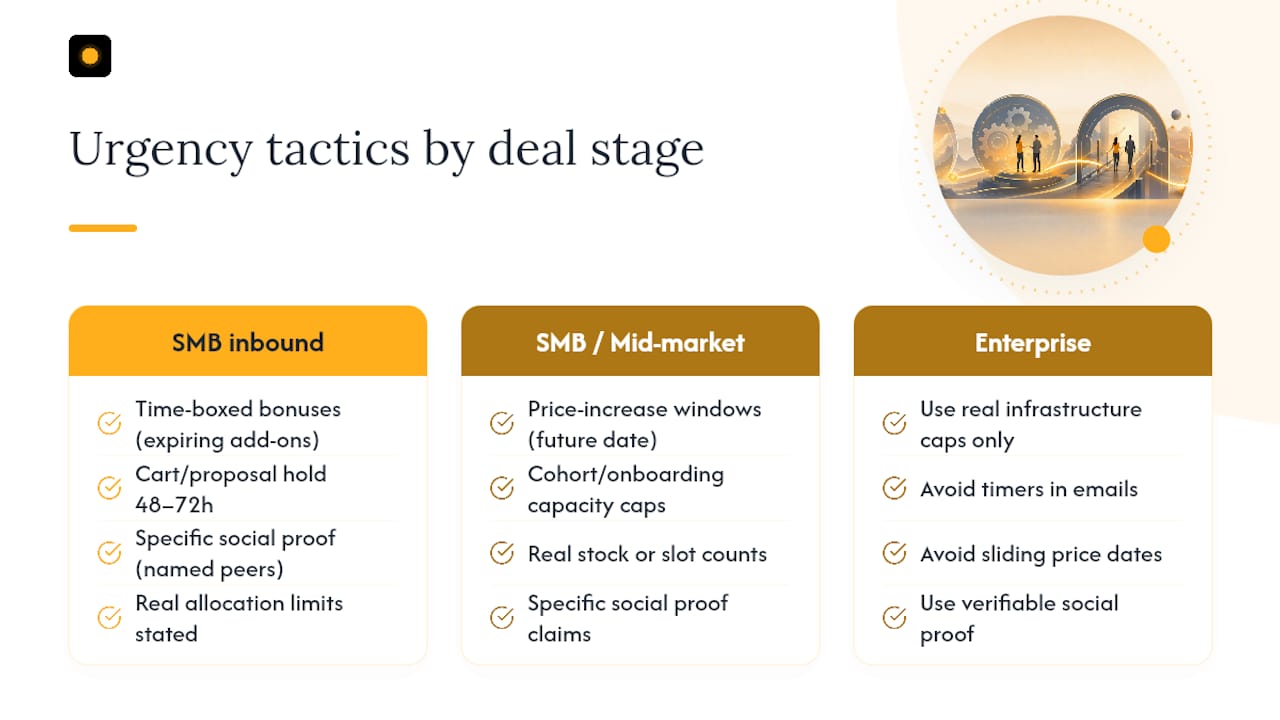
Time-boxed bonuses. Instead of cutting price, add value with an expiration: free onboarding hours, an extra seat, priority implementation support. Place the offer in the proposal itself and mention it once in a follow-up email, never in the subject line. This fits SMB inbound deals best, where a small nudge can move a stalled decision.
Cohort or onboarding capacity limits. If your customer success team can only onboard a fixed number of accounts per month, say so, and mean it. Quikly’s framework treats this as infrastructure, not marketing copy, meaning the cap has to be real and tracked, not a number someone typed into an email template.
Price-increase windows. Announcing a future price change (not a current discount) gives buyers a legitimate reason to move now. This works best in SMB and mid-market deals with shorter cycles; enterprise buyers usually see through it if the increase date keeps sliding.
Real stock or allocation limits. If you’re selling implementation slots, support hours, or a limited pilot cohort, state the actual number left. “Six pilot spots, four filled” only works if that’s literally true.
Social proof and activity nudges. “Three companies in your sector adopted this last month” is powerful because it’s specific and checkable, unlike vague claims about popularity.
Cart or proposal reservation timers. A 48 to 72 hour hold on a proposed contract term works in self-serve and low-touch SMB motions, but reads as gimmicky in enterprise negotiation, where legal review timelines make any timer meaningless.
Pro Tip: Avoid combining too many urgency signals in a single email. Stacking a countdown timer, a bonus, and a scarcity claim in one message reads as desperation, not confidence.
Frequency matters as much as content. Cap urgency messaging to once per deal stage, and escalate from implied urgency (mentioning a trend) to explicit urgency (naming a real deadline) only once the buyer has confirmed the underlying fact themselves.
How Do You Test and Govern Urgency Without It Backfiring?
Urgency claims need the same operational rigor as your billing system, because a broken promise here costs more than a bug ticket. Three requirements come first.
- Anchor every timer server-side. A countdown that resets when a visitor clears cookies isn’t urgency, it’s a lie with a clock graphic. Quikly’s guidance treats server-anchored timers and live participation caps as the baseline, not an upgrade.
- Synchronize messaging across channels. If email says four spots remain and the landing page says available now, you’ve already lost the buyer’s trust before they book the call.
- Document eligibility rules before launch. Who qualifies for the bonus, what happens at the deadline, and who signs off on exceptions. Write it down before the campaign goes live, not after the first complaint.
Test urgency the way you’d test pricing: run a control group against a variant with one urgency lever isolated, and give it enough volume to read a real signal rather than noise. Watch three KPIs. Conversion lift tells you whether the tactic moves deals at all. Refund requests and support ticket volume tell you whether buyers felt misled after the fact, which several sources flag as the fastest signal of manufactured scarcity. Qualified-pipeline velocity tells you whether deals are actually closing faster or just closing messier.
Roll out in this order: pilot on one segment, measure for a full sales cycle, then scale. Stop immediately if refund or churn signals rise even while conversion looks good, because that combination means you moved the decision, not the conviction.
What Red Flags Signal Fake Urgency Is Damaging Trust?
A few patterns show up right before a customer relationship sours. Watch for these:
- Timers that reset when a prospect revisits a page or clears their cache.
- “Limited spots” language that appears on every single page, quarter after quarter, with no cap that ever actually binds.
- Perpetual sales where the “ending soon” banner has been ending soon for a year.
- Hidden terms discovered only after signature, like a bonus that turns out to require a longer contract.
These show up in your data before anyone complains out loud: rising refund requests, a spike in support tickets asking “wait, is this real,” and slowly declining email open rates as your list learns to tune you out.
Recovery is straightforward but non-negotiable. Honor every commitment you made, even the ones you regret. Tighten your eligibility rules so the next campaign can’t repeat the mistake. Then say so, plainly, in your next customer communication, because silence reads as more of the same.
How OffBook Helps Reps Surface Real Urgency Live on the Call
Most urgency gets missed not because reps don’t care, but because they’re too busy running the conversation to catch the signal and do the math in real time.
OffBook listens to the call and surfaces live cues on-screen, prompting the discovery question that uncovers a deadline instead of leaving it for the drive home when the moment’s gone. If a buyer mentions a board review in six weeks or a new hire starting next month, OffBook can prompt the rep to ask the follow-up that turns that mention into a number: “What’s the cost if this project isn’t live before that hire starts?”
The most useful thing a coaching prompt can do isn’t tell a rep what to say. It’s catch the ten-second window where a real deadline slips by unnoticed and hand the rep the next question before it’s gone.
Because the prompts are structured around MEDDIC and MEDDPICC, they push toward quantified pain and verified timelines rather than generic objection handling. That structure is also what makes it harder to fall back on artificial pressure. When a rep can build a credible cost-of-delay case with the buyer, live, there’s no need for a countdown timer to do the persuading. Pre-call briefs add the other half: reps walk in already knowing likely triggers (funding stage, hiring plans, recent leadership changes) instead of discovering them cold. Explore OffBook for sales teams to see how live coaching fits into your existing call structure.
Author perspective: what to test first if you’re a founder-led team
Start with discovery and the cost-of-delay template, it costs nothing and works in an email. Add one time-boxed bonus once you’ve proven the math resonates. Skip anything requiring engineering (real-time caps, synced timers) until you’ve validated demand manually. Runway is too short to build infrastructure for a tactic you haven’t confirmed works.
Sources
- Urgency Creation: Accelerating Decisions Without Manipulation
- How to Create Urgency Without Discounts
- How to Create Urgency Without Cheapening Your Brand
- Creating urgency in marketing