ACV Gate: BANT vs MEDDIC, Use BANT Under $15,000
Use BANT as a four-question intake filter. Trigger MEDDIC when ACV or stakeholder gates are met. Includes CRM gate rules and a live-call evidence workflow.
Published: September 11, 2026
Author: OffBook Editorial Team

Run BANT when you need a fast, four-question filter for high-velocity deals. Run MEDDIC, or its extended cousin MEDDPICC, when the deal has multiple stakeholders, a procurement process, or an ACV big enough to justify real deal inspection. The safe default is to use BANT to triage every lead at intake, then escalate to MEDDIC once a deal crosses your team’s dollar or stakeholder threshold.
TL;DR:
- Most deals require escalating from BANT to MEDDIC once the contract value exceeds around $15,000 to $25,000 or when multiple stakeholders are involved.
- BANT is effective for quick qualification of low-value, single-decision deals, but risks disqualification on early budget issues or committees.
- MEDDIC provides a comprehensive deal inspection over the full sales cycle, emphasizing evidence collection for Metrics, Economic Buyer, and Decision Process.
- Successful adoption relies on integrating minimal MEDDIC fields into CRM, live call coaching, and consistent deal review routines focused on evidence, not checkbox completion.
- AI tools that prompt real-time qualification questions during calls significantly improve deal qualification timing, reducing forecast errors and increasing late-stage conversions.
Table of Contents
- What Is BANT in Sales, and When Does It Actually Work?
- What Is MEDDIC, and How Does It Become MEDDPICC?
- BANT vs MEDDIC: A Side-by-Side Comparison
- When to Use BANT vs MEDDIC: A Decision Checklist
- Rolling Out MEDDIC and MEDDPICC Without Losing Your Team
- How Live Call Coaching Turns MEDDIC Into a Habit, Not a Form
- The Bottom Line on BANT vs MEDDIC
- Common Pitfalls When Applying BANT or MEDDIC
- Training Sales Teams on Both Frameworks
- Where AI and Sales Engagement Tools Fit Into BANT and MEDDIC
- Why the Real BANT vs MEDDIC Debate Misses the Point
- Sources
What Is BANT in Sales, and When Does It Actually Work?
BANT stands for Budget, Authority, Need, and Timeline. It was built decades ago as a quick gate for transactional sales, where one person could say yes and the purchase decision lived in a single conversation. Each letter maps to a single, blunt question you can ask on a first call, and that simplicity is exactly why BANT still works for high-volume inbound motions.
Here’s how the questions actually sound on a call:
- Budget: “Do you have money allocated for this, or would this be a new line item?”
- Authority: “Who else needs to sign off before you can move forward?”
- Need: “What happens if you don’t solve this in the next quarter?”
- Timeline: “When do you need this live?”
BANT earns its keep in SMB sales, inbound funnels, and any motion where reps handle high call volume and short cycles. It’s fast, it’s teachable in a day, and it stops reps from chasing leads with no real intent.
It also breaks down in three predictable ways. First, budget often doesn’t exist yet. Enterprise buyers frequently create budget mid-cycle once they see a compelling business case, so disqualifying on “no budget” in month one can kill a deal that would have closed in month four. Second, “Authority” assumes one decision-maker, but most B2B purchases now run through a buying committee, not a single signer. Third, reps often use BANT to justify premature disqualification, walking away from deals that just need more nurturing instead of a hard no.
What Is MEDDIC, and How Does It Become MEDDPICC?
MEDDIC is a six-element framework for inspecting complex B2B deals, not a script for a single call. It forces reps to collect evidence over multiple conversations rather than take a prospect’s word for it, and each element maps to a specific proof point you should be able to point to in your CRM:
- Metrics. What quantified business outcome is the buyer trying to hit? Evidence looks like a specific number the buyer stated out loud, not your assumption of one.
- Economic buyer. Who controls the budget and can say yes without escalating further? Evidence is a name, a title, and ideally a call where that person spoke.
- Decision criteria. What formal or informal checklist will this deal get measured against? Evidence is a documented list, whether it’s a spreadsheet the buyer shares or notes from a discovery call.
- Decision process. What are the actual steps, in order, between now and a signed contract? Evidence is a dated sequence: legal review on this date, security review on that one.
- Identify pain. What specific, painful business problem is driving urgency? Evidence is a quote from the buyer describing the cost of inaction in their own words.
- Champion. Who inside the account will sell on your behalf when you’re not in the room? Evidence is that person taking action for you unprompted, like scheduling your next meeting internally.
The two extra letters in MEDDPICC add Paper Process and Competition, and they earn their place the moment procurement gets involved. Paper Process covers every administrative step after someone says “yes” verbally: security questionnaires, legal redlines, PO issuance. Deals stall here constantly, and qualifying those steps early correlates directly with how defensible your forecast actually is. Competition matters once more than one vendor is in the room, because a deal you’re “winning” on paper can lose to a competitor who understood the decision criteria better than you did.
The real shift MEDDIC demands isn’t vocabulary. It’s habit. MEDDIC only works as an ongoing deal inspection ritual, revisited in every call and every deal review, not a form you fill out once after discovery and never touch again.
BANT vs MEDDIC: A Side-by-Side Comparison
The two frameworks aren’t competing for the same job. BANT answers “is this worth my time,” and MEDDIC answers “will this actually close, and when.” Here’s how they stack up on the axes that matter to a sales manager building pipeline hygiene.
| Axis | BANT | MEDDIC / MEDDPICC |
|---|---|---|
| Primary purpose | Fast intake filter | Deep deal inspection |
| Best-fit deal profile | Low ACV, single decision-maker | Mid-market and enterprise, multiple stakeholders |
| Time to qualify | One call, a few minutes | Spans the full sales cycle |
| Stakeholder coverage | Assumes one buyer | Maps the full buying committee |
| CRM / tooling burden | Minimal, four fields | Heavy, six to eight fields per deal |
| Forecasting reliability | Weak on complex deals | Strong when fields are enforced |
A few things worth pulling out of that table. BANT’s speed is real, but it’s a feature, not a flaw to fix. Forcing a six-field MEDDIC review onto a $2,000 self-serve deal wastes rep time that should go toward volume. On the flip side, MEDDIC’s stakeholder mapping is what actually protects your forecast once a deal has more than one decision-maker, because a forecast built on “the champion said yes” collapses the moment that champion gets overruled.
The CRM burden row deserves a caveat too. MEDDPICC’s extra fields only pay off if someone actually checks them. A CRM full of unverified checkboxes is worse than no framework at all, because it gives leadership false confidence in a number that isn’t real.
When to Use BANT vs MEDDIC: A Decision Checklist
Most teams don’t need to pick one framework forever. They need a rule that tells a rep, in the moment, which one applies to the deal in front of them. Here’s a workable version you can adapt:
- Run BANT at intake, always. Every new opportunity gets the four-question filter within the first call, no exceptions.
- Set an ACV gate. If the deal’s annual contract value crosses your predefined threshold (many founder-led SaaS teams use somewhere between $15,000 and $25,000 as the line), MEDDIC becomes mandatory, not optional.
- Set a stakeholder gate. The moment a second decision-maker or influencer joins a call, escalate to MEDDIC regardless of deal size. One extra voice in the room means a buying committee, and BANT has no mechanism for that.
- Treat missing letters as risk, not disqualification. A deal with no identified Economic Buyer isn’t dead, it’s a flagged risk that needs a specific next action: get that person on a call within two weeks.
- Score deals on evidence, not intuition. A deal with five of six MEDDIC elements documented with real evidence outranks one where a rep just marked every field “yes” from memory.
Sequencing the two frameworks this way protects rep velocity on small deals while giving managers a real forecast on the ones that matter most to the quarter.
Pro Tip: Write your ACV and stakeholder gates directly into the deal stage requirements in your CRM, not just in a wiki page nobody reads. If a rep can’t move a deal from “Discovery” to “Proposal” without an Economic Buyer field filled in, the rule enforces itself.
Rolling Out MEDDIC and MEDDPICC Without Losing Your Team
Adoption fails more often than the framework does. The methodology isn’t the hard part. Getting eight reps to fill in the same six fields the same way, every week, is.
Start with the CRM fields themselves, and keep the list short enough that reps don’t treat it as busywork:
- Evidence for Metrics (a specific number, quoted)
- Economic Buyer name and title
- Decision Criteria (documented, with a date it was confirmed)
- Decision Process steps with dates
- Champion status and last confirmed action
- Paper Process checklist (security review, legal, PO)
- Competition notes, updated per call
Fields alone don’t create discipline. That comes from three rituals: weekly deal reviews where a manager asks for evidence, not just field completion; forecast calls where any deal missing an Economic Buyer gets flagged automatically; and live call coaching, where a rep gets nudged toward the right question in the moment instead of learning about the gap after the deal is already lost.
Three failure modes show up constantly. Check-boxing, where reps mark fields complete without real evidence behind them. Retrospective filling, where a rep back-fills MEDDIC fields the night before a forecast call instead of capturing them live. And inconsistent definitions, where one rep’s “Champion” is another rep’s “friendly contact who answers emails.” The fix for all three is the same: managers spot-check evidence in deal reviews, not just field completion rates.
Adoption of MEDDPICC fields is often widespread, but full, consistent qualification is not, which is the gap between having a framework and running one. Track three KPIs to know if it’s actually working: late-stage conversion rate, forecast accuracy (committed versus actually closed), and slippage rate on deals marked “commit.” If those three numbers aren’t moving after a quarter, the fields exist but the discipline doesn’t. A short weekly dashboard tracking just those three, next to MEDDIC field completeness, tells you which failure mode you’re dealing with faster than any all-hands meeting will.
How Live Call Coaching Turns MEDDIC Into a Habit, Not a Form
MEDDIC’s biggest weakness in practice is timing. Reps remember to ask about the Economic Buyer during deal review prep, three days after the call where they should have asked it. By then the moment’s gone, and the CRM field gets filled in from memory instead of evidence.
A three-part workflow closes that gap:
- Pre-call brief: before the meeting, the rep gets context on who’s joining, their role, and what MEDDIC gaps remain open from the last call.
- In-call evidence capture: live, on-screen prompts flag the moment a rep should ask for a specific metric, confirm the Economic Buyer, or probe the decision process, right as the conversation opens the door for it.
- Post-call CRM update: the specific evidence captured, quotes, names, dates, documents mentioned, flows straight into the right MEDDIC field instead of getting summarized from memory an hour later.
OffBook builds exactly this workflow, listening to live video calls and surfacing on-screen cues without a bot ever joining the meeting, structured around MEDDIC and MEDDPICC rather than generic talk-track prompts. A rep mid-call gets nudged toward “who else needs to sign off on this” the moment a buyer mentions procurement, instead of realizing three days later that nobody asked.
The likely outcome of capturing evidence this way, rather than backfilling it, is fewer placeholder close dates and a forecast that reflects actual deal state instead of rep optimism. Teams piloting this kind of structured rollout can start with a documented MEDDPICC template for their CRM fields before adding live coaching on top.
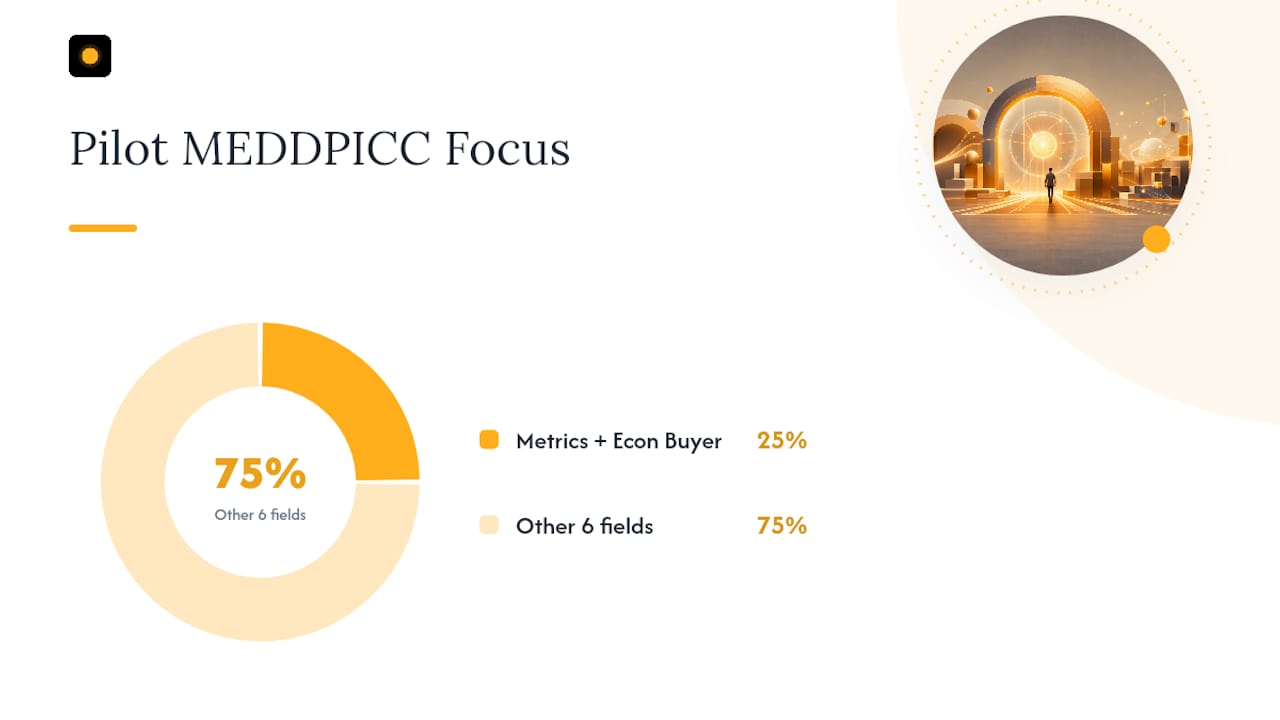
Pro Tip: If you’re piloting MEDDIC for the first time, don’t try to capture all eight MEDDPICC fields in week one. Start with Metrics and Economic Buyer only, get reps consistent on those two, then layer in the rest.
The Bottom Line on BANT vs MEDDIC
Neither framework replaces the other. BANT filters fast at intake; MEDDIC or MEDDPICC inspects deals once they’re worth the extra scrutiny. Sequencing them protects both rep velocity and forecast accuracy.
- Set your ACV and stakeholder gates this week, and write them into your CRM stage requirements.
- Add the minimal MEDDIC fields and one weekly governance ritual, a deal review where a manager asks for evidence, not just checkboxes.
- Start coaching to the framework live, not retroactively, and track late-stage conversion and forecast accuracy from day one.
| After one quarter, you should see | Why it matters |
|---|---|
| Fewer deals with placeholder close dates | Evidence replaces guesswork in the forecast |
| Higher late-stage conversion on MEDDIC-gated deals | Real Economic Buyer and Champion confirmation catches risk earlier |
| Consistent field completion across reps, not just top performers | Signals the ritual is working, not just individual discipline |
Common Pitfalls When Applying BANT or MEDDIC
The most common BANT mistake is treating “no budget yet” as a hard disqualifier instead of a timing issue. Budget gets created constantly once a strong business case lands in front of the right person, and a rep who walks away too early hands that deal to a competitor with more patience.
The most common MEDDIC mistake is the opposite problem: over-collection without verification. A rep fills in all six fields from a single call, based on assumptions rather than confirmed evidence, and the deal looks healthy in the CRM right up until it stalls in legal review. Champion status is especially prone to this. Reps mistake a friendly, responsive contact for a true champion, someone willing to advocate internally, when that contact has no actual influence over the decision.
A subtler pitfall hits both frameworks equally: definitional drift across a team. If five reps have five different bars for what counts as a confirmed Economic Buyer, your pipeline reports are comparing five different qualification standards under one label. That’s a coaching problem, not a framework problem, and it only shows up when a manager actually audits the evidence behind a few “qualified” deals each week rather than trusting the field.
Training Sales Teams on Both Frameworks
Training works best when it’s built around live deals, not slide decks. Run a session where reps bring a real, active opportunity and map it against BANT first, then MEDDIC. Most reps discover in that exercise that they can answer the four BANT questions but can’t name the Economic Buyer or describe the decision process in specific terms, which makes the gap between “qualified” and “actually understood” obvious fast.
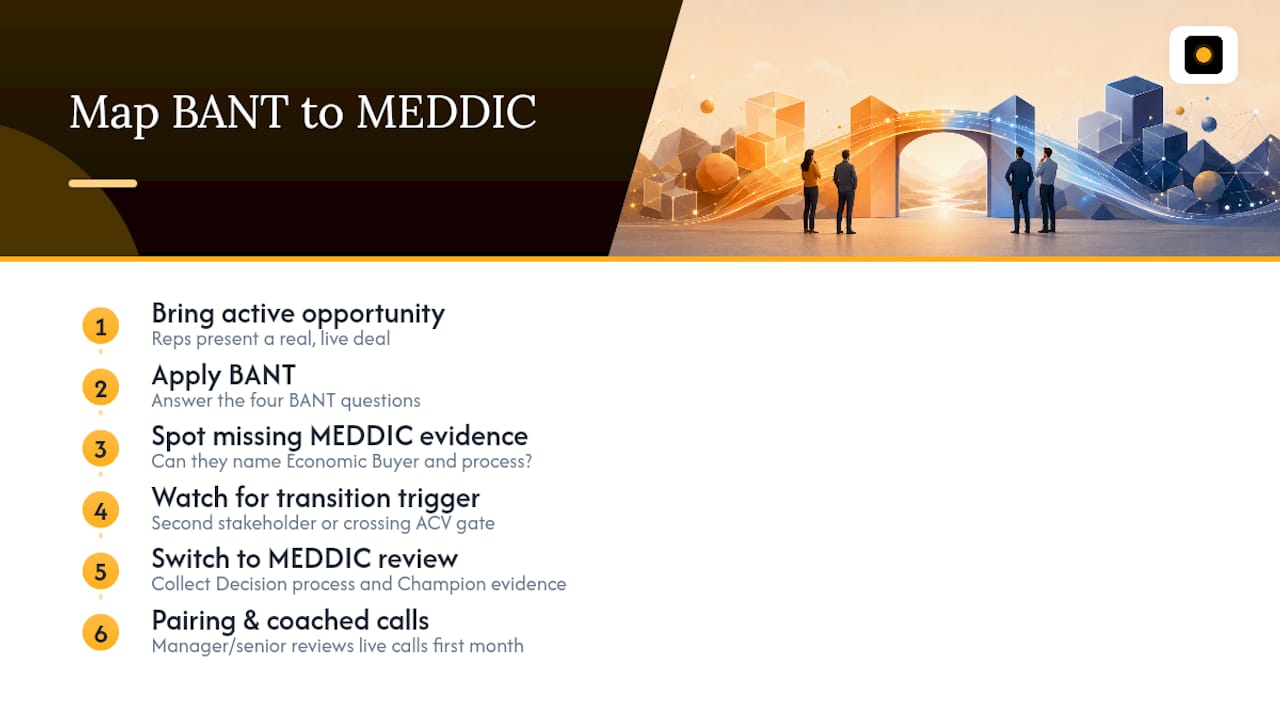
Role-play the transition point specifically: the moment a rep should stop treating a deal as BANT-qualified and start collecting MEDDIC evidence. New reps especially need practice recognizing that trigger, whether it’s a second stakeholder joining a call or a deal crossing the ACV gate, because it doesn’t announce itself.
Pair new reps with a manager or senior rep during live deal reviews for the first month, reviewing actual call recordings or live sessions rather than CRM notes alone. Coaching cadence tied to real calls, not just quarterly training refreshers, drives measurably better late-stage conversion than a one-time framework rollout ever does. A step-by-step MEDDIC implementation guide can anchor that first month, giving new hires a shared reference instead of five different verbal interpretations of what “Champion” means.
Where AI and Sales Engagement Tools Fit Into BANT and MEDDIC
Sales engagement platforms have automated a lot of the outbound and follow-up work around qualification, but most of them log what happened after the call ends. That’s useful for pipeline reporting. It does nothing to help a rep ask the right question while the buyer is still on the line.
The gap that AI coaching tools are starting to close is timing, not data collection. A rep mid-call, hearing a buyer mention a security review for the first time, needs a nudge right then to ask who owns that review and when it’s scheduled. By the next day, that detail is gone or reconstructed from memory, which is exactly how Paper Process gaps become forecast surprises three weeks later.
This is also where deal advancement tactics intersect with the framework choice itself. A rep who knows the right MEDDIC question to ask but forgets to ask it in the moment gets the same bad outcome as a rep who never learned the framework at all. Tools that surface qualification prompts live, rather than summarizing calls after the fact, are built specifically to close that execution gap, turning a framework reps know intellectually into one they actually run on every call.
Why the Real BANT vs MEDDIC Debate Misses the Point
The framing of “BANT vs MEDDIC” as a single winner-take-all choice is where most sales leaders go wrong. It’s not the wrong question because both frameworks have merit. It’s the wrong question because it assumes one model has to govern every deal in the pipeline, when the actual job is matching qualification depth to deal complexity.
What conventional advice underplays is enforcement. Plenty of teams have MEDDPICC fields sitting in their CRM right now, mandated by leadership eighteen months ago, filled in retrospect the night before forecast calls. That’s not a framework failure. It’s a discipline failure wearing a framework’s name.
If you’re a sales leader deciding where to spend your attention this quarter, spend it on the gate and the ritual, not the acronym. Set the ACV and stakeholder threshold that triggers MEDDIC. Build one weekly review where a manager checks evidence, not field completion. Everything else, including whether you call the extra letters MEDDPICC or something your team invented, matters far less than whether anyone is actually checking the work.
— Neil
Sources
- MEDDIC vs MEDDPICC: What the extra letters add | Closing Foundry
- MEDDPICC vs BANT: Which framework gates enterprise deals? | ORM
- B2B buying journey insights | Gartner