The B2B Sales Tech Stack Checklist for 2026
Unlock your sales potential with our B2B sales tech stack checklist for 2026. Discover essential tools to boost efficiency and drive growth!
Published: July 21, 2026
Author: OffBook Editorial Team

What belongs in your B2B sales tech stack checklist
The five categories every functional B2B sales tech stack needs in 2026 are data and enrichment, CRM, multi-channel outreach, conversation intelligence, and analytics and forecasting. Get all five in place and integrated before adding anything else. Everything beyond that is supplementary until you scale past 20 reps.
The tools that fill those categories are well established. Apollo and Cognism lead on data. Salesforce and HubSpot CRM anchor the CRM layer. Salesloft and Outreach handle multi-channel outreach at scale. Gong and Fireflies cover conversation intelligence at different price points. Clari owns the forecasting layer for mid-market and enterprise teams. The table below maps every major category to the tools worth considering, their best-fit use case, and what they actually cost.
Core categories your stack must cover:
- Data and enrichment (Apollo, Cognism, ZoomInfo, Kaspr, Lead Forensics, Leadfeeder)
- CRM and pipeline management (Salesforce, HubSpot CRM, Pipedrive, Close)
- Multi-channel outreach and sequencing (Salesloft, Outreach, Groove, Amplemarket, Mailtastic)
- Scheduling and meeting routing (Calendly, Chili Piper, Doodle)
- Conversation intelligence and coaching (Gong, Fireflies, Jiminny)
- Analytics, forecasting, and revenue intelligence (Clari)
- Sales enablement and demos (Navattic, Trumpet)
- Commission and compensation management (QuotaPath, Spiff, CaptivateIQ)
| Tool | Category | Best for | Key features | Pricing overview |
|---|---|---|---|---|
| Salesforce | CRM | Large enterprises with complex processes | Deep customization, AppExchange, AI forecasting | $150–$300/user/month |
| HubSpot CRM | CRM | SMB to mid-market, marketing alignment | Free tier, native automation, marketing suite | Free; $50–$120/user/mo |
| Pipedrive | CRM | Pipeline-focused SMB teams | Visual pipeline, affordable tiers, easy adoption | ~$50/user/mo (Professional) |
| Close | CRM | High-velocity inside sales teams | Native dialer, calling workflows, clean UX | $70–$110/user/mo |
| Apollo | Data and enrichment | B2B teams needing contact data and outreach | 275M+ contact database, sequences, dialer | Free tier |
| Cognism | Data and enrichment | Mid-market to enterprise, compliance-sensitive | AI-verified data, intent signals, GDPR focus | Custom pricing |
| ZoomInfo | Data and enrichment | Enterprise teams needing wide coverage | Vast verified database, intent data, integrations | $2,500+/mo |
| Kaspr | Data and enrichment | LinkedIn-first prospecting teams | LinkedIn contact extraction, enrichment | Tiered plans |
| Lead Forensics | Data and enrichment | Teams wanting anonymous visitor intelligence | Website visitor ID, company-level lead data | Custom pricing |
| Leadfeeder | Data and enrichment | Marketing and sales lead qualification | Behavioral web tracking, CRM sync | Tiered plans |
| Salesloft | Outreach and sequencing | Scaling outbound with complex cadences | Multi-channel sequences, analytics, coaching | $125+/user/mo |
| Outreach | Outreach and sequencing | Mid to large teams needing automation | Workflow automation, pipeline visibility | $100+/user/mo |
| Groove | Outreach and sequencing | Salesforce-heavy sales teams | Native Salesforce integration, automation | Custom pricing |
| Amplemarket | Outreach and sequencing | Startups and SMBs needing all-in-one outbound | Prospecting, sequences, data enrichment | Custom pricing |
| Mailtastic | Email outreach | Teams needing scalable email campaigns | Personalized email automation, campaign tools | Tiered plans |
| Gong | Conversation intelligence | Data-driven coaching and performance insight | AI call analysis, deal intelligence, coaching | around $120/user/year |
| Fireflies | Conversation intelligence | Budget-conscious teams needing call insights | Transcription, analytics, meeting summaries | ~$120/user/yr |
| Jiminny | Conversation intelligence | Teams focused on call capture and coaching | Live transcription, CRM integration, analytics | Custom pricing |
| Clari | Analytics and forecasting | Mid-market to enterprise pipeline health | AI forecasting, revenue intelligence, deal scoring | $50–$150/user/mo |
| Calendly | Scheduling | All team sizes needing scalable booking | Booking links, multi-integration, team scheduling | — |
| Chili Piper | Scheduling and routing | Inbound-heavy teams needing lead routing | Intelligent meeting routing, CRM sync | $30/user/mo+ |
| Doodle | Scheduling | Multi-party meeting coordination | Group availability, simple booking | Tiered plans |
| Navattic | Sales demos | Teams needing interactive product demos | No-code demo builder, prospect engagement | Tiered plans |
| trumpet | Sales enablement | Outbound teams improving collaboration | Engagement tools, cadence management, content | Tiered plans |
| QuotaPath | Commission management | Teams tracking compensation plans | Real-time commission visualization, transparency | Tiered plans |
| Spiff | Commission management | Enterprises with complex compensation | Automated calculation, custom structures | Custom pricing |
| CaptivateIQ | Commission management | Organizations wanting no-code commission setup | No-code plan builder, easy updates | Custom pricing |
A closer look at each category and what to buy
CRM: the foundation everything else connects to
Your CRM is the system of record. Every other tool either feeds data into it or pulls from it, so choosing the wrong one creates problems that compound over time. HubSpot CRM is the default recommendation for most teams under $50M ARR: the free tier is genuinely functional, the native marketing integration is tight, and adoption tends to be high because the interface doesn’t fight you. Salesforce is the enterprise standard, infinitely customizable, but it demands dedicated RevOps support and runs $150–$300/user/month all-in with necessary add-ons. Pipedrive suits pipeline-focused SMB teams who want a clean visual view without the overhead. Close is built specifically for high-velocity inside sales, with the best native dialer of any CRM at $70–$110/user/month.

Pro Tip: Skip Salesforce until you cross 25 reps unless you have a specific integration requirement that only it can satisfy. The admin overhead before that threshold usually costs more than the capability gains.
Data and enrichment: start here before anything else
Bad contact data breaks the entire outbound system. Apollo is the most practical starting point for most teams: a 275M+ contact database combined with built-in sequences and a dialer eliminates the need to buy and integrate three separate tools. Cognism is the better choice for teams selling into European markets or operating in compliance-sensitive industries, with AI-verified data and a strong GDPR focus. ZoomInfo offers the widest coverage but starts at $2,500/month, which only makes sense at mid-market scale. Kaspr is worth considering for teams doing heavy LinkedIn prospecting, since it pulls contact data directly from LinkedIn profiles. Lead Forensics and Leadfeeder both identify companies visiting your website, which gives sales teams a warm prospecting signal that cold lists can’t replicate.
For B2B prospect research, the practical buying guidance is: start with Apollo or Cognism as your base layer, then add enrichment tools like Clay for waterfall logic once you need higher accuracy on specific ICPs.
Outreach and sequencing: execution at scale
Salesloft and Outreach are the enterprise-grade options, with advanced analytics, multi-channel orchestration, and coaching integrations built in. Salesloft starts at $125/user/month and Outreach at $100/user/month. Both are arguably overkill for teams under 15 reps. Groove is the right call for teams already deep in the Salesforce ecosystem, since its native integration means activity logging happens without manual effort. Amplemarket bundles prospecting, sequences, and data enrichment into one platform, which makes it appealing for startups that want to minimize the number of tools they manage.

Scheduling: the underrated conversion layer
Calendly is the default for a reason: it’s simple, widely adopted, and integrates with almost everything. The free tier covers most use cases for individual reps. Chili Piper is the upgrade for inbound-heavy teams, where intelligent meeting routing and speed-to-lead automation directly affect conversion rates. Doodle handles multi-party scheduling when you’re coordinating calls with multiple stakeholders on the prospect side.
Conversation intelligence: coaching that scales
Gong is the gold standard for teams investing seriously in data-driven coaching. Its AI call analysis surfaces deal risk signals, tracks keyword trends across the pipeline, and gives managers a coaching layer that doesn’t require sitting in on every call. Fireflies delivers the core value at a fraction of the cost, around $120/user/year, making it the right starting point for smaller teams. Jiminny sits between the two, with live transcription and CRM integration that works well for teams focused on call capture and structured coaching.
Commission management: often the last tool bought, rarely the last problem
QuotaPath, Spiff, and CaptivateIQ all solve the same core problem: commission calculations done in spreadsheets break at scale and create trust issues between reps and management. QuotaPath offers real-time commission visualization that reps can check themselves, which reduces the back-and-forth. Spiff handles complex enterprise compensation structures with automated calculation. CaptivateIQ’s no-code setup means finance and RevOps can update plans without engineering support.
Sales demos and enablement
Navattic lets teams build interactive product demos without engineering involvement, which shortens the time between a prospect’s interest and their first meaningful product experience. Trumpet combines engagement tracking, content sharing, and cadence management in one platform, useful for outbound teams that want to know exactly how prospects are engaging with shared materials.
How to build and optimize your sales tech stack step by step
The buying order matters more than most sales leaders realize. Teams that skip foundational layers and jump straight to sequencing or analytics tools end up with a system that looks complete on paper but fails in practice.
-
Audit what you already have. Catalog every tool, its owner, seat count, renewal date, monthly cost, and the one-sentence job it does. Take screenshots of critical settings. This takes two hours and prevents you from buying duplicates.
-
Build the data layer first. Contact accuracy and enrichment come before everything else. Outbound fails more from bad data and burned domains than from missing features in your sequencing tool.
-
Set up deliverability infrastructure before scaling email volume. This means separate sending domains from your primary domain, inbox rotation across multiple mailboxes, SPF and DKIM configured correctly, gradual inbox warmup, and list hygiene with two verifiers minimum. Skipping this layer is how teams destroy their sender reputation before their first campaign lands.
-
Choose and configure your CRM as the system of record. Decide which object lives where: contacts and accounts in the CRM, activities synced from your sequencing platform, revenue numbers in the CRM then piped to your BI layer for reporting.
-
Add your execution layer: sequencing and outreach. Connect it to your CRM with bidirectional sync. Every email reply, meeting booking, and call log should flow into the deal record automatically. Integration failure is the most common collapse point in sales tech stacks. Manual syncing negates the value of every tool it touches.
-
Layer in scheduling, dialing, and call recording. Calendly or Chili Piper for booking, a dialer integrated with your CRM, and Gong or Fireflies for call intelligence once you have enough call volume to make coaching data meaningful.
-
Add analytics and forecasting last. For teams under $10M ARR, native CRM reporting plus a spreadsheet gets you most of the way there. Clari becomes worth the investment once you have 30+ quota-carrying reps and forecasting accuracy has real financial stakes.
Pro Tip: A lean, integrated stack of 5–7 tools consistently outperforms a bloated one of 10–15 disconnected point solutions. Overlap waste costs $2,340 per rep annually on average. If you’re above 10 tools, run the audit before buying anything new.
The recommended buying order in shorthand: data layer → deliverability layer → execution layer → meeting layer → inspection layer → enablement layer.
How real-time AI sales coaching fits into a modern stack
Most conversation intelligence tools record and analyze calls after the fact. That’s useful for coaching retrospectives, but it doesn’t help a rep who just got hit with a pricing objection they weren’t prepared for. Real-time AI coaching addresses the moment that actually changes the outcome: the live call itself.
Offbook is built specifically for this gap. It listens to video calls and surfaces live on-screen cues to the rep, covering the right questions to ask, objections to handle, and qualification gaps to close, all structured around MEDDIC and MEDDPICC. No bot joins the meeting. The prospect never knows it’s there. Offbook also generates pre-call briefs on the company and people a rep is about to meet, so they walk in with context rather than scrambling to pull up a LinkedIn profile mid-conversation. For AI-assisted sales conversations, the difference between coaching before and coaching during is the difference between preparation and execution.
Benefits of real-time AI coaching in the stack:
- Reps run more disciplined calls because the methodology is surfaced live, not reviewed in a debrief two days later
- Qualification gaps get caught during the call, not after the deal is already lost
- New reps reach competency faster when they have live guidance rather than relying on memory
- Pre-call briefs reduce the prep time that currently eats into selling time
Pro Tip: Pair Offbook with your CRM and a post-call tool like Gong or Fireflies for a complete coaching loop: Offbook handles the live call, Gong handles the retrospective analysis and pipeline intelligence. The two tools serve different moments and don’t overlap.
The role of AI cues in sales performance is shifting from a nice-to-have to a genuine competitive differentiator, particularly for founder-led B2B SaaS teams at seed and Series A where every call carries real weight.
Budgeting your sales tech stack without wasting money
The average B2B sales tech stack runs about 8 tools in 2026. Above 10 tools, you need enterprise-grade governance or you’re paying for duplicates and admin overhead. The math on overlap waste adds up fast across a team of any size.
Budget guidance by team stage:
| Team stage | Stack goal | Tool count target | Monthly budget band |
|---|---|---|---|
| Solo/founder | Ship meetings fast | 4–6 | $150–$300/month |
| SMB (5–25 reps) | Repeatable outbound | 6–8 | $150–$300/user/month |
| Mid-market (25–150 reps) | Governance and scale | 7–10 | $100–$125/user/month |
A minimum viable stack for a 5–15 rep team can come in well under $2,000/month: HubSpot Starter at $20/user, Apollo Professional at $99/user for three users, sending infrastructure with Smartlead plus 20 inboxes across 10 domains for around $300/month, and Calendly for scheduling at effectively no cost. That covers data, CRM, outreach, deliverability, and scheduling. Conversation intelligence and forecasting come later, once the outbound motion is proven.
Categories to skip until you scale past 20–25 reps: dedicated revenue intelligence platforms like Clari, ABM platforms, advanced sales engagement beyond what your sending platform’s native sequencer provides, and AI SDR tools. The technology for fully autonomous AI sales reps isn’t production-ready for most teams, and the downside risk on deliverability and brand reputation is real.
When evaluating any tool, apply a simple scorecard: Is it actively used by the team? Does it have a clear owner? Does it write data to the CRM automatically? Can you point to one metric that proves it earns its keep? If a tool fails three of those four questions, it’s a sunset candidate regardless of what it cost to buy.
Key Takeaways
A well-integrated B2B sales tech stack built in the right order, starting with data quality and deliverability before scaling outreach and analytics, consistently outperforms a larger, disconnected one.
| Point | Details |
|---|---|
| Build in the right order | Data and enrichment first, then deliverability, CRM, multi-channel outreach, conversation intelligence, and analytics last. |
| Keep the stack lean | Aim for 5–7 integrated tools; overlap waste costs $2,340 per rep annually above 10 tools. |
| Integration is the failure point | Every tool must sync automatically to the CRM; manual data entry kills productivity and ROI. |
| Real-time coaching fills the gap post-call tools miss | Offbook surfaces live MEDDIC and MEDDPICC cues during calls, improving rep discipline and qualification without adding a meeting bot. |
| Budget by stage | Solo founders need 4–6 tools at $150–$300/month; SMB teams target 6–8 tools at $150–$300/user/month. |
The part most sales leaders get wrong about tech stacks
The conversation about sales tech stacks almost always centers on which tools to buy. The harder question, and the one that actually determines outcomes, is whether the tools you already have are being used correctly and whether they talk to each other.
Most teams I see have a CRM that’s half-populated, a sequencing platform that isn’t syncing activity back to deal records, and a conversation intelligence tool that managers check once a month. The stack looks complete on paper. In practice, reps are still keeping their own spreadsheets because the official system doesn’t reflect reality.
The fix isn’t buying more tools. It’s enforcing the integrations and governance rules that make existing tools worth having. Field naming conventions, sync direction decisions, dedupe rules, and a clear system of record per object: these are the unglamorous details that separate a stack that works from one that creates admin drag. Real-time communication tools, like those explored at Pocket App, reinforce why the live layer of the stack matters as much as the data layer.
The other mistake is treating AI as a category to check off rather than a specific problem to solve. Gong is genuinely useful for teams with the call volume and management rhythm to act on its insights. Clari earns its cost when forecasting accuracy has real financial stakes. But buying either tool before the foundational layers are solid is like installing a dashboard in a car with no engine. The real competitive advantage in 2026 isn’t the most tools. It’s the tightest loop between data, execution, and coaching, with reps who actually use what’s in front of them.
Offbook gives your reps live coaching exactly when it counts
Most sales tech stacks cover everything except the moment a deal is won or lost: the live call. Post-call tools tell you what went wrong after the fact. Offbook tells your rep what to do while the conversation is still happening.
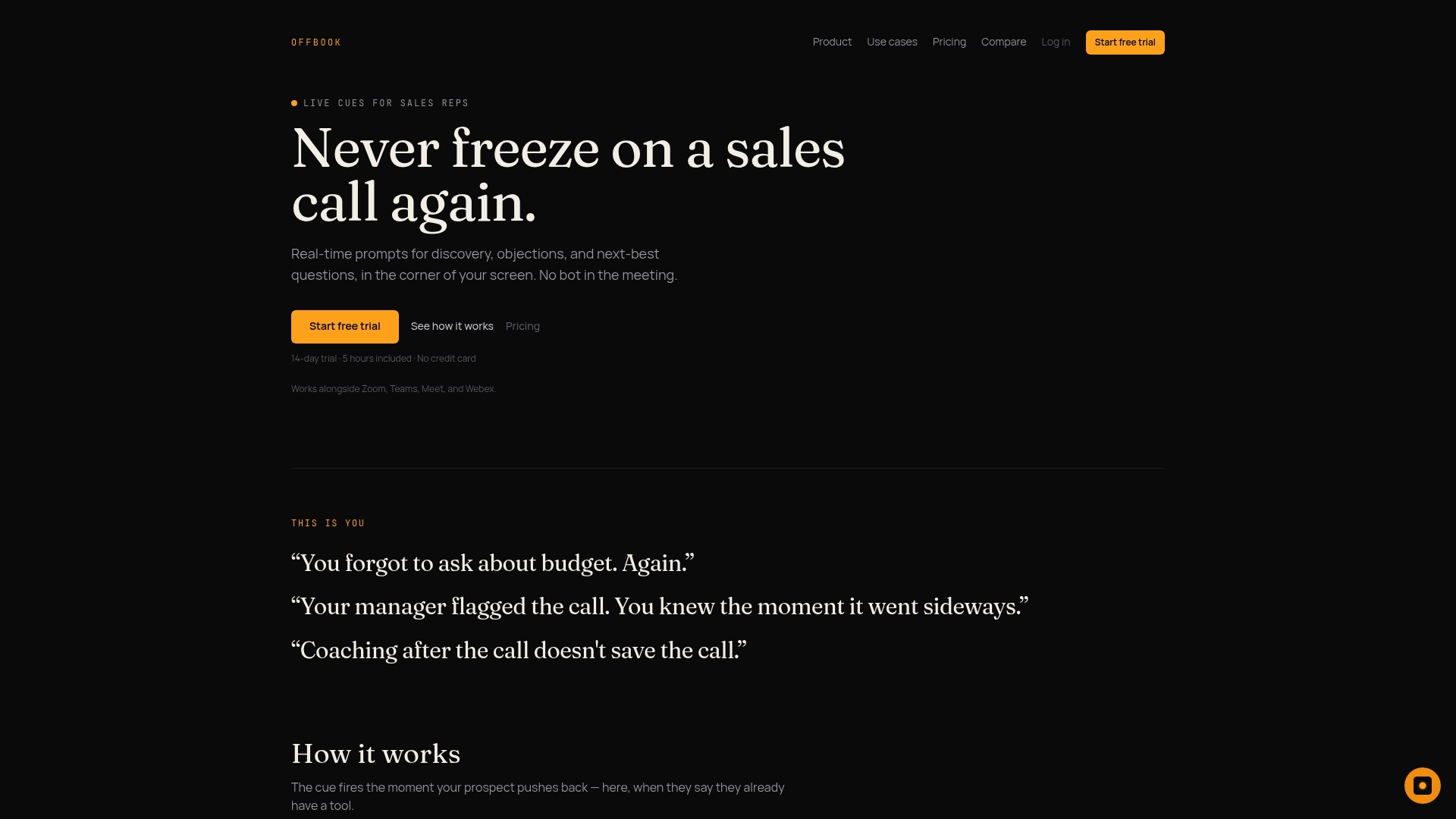
Offbook surfaces live AI cues on-screen during video calls, structured around MEDDIC and MEDDPICC, covering the questions to ask, the objections to handle, and the qualification gaps to close. No bot joins the meeting. No disruption to the conversation. It also generates pre-call briefs so reps walk in prepared, not scrambling. Built for founder-led B2B SaaS teams at seed and Series A, Offbook fits directly into the stack you’re already building, alongside your CRM and conversation intelligence tools. For sales teams that want to close more deals without adding headcount, AI call coaching is the layer most stacks are still missing. See what Offbook does for your team at offbook.pro.