Prove AI Sales Coaching ROI in 60 Days With Two Leading Metrics
Build a CFO-ready ROI model and run a 60-day pilot that uses two leading metrics—behavior adoption and coaching-moment frequency—to prove AI sales...
Published: September 22, 2026
Author: OffBook Editorial Team

Yes, AI sales coaching produces measurable ROI, and it usually shows up faster than most sales leaders expect. The two fastest proof points are behavior adoption within the first seven days of a coached call and early pipeline lift or manager time saved. Payback commonly lands inside 60 to 90 days when the coaching gets embedded into daily manager workflows rather than left as a dashboard nobody opens. The right next step is not a full rollout. It is a bounded pilot with a control cohort.
TL;DR:
- Behavior adoption typically improves within one week, and pipeline improvements often become evident within 30 days, but full ROI usually requires 60 to 90 days.
- Leading indicators such as coaching frequency, skill progression, and early behavior changes predict revenue impact more reliably in the short term than lagging metrics like win rate or quota attainment.
- Calculating ROI involves estimating performance lift from baseline data, translating it into dollars, and subtracting program costs, with payback often under one month in small, well-structured pilots.
- A conservative, pilot-based approach with clear control groups and tracking of early behaviors offers the most credible ROI proof for CFOs and finance teams.
- Embedding coaching into daily routines and tracking weekly behavior adoption are key to scaling AI sales coaching and sustaining measurable ROI beyond initial pilots.
Table of Contents
- What Metrics Actually Predict AI Sales Coaching ROI?
- How Do You Calculate AI Sales Coaching ROI?
- How Do You Build a CFO-Ready Business Case?
- How Do You Embed AI Coaching So the ROI Actually Scales?
- What Does a Real 60-Day Proof Path Look Like?
- Where AI Sales Coaching Programs Actually Fail
- How OffBook Helps You Prove This Model Fast
- Sources
- FAQ
What Metrics Actually Predict AI Sales Coaching ROI?
Most sales coaching effectiveness gets measured wrong. Teams wait for a quarter of closed-won deals to judge a program, then wonder why finance is skeptical of the results six months in. The fix is tracking leading indicators first and letting lagging indicators confirm what the leading ones already told you.
Leading metrics move within days and predict where revenue is headed:
- Behavior adoption: whether a rep applies a coached tactic within seven days of receiving it
- Skill progression velocity: how fast a rep closes specific competency gaps (discovery questions, objection handling, MEDDIC qualification)
- Coaching frequency per rep: how many structured coaching touches happen weekly
Lagging metrics confirm the business impact but take longer to move:
- Win rate
- Quota attainment and time-to-quota for new hires
- Average deal size
- Rep retention
Pro Tip: Don’t wait for lagging metrics to justify a pilot’s continuation. If behavior adoption hasn’t moved within two weeks, no amount of patience will fix a pipeline number three months later.
Gartner’s sales enablement research found that organizations using real-time AI coaching often see win-rate improvements of 8 to 12% within three months, along with ramp-time reductions of roughly one-third to one-half for new hires in some deployments. Those ranges vary widely by sales motion. A transactional SMB team with short cycles will see win-rate movement faster than an enterprise team running nine-month cycles, simply because there are more data points to observe.
For short pilots (30 to 90 days), lean almost entirely on leading indicators. Win rate and quota attainment need a longer runway to mean anything statistically, especially for teams with fewer than 20 reps or long sales cycles.
How Do You Calculate AI Sales Coaching ROI?
The formula itself is simple. The discipline is in where the inputs come from.
ROI = (Value of Performance Gain − Total Program Cost) / Total Program Cost
Payback Months = Total Program Cost / Monthly Value of Performance Gain
Here’s the step-by-step model:
- Pull your baseline numbers from CRM and finance: current win rate, average deal size, monthly pipeline volume, and quota attainment rate.
- Estimate the expected lift on one primary metric (usually win rate or ramp time) using a conservative percentage.
- Convert that percentage lift into dollars using your actual deal volume and average deal size.
- Add total program cost: platform seats, onboarding time, and any manager hours spent reviewing coaching data.
- Subtract cost from value, divide by cost, and calculate payback in months.
Here’s a worked example for a 15-rep team:
| Input | Value |
|---|---|
| Monthly closed deals (baseline) | 30 |
| Average deal size | $8,000 |
| Baseline win rate | 22% |
| Modeled win-rate lift | 3 points |
| Additional deals per month | 4 |
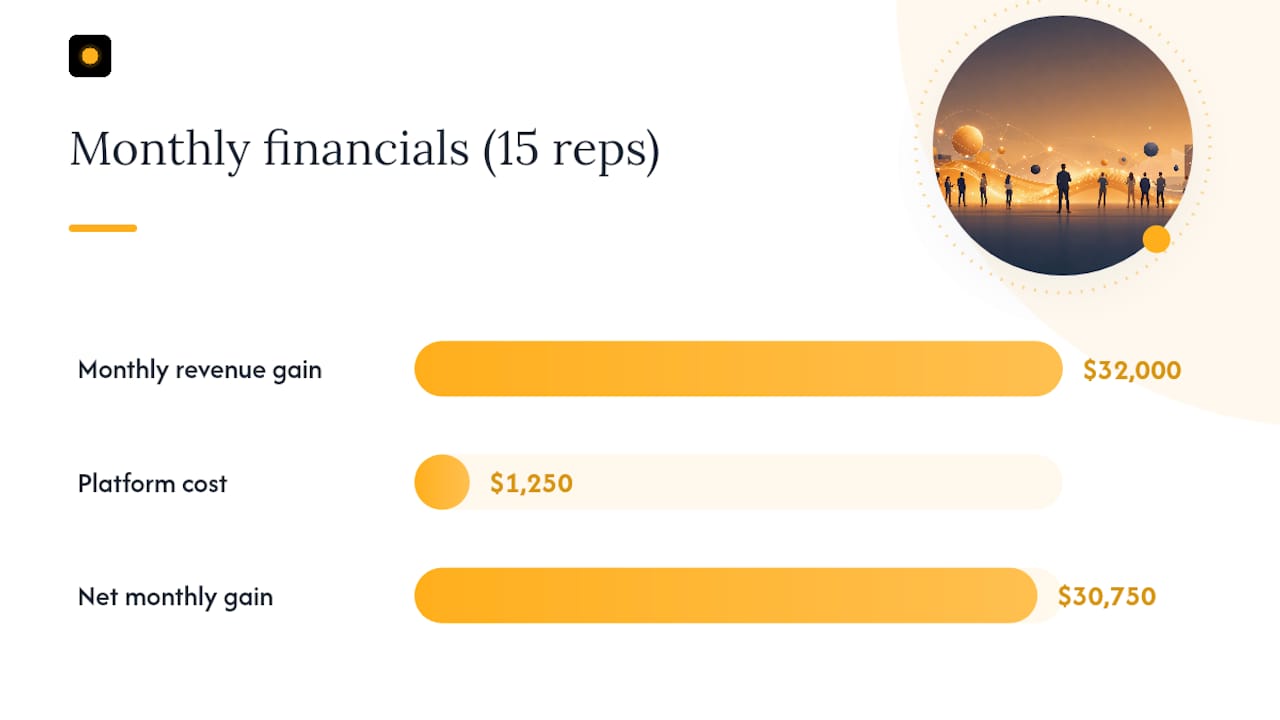
| Monthly revenue gain | $32,000 |
| Platform cost (15 seats, team plan) | ~$1,250/month |
| Net monthly gain | ~$30,750 |
| Payback period | Under 1 month |
That 3-point lift sits well inside the 8 to 12% win-rate improvement range Gartner reported, so it’s a conservative starting assumption, not a best-case one. Run the same math at 1 point of lift for your conservative case and 6 points for your optimistic case. That’s your sensitivity range, and it’s the range finance will actually trust.
How Do You Build a CFO-Ready Business Case?
Finance doesn’t trust a single ROI number from a vendor deck. They trust a model built from your own baseline costs, tested against a real pilot. Revenue makes the same point: lead with the cost of your current state, not with someone else’s success story.
Start by itemizing four cost categories:
- Software seats (per-rep or per-team pricing)
- Enablement and onboarding time (hours spent training reps and managers)
- Integrations and engineering time (CRM, calendar, call recording setup)
- Manager time and opportunity cost (hours spent reviewing coaching data instead of other work)
Once costs are itemized, present three scenarios side by side: conservative (bottom of the benchmark range), moderate (midpoint), and optimistic (top of the range). Pick effect sizes from published ranges like Gartner’s, not from a vendor’s best-case testimonial.
Pro Tip: When a VP of Sales asks “what if it doesn’t work,” show them the conservative scenario’s payback number, not the optimistic one. If the conservative case still pays back in under six months, you’ve already won the argument.
The pilot design itself needs a clear structure to hold up under scrutiny:
- Select a cohort of 8 to 15 reps with mixed tenure and performance history
- Match a control cohort of similar size and profile that continues without the new coaching tool
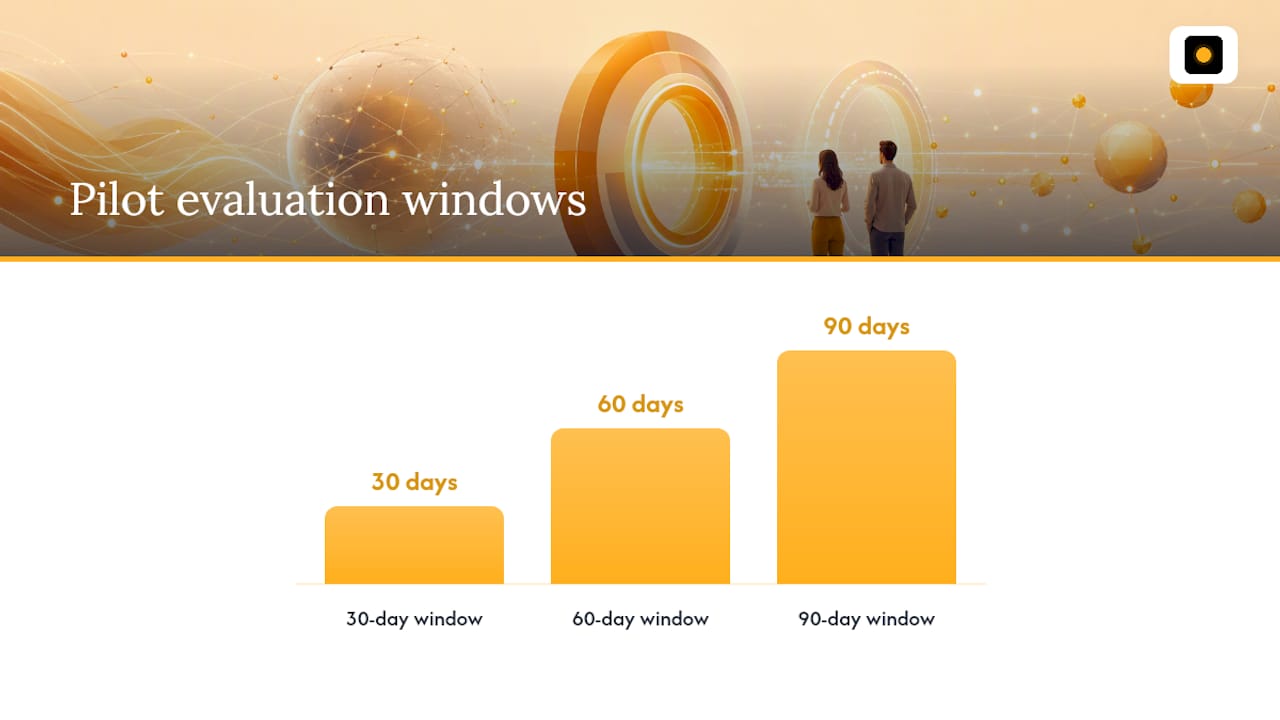
- Track both cohorts across 30, 60, and 90-day windows
- Set one primary KPI (usually win rate or ramp time) and two or three leading indicators as early signals
For CFO and IT objections, address data privacy and consent up front (most platforms operate on explicit per-session consent, not blanket recording), and note that a single coaching platform often consolidates costs previously spread across call recording, transcript tools, and separate training software. Replication matters more than a single strong pilot number. If the second cohort shows a similar lift, that’s when the model earns real credibility.
How Do You Embed AI Coaching So the ROI Actually Scales?
A pilot that proves ROI once and then quietly dies is the most common failure mode in this category. The fix is operational, not technical: coaching has to become a routine, not a report.
- Managers review AI-flagged coachable moments daily, not monthly, and follow up on specific calls within 48 hours
- Behavior adoption gets tracked weekly: did the rep apply the flagged tactic in their next call?
- Coached behaviors tie into quarterly reviews and comp conversations, not just a coaching scorecard nobody revisits
- Forecasting meetings reference qualification gaps the coaching tool surfaced, connecting coaching directly to pipeline conversations
The minimal integration checklist is short: CRM connection for activity data, calendar sync for call scheduling, and clear recording consent workflows. Embedding coaching into daily manager routines, rather than treating it as a passive dashboard, is what separates programs that sustain ROI from ones that show a good first month and flatline after that. Salesforce’s enablement guidance recommends weekly measurement cycles specifically so teams can course-correct before a full quarter gets wasted on an approach that isn’t landing.
What Does a Real 60-Day Proof Path Look Like?
One useful illustration of how a short-window pilot can work is shown here, though the numbers below are illustrative, not a guarantee. Insert your own baseline figures before presenting anything to finance.
OffBook delivers real-time, in-call cues during video calls without a bot joining the meeting, structured around MEDDIC and MEDDPICC qualification frameworks. Such software can also generate pre-call briefs on the people and companies a rep is about to meet, which may shorten prep time and improve the first few minutes of a call.
For a 60-day proof window, OffBook recommends tracking two leading metrics: behavior adoption (does the rep apply a flagged qualification question or objection response within the next call?) and coaching-moment frequency (how often the tool surfaces a real-time cue the rep acts on).
A small team piloting this kind of tool for 60 days might reasonably expect to see:
- Behavior adoption climbing from near zero to a majority of flagged moments acted on by week four
- Early qualification gaps (missing budget or timeline data) closing faster in coached calls versus the control group
- Manager review time dropping because coaching happens live instead of in a separate debrief session
Those are directional patterns, not promises. How AI cues change performance signals in your specific pipeline depends entirely on your baseline win rate and deal complexity.
Where AI Sales Coaching Programs Actually Fail
Three mistakes keep showing up. Treating the dashboard as passive reporting instead of a daily habit. Skipping accountability, so adoption never gets checked. Rewarding old behaviors while asking for new ones. Fix the incentive mismatch first, or pause the rollout entirely rather than expand it on a shaky foundation. Set executive expectations at the conservative case, not the vendor’s best month.
— Neil
How OffBook Helps You Prove This Model Fast
OffBook is built for exactly the kind of bounded pilot this article walks through: a founder-led or early-stage sales team that needs to prove coaching ROI in weeks, not quarters, without hiring a dedicated enablement analyst to run the math. Because the coaching happens live during the call, tied to MEDDIC and MEDDPICC qualification steps, behavior adoption shows up in the data almost immediately instead of waiting for a post-call review cycle.
Run the ROI model above with your own baseline numbers first. Once you have a conservative estimate you’re comfortable with, the Power plan starts at $59 per month (or $590 billed annually), and team pricing runs $1,000 per year per seat for larger rollouts. Check OffBook’s sales coaching page for the specifics, then start a pilot cohort and see whether your numbers track with the benchmarks here.
Sources
For deeper benchmarking, see Gartner’s sales enablement research, Salesforce’s AI enablement guidance, Harvard Business Review’s analysis on AI and sales effectiveness, and Business Insider’s coverage of AI coaching adoption. For business-case structure, Revenue.io’s guide and this AI productivity ROI analysis are both worth a close read.
FAQ
How Long Does It Take to See AI Sales Coaching ROI?
Behavior adoption often shifts within the first one to two weeks, with pipeline signals following within about 30 days. Full payback, measured against program cost, commonly lands within 60 to 90 days when coaching is embedded into daily manager routines.
What Is the Best Formula for Measuring Sales Coaching ROI?
The core formula is (Value of Performance Gain minus Total Program Cost) divided by Total Program Cost, with payback months calculated as cost divided by monthly gain. Feed it with your own baseline win rate, deal size, and pipeline volume rather than a vendor’s generic assumption.
Which Metrics Show Impact First: Behavior, Pipeline, or Revenue?
Behavior adoption moves first, usually within a week, followed by pipeline indicators like qualification quality and deal velocity within about 30 days. Revenue and win-rate changes, the slowest to confirm, typically need 60 to 90 days to show a statistically meaningful shift.
How Much Does OffBook Cost?
OffBook’s Power plan is $59 per month or $590 per year for individual use. Team plans run $1,000 per year per seat, with overage billing for call hours beyond the included limit.
Do You Need a Control Group to Prove AI Coaching ROI?
A matched control cohort strengthens the case considerably, since it isolates the coaching’s effect from normal seasonal or market fluctuation. Without one, a 30 to 60 day pilot can still show directional signal on leading indicators like behavior adoption, but the CFO case gets much harder to defend without a comparison group.