What Is Product Led Sales? A B2B SaaS Guide
Discover what is product led sales and how it transforms B2B SaaS strategies. Learn to engage leads effectively based on user behavior.
Published: July 14, 2026
Author: OffBook Editorial Team

Product-led sales (PLS) is a go-to-market model where product usage data drives sales engagement, replacing cold outreach with targeted conversations triggered by real user behavior. Instead of guessing who might buy, sales teams engage accounts that have already experienced product value. This approach sits between pure product-led growth (PLG) and traditional sales-led models. It uses two qualification signals: product qualified leads (PQLs), which are individual users showing buying intent through usage, and product qualified accounts (PQAs), which are accounts showing expansion potential at the organizational level. Understanding what is product led sales matters because it changes not just when sales teams reach out, but why, and with what evidence.
What is product led sales and how does it work?
Product-led sales is defined as a go-to-market model that layers targeted sales engagement on top of a self-serve product motion, activating sales only when accounts cross measurable engagement thresholds. The product does the early qualification work. Sales enters the conversation after the user has already realized value, not before.
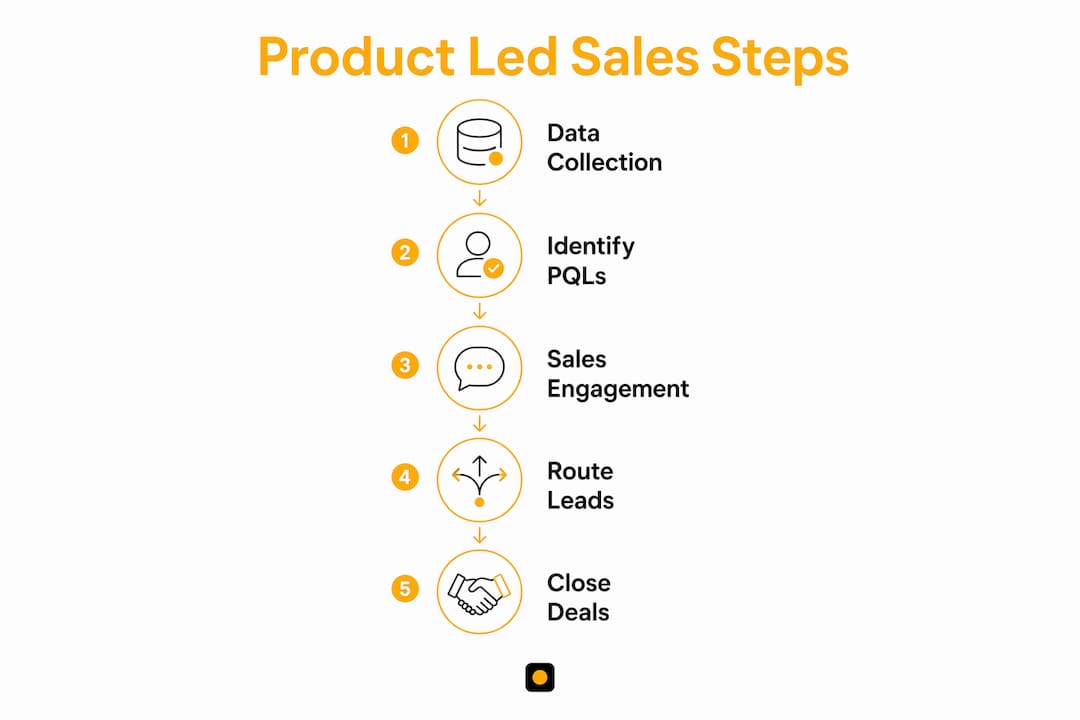
The mechanics start with data collection. Your product tracks feature adoption, session frequency, team invitations, and depth of usage across accounts. That data feeds a scoring model that separates casual users from accounts with genuine expansion potential.

How PQLs and PQAs work together
Conflating PQLs with PQAs is one of the most common mistakes in early PLS implementations. A PQL is an individual user whose behavior signals purchase readiness. A PQA is an account where multiple users are active, usage is spreading across teams, and the organization has the size and budget to convert into an enterprise contract.
You need both signals to route correctly. A single power user at a five-person startup is a PQL but probably not a PQA worth a full enterprise sales cycle. Ten users at a 500-person company hitting your collaboration limits every week is a PQA that sales should prioritize immediately.
Timing the sales conversation
Product usage patterns reveal adoption momentum and readiness to expand, but high activity alone does not equal intent. Context matters. A user who has invited three colleagues, exported data twice, and hit a paywall is showing intent. A user who logs in daily but never leaves the free tier’s core feature is not.
The sales conversation in PLS shifts away from discovery. Reps already know what the account uses, how often, and where they are hitting limits. The call focuses on expansion, not qualification. That shift shortens the B2B sales cycle significantly because both sides skip the “what does your product do?” phase.
Pro Tip: Set a minimum PQL threshold that requires at least two distinct behavioral signals before routing to sales. One signal, like a single feature activation, generates too many false positives and burns rep time.
What are the benefits of product led sales?
The core benefit of PLS is that it lowers customer acquisition costs by reducing reliance on cold outbound and shortens sales cycles by engaging users after they have already experienced product value. That combination directly improves sales efficiency in ways traditional models cannot match.
Here is what that looks like in practice across four key areas:
- Lower CAC. Self-serve acquisition handles the top of funnel without sales involvement. Reps spend time only on accounts already qualified by product behavior, not on cold prospects who have never seen the product.
- Shorter sales cycles. When a rep calls a PQA, the account already understands the product. Conversations move faster because there is no education phase. The rep focuses on contract terms and expansion scope.
- Expansion revenue. Usage data reveals exactly where accounts are approaching limits or adopting new features. Sales can time upsell conversations to moments of maximum perceived value, not arbitrary quarterly check-ins.
- Product and sales alignment. Sales reps see which features drive conversion. Product teams see which features correlate with expansion. Both teams share a data layer that makes decisions less political and more grounded in evidence.
PLS preserves self-serve growth while recovering enterprise revenue that self-serve alone cannot capture. Only high-potential accounts get routed to sales. The rest continue through the self-serve motion without friction.
How does product led sales differ from PLG and sales-led models?
The three models differ in where sales enters the customer journey and what triggers that entry.
Product-led growth is an acquisition and activation model. The product markets itself through free tiers, trials, or freemium plans. Sales plays no role in the early funnel. PLG works well for individual users and small teams but often stalls when an account needs procurement, security review, or a custom contract.
Sales-led growth starts with sales before the prospect touches the product. A rep qualifies the lead, runs a demo, and closes the deal before the buyer has any hands-on experience. This model works for complex enterprise software but carries high CAC and long cycles.
Product-led sales is a hybrid. Successful B2B SaaS companies run self-serve and sales-led motions simultaneously, enabled by real-time usage alerts that trigger sales engagement at the right moment. The product self-sells to individual users. Sales engages economic buyers when account-level signals indicate enterprise potential.
The critical distinction: PLS is not just adding a free tier to a sales-led approach. It requires data-driven routing of qualified leads to sales at the right time, triggered by usage and expansion potential rather than calendar-based outreach. Many founders make the mistake of launching a free plan and calling it product-led sales. Without the data infrastructure and scoring model behind it, that is just a cheaper acquisition channel, not a PLS motion.
| Model | Sales entry point | Qualification trigger | Best fit |
|---|---|---|---|
| Product-led growth | No early sales | Self-serve activation | SMB, individual users |
| Sales-led growth | Before product trial | Rep-driven discovery | Complex enterprise |
| Product-led sales | After product value | Usage and PQL/PQA score | Mid-market to enterprise |
How to implement product led sales effectively
Building a working PLS motion requires four components: data infrastructure, a scoring model, a redefined sales role, and organizational alignment. Missing any one of them produces a broken motion.
-
Build the data pipeline first. Effective PLS requires infrastructure that tracks account-level usage aggregation, domain mapping, expansion velocity, and feature exploration signals, all feeding into your CRM for prioritization. Without this, reps are flying blind. A well-configured tailored CRM system that ingests product signals alongside firmographic data is the foundation of any PLS operation.
-
Build a scoring model that combines usage with firmographic fit. A reliable PQL scoring system combines product usage signals with firmographic fit to avoid unqualified alerts and sales burnout. Usage depth, feature adoption breadth, account expansion signals, and intent context all contribute to the score. Firmographic data, such as company size, industry, and funding stage, filters out accounts that are active but cannot buy at enterprise scale.
-
Redefine the sales role. Sales reps in PLS act as value-added consultants focused on expanding usage, not cold prospecting. This requires a genuine cultural shift. Reps who are trained to open cold conversations need retraining to enter warm conversations with product context. The sales call preparation process changes entirely. Instead of researching the prospect from scratch, reps review usage data, identify the champion user, and plan an expansion conversation.
-
Align product, sales, and marketing on shared metrics. Shared dashboards showing PQL volume, conversion rates from PQL to closed-won, and expansion revenue by feature segment keep all three teams pulling in the same direction. Without shared metrics, product teams optimize for activation and sales teams optimize for new logos, and neither group helps the other.
-
Avoid premature sales engagement. Reaching out before a user has hit a meaningful usage threshold is the fastest way to kill the self-serve motion. Users who feel sold to before they have decided they want to buy will churn. Set conservative thresholds at first and raise them only when conversion data supports it.
Pro Tip: Start your PLS motion with a small, dedicated pod of two or three reps focused exclusively on PQA expansion. Mixing PLS and traditional outbound in the same rep’s quota creates conflicting incentives and muddies your conversion data.
For early-stage B2B sales teams building this motion for the first time, the temptation is to over-engineer the scoring model before you have enough usage data to validate it. Start simple. Track three to five signals, route manually, and refine the model as patterns emerge.
Key Takeaways
Product-led sales works because it grounds every sales conversation in verified product behavior, replacing guesswork with evidence and cold outreach with warm, timed engagement.
| Point | Details |
|---|---|
| Core definition | PLS layers targeted sales on self-serve PLG, triggered by PQL and PQA signals. |
| Qualification signals | Use both PQLs (individual intent) and PQAs (account-level expansion potential) to route correctly. |
| Key benefits | Lower CAC, shorter sales cycles, and expansion revenue driven by usage data. |
| PLS vs. PLG vs. sales-led | PLS is a hybrid that adds selective sales engagement after product value is realized. |
| Implementation priority | Build the data pipeline and scoring model before retraining reps or setting quotas. |
Why most PLS rollouts fail before they start
The companies that struggle with product-led sales almost always share one problem: they treat it as a sales initiative rather than a data infrastructure initiative. They hire a few reps, point them at free-trial signups, and call it PLS. It is not. Without a scoring model that separates PQLs from noise, reps burn out chasing unqualified accounts and the motion collapses within two quarters.
The mindset shift required here is deeper than most founders expect. Traditional sales culture rewards activity: calls made, emails sent, demos booked. PLS rewards patience and precision. A rep who waits for the right signal and then runs a tight, consultative expansion call will outperform a rep who blasts every free-trial signup with a sequence. That is a hard cultural change to make, especially in teams where activity metrics are baked into compensation.
The other thing I have seen consistently underestimated is the organizational alignment piece. Product teams often resist sharing usage data with sales because they worry about reps disrupting the self-serve motion. Sales teams often distrust product data because they did not generate it. Getting both teams to trust a shared data layer takes deliberate effort, shared metrics, and executive sponsorship. Without it, the data pipeline becomes shelfware and reps revert to cold outreach.
PLS is not a replacement for good selling. It is a refinement that removes the guesswork by grounding conversations in actual product engagement. The reps who thrive in this model are the ones who can walk into a call already knowing what the account uses, where they are stuck, and what the next logical expansion looks like. That is a different skill set than traditional prospecting, and it is worth investing in coaching to build it.
— Neil
How Offbook supports sales teams in a product led sales motion
Sales reps in a PLS model enter calls with product context, but they still need to run the conversation well. Knowing a prospect’s usage data does not automatically translate into a disciplined, consultative call.
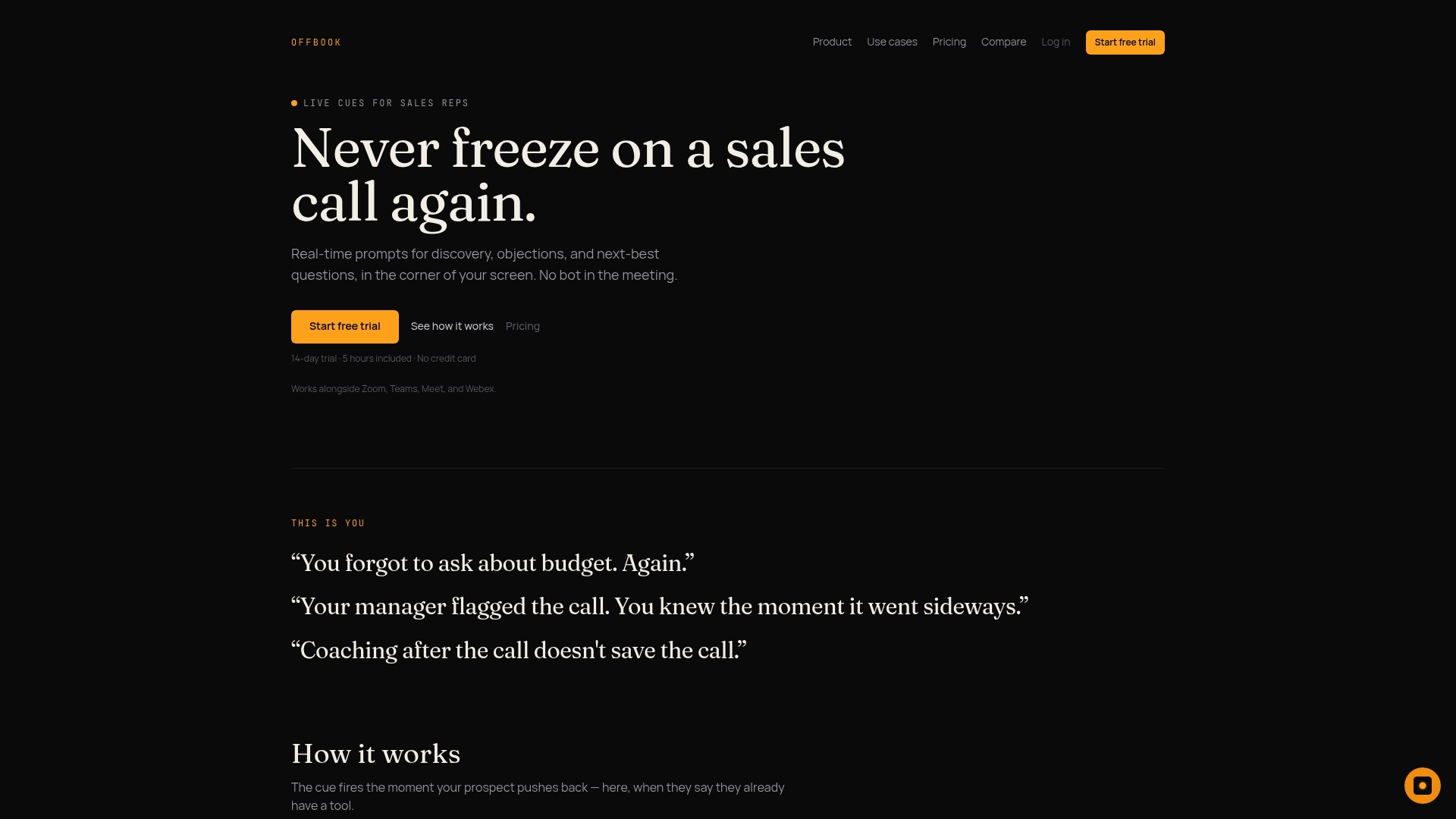
Offbook’s AI call coaching for sales surfaces live cues during video calls, prompting reps with the right questions, objection responses, and qualification gaps in real time, structured around frameworks like MEDDIC and MEDDPICC. Offbook also generates pre-call briefs so reps walk into every PQA conversation fully prepared. For founder-led B2B SaaS teams at the seed and Series A stage, Offbook turns product usage context into disciplined sales execution, call by call.
FAQ
What is the definition of product led sales?
Product-led sales is a go-to-market model that uses product usage data to identify qualified leads and trigger targeted sales engagement after users have experienced product value. It combines self-serve acquisition with selective sales outreach focused on expansion.
What is the difference between PLG and product led sales?
Product-led growth relies entirely on the product to acquire and activate users without sales involvement. Product-led sales adds a sales layer on top of PLG, engaging accounts that show enterprise expansion potential based on usage signals.
What is a product qualified lead?
A product qualified lead (PQL) is an individual user whose product behavior, such as feature adoption, team invitations, or paywall hits, signals readiness to buy or expand. PQLs differ from PQAs, which measure expansion potential at the account level.
How do you implement a product led sales strategy?
Start by building a data pipeline that feeds product usage signals into your CRM, then create a scoring model combining usage depth with firmographic fit. Route only high-scoring PQAs to sales and train reps to run consultative expansion conversations rather than traditional discovery calls.
What are the main benefits of product led sales?
The primary benefits are lower customer acquisition costs, shorter sales cycles, and higher expansion revenue. Sales teams engage accounts that already understand the product, which removes the education phase and accelerates time to close.