What Is ICP in B2B Sales? A 2026 Guide
Discover what ICP in B2B sales means and how defining it can boost your win rates and sales efficiency by 68% in 2026!
Published: June 3, 2026
Author: OffBook Editorial Team

An Ideal Customer Profile (ICP) is a detailed description of the company type most likely to buy your product, generate the highest lifetime value, and become a long-term advocate. Salesforce defines ICP as combining behavioral, firmographic, and environmental characteristics to focus sales and marketing on the most valuable opportunities. For B2B founders and sales reps, this is not a marketing exercise. It is the filter that determines where your time goes and which deals you actually win. Companies with a well-defined ICP achieve 68% higher win rates and shorten sales cycles by 25 to 35%. That gap between teams who define their ICP and those who skip it is not marginal. It is the difference between a predictable pipeline and a chaotic one.
What is ICP in B2B sales and how does it differ from buyer personas?
The most common mistake sales teams make is treating ICP and buyer personas as the same thing. They are not. Confusing them wastes pipeline time and produces messaging that lands with no one.
HubSpot frames the distinction precisely: the ICP is your pre-qualification filter, and buyer personas are your personalization guide. The ICP answers “which companies should we even talk to?” Buyer personas answer “who inside that company do we talk to, and how?”
Here is how the two concepts split:
- ICP (company level): Industry, revenue range, headcount, geography, tech stack, growth stage, and buying behavior. This is the account filter. If a company does not fit your ICP, no amount of great messaging will make the deal work.
- Buyer persona (individual level): Job title, goals, pain points, decision-making authority, and communication preferences. This is the conversation guide. Once you are inside an ICP-fit account, personas tell you how to speak to the VP of Sales versus the CFO.
Pairing ICP with persona mapping identifies who inside the account feels the pain, holds the budget, and can block the deal. Complex B2B sales require both layers. Without the ICP, you waste cycles on accounts that will never convert. Without personas, you get into the right accounts and still lose because you pitched the wrong person with the wrong message.
The practical rule: qualify accounts with your ICP first, then activate personas to run the deal.
What key attributes compose a strong ideal customer profile in B2B?
Most teams build their ICP around two variables: industry and company size. That produces a weak filter. Salesforce and HG Insights both highlight that a strong ICP requires multiple data layers to generate real predictive power.
The three core attribute categories are:
- Firmographics: Industry vertical, annual revenue, employee count, geography, and growth stage. A Series B SaaS company in fintech with 50 to 200 employees is a far more precise target than “mid-market technology companies.”
- Technographics: The technology stack a company runs tells you more about their buying context than their headcount does. A company using Salesforce as their CRM has a different buying context than one running spreadsheets. Tools like HG Insights, Clearbit, and ZoomInfo surface this data at scale.
- Behavioral and intent signals: Recent funding events, leadership changes, new product launches, job postings in sales or marketing, and G2 category research activity. These signals indicate a company is in motion and likely to buy now, not in 18 months.
Behavioral signals are where most teams leave money on the table. A company that just raised a Series A and is hiring five account executives is a live buying signal for sales enablement tools. That same company with no hiring activity and flat headcount growth is not.
Pro Tip: Add one behavioral trigger criterion to your ICP immediately. Something like “raised funding in the last 90 days” or “posted three or more sales roles in the last 60 days.” This single addition will improve your outbound response rates faster than any copy change.

How to build and validate your ICP from CRM data
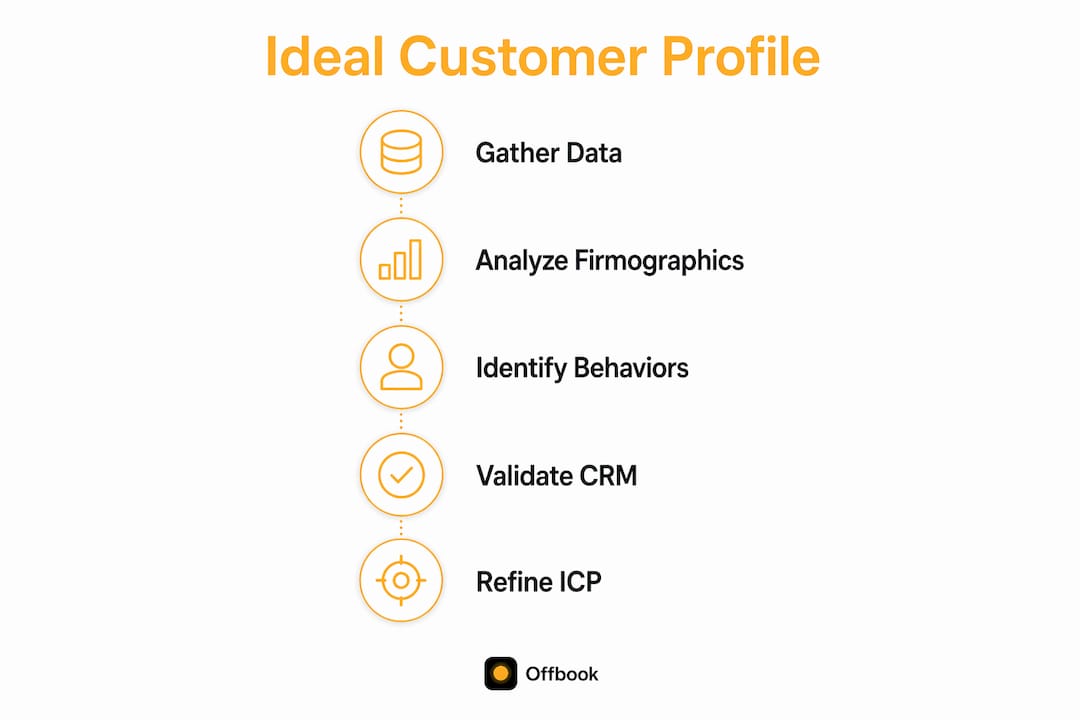
Building an ICP without starting from your own closed-won data is guesswork. The most reliable method starts inside your CRM.
- Pull your top 20% by lifetime value. Mark Gabrielli recommends starting with the highest-LTV closed-won accounts and identifying every shared characteristic across firmographics, technographics, and buying behavior. These are your proof-of-concept customers.
- Identify the patterns. Look for what these accounts have in common. Industry clusters, revenue bands, tech stack overlaps, deal velocity, and the triggers that preceded their purchase. If eight of your top ten customers were using HubSpot before they bought from you, that is a technographic signal worth building into your ICP.
- Build a weighted scoring model. An effective ICP scoring model assigns points across three dimensions:
| Dimension | Example Criteria | Weight |
|---|---|---|
| Firmographic fit | Industry, revenue range, headcount | 40% |
| Technographic fit | CRM type, cloud maturity, IT budget | 35% |
| Behavioral/intent signals | Funding events, hiring activity, G2 research | 25% |
- Test the model against your current pipeline. Run your active opportunities through the scoring model and check whether high-scoring accounts are converting at higher rates. If they are not, your criteria need adjustment.
- Update the ICP on a regular cadence. B2B data decays fast. Stale ICP criteria reduce targeting quality within weeks, not quarters. Set a quarterly review to incorporate new closed-won patterns and remove criteria that no longer predict conversion.
Pro Tip: Use OrbiSearch or a similar email validation tool to clean your CRM data before running your ICP analysis. Dirty contact data produces misleading patterns and sends your ICP in the wrong direction from the start.
Common pitfalls in ICP specification and how to avoid them
Most ICP failures are not failures of concept. They are failures of execution. These are the mistakes that show up repeatedly across B2B sales teams.
- Treating ICP as a static document. An ICP written once and filed away is not an ICP. It is a marketing artifact. A live ICP functions as an operational sales tool that reps use to qualify or disqualify accounts in real time.
- Defining ICP too broadly. “B2B SaaS companies with 50 to 500 employees” is not an ICP. It is a market segment. A real ICP narrows to the specific conditions under which your product wins.
- Ignoring technographics and behavioral signals. Industry and size alone produce weak targeting. The teams that consistently outperform use all three attribute layers.
- Misaligning sales and marketing on ICP criteria. When sales qualifies on one set of criteria and marketing generates leads against a different set, the pipeline fills with accounts that waste everyone’s time. GrowLeads reports 36% higher retention, 38% higher win rates, and 208% more marketing revenue when sales and marketing align on a shared ICP.
- Confusing ICP with buyer personas in qualification. Using persona-level criteria to filter accounts leads to disqualifying good-fit companies because the first contact did not match your persona template.
“Your ICP is not a description of who you want to sell to. It is a description of who you have already proven you can win and retain.” This distinction changes how you build it and how you use it.
The operationalization gap is the most costly mistake. An ICP that lives in a Google Doc but never appears in your CRM qualification fields, your outbound sequences, or your call prep is not working for you.
How to apply your ICP in practice for better sales targeting
Defining your ICP is the first step. Embedding it into your daily sales workflow is where the conversion gains actually happen.
- Score and prioritize your account list. Apply your weighted ICP scoring model to every account in your pipeline and your prospecting list. Work high-scoring accounts first, every time. This single habit compounds over a quarter.
- Use intent data platforms for dynamic qualification. Tools like 6sense, Bombora, and G2 Buyer Intent surface accounts that match your ICP and are actively researching solutions in your category. This turns your ICP from a static filter into a live prospecting engine.
- Combine ICP scoring with persona mapping for outreach. Once an account clears your ICP threshold, use your buyer personas to identify the economic buyer, the end user, and the likely blocker. Tailor your first message to the economic buyer’s business outcome, not the product feature.
- Align your marketing campaigns to ICP criteria. Paid campaigns, content distribution, and ABM programs built around ICP attributes generate higher-quality inbound leads and reduce the time sales spends disqualifying marketing-sourced pipeline.
- Track ICP-specific metrics. Monitor win rate, average deal size, and sales cycle length segmented by ICP fit score. Apollo’s ICP Guide notes that ICP-fit customers are also the ones most likely to renew, expand, and refer. The downstream revenue impact extends well beyond the initial close.
For founders running early-stage sales, the ICP also determines which calls are worth your personal time. If an account scores below your threshold, it goes to a junior rep or a nurture sequence. Your time goes to the accounts most likely to become your next reference customer.
Key takeaways
A well-built and actively maintained ICP is the single highest-leverage tool in B2B sales because it determines where every rep’s time goes and which deals are worth closing.
| Point | Details |
|---|---|
| ICP is company-level, not person-level | Use ICP to filter accounts first, then apply buyer personas to run the deal. |
| Three attribute layers beat two | Firmographics alone produce weak targeting; add technographics and behavioral signals. |
| Build from closed-won CRM data | Start with your top 20% by LTV and identify shared patterns before prospecting outward. |
| Treat ICP as a live sales tool | Update it quarterly and embed it in CRM qualification fields, not just a document. |
| Alignment multiplies results | Sales and marketing using the same ICP criteria drives 38% higher win rates and 208% more marketing revenue. |
Why most teams are using their ICP wrong
I have reviewed sales processes at dozens of early-stage B2B companies, and the pattern is consistent. The ICP exists. It is usually a two-page document with a list of firmographic criteria someone wrote during a strategy offsite. And then it sits there, completely disconnected from how reps actually qualify deals on calls.
The teams that get real results from their ICP do something different. They treat it as a disqualification tool, not a targeting wish list. The question is not “could this company buy from us?” It is “does this company match the profile of accounts we have already proven we can win?” That is a harder standard, and it cuts pipeline volume. But it also cuts wasted cycles by a significant margin.
The technographic layer is where I see the biggest missed opportunity. Knowing that a prospect runs Salesforce versus a homegrown CRM tells you more about their buying sophistication, their budget, and their likely objections than their employee count ever will. Yet most teams never collect this data systematically.
My honest recommendation for any founder or sales lead reading this: before you touch your messaging, your sequences, or your call scripts, go back to your CRM and run the closed-won analysis. Find the ten customers who renewed, expanded, and referred others. Build your ICP from those ten accounts. Everything else is optimization on top of a foundation that may not exist yet. You can explore more on this at the Offbook blog, where we cover qualification frameworks in depth.
— Neil
Run better discovery calls with Offbook’s AI coaching
Understanding your ICP is the foundation. Executing on it during a live sales call is where deals are won or lost.
Offbook is real-time AI call coaching software built for B2B SaaS sales teams at the seed and Series A stage. It listens to your calls and surfaces live on-screen prompts covering the right qualification questions, objection responses, and MEDDIC gaps to close, without a bot ever joining the meeting. When your ICP is precise, Offbook helps reps act on it in the moment, asking the questions that confirm fit and surfacing gaps before the call ends. Explore AI call coaching for sales to see how Offbook turns ICP criteria into real-time qualification discipline.
FAQ
What is an ICP in B2B sales?
An ICP, or Ideal Customer Profile, is a detailed description of the company type most likely to buy your product and generate the highest long-term value. It combines firmographic, technographic, and behavioral attributes to focus sales effort on the most winnable accounts.
How is an ICP different from a buyer persona?
An ICP filters which companies to target at the account level, while a buyer persona describes the individual decision-makers inside those companies. Use ICP to qualify accounts first, then use personas to personalize your outreach and run the deal.
How do you build an ICP from scratch?
Start by pulling your top 20% of closed-won customers by lifetime value from your CRM and identifying shared firmographic, technographic, and behavioral patterns. Build a weighted scoring model from those patterns and test it against your current pipeline conversion rates.
Why does ICP matter for sales cycle length?
Companies with a well-defined ICP shorten their sales cycles by 25 to 35% because reps spend less time on accounts that will never convert and more time on accounts that match proven winning criteria.
How often should you update your ICP?
B2B data decays rapidly, so ICP criteria should be reviewed at least quarterly. Incorporate new closed-won patterns, remove criteria that no longer predict conversion, and adjust for any shifts in your target market or product positioning.