The Role of Pain Discovery in Sales: B2B Guide
Discover the role of pain discovery in sales. Learn how identifying core problems accelerates B2B sales success and closes deals faster.
Published: July 18, 2026
Author: OffBook Editorial Team

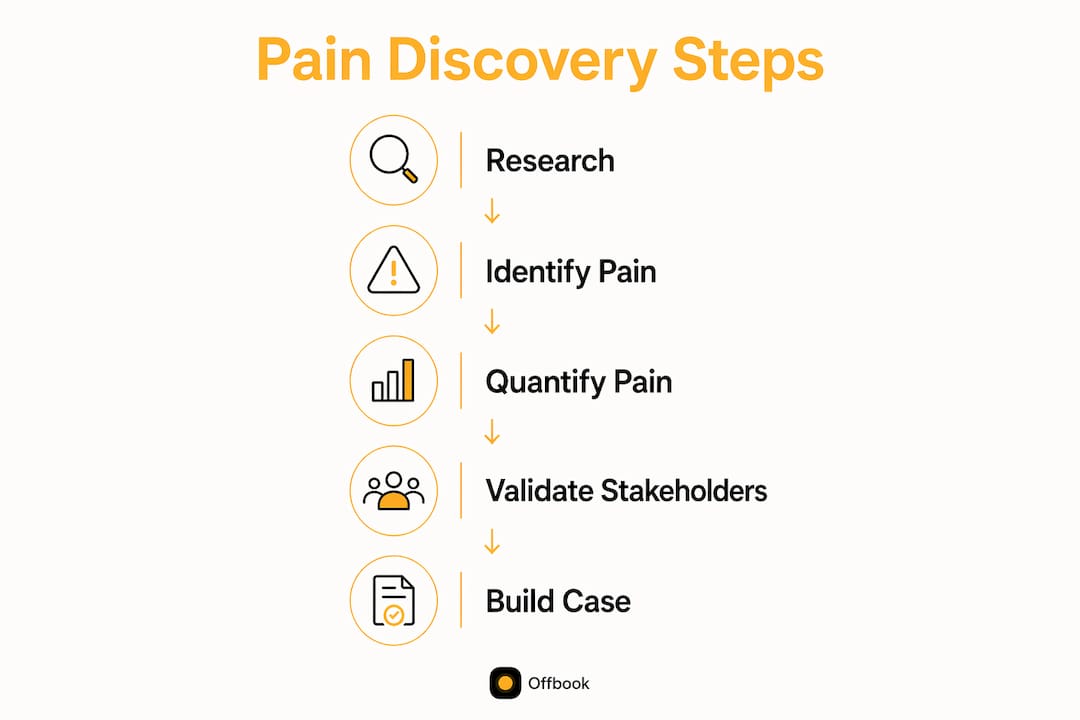
Pain discovery in sales is the process of identifying, exploring, and quantifying a prospect’s core problems to build urgency and justify a buying decision. Without it, even the most polished pitch lands flat. 82.4% of B2B sales professionals identify “no-decision” losses as a critical obstacle, meaning deals stall not because buyers chose a competitor, but because they felt no pressure to act. That pressure comes from uncovering pain. Sales teams that master pain identification close faster, win bigger, and waste less time on deals that were never real.
What does pain discovery look like in effective B2B sales?
Pain discovery is not a single question. It is a structured, multi-layer process that moves a conversation from surface symptoms to quantified business consequences. The goal is to understand not just what is broken, but what it costs the business and who feels that cost personally.
The process follows a three-layer sequence:
- Surface symptom: What does the prospect say is wrong? (“Our reporting takes too long.”)
- Quantified business cost: What does that symptom actually cost in time, revenue, or productivity? (“We lose 12 hours per week across the team.”)
- Personal and organizational consequences: Who is accountable? What happens if nothing changes? (“Our VP of Sales can’t trust the forecast, so we miss board commitments.”)
Pain exists across four categories: financial, productivity, process, and strategic. Most reps focus only on financial pain, which procurement then defends against. The bigger deals often unlock when you surface process and strategic pain, because those problems sit closer to executive priorities.
Pre-call research sharpens your hypotheses before you ever ask a question. Job postings, recent tech changes, and intent data all signal where a company is struggling. Pre-call research using intent data creates precise discovery hypotheses that make your questions feel informed rather than generic. Walking in with a hypothesis also signals credibility to the buyer.

One underused technique is watching for workarounds. When a buyer has built a manual fix around a broken process, that is evidence of urgent, real pain. They have already tried to solve the problem themselves. That effort tells you the pain is real, not hypothetical.
Pro Tip: Slow down after the buyer answers. Deliberate silence after a response pulls out more detail than any follow-up question. Buyers fill silence by elaborating, and that elaboration is where the real pain lives.
A strong discovery call structure keeps reps from rushing to the demo before they have fully mapped the pain. The best reps treat discovery as the most important part of the sale, not the warm-up.
Why quantifying customer pain closes more deals
Identifying pain is not enough. Executives do not buy pain. They buy measurable outcomes. If you cannot translate a prospect’s problem into financial or productivity terms, you cannot build a business case, and without a business case, budget approval stalls.
The most effective quantification metrics in B2B sales fall into four categories:
- Time lost: Hours per week spent on manual workarounds, rework, or broken processes.
- Revenue leakage: Deals lost, renewals missed, or pricing errors caused by the problem.
- Productivity drag: Headcount tied up in tasks that should be automated or eliminated.
- Opportunity cost: What the business cannot do because resources are consumed by the problem.
Unquantified pain produces weak deals. The buyer acknowledges the problem, nods along, and then does nothing. Without a number attached to the pain, there is no urgency, no budget conversation, and no internal champion who can make the case upstairs. Deals stall because the pain feels real but not expensive enough to act on now.
The most effective way to quantify pain is to do it with the buyer, not for them. Ask the buyer to estimate the cost. Their number carries more credibility internally than any figure you provide. When a CFO hears a number that came from their own team, the business case becomes theirs to defend, not yours to sell.
Pro Tip: Ask the buyer: “If this problem costs you X per quarter, what would solving it be worth?” That question shifts the conversation from pain to value, and the buyer does the math themselves.
Top sales teams that quantify pain consistently move deals faster because they give economic buyers a concrete reason to prioritize the purchase over competing internal projects. A well-structured set of discovery questions makes this quantification feel natural rather than interrogative.
How to validate pain across multiple stakeholders
B2B buying decisions involve more people than most reps account for. The average buying group comprises 6 to 10 stakeholders. Each person on that group experiences the same problem differently, and each has a different reason to care about solving it.
Validating pain across stakeholders serves two purposes. First, it confirms that the pain is real and not just one person’s frustration. Second, it builds internal alignment, which is what actually moves a deal through procurement and legal.
The key distinction to make is between end user pain and economic buyer pain:
- End user pain is daily friction. A sales rep who spends two hours per week reformatting reports is experiencing end user pain. They feel it every day, but they rarely control budget.
- Economic buyer pain is business consequence. The VP of Revenue who cannot trust her forecast because the data is unreliable is experiencing economic buyer pain. She controls budget and has a reason to act.
Connecting these two perspectives is what builds a compelling business case. When you can show an economic buyer that the daily friction their team experiences directly causes the business outcome they are accountable for, the deal gains momentum.
Map each stakeholder’s pain to a specific product outcome, not a feature. “This reduces your team’s reporting time by 10 hours per week” is a product outcome. “This has a dashboard” is a feature. Outcomes connect to pain. Features do not.
Validating pain across end users and economic buyers strengthens internal buy-in and reduces the risk of a deal dying in committee. Aim to validate the core pain with at least two stakeholders before advancing to a proposal.
Common mistakes in pain discovery and how to fix them
Most failed deals trace back to a discovery problem, not a pricing or product problem. The mistakes are consistent and correctable.
- Mistaking symptoms for root pain. A buyer says, “Our onboarding takes too long.” That is a symptom. The root pain might be churn caused by slow time-to-value, or a support cost that spikes in the first 90 days. Stopping at the symptom means you never find the real problem.
- Skipping quantification. Reps hear the pain, feel confident, and move to the demo. Without a number attached to the problem, the buyer has no urgency and no internal justification to act.
- Rushing to solutions. Top sales reps ask 39% more questions during discovery than average reps. Rushing to pitch before fully exploring pain is the single most common reason deals stall after a promising first call.
- Assuming stated pain is accurate. Buyers often describe what they think the problem is, not what it actually is. A buyer who says “we need better reporting” may actually have a data quality problem, a process problem, or a people problem. Probe beneath the stated pain.
- Using generic open-ended questions. “What keeps you up at night?” produces vague answers. Hypothesis-driven questions produce specific ones. “We often see companies at your stage struggling with forecast accuracy after a rapid headcount increase. Is that something you’re dealing with?” gives the buyer something concrete to react to.
Pro Tip: Use consequence-focused questions to create urgency. “What happens if this isn’t resolved by Q3?” forces the buyer to articulate the cost of inaction, which is more powerful than any benefit you can describe.
Weak discovery questions are fixable. Reviewing examples of weak questions and replacing them with consequence-focused alternatives is one of the fastest ways to improve close rates.
Key Takeaways
Pain discovery in sales is the foundation of every B2B deal that closes: without quantified, validated pain, there is no urgency, no business case, and no decision.
| Point | Details |
|---|---|
| Use a three-layer sequence | Move from surface symptom to business cost to personal consequence on every discovery call. |
| Quantify pain with the buyer | Let buyers estimate the cost themselves so the number carries internal credibility. |
| Validate across stakeholders | Confirm pain with at least two people to connect daily friction to executive accountability. |
| Avoid rushing to solutions | Top reps ask 39% more questions; slow down and explore before pitching. |
| Watch for workarounds | Manual fixes signal urgent, real pain the buyer has already tried to solve. |
Pain discovery is the deal, not the warm-up
Most sales teams treat discovery as a formality before the demo. That is the wrong frame. After working with B2B founders and early-stage sales teams, the pattern is clear: the reps who close the most are not the best presenters. They are the best listeners, and more specifically, the best at making buyers feel the weight of their own problem.
The shift that changes everything is moving from “let me understand your situation” to “let me help you see what this is costing you.” Those are different conversations. The first is an interview. The second is a business case in progress. Buyers who articulate their own pain aloud, in financial terms, become their own internal champions. You do not have to sell them. They sell themselves.
The trend I find most promising in 2026 is AI-supported pre-call research. When a rep walks into a discovery call already knowing a company’s recent tech changes, hiring patterns, and likely pain clusters, the conversation starts three levels deeper. That preparation is not a shortcut. It is what separates a surgical discovery call from a fishing expedition.
The teams that build pain discovery into their process as a discipline, not an instinct, win more deals and waste less time on prospects who were never going to buy.
— Neil
How Offbook helps reps run better discovery calls
Knowing the right questions to ask is one thing. Remembering to ask them under pressure, in a live call, is another.
Offbook is real-time AI call coaching built for B2B sales reps and founders. It listens to your discovery calls and surfaces live on-screen cues when you need to dig deeper into pain, quantify a business impact, or close a qualification gap. It works without a bot joining the meeting, so the conversation stays natural. Offbook structures its cues around MEDDIC and MEDDPICC, which means every prompt is tied to a proven discovery framework. If you want to run more disciplined discovery calls and stop leaving pain unquantified, Offbook is built for exactly that.
FAQ
What is pain discovery in B2B sales?
Pain discovery is the process of identifying and quantifying a prospect’s core business problems to build urgency and justify a purchase decision. It goes beyond surface symptoms to uncover financial, productivity, process, and strategic pain.
Why do deals stall without proper pain discovery?
Without quantified pain, buyers have no internal justification to prioritize the purchase. 82.4% of B2B sales professionals report “no-decision” losses as a critical obstacle, which typically trace back to weak discovery.
How many stakeholders should you validate pain with?
Validate pain with at least two stakeholders before advancing to a proposal. The average B2B buying group includes 6 to 10 people, and aligning their perspectives strengthens the internal business case.
What is the difference between a symptom and root pain?
A symptom is what the buyer describes on the surface, such as slow reporting. Root pain is the underlying business consequence, such as forecast inaccuracy that causes missed board commitments. Effective discovery uncovers the root, not just the symptom.
How do you quantify customer pain during a discovery call?
Ask the buyer to estimate the cost of the problem themselves, using metrics like hours lost per week, revenue leakage, or headcount tied to manual work. Buyer-generated numbers carry more internal credibility than figures a rep provides.