The Role of Confidence in Sales Calls That Close
Discover the crucial role of confidence in sales calls. Uncover how it enhances motivation and adaptability for closing deals successfully.
Published: July 1, 2026
Author: OffBook Editorial Team

Confidence in sales calls is defined as a rep’s belief in their ability to execute, combined with the intrinsic motivation to adapt when conditions get hard. It is not volume or aggression. Sales researchers describe it as calm, purposeful assurance rooted in knowing the right questions to ask. The role of confidence in sales calls goes far deeper than tone or body language. Recent research shows it operates as a performance multiplier, most powerfully when competition is fierce and buyers are skeptical.
How does confidence influence motivation and adaptability in sales?
Self-efficacy predicts adaptive sales performance indirectly, through intrinsic motivation. That chain matters. Confidence does not directly produce results. It fuels the internal drive that keeps a rep curious, flexible, and persistent when a call goes sideways.
The research is specific about when this effect is strongest. Competitive intensity acts as a catalyst. When buyers have more options and more information, a rep’s self-belief determines whether they adapt their approach or fall back on a scripted pitch. Reps with high self-efficacy read the room and shift. Reps without it default to what feels safe, which is rarely what the buyer needs.
Adaptive performance in practice looks like this:
- A buyer raises a pricing objection mid-call. A confident rep pauses, reframes value, and asks a clarifying question. A low-confidence rep either caves on price or rushes past the objection.
- A call runs long and the decision-maker joins late. A confident rep resets the agenda without apology. A low-confidence rep restarts from the beginning and loses the room.
- A prospect challenges the product’s fit. A confident rep welcomes the pushback as a discovery signal. A low-confidence rep gets defensive.
The importance of confidence in sales is not about projecting certainty you do not have. It is about having enough belief in your preparation to stay curious under pressure.
Pro Tip: Before your next call, write down the three hardest objections you expect. Rehearse your response out loud. Preparation converts abstract confidence into concrete readiness.

Why calibrated confidence outperforms raw confidence
Calibrated confidence is the alignment between how confident a rep feels and how skilled they actually are. Research on emotional self-efficacy shows this calibration is the single strongest predictor of sales performance, and the gap between calibrated and uncalibrated reps is striking.
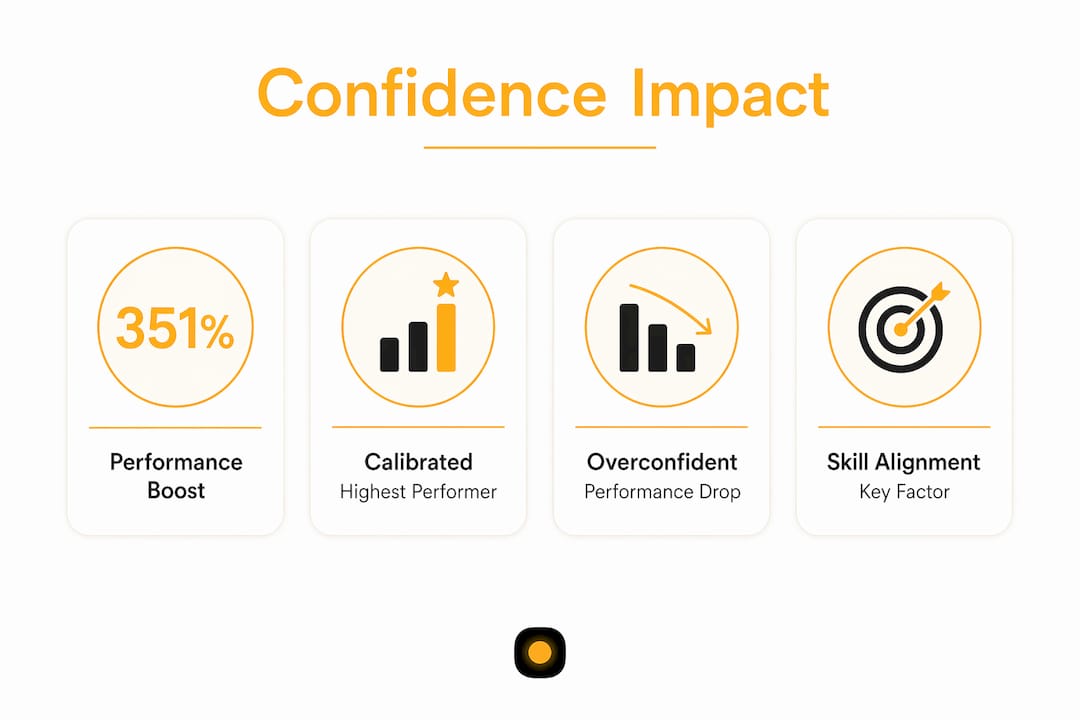
Calibrated salespeople outperform overconfident ones by 351%. That number deserves a moment. Overconfidence is not a minor drag on performance. It is the worst possible miscalibration, worse even than low skill paired with low confidence.
The table below shows how calibration affects outcomes:
| Confidence profile | Relative performance |
|---|---|
| Calibrated (confidence matches skill) | Highest performer |
| Underconfident (skill exceeds confidence) | 37% below calibrated |
| Low skill, low confidence | 61% below calibrated |
| Overconfident (confidence exceeds skill) | 351% below calibrated |
The mechanism behind overconfidence failure is straightforward. A rep who believes they are better at handling objections than they actually are stops preparing for hard ones. They skip discovery steps because they feel they already know the answer. They miss buyer signals because they are not listening. They close too early and lose deals they should have won.
The managerial implication is direct. Generic confidence assessments (“rate your confidence 1–10”) do not catch this. Skill-level confidence measurement focused on specific capabilities like discovery, objection handling, or qualification produces actionable coaching data. A rep can be calibrated on pricing conversations and wildly overconfident on technical objections. You need that granularity to coach effectively.
Pro Tip: Ask your reps to rate their confidence on five specific call skills, not their overall confidence. Then compare those ratings to actual call recordings. The gaps tell you exactly where to coach.
When does confidence backfire on a sales call?
Confidence backfires when it creates the illusion of progress while the buyer is still confused. This is one of the most common and least diagnosed problems in B2B sales. A rep delivers a fluent, assured pitch. The buyer nods. The call ends on a positive note. Then the deal goes quiet.
Confident sales still lose when the buyer lacks clarity on their own problem. Buyer decisions depend on problem understanding, not on a rep’s delivery quality. A rep who sounds confident but skips thorough discovery is solving the wrong problem with great conviction.
The signs that confidence is masking weak discovery are specific:
- Rapid answers to buyer questions. A rep who answers immediately, without pausing to understand the question fully, signals they are performing rather than listening.
- Pitching before problem clarity. Moving to solution before the buyer has articulated their pain in their own words is the most common confidence trap.
- Weak or absent follow-up questions. A confident rep who never says “tell me more about that” is not exploring. They are presenting.
- Skipping qualification gaps. Frameworks like MEDDIC and MEDDPICC exist because confident reps routinely skip steps they feel they can intuit. They cannot.
- Summarizing the buyer’s problem in your own words, not theirs. This signals you heard the words but missed the meaning.
The fix is not less confidence. It is redirecting confidence toward discovery quality rather than delivery fluency. A rep who is genuinely confident in their process asks harder questions, sits with silence, and lets the buyer arrive at clarity. That kind of call closes.
How does vocal confidence build buyer trust?
Vocal confidence is the set of delivery choices that signal competence and calm to a buyer before the content of your words registers. Tone, pacing, and intentional pauses all carry meaning. Buyers form trust judgments within seconds of hearing a voice, and those judgments shape how they receive everything that follows.
Research on vocal similarity adds a specific, counterintuitive finding. An analysis of 2,000+ Kickstarter campaigns found that voices similar to the target audience increased funding success, even without other credibility factors. Familiarity lowers the buyer’s guard. This means mirroring a buyer’s pace, energy level, and vocabulary is not just rapport building. It is a persuasion mechanism with measurable results.
Practical vocal confidence techniques that work on sales calls:
- Slow your pace at key moments. Slowing down when you state a key claim signals you believe it. Rushing signals anxiety.
- Use intentional pauses after questions. Silence after a question communicates patience and invites a real answer. Filling silence immediately signals discomfort.
- Match the buyer’s energy level early, then lead. Start where they are, then gradually bring more warmth or focus. Buyers follow a confident voice that feels familiar.
- Drop your pitch at the end of statements. Rising intonation at the end of a declarative sentence sounds like a question. It signals uncertainty. Flat or falling intonation signals conviction.
Vocal confidence is trainable. Reps who practice call delivery with feedback on tone and pacing improve measurably. The goal is not a performance voice. It is a voice that sounds like someone who has done this before and is not worried about the outcome.
Key takeaways
Calibrated confidence, where belief in your ability matches your actual skill level, is the most reliable predictor of sales call performance.
| Point | Details |
|---|---|
| Confidence works through motivation | Self-efficacy drives intrinsic motivation, which enables adaptive performance under competitive pressure. |
| Calibration beats raw confidence | Calibrated reps outperform overconfident ones by 351%; measure confidence at the skill level, not overall. |
| Discovery quality is the real test | Confident delivery without thorough discovery creates buyer confusion and kills deals after the call. |
| Vocal similarity builds trust | Mirroring a buyer’s pace and tone lowers their guard and increases persuasive impact. |
| Practice closes the gap | Consistent rehearsal with specific feedback converts preparation into genuine, calibrated confidence. |
The uncomfortable truth about confidence I’ve seen on calls
Sales leaders talk about confidence as if it is a personality trait you either have or develop through motivation. That framing misses the point entirely. Confidence is a byproduct of preparation and calibration, not a starting condition.
The reps I have seen struggle most are not the ones who seem nervous. They are the ones who seem polished. They move fast, answer cleanly, and fill every silence. Buyers often like them. But the deals do not close because the buyer never got to articulate their actual problem. The rep’s confidence crowded out the buyer’s thinking.
The most effective approach I have observed is what I would call diagnostic confidence. A rep who treats hesitation, a vague answer, or a deflected question as a signal rather than an obstacle. That rep slows down exactly when a less aware rep speeds up. They ask the follow-up question that feels risky. They sit with an uncomfortable silence. That behavior comes from confidence in the process, not confidence in their own performance.
Measuring confidence at the skill level changes coaching conversations entirely. Instead of “you need to be more confident,” you can say “you are strong on pricing but you rush past technical objections.” That specificity is what produces real improvement. Generic encouragement does not move numbers. Granular call quality assessment does.
The reps who close consistently are not the loudest or the smoothest. They are the most prepared and the most curious. Confidence follows from that combination. It does not precede it.
— Neil
How Offbook builds calibrated confidence in real time
Confidence built before a call is good. Confidence supported during a call is better.
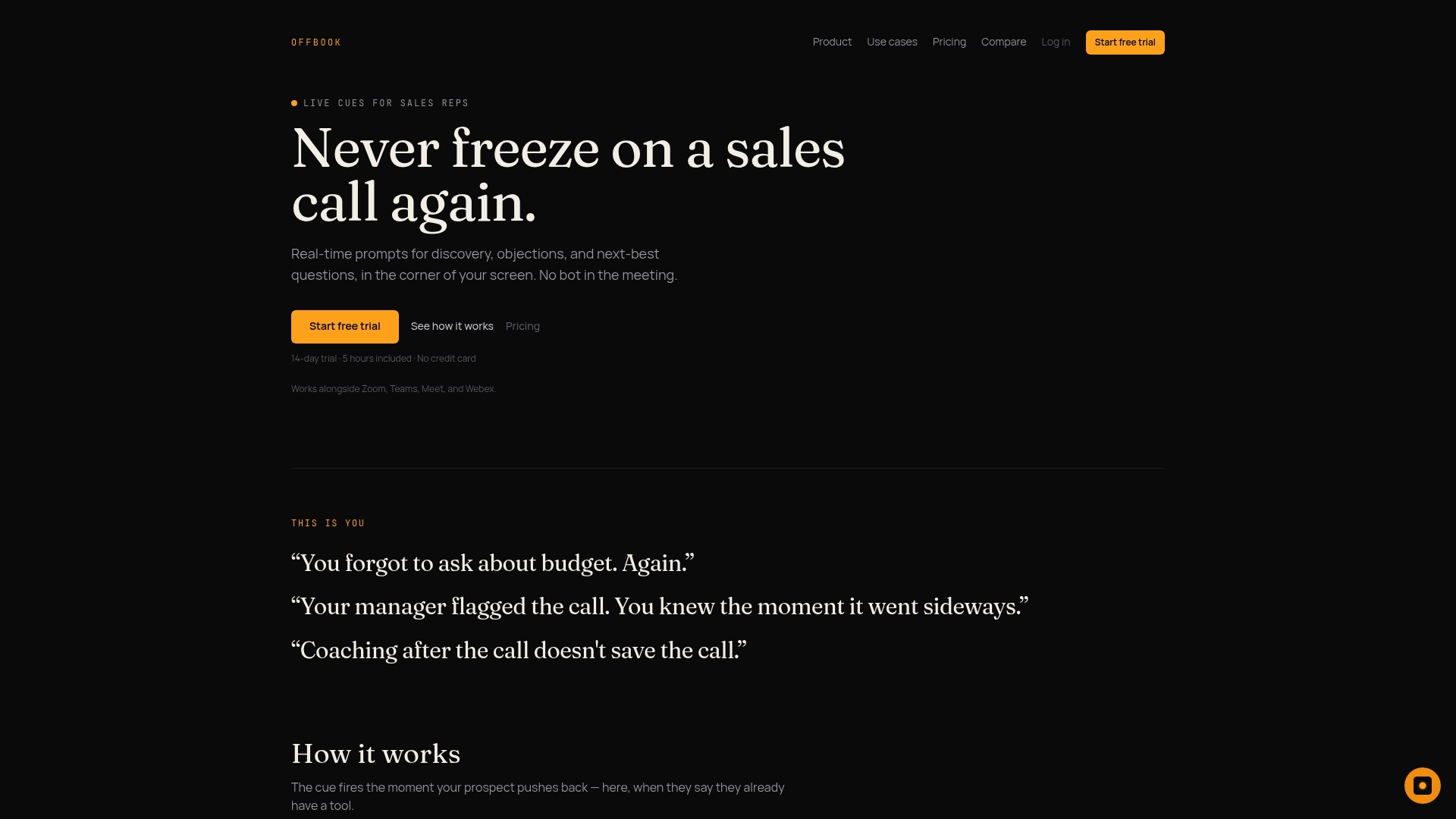
Offbook is real-time AI call coaching built for B2B SaaS sales teams at the seed and Series A stage. It listens to your calls and surfaces live prompts on-screen, covering the questions to ask, the objections to address, and the qualification gaps to close, all structured around MEDDIC and MEDDPICC. Offbook also generates pre-call briefs on the companies and people you are about to meet, so you walk in with the preparation that produces genuine confidence. No bot joins the meeting. No one on the other side knows it is there. You get the coaching exactly when it changes the outcome: in the moment, not in the debrief.
FAQ
What is the role of confidence in sales calls?
Confidence in sales calls fuels intrinsic motivation, which enables reps to adapt their approach under competitive pressure. Research shows self-efficacy predicts adaptive performance indirectly through motivation, not through delivery alone.
How does overconfidence hurt sales performance?
Overconfident reps outperform calibrated reps by 351% in reverse. Overconfidence leads reps to skip discovery, miss buyer signals, and close too early, producing the worst performance outcomes of any confidence profile.
What is calibrated confidence in sales?
Calibrated confidence means your belief in your ability matches your actual skill level. Reps with calibrated emotional self-efficacy significantly outperform both underconfident and overconfident peers.
How does vocal confidence affect buyer trust?
Vocal tone, pacing, and intentional pauses signal competence before content registers. Research on vocal similarity shows that matching a buyer’s voice patterns lowers their guard and increases persuasive impact.
How can sales reps build genuine confidence for calls?
Consistent practice with specific feedback on individual skills, such as objection handling or discovery, builds calibrated confidence. A structured pre-call preparation process converts preparation into performance.