Sales Manager Coaching Cadence Best Practices in 2026
Discover essential sales manager coaching cadence best practices for 2026. Boost deal wins and ramp up new reps with effective strategies!
Published: July 23, 2026
Author: OffBook Editorial Team

What is a sales coaching cadence and why does it drive results?
A sales coaching cadence is a structured, recurring rhythm of coaching conversations between a manager and each rep, designed to build skills deliberately over time rather than react to problems as they surface. It is not a pipeline review. It is not a status check. It is a protected, scheduled commitment to rep development that runs regardless of quarter-end pressure or deal urgency.
The performance gap between consistent and inconsistent coaching is real and measurable. Weekly structured coaching produces a 19% increase in deal wins and 27% faster ramp time for new reps compared to infrequent coaching. Reps coached weekly hit quota at 76% compared to 47% for those coached quarterly or less.
The distinction between coaching and pipeline review is where most managers go wrong. Pipeline review is about deals. Coaching is about the rep’s skill, the behavior that will win the next ten deals, not just the current one. Combining them turns every one-on-one into deal triage and the skill work never happens.
Core benefits of a disciplined coaching cadence:
- Accelerates skill development through repetition and feedback loops
- Drives measurable behavior change tied to real deals and real calls
- Improves quota attainment, particularly for the middle 60% of reps
- Shortens new hire ramp time to productivity
- Builds rep ownership through question-led, self-diagnosis coaching
- Maintains a balance where the rep does the majority of the talking during sessions, with the manager facilitating through questions.
Sales manager coaching cadence best practices: building the right structure
The foundation of an effective coaching cadence is frequency matched to rep experience. Weekly one-on-ones for new and developing reps, bi-weekly for experienced reps at or above quota. A 30-minute session every week produces more skill development than a 90-minute session once a month because the shorter gap lets reps practice, get feedback, adjust, and repeat within the same cycle.
Separate coaching from pipeline review as two distinct calendar events. When they share a slot, deals always win. The coaching conversation disappears.
Key structural elements to build into your cadence:
- Weekly 30-minute one-on-one per rep: deal-anchored skill coaching, not status update
- 15-minute weekly check-in: temperature check between deeper sessions, not a coaching replacement
- Monthly skill deep-dive (60 minutes): zoom out to one skill theme, review a scorecard of three to four calls
- Quarterly career conversation: decoupled from any deal, focused on development trajectory
- Separate pipeline scrub: 15 minutes, different meeting, never mixed with coaching
Tailor frequency by rep profile. New hires in the early months need weekly longer sessions focused on foundational skills and process adherence. Struggling reps benefit from regular sessions with root cause analysis. Top performers require periodic shorter sessions focused on strategic insights and stretch challenges.
Pro Tip: When managing eight or more reps, batch coaching days by profile. Mondays for new hires, Wednesdays for reps who are struggling, Thursdays for your experienced team. This keeps coaching from getting crowded out by deal escalations and admin throughout the week.

How to run each coaching session for maximum skill transfer
The single most important rule in any coaching session: focus on one skill. Not three. Not five. One. Managers who try to fix everything at once fix nothing. Pick the highest-leverage gap and stay there until the metric moves.

Anchor every session to a real artifact. A call recording clip, a deal in your CRM, an email thread. Abstract conversations about “discovery skills” produce abstract behavior change, which means none. Pulling up minute 12 of yesterday’s call and listening together produces something the rep can act on tomorrow.
Session structure that works:
- 5-minute metrics check: two to three leading indicators (discovery-to-demo rate, call-to-meeting ratio), not just quota
- 20-minute skill development block: one skill, question-led throughout, rep does most of the talking
- 15-minute deal coaching: two deals maximum, rep presents their read and strategy, manager asks questions
The GROW model (Goal, Reality, Options, Will) is the most widely used coaching framework for a reason. It forces the rep to self-diagnose and commit to a solution in their own words. Reps who discover the insight themselves change behavior. Reps who get told what to do forget it before the next call.
Pro Tip: Instead of replaying an entire call, pull a 2–3 minute clip at a specific moment: a weak discovery question, a missed objection, a strong closing move. Ask the rep to self-assess first: “What did you notice?” Reps who hear themselves and articulate what to change are far more likely to actually change than those who receive written feedback after the fact.
Coaching dos and don’ts:
- Ask, don’t tell. If you’re above 30% of the airtime, you’re lecturing.
- Close every session with one written commitment the rep owns, not a list of five.
- Open the next session by inspecting last week’s commitment first.
- Keep a simple coaching log: date, skill focus, action item, outcome at the next session.
How to schedule coaching sessions so they actually happen
Thirty to 45 minutes per rep weekly is the right session length. Longer sessions usually mean the manager is talking too much. Shorter sessions usually mean the agenda wasn’t built around a real artifact.
Schedule coaching during off-peak selling hours. Coaching a rep during core selling hours means they’re distracted. Coaching them at the end of a depleted day means you get the minimum. Early morning or late afternoon slots, when reps aren’t mid-call, produce sharper conversations.
Scheduling principles that protect the cadence:
- Set a permanent recurring calendar block, same day, same time, every week
- Treat canceling as the exception that requires justification, not the default when things get busy
- Run pipeline review in a separate meeting with its own recurring invite
- Set the session purpose explicitly at the start: “The first 25 minutes are for your development. Then we’ll look at the pipeline.”
- When a conversation drifts toward deals, name it and redirect: “Let’s park that for the pipeline section.”
For managers with larger teams, the math matters. A team of six to eight reps at 30 minutes each translates to roughly 90 minutes of coaching per week. That’s manageable. If you can’t carve out that time, the span of control is wrong, and that’s a structural problem, not a coaching problem.
Common pitfalls that kill coaching cadences and how to fix them
Coaching cadences don’t collapse dramatically. They slip. One-on-ones drift into pipeline reviews. A session gets canceled for a deal. The rep goes two weeks without a real development conversation, then three. The manager means to get back to it.
The most common mistakes, and what to do instead:
- Canceling when it gets busy: the first canceled session teaches the rep that coaching is optional. Never cancel; shorten instead. Fifteen minutes with one call clip beats skipping entirely.
- Coaching the deal, not the skill: “Send them the case study” closes one deal. “Here’s how to handle social proof on any call” closes ten. Run deal coaching separately.
- Coaching everything at once: five pieces of feedback equals zero behavior change. Two equals one.
- No follow-through: a commitment nobody inspects is a wish. Open every session by reviewing last week’s written commitment.
- Coaching the wrong reps too hard: your bottom 20% needs performance management, not more coaching. Your top 20% needs autonomy. Your middle 60% is where coaching ROI is highest.
When a cadence has slipped and restarting feels heavy, the instinct is to overcorrect: schedule extra meetings, push harder, try to fix everything at once. That’s where resets fail. Start with an honest audit. Have sessions been canceled or drifted into pipeline reviews? Name it honestly, then co-create a simple plan with the rep: agreed topics, milestones, and a light rhythm both parties commit to.
Coaching as a system, not a manager personality trait
The research is unambiguous: coaching is a system, not a personality trait. The managers who produce consistent rep development aren’t necessarily the most charismatic. They’re the most disciplined about protecting the cadence and following a repeatable structure.
A continuous improvement system requires five core components: executive sponsorship (leaders recording their own pitches first), a structured methodology like MEDDPICC that every manager coaches against, recurring practice loops, AI-powered real-time feedback, and performance dashboards measuring both leading and lagging indicators. Remove any one component and the system loses integrity.
Principles that separate systems-based coaching from intuition-based coaching:
- Structured frameworks like GROW or PRAISE produce measurably better win-rate lift than unstructured one-on-ones
- Rep self-diagnosis drives deeper behavior change than top-down feedback
- Coaching must run on a fixed weekly cadence regardless of whether the rep is overperforming or behind
- Executive modeling matters: when leaders record their own pitches and submit to the same scrutiny, adoption follows
Statistic callout: Reps who receive weekly structured coaching win 19% more deals and ramp 27% faster than those who receive coaching infrequently.
The ask-versus-tell distinction is where most managers underperform. Telling a rep what to do feels faster. Asking them to diagnose the problem themselves feels slower. But reps who self-diagnose retain the lesson. Reps who get told forget it before the next call.
How to measure whether your coaching cadence is working
Quota is a lagging indicator. It tells you the cadence worked two quarters ago. By the time quota numbers validate your coaching, you’ve already lost months of course-correction opportunity.
Measure leading indicators over a 90-day window:
- Stage-to-stage conversion rates: is the rep’s discovery-to-demo rate trending up? This is the earliest signal that discovery skills are improving.
- Activity-to-outcome ratio: calls-to-meetings ratio improving means the coaching is working. A flat ratio means it isn’t.
- Average deal velocity: deals moving faster through the pipeline indicate the rep is better at driving urgency.
- Ramp time for new hires: days to first deal and days to quota attainment are the cleanest signals for onboarding coaching.
- Cadence adherence: what percentage of scheduled sessions actually happened, and what percentage of written commitments were inspected at the next session. This measures the manager, not just the rep.
Keep a simple coaching log for each rep: date, skill focus, action item, and outcome at the next session. It takes two minutes to maintain and surfaces patterns you’d otherwise miss, like the fact that a rep’s objection handling improved but their discovery is still weak three months in.
A qualitative signal that coaching is working: reps begin diagnosing their own performance gaps without being prompted. That shift in self-awareness is the clearest sign the cadence has become part of how the team operates.
Which tools support a consistent coaching cadence?
Technology doesn’t replace coaching discipline, but it removes the friction that causes cadences to slip. The right tools make it easier to anchor sessions to real artifacts, track commitments, and surface coaching moments between scheduled sessions.
Conversation intelligence platforms let managers pull a 2–3 minute call clip directly into a coaching session rather than scrubbing through a full recording. The rep narrates what they’d change. One clip beats a whole-call review for focus and retention. Tools in this category also surface keyword trends, objection patterns, and talk-time ratios that give coaching sessions a data foundation rather than relying on memory.
CRM platforms like Salesforce and HubSpot serve as the artifact layer for deal-anchored coaching. Pulling up a specific opportunity during the deal coaching zone of a session grounds the conversation in real data rather than a rep’s subjective account of where things stand.
For real-time skill development, Offbook takes a different approach entirely. Rather than coaching after the call, Offbook surfaces live AI cues to reps during video calls, prompting them on-screen with the right questions to ask, objections to handle, and qualification gaps to close, all structured around methodologies like MEDDIC and MEDDPICC. It also generates pre-call briefs so reps walk into every conversation prepared. The coaching happens in the moment, when it actually changes the outcome, not days later in a scheduled review.
Offbook’s technology approach to sales coaching complements a structured cadence by compressing the feedback loop between sessions. Managers still run weekly one-on-ones. But the skill work reps do on live calls reinforces what was discussed in coaching, rather than waiting a week to apply it.
How to set goals within your coaching cadence framework
Goal-setting inside a coaching cadence works best when the rep owns the goal, not the manager. Reps who set their own focus areas show stronger buy-in and follow-through than those handed improvement targets from above.
At the start of a new coaching cycle, ask the rep what they want to work on. Then align that to the skill gap you’ve identified from call data and conversion metrics. The overlap between what the rep wants to develop and what the data shows they need is where the most productive coaching happens.
Structure goals at three levels within the cadence:
- Weekly: one specific behavioral commitment tied to an upcoming call or deal (e.g., “I will ask for the economic buyer’s name in every discovery call this week”)
- Monthly: one skill theme with a measurable outcome over 30 days (e.g., improve discovery-to-demo conversion rate by focusing on problem qualification)
- Quarterly: a development milestone that connects to career trajectory, not just quota (e.g., run a full MEDDPICC qualification on every deal above a certain size)
The written commitment at the end of each session is the bridge between goal-setting and accountability. The rep writes it, not the manager. That single habit, combined with opening the next session by reviewing it, creates the continuity that makes goals feel real rather than aspirational.
For reps building their sales career skills, connecting coaching goals to visible skill development also strengthens retention. Reps who see their growth tracked and recognized stay longer.
How to overcome resistance to maintaining a coaching cadence
Resistance to coaching cadences usually comes from one of three places: the rep doesn’t see value because sessions haven’t been development-focused, the manager cancels too often and the rep learns it’s optional, or there’s a trust gap that makes honest skill conversations feel risky.
The fix for each is different. If sessions have been drifting into pipeline reviews, name it directly: “I know our recent sessions have been more about deals than your development. I want to reset that.” Then co-create a simple plan with agreed topics and a light rhythm. Reps respond well to honesty about what got dropped.
Strategies for sustaining cadence through resistance:
- Never cancel, only shorten: a 15-minute session with one call clip maintains the rhythm. A canceled session breaks it.
- Rotate session ownership: every fourth week, the rep picks the call clip, leads the diagnosis, and proposes their own commitment. This shifts the session from “manager’s agenda” to “rep’s growth time.”
- Address the underlying cause of avoidance: if a rep consistently skips sessions, don’t chase them. Find out whether they’re under too much pressure, don’t see the value, or have a trust issue with the coaching relationship.
- Diagnose before coaching: not every performance gap is a skill problem. A will gap, a knowledge gap, or a broken territory requires a different response than more coaching.
- Protect the block like a customer meeting: put it on a permanent recurring invite and treat moving it as the exception that requires justification.
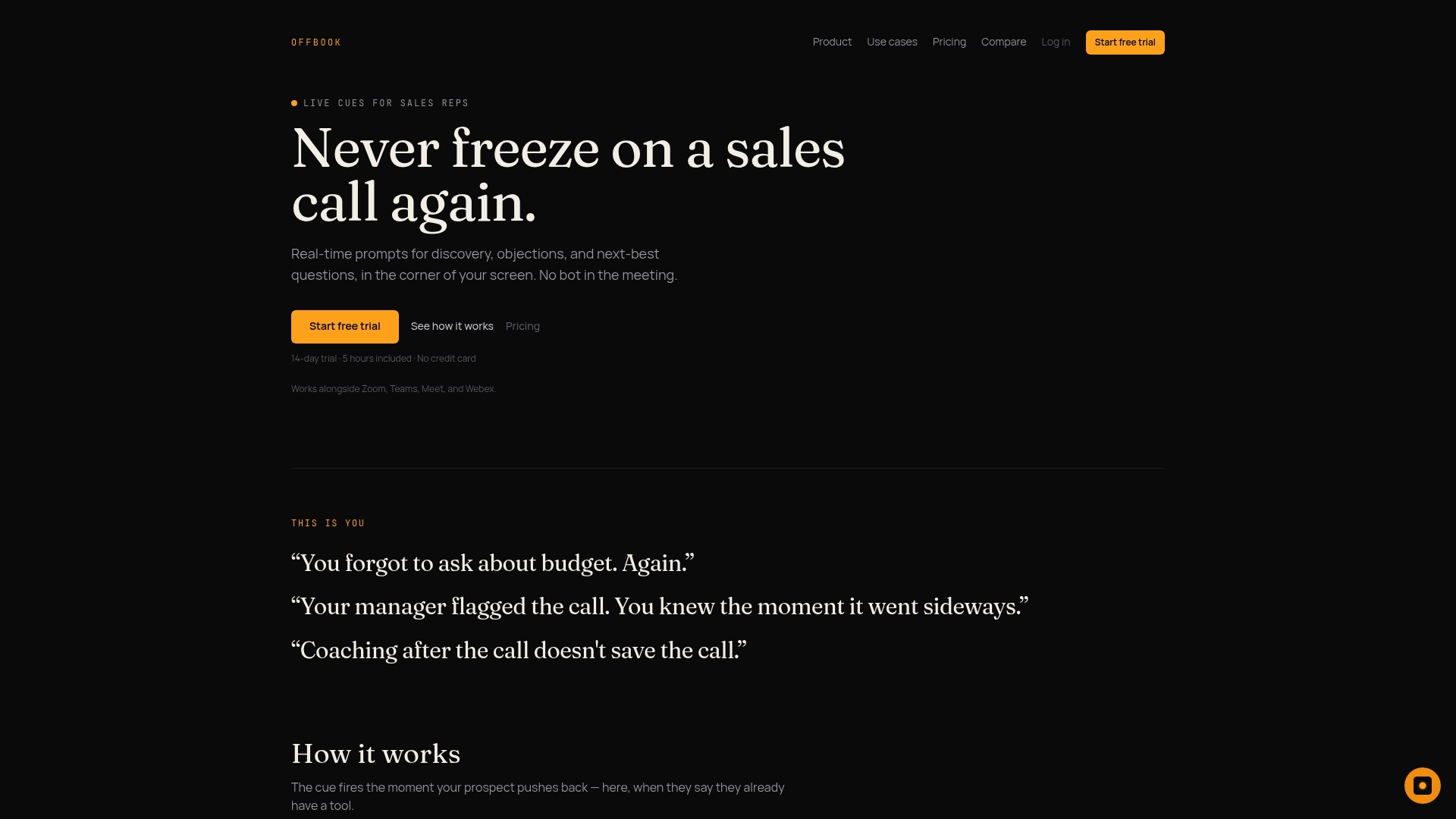
Offbook helps sales managers close the gap between scheduled coaching and real-time skill application. While your cadence handles the weekly rhythm, Offbook coaches reps live on calls, surfacing the right prompts at the exact moment they’re needed. No bot joins the meeting. No post-call delay. Just in-the-moment guidance that reinforces what you worked on in your last session. See how Offbook works for B2B SaaS teams at the seed and Series A stage.
Key Takeaways
A disciplined coaching cadence, protected from pipeline reviews and anchored to real call artifacts, is the single most reliable driver of rep skill development and quota attainment.
| Point | Details |
|---|---|
| Weekly cadence drives results | Reps coached weekly win 19% more deals and ramp 27% faster than those coached infrequently. |
| Separate coaching from pipeline review | Combining them turns every session into deal triage; run them as two distinct calendar events. |
| One skill per session | Targeting a single behavior per session produces measurable improvement; five topics produce none. |
| Measure leading indicators | Track stage-to-stage conversion rates and deal velocity over 90 days, not just quota attainment. |
| Never cancel, only shorten | The first canceled session teaches reps that coaching is optional; protect the block every week. |