Pricing Objection Prompts and Live Coaching Cues for B2B SaaS Reps
Copy ready pricing objection prompts and scripts for founder led B2B SaaS reps, plus how live coaching cues turn those prompts into won deals.
Published: September 9, 2026
Author: OffBook Editorial Team

The best move when a prospect says “too expensive” isn’t to defend your price. It’s to diagnose it. Ask “Too expensive compared to what?” and let them name the anchor. Follow with: “Help me understand what’s driving that reaction, is it the number itself, or something about the timing?” Personalize both lines; they’re diagnostic starting points, not scripts to recite word for word.
TL;DR:
- Most “too expensive” objections stem from value gaps, negotiation tactics, authority issues, or timing, and misdiagnosing them leads to unnecessary discounts or lost deals.
- Asking specific diagnostic questions and pausing before responding help uncover the true concern, enabling targeted solutions instead of generic pricing pushes.
- Reframing “we have a cheaper option” as a discussion about value versus cost shifts focus from price to outcomes and differentiates true competitive advantages.
- Using conditional trades like longer contracts or references preserves margins and avoids damaging discounts during negotiations.
- Employing quick ROI and social proof statements with clear numbers strengthens justification, especially when tailored to the prospect’s real priorities.
Table of Contents
- What Are the Best Pricing Objection Prompts to Diagnose the Real Issue?
- Copy-Ready Pricing Objection Prompts by Category
- How Do You Script a Response to “We Have a Cheaper Option”?
- What Should You Trade Instead of Discounting?
- How Do You Use ROI and Social Proof to Justify Price?
- A Coaching Note on Practicing These Prompts
- Turn These Prompts Into Live Coaching During Real Calls
- Sources
What Are the Best Pricing Objection Prompts to Diagnose the Real Issue?
Every “too expensive” hides one of four problems: a value gap, a negotiation tactic, a budget or authority constraint, or bad timing. Respond to the wrong one and you either discount when you didn’t need to, or lose a deal you could have saved.
A simple four-step flow gets you there fast:
- Listen for the exact phrasing. “Too expensive” is different from “we don’t have budget” or “I need to check with my boss.”
- Pause for three to five seconds before responding. HubSpot’s research on price objections found this pause alone reduces premature discounting and lets the prospect keep talking, often revealing the real concern unprompted.
- Clarify with a direct question rather than an assumption.
- Isolate the blocker so you know exactly what you’re solving before you respond.
Common buyer lines map fairly predictably to root causes. “It’s too expensive” usually signals a value gap: they don’t see enough return yet. “Can you do better on price?” is a negotiation opener, they already want it, they’re testing your flexibility. “I need to run this by finance” is an authority issue. “Let’s revisit this next quarter” is timing, sometimes real, sometimes a soft no in disguise.
Once you’ve isolated the cause, the next move is clear: sell more value if it’s a gap, negotiate terms if it’s a tactic, help build an internal case if it’s authority, or ask what would need to be true today if it’s timing.
Copy-Ready Pricing Objection Prompts by Category
Match the language to the diagnosis. Here’s a working set organized by what you’re trying to accomplish.
- Diagnostic questions (use these first, always): “Too expensive compared to what, exactly?” “What were you expecting to pay?” “Is it the total number, or how it’s structured?” “What would need to be true for this to feel like an easy yes?”
- Value-reframe prompts (once you’ve confirmed a value gap): “What’s it costing you every month to keep doing this manually?” “If this saves your team ten hours a week, where does that number land against the price?” “What happens if you don’t solve this in the next two quarters?”
- Negotiation openers (once you’ve confirmed they want a deal, not more convincing): “What would make this work for you on a 12-month term instead of monthly?” “If we can find room on price, is that the only thing standing between us and a signed deal today?” “Are we negotiating price, or are we negotiating value, meaning is there a feature or seat count I can adjust instead?”
- Stakeholder and approval prompts (once you’ve confirmed it’s an authority issue): “What does your CFO need to see to approve this?” “Would it help if I put together a one-pager with the ROI math for your exec?” “Who else needs to weigh in, and what’s usually the sticking point when deals like this get reviewed?”
Prospeo’s breakdown of price objection scripts makes the same point differently: reps who classify the objection before responding discount less and close more, because they stop treating every “too expensive” as the same problem. A deeper look at common B2B sales objections covers how this classification habit extends beyond pricing to nearly every stall tactic you’ll hear on a call.
How Do You Script a Response to “We Have a Cheaper Option”?
Different phrasing needs different scripts. Below are three situations you’ll hit constantly, each with a diagnosis cue, a short response, and a question that keeps the deal moving.
- “This is too expensive.” (Value gap) Say: “I hear that a lot before someone sees the full cost of the problem we’re solving. Walk me through what ‘expensive’ is being measured against right now.” Then stop talking.
- “We have a cheaper vendor.” (Competitive anchor) Say: “Cheaper is easy to find. The question is what you’re not getting at that price. What matters most to you in this decision, the lowest number or the best outcome?”
- “I need to check with finance.” (Stakeholder) Say: “Makes sense. What’s the one thing finance usually pushes back on, so I can help you get ahead of it?”
Pro Tip: After you ask an isolating question, count to five in your head before you say anything else. Reps who fill silence with more selling are the ones who talk themselves into a discount nobody asked for.
The pause matters as much as the words. A rushed follow-up signals you’re nervous about the price. A held pause signals you’re confident it’s worth the conversation.
What Should You Trade Instead of Discounting?
Discounting straight-up trains buyers to expect it every renewal. Trading protects your margin and gives the prospect something that feels like a win.
Reliable tradeables include a longer initial contract term, faster payment terms (annual upfront instead of monthly), a phased rollout that starts smaller, or an agreement to serve as a reference or case study later.
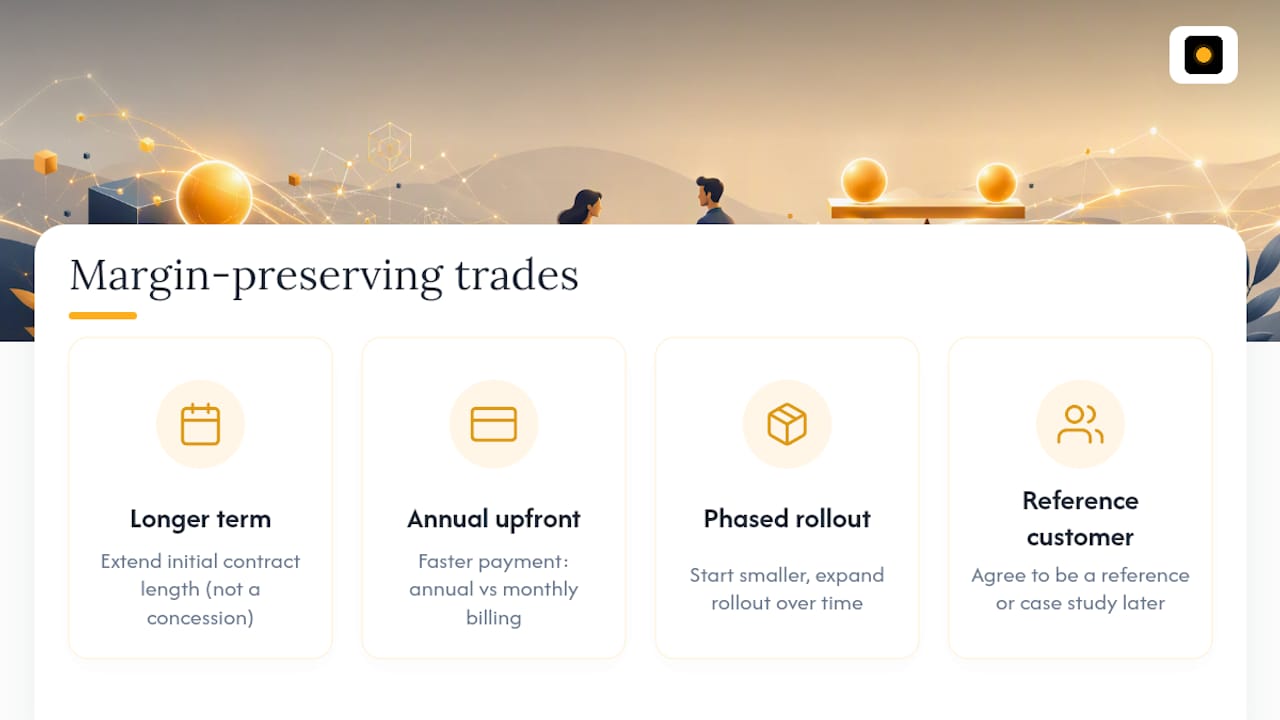
Frame every trade conditionally, never as a concession you hand over. Use if-then language: “If you can commit to an annual term, I can adjust the per-seat price.” “If you’re comfortable being a reference customer once you’re live, I can bring the onboarding fee down.” NetHunt’s guide to handling price objections makes the case for conditional trades over blanket discounts precisely because they keep the negotiation two-directional instead of one-sided.
Loop in pricing approval before you make any trade involving contract length changes or anything below your standard floor. Improvising on those terms live is how margin erodes deal by deal.
How Do You Use ROI and Social Proof to Justify Price?
Numbers land harder than adjectives. Keep the math short enough to say out loud in one breath.
| ROI framing | Example phrasing |
|---|---|
| Monthly cost of inaction | “If this saves five hours a week per rep, that’s roughly one full workday back, every week.” |
| Annualized comparison | “Over a year, that time savings adds up to more than the subscription costs.” |
| Risk-reversal framing | “If it doesn’t move your close rate in the first quarter, we talk about why before you renew.” |
Have one social proof line ready, not a slide deck. A single sentence like “teams using this cut their ramp time by weeks” works better mid-call than a case study PDF you email afterward. Strategies for using social proof to reduce perceived risk reinforce that specificity beats volume, one sharp example outperforms five vague ones.
Offer a trial or pilot selectively, when the prospect’s skepticism is genuinely about unproven ROI, not as a default fallback every time price comes up. Overusing trials trains buyers to expect one before they’ll commit to anything.
A Coaching Note on Practicing These Prompts
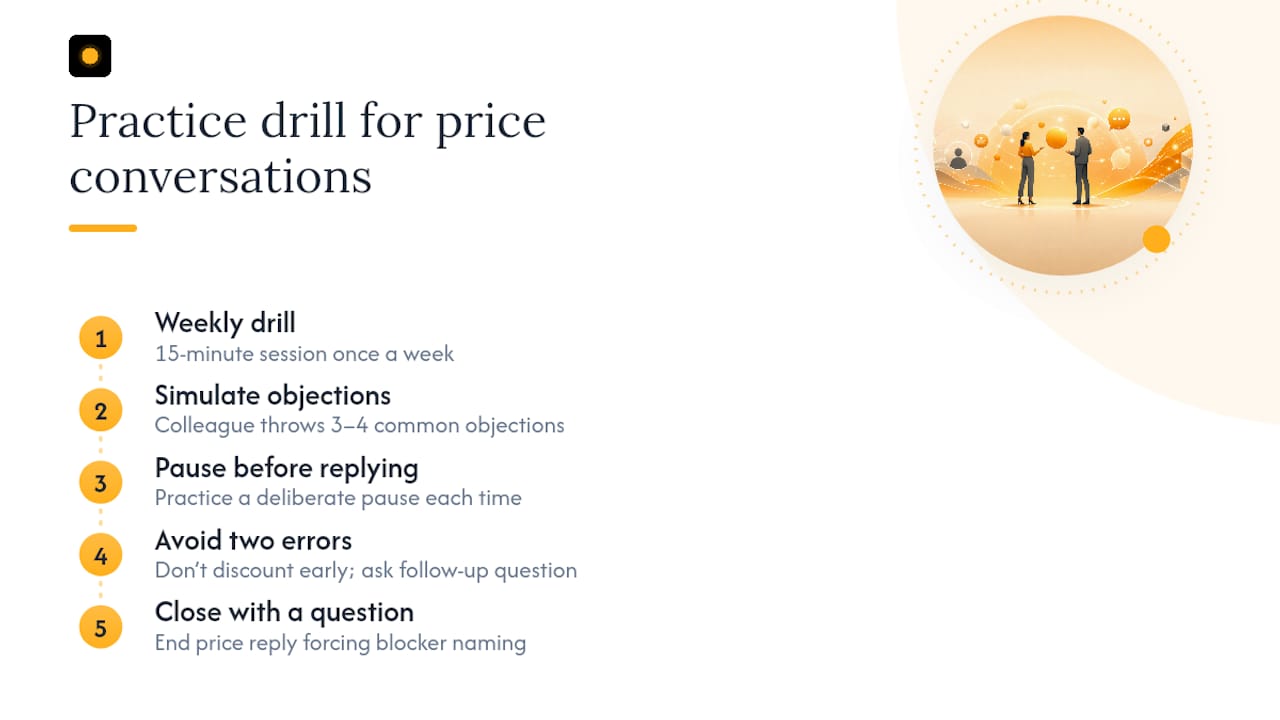
The habit that separates reps who handle price well from reps who don’t isn’t cleverer language. It’s rehearsal. Run a 15-minute drill once a week: have a colleague throw three or four common objections at you, and practice pausing before you respond to each one. Most reps skip this because it feels awkward to rehearse alone, but the awkwardness is the point, it’s where the instinct gets built.
The two errors I see most often: discounting before diagnosing, and asking a clarifying question but never following it with a second question that actually isolates the blocker. A price statement without a question attached to the end isn’t a script, it’s a monologue. Make it a habit to close every price response with a question that forces the prospect to name what’s actually stopping them.
— Neil
Turn These Prompts Into Live Coaching During Real Calls
Reading a list of prompts is one thing. Remembering the right one at the exact second a prospect says “too expensive” on a live call is another. A real-time coaching tool can listen to your sales calls and surface matching prompts, objection cues, or qualification gaps directly on your screen without a bot joining the meeting or others knowing.
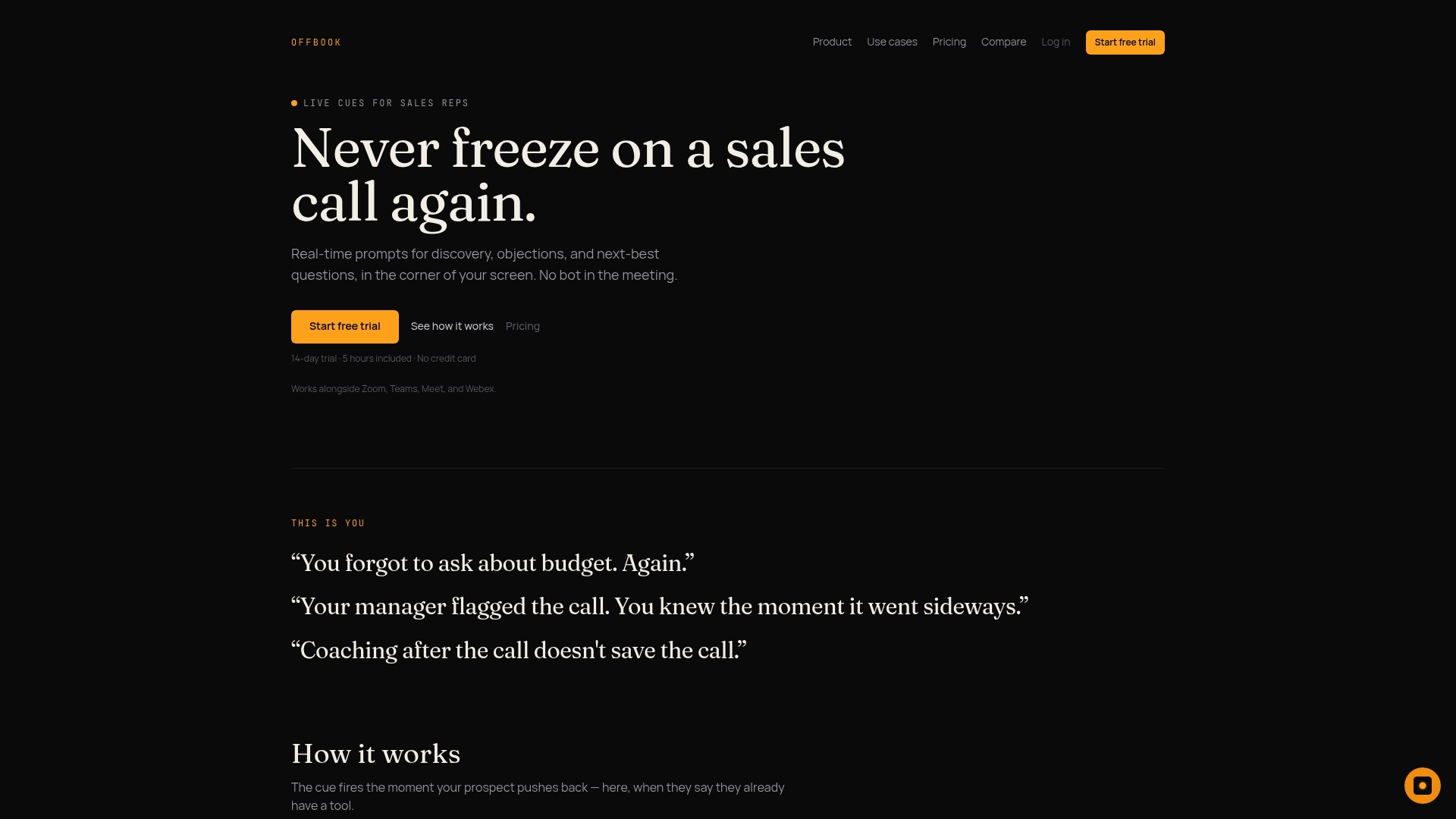
Instead of hoping you remember to pause and isolate, such software can flag issues in the moment, provide a pre-call brief on the person you’re about to talk to, and offer a post-call debrief with next steps drafted for you. For founder-led sales teams running every call solo, that’s the difference between winging a price conversation and running it on structure. Start a trial on the Offbook sales landing page and see what live coaching looks like on your next call.
Sources
This article draws on HubSpot’s guide to price objection responses, Prospeo’s tactical playbook for diagnosing objections, NetHunt’s rebuttal examples for price objections, and Tarka’s GTM drill for classifying and logging objections. For more on applying these tactics live, see Offbook’s guide to handling objections on live sales calls.
- 14 responses to the sales objection, “Your price is too high”
- Price Objection Handling Examples: 15 Scripts That Work in 2026
- The price is too high: How to handle price sales objections +27 examples of rebuttals