How Video Sales Calls Differ from In-Person: 2026 Guide
Discover how video sales calls differ from in-person meetings. Learn communication nuances that impact trust and deal closure for better sales.
Published: July 15, 2026
Author: OffBook Editorial Team

Video sales calls and in-person meetings differ most fundamentally in communication bandwidth. The channel you choose determines how much trust you build, how well you read the room, and whether you close the deal. Understanding how video sales calls differ from in-person meetings is not a matter of preference. It is a matter of revenue. Live video calls convert at 35%–50% compared to 5%–10% for text chat, and face-to-face requests are 34 times more effective at securing commitments than email. The best sales professionals treat both formats as distinct tools, not interchangeable options.
What are the key communication differences between video and in-person sales calls?
In-person meetings give you the full signal. You read micro-expressions, posture shifts, and the energy in the room simultaneously. Video calls compress all of that into a camera frame, a microphone, and a screen. The result is a narrower communication channel, even when the technology works perfectly.
The behavioral gaps show up in specific ways:
- Nonverbal cues: Body language, hand gestures, and group dynamics are fully visible in person. On video, camera angle and framing cut most of that out.
- Latency and interruptions: Even a half-second delay on a video call disrupts natural conversational rhythm and makes mirroring harder.
- Eye contact: True eye contact requires looking at the camera, not the person’s face on screen. Most reps look at the face, which reads as avoidance to the prospect.
- Ambient distractions: Notifications, open tabs, and background noise all compete for attention in a way that a conference room does not.
- Vocal pacing: On video, matching the prospect’s speed and rhythm in the first minute creates subconscious alignment. This is the primary rapport tool when physical presence is absent.
The fix for most video call problems is discipline, not technology. Reps who slow down, pause deliberately, and modulate their tone close the communication gap significantly.
Pro Tip: Hide your self-view during video calls. Watching yourself on screen splits your attention and causes subtle, distracting movements. Your prospect notices even when you do not.

How do video and in-person sales calls perform across different sales stages?
The format that wins depends on where you are in the deal. Hybrid sales models that use video for qualification and in-person for closing generate 28% more revenue than teams that rely exclusively on one format. That number reflects a structural truth: each format has a natural home in the sales cycle.
| Sales stage | Best format | Why it works |
|---|---|---|
| Initial prospecting | Video or phone | Speed and scale; no travel cost |
| Discovery and qualification | Video | Efficient, repeatable, easy to record for review |
| Product demo | Video | Screen sharing and live walkthroughs work well remotely |
| Complex negotiation | In-person | Full nonverbal access; silence as a tool; group dynamics |
| Closing high-value deals | In-person | Trust signal; physical presence reduces friction |
| Post-sale check-in | Video | Relationship maintenance without travel overhead |
Video excels at the top of the funnel. It lets reps run more calls per day, qualify faster, and reach prospects across geographies without a travel budget. Remote selling scales reach in a way that in-person never can.
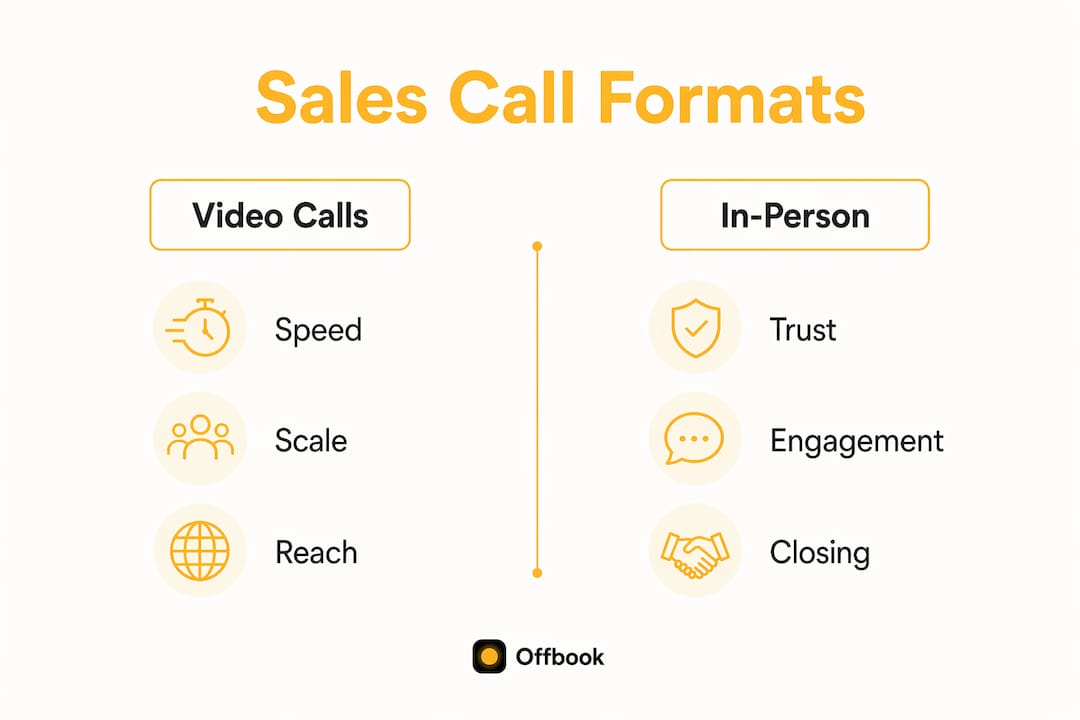
In-person earns its place at the bottom of the funnel. For deals above $50,000 or those involving multiple stakeholders, physical presence changes the dynamic. Real-time nonverbal signals during negotiation, including body language and group energy, are only fully available face-to-face. Reps who skip the in-person close on complex deals leave money on the table.
What are the psychological and trust-building differences between video and in-person calls?
Trust is harder to build through a screen. 67% of business professionals prefer in-person meetings for high-stakes decisions, citing richer communication as the primary reason. That preference is not nostalgia. It reflects a real gap in how trust signals transmit across formats.
Physical presence carries weight that video cannot replicate. When a rep shows up in person, it signals commitment, accountability, and credibility. Online crime losses rose 33% between 2023 and 2024, and buyers are more skeptical of digital interactions as a result. A face-to-face meeting cuts through that skepticism in a way that no amount of polished video presence can.
The chameleon effect is also stronger in person. Mirroring a prospect’s posture and gestures builds perceived trust and enjoyment more effectively face-to-face than video allows. On a call, you can mirror vocal tone and pacing, but the physical dimension is missing. That missing layer matters most in sensitive negotiations and relationship-heavy deals.
“Physical presence in a sales meeting is itself a trust signal. In a world where buyers are increasingly wary of digital fraud and impersonation, showing up in person communicates something no video call can: that you are real, accountable, and invested in the relationship.”
Pro Tip: When in-person is not possible for a high-stakes conversation, use synchronous video rather than asynchronous messaging. Live interaction, even through a screen, preserves more of the trust-building dynamic than recorded or written communication.
How do distractions and engagement vary on video versus in-person calls?
In-person meetings create natural social accountability. When you are physically present with someone, leaving the room, checking your phone, or zoning out carries a social cost. That accountability keeps both parties engaged in a way that a video call simply does not.
Virtual meetings remove that social friction. 23% of employees report extreme video meeting fatigue, and women are disproportionately affected. Multitasking is common and often invisible to the other party. A prospect who appears attentive on camera may be reading email at the same time.
Sales reps can manage this gap with specific techniques:
- Shorten the call: Video attention spans are shorter. A 30-minute video call often achieves more than a 60-minute one.
- Ask more questions: Questions force engagement. A prospect who is multitasking has to re-engage to answer.
- Minimize your own movement: Excessive movement on video distracts the prospect and signals nervousness. Stay still and deliberate.
- Use names: Addressing the prospect by name at key moments pulls attention back to the conversation.
- Pause before key points: A deliberate pause signals that something important is coming and prompts the prospect to refocus.
The goal on video is to create the same sense of presence and accountability that in-person delivers naturally. That requires more active effort from the rep, not less.
What practical strategies should sales professionals use for video and in-person calls?
The reps who perform best in 2026 treat video and in-person as a system, not a choice. Each format has a job, and the discipline is in knowing which job belongs to which format.
- Use video for qualification and demos. Run your discovery calls and product walkthroughs on video. You cover more ground, reach more prospects, and keep your call preparation checklist consistent across every conversation.
- Reserve in-person for high-value closes. Any deal above $50,000 or involving three or more stakeholders warrants a face-to-face meeting. The trust signal alone justifies the travel cost.
- Plan your in-person routes around your pipeline. Group in-person visits geographically and schedule them around deal stage, not convenience. A CRM with territory mapping prevents wasted travel.
- Prepare differently for each format. Video calls need a clean background, camera at eye level, and a tested audio setup. In-person meetings need printed materials, a clear agenda, and a plan for managing silence during negotiation.
- Use silence as a tool in person. A three-second pause after a key question creates space for the prospect to think and reveal more. On video, silence often feels like a technical glitch. In person, it reads as confidence.
- Use real-time coaching on video calls. Tools like Offbook surface live prompts during the call, covering qualification gaps, objection handling, and MEDDIC methodology cues. That kind of in-call sales guidance is harder to replicate in person but changes outcomes on video.
- Debrief after every call, regardless of format. Note what worked, what the prospect revealed, and what the next step is. The format changes; the discipline does not.
Key Takeaways
Video and in-person sales calls serve different functions in the sales cycle, and the reps who use both deliberately close more deals than those who default to one format.
| Point | Details |
|---|---|
| Communication bandwidth | In-person delivers richer nonverbal cues; video compresses signals and requires more active vocal compensation. |
| Stage-based format choice | Use video for prospecting and demos; reserve in-person for complex negotiations and high-value closes above $50,000. |
| Trust signals | Physical presence cuts through digital skepticism; 67% of professionals prefer in-person for high-stakes decisions. |
| Engagement management | Video fatigue is real, affecting 23% of employees; reps must actively manage attention through questions and pacing. |
| Hybrid model revenue | Teams combining video qualification with in-person closing generate 28% more revenue than single-format approaches. |
The format is not the strategy
I have watched sales teams spend months debating video versus in-person as if it were an either/or question. It is not. The reps I have seen consistently outperform their peers do not pick a favorite format. They pick the right format for the moment, and they prepare differently for each.
The subtlest mistake I see is reps treating video calls as a lesser version of in-person. They prepare less, dress more casually, and assume the lower stakes justify a looser approach. That is exactly backwards. Video calls are harder to execute well precisely because the communication channel is narrower. You have to work more deliberately to build rapport, manage attention, and read the room.
The other mistake is the opposite: over-indexing on in-person for deals that do not warrant it. Traveling to a first discovery call with a prospect who has not been qualified is an expensive way to learn they were never a fit. Video handles that job better, faster, and at a fraction of the cost.
The role of technology in sales coaching has changed what is possible on video calls specifically. Real-time coaching tools close the gap between what a rep knows and what they actually say in the moment. That is where I see the biggest performance gains for teams willing to invest in the discipline.
— Neil
How Offbook helps you run better calls in both formats
Sales reps who understand the differences between video and in-person calls still need a system to execute consistently. Offbook is AI call coaching for sales that surfaces live prompts during video calls, covering qualification gaps, objection handling, and methodology cues from MEDDIC and MEDDPICC, without a bot ever joining the meeting.

Offbook also generates pre-call briefs on the companies and people you are about to meet, so you walk into every conversation prepared. For founder-led B2B SaaS teams at seed and Series A, that preparation is the difference between a call that advances the deal and one that stalls it. Explore the Offbook product to see how real-time coaching fits your sales workflow.
FAQ
How do video sales calls differ from in-person for closing deals?
In-person meetings are significantly more effective for closing high-value deals. Face-to-face requests are 34 times more effective at securing commitments, and physical presence provides trust signals that video cannot replicate.
When should sales reps use video calls instead of meeting in person?
Video calls work best for prospecting, qualification, and product demos. They scale reach efficiently and reduce travel costs, making them the right choice for early-stage conversations before deal complexity justifies in-person time.
What causes video call fatigue and how can reps reduce it?
23% of employees report extreme video meeting fatigue, driven by the mental effort of processing compressed communication signals. Reps can reduce it by shortening calls, asking more questions, and minimizing on-screen movement.
Does a hybrid sales model actually improve revenue?
Hybrid models that use video for qualification and in-person for closing generate 28% more revenue than teams relying on a single format. The revenue lift comes from matching the right communication channel to the right deal stage.
What is the most important video call sales technique for building rapport?
Matching the prospect’s vocal pacing and rhythm in the first minute of a video call creates subconscious alignment. This NLP-based mirroring technique is the primary rapport tool when physical presence is not available.