How Sales Hiring Affects Revenue: A 2026 Guide
Discover how sales hiring affects revenue and how to optimize your hiring strategy for maximum profit. Make every hire count!
Published: July 22, 2026
Author: OffBook Editorial Team

Sales hiring is one of the highest-stakes capital decisions a company makes, and most leaders treat it like a scheduling problem. The timing of your hires, the quality of candidates you select, and how long seats sit vacant all have direct, measurable consequences on revenue. A single unfilled sales seat at a $10M ARR SaaS company can cost substantial lost revenue over a short period. A bad hire runs a very high fully loaded cost. These are not HR abstractions. They show up in your next board deck.
Here is what the data tells us about how sales hiring shapes revenue outcomes:
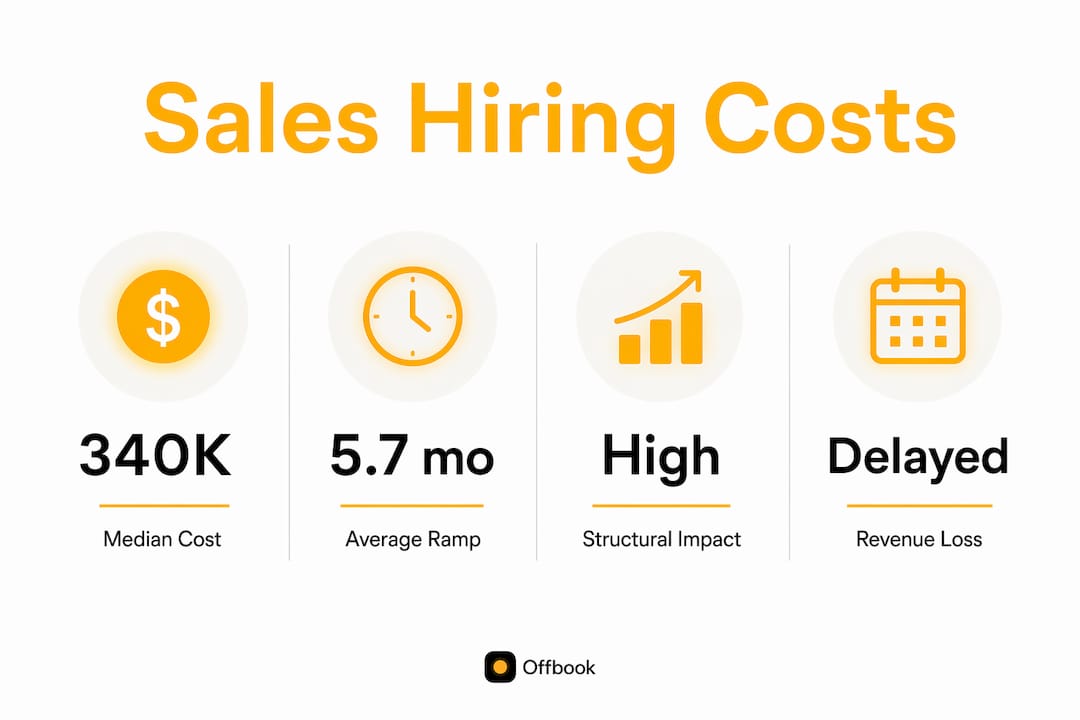
- Ramp time delays revenue realization. The average ramp time for SaaS sales reps is 5.7 months. You pay full compensation while receiving partial output.
- Top performers compound returns. A-player hires generate significantly more profit than average hires, and that gap widens as their territory matures.
- Poor hires cost far more than their salary. The loss from a bad sales hire includes substantial indirect costs that can be multiple times the direct payroll figure.
- Delayed hiring creates revenue debt. When headcount lags your growth plan, you accumulate forecasted revenue that never had the human capacity to materialize.
How sales hiring affects revenue: the operational and financial fallout of delays
Every day a sales seat sits open, revenue leaks. That is not a metaphor. It is a daily accounting problem that most finance teams fail to model correctly because they focus on payroll savings instead of pipeline loss.
The operational consequences spread fast. Marketing-generated leads go cold without follow-up. Channel partners deprioritize your product when there is no rep actively managing the relationship. Customer success teams absorb renewal and upsell responsibilities they were never built to handle, which degrades the buyer experience and puts net promoter scores at risk. None of these costs appear on a payroll report, but they all show up in next quarter’s revenue.
The financial misalignment runs deeper for venture-backed companies. Capital arrives in large rounds, but revenue is generated incrementally by people who take months to hire and ramp. When hiring lags the growth plan, you create revenue debt, a gap between forecasted revenue and the human capacity that was supposed to produce it. That gap compounds with every week of delay.
Pro Tip: Treat every open sales seat as a capital deployment decision, not an HR ticket. Model the daily revenue cost of vacancy alongside payroll savings, and present both numbers to leadership. The math almost always favors moving faster.
Quantifying the revenue loss from missed quotas and hiring gaps
The numbers here are uncomfortable, and they should be. A bad sales hire costs $340K at the median fully loaded amount over a six-month detect-to-terminate window. That figure is the one to budget against when making the case for hiring rigor.
The salary is the cheapest line item. The expensive lines are the territory that sat idle for six months, the eight to fourteen opportunities the rep mis-staged and contaminated, the manager bandwidth siphoned away from coachable reps, and the recruiting fee you pay twice when you re-run the cycle.
The direct costs, covering salary, benefits, recruiting fees, tech, and onboarding labor, run substantial amounts. But the indirect costs, which include territory opportunity cost, pipeline contamination, manager time, and the replacement cycle, add even larger additional sums. Finance models the direct stack. The indirect stack is where the real damage lives.
| Cost layer | What it captures | Rough magnitude |
|---|---|---|
| Direct | Salary, benefits, recruiting fee, tech, onboarding | — |
| Indirect | Territory loss, manager time, pipeline contamination, replacement cycle | — |
| Structural | Portion you will pay again unless you fix the system | — |
The structural layer is the one most companies ignore. A significant portion of bad hire costs trace back to systemic problems: a poorly defined territory, weak onboarding, or a manager who cannot coach. Fire the rep without fixing those root causes, and you risk incurring similar costs on the next hire.
Ramp time makes the math worse. With average ramp measured at 5.7 months, enterprise roles taking longer, and detection of underperformance often delayed, a bad hire can consume much of a year before you even start the replacement cycle.
How a bad hire drags down the whole team’s productivity
Underperforming reps do not just miss their own quota. They pull the entire team’s output down with them. Research shows that a bad hire can decrease team productivity by a measurable percentage. On a team generating millions in annual revenue, a productivity drag costs substantial amounts, and that loss comes entirely from the people around the underperformer, not from the underperformer’s own missed number.
The manager burden is where this gets concrete. Managers spend a significant portion of their quarterly time managing one underperforming rep. That is time not spent coaching the B+ rep who is one habit away from becoming an A rep. Gartner’s Sales Executive Council research found that coaching the middle of the team produces the largest revenue lift. A distracted manager forfeits exactly that lift.
- Pipeline contamination. A weak rep mis-stages deals, creating false signals in the forecast and damaging relationships with prospects who may never re-engage.
- Morale drag. High performers disengage when they watch a struggling colleague receive disproportionate management attention and cover for missed commitments.
- Turnover acceleration. According to research cited by SalesFuel, 60% of sales professionals have encountered toxic colleagues or managers and, in many cases, left because of them.
- Ramp resets. Every departure reopens a territory gap and restarts a 5.7-month ramp clock, compounding the original cost.
The ripple effect from a single bad hire on a six-person team can easily dwarf the direct $340K median figure once you price the lost coaching lift across the rest of the team.
Strategies to improve sales hiring for sustainable revenue growth
The companies that avoid revenue debt do not hire faster. They hire smarter and earlier. The difference is a planning posture, not a recruiting tactic.

Hire well ahead of revenue commitments. Because ramp time takes 5.7 months on average and detection of underperformance is also delayed, you need reps in seat well before the number is due. A team hired the quarter before you need the revenue will still be ramping when the target lands. Startup sales teams that build this lead time into their headcount plan consistently outperform those that hire reactively.
Front-load diligence, not speed. The instinct to close a vacancy fast is understandable, but it is the wrong optimization. Rigorous pre-hire diligence, structured interviews, reference checks, and role-play assessments, prevents the six-month back-loaded loss that comes from a bad hire. The real costs of a bad hire compound across recruitment fees, ramp time, lost pipeline, and management drag. Spending more time upfront is the cheaper path.
- Align hiring to funding timelines. Treat each hire as a load-bearing variable in your financial model, not a headcount line. Map when each rep needs to be at full productivity and work backward to a hire date.
- Use data-driven candidate assessment. Competency-based interviews and structured scorecards reduce the subjective bias that produces bad fits. Predictive hiring systems, aligned to your specific sales motion, outperform gut-feel evaluation.
- Maintain recruiting intensity in slow markets. Companies that keep recruiting during contractions hire top talent at better compensation and emerge with stronger teams. Cutting recruiting spend when the market softens means rebuilding many months behind when it turns.
- Define roles by the motion, not the vacancy. Inherited job descriptions from the last person who held the role often describe the wrong profile for the next stage of growth. Start with the deal size, buyer, and sales cycle, then build the role around those requirements.
Pro Tip: The revenue leader should own the hiring plan as tightly as the forecast. If the head of sales is not signing off on headcount timing with the same rigor applied to pipeline coverage, the plan has a structural gap.
What the research says about ramp time, ROI, and treating hiring as capital
The framing that changes everything: sales hiring is a capital allocation decision. Not an HR function. Not a talent acquisition task. A decision about where to deploy finite resources for maximum revenue return, with the same analytical rigor you would apply to a product investment or a market expansion.
Scalable companies treat hiring as a predictive, data-driven system aligned to funding timelines, viewing each rep as a load-bearing variable in the growth model. The number of reps, their ramp curve, their productivity per head, and their retention are not HR details. They are the assumptions your financial model either validates or quietly breaks.
Sales hiring is where your strategy either compounds or stalls. Hire the wrong profile, or hire too slowly, and the model breaks regardless of how good the product or the market is. The revenue leader owns the hiring plan as tightly as the forecast.
The ROI math on quality is stark. Top performers deliver significantly more profit than average hires, and that gap compounds over time as territory matures, referral hires accumulate, and the rep’s influence on team culture grows. Modeling only year-one value materially understates the return on an A-player hire.
Companies also consistently mismeasure recruiting ROI by focusing on fee percentages rather than total value delivered. The multi-year compounding impact of a great hire dwarfs the fee difference between a rigorous process and a fast one. The cheapest dollar in sales hiring is spent on pre-hire diligence. The most expensive is spent on severance.
Why hiring timing relative to market cycles and product launches changes your revenue trajectory
When you hire relative to your market cycle matters as much as who you hire. A rep brought on three months before a major product launch will still be in ramp when the launch window opens. That timing error does not just cost one quarter. It costs the compounding pipeline that a fully productive rep would have built during the highest-demand period in your calendar.

Product launches, funding rounds, and market expansions all create finite windows of elevated buyer interest. Sales capacity that is not in place before those windows open cannot be retrofitted. You cannot ramp a rep retroactively. The revenue debt from that timing miss accumulates quietly and shows up months later as a forecast shortfall with no obvious cause.
Counter-cyclical hiring creates a structural advantage. When the market contracts and competitors cut recruiting budgets, the talent pool improves and compensation expectations moderate. Companies that maintain recruiting through slow periods enter the recovery with a stronger, fully ramped team while competitors spend 6–12 months rebuilding. The timing of the hire, not just the quality, determines when the revenue arrives.
For B2B SaaS teams at the seed and Series A stage, the most dangerous transition sits between $3M and $10M ARR. Roughly 60% of companies that reach this range fail to build a repeatable go-to-market engine because sales remains dependent on individuals rather than a structured, timed hiring process.
The best metrics to track sales hiring effectiveness beyond immediate revenue
Revenue attainment is the obvious metric. It is also the lagging one. By the time a bad hire shows up in your revenue numbers, you have already paid most of the cost. The metrics that give you earlier signal are the ones worth tracking.
Time to full productivity measures how long a new rep takes to reach 100% of quota consistently, not just one good month. Tracking this against your 5.7-month industry benchmark tells you whether your onboarding and coaching infrastructure is working or whether you are extending ramp unnecessarily.
Manager time allocation is an underused proxy for hiring quality. If a frontline manager is spending more than 20% of their week on one rep’s performance issues, that rep is consuming resources that should be going to the rest of the team. Sales rep productivity metrics that include manager time allocation surface this cost before it becomes a termination conversation.
Additional metrics worth building into your hiring review cadence:
- Quota attainment by cohort. Group reps by hire date and track attainment curves. Cohorts that plateau early signal a hiring or onboarding problem, not just an individual performance problem.
- Pipeline quality by rep. A rep who books meetings but consistently mis-stages deals is contaminating your forecast. Win rate and average deal size by rep reveal this faster than quota attainment alone.
- Voluntary attrition among high performers. When your best reps leave, the cause is often a bad hire on the same team, not compensation. Tracking attrition by team composition connects hiring decisions to retention outcomes.
- ARR per employee. This efficiency metric, tracked over time, shows whether your hiring pace is generating proportional revenue or whether headcount is growing faster than output.
Offbook’s AI-powered sales coaching gives sales leaders a real-time view of rep performance during calls, surfacing qualification gaps and coaching opportunities in the moment rather than in a post-mortem. That kind of in-call visibility shortens the feedback loop between a new hire’s behavior and a manager’s ability to course-correct, which directly compresses ramp time and protects revenue during the most vulnerable period of a hire’s tenure.
When you treat these metrics as a system rather than a checklist, hiring effectiveness becomes visible long before it shows up in a quarterly revenue report. The goal is to catch the signal at month two, not month six.
Key Takeaways
Sales hiring decisions directly determine revenue outcomes: the timing, quality, and rigor of each hire either compounds growth or creates revenue debt that takes quarters to unwind.
| Point | Details |
|---|---|
| Vacancy costs are immediate | A 45-day open seat at a $10M ARR company costs $69K in lost revenue, net of payroll savings. |
| Bad hires run $340K at the median | The fully loaded cost of a poor sales hire is typically $340K at the median, ranging from $240K to $480K, with indirect costs exceeding direct costs by 2–3x. |
| Ramp time delays all revenue | The average SaaS ramp time is 5.7 months, with enterprise roles taking longer before full productivity. |
| Top performers compound returns | A-player hires generate significantly more profit than average hires, and that gap widens as their territory matures. |
| Hire ahead of the revenue date | Reps need to be in seat 9–12 months before revenue commitments to account for ramp lag and detection delays. |