How Founders Measure Sales Call Effectiveness
Discover how founders measure sales call effectiveness with key metrics. Improve your sales strategy and close deals faster today!
Published: June 15, 2026
Author: OffBook Editorial Team

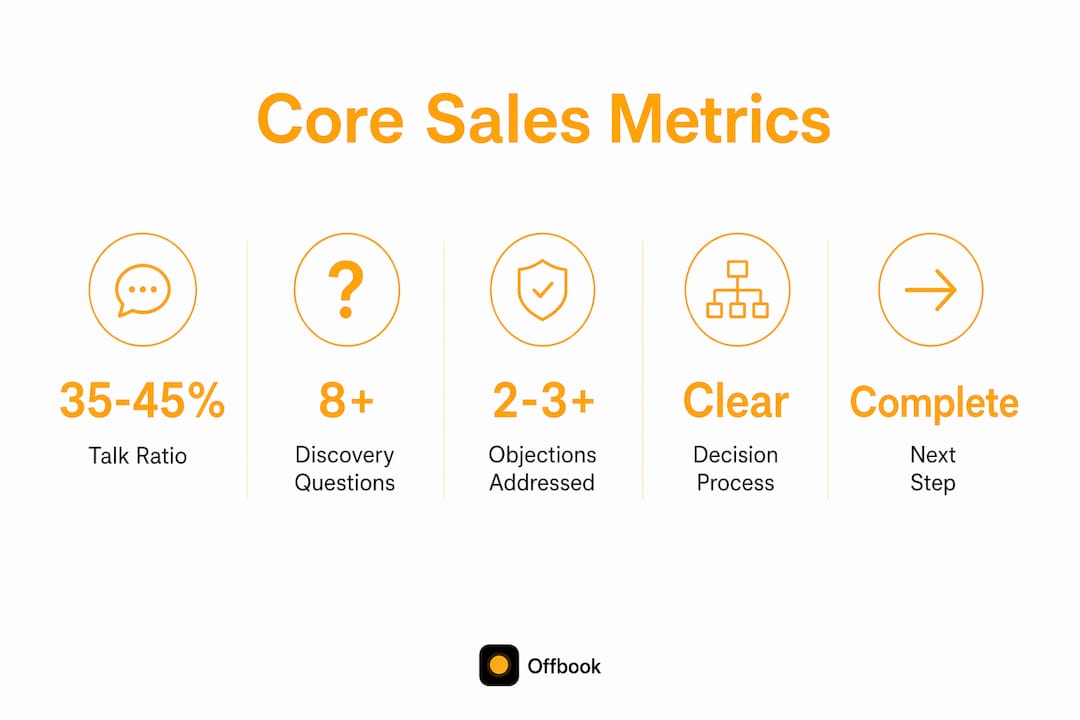
Sales call effectiveness is defined by five quantifiable metrics: talk ratio, discovery questions asked, objections addressed, decision process clarity, and next-step completion. For founders running B2B SaaS sales, gut feel is not a measurement system. To measure sales call effectiveness, founders need structured data, consistent grading, and a clear picture of what “good” looks like on every call. Tools like GradeMyClose, Hypergen, and Offbook have made this kind of structured evaluation accessible to early-stage teams. The payoff is real: better call data leads to faster close rates, sharper coaching, and a sales motion you can hand off to your first hire.
Which sales call metrics should founders track?
The five primary founders sales call metrics are talk ratio, discovery questions, objections addressed, decision process clarity, and next-step completion. Each one tells you something specific about call quality that volume alone cannot reveal.
Talk ratio targets 35–45% for the rep. If you are talking more than 55% of the time, you are pitching instead of listening. Discovery suffers, and so does your close rate.
Discovery questions should reach 8 or more per call. This is not about interrogating prospects. It is about surfacing the pain, urgency, and decision context that determine whether a deal is real. You can read more about how discovery questions directly drive close rates in B2B contexts.

Objections addressed should hit 2–3 or more per call. Unaddressed objections do not disappear. They become the reason a prospect ghosts you after the demo.
Decision process clarity means you know who signs, what the approval process looks like, and what timeline the buyer is working with. Without this, your forecast is fiction.
Next-step completion after each call predicts deal progression more reliably than any other single metric. Calls with a confirmed next step convert at significantly higher rates.
Beyond call-level metrics, founders need to track broader sales health numbers. A CAC payback period over 12 months signals either the wrong customer type or insufficient product value. Elite operators hit 8–10 month payback periods and LTV:CAC ratios of 4:1 or higher. These numbers are the downstream result of call quality compounding over time.
Track funnel conversion rates at every stage: outreach to meeting, meeting to proposal, and proposal to close. When one stage drops, your call data tells you why.
Pro Tip: Prioritize the two or three metrics that most directly correlate with your win rate. Tracking ten metrics at once creates noise. Start with talk ratio, discovery depth, and next-step completion, then add more as your process matures.
| Metric | Target | Why It Matters |
|---|---|---|
| Talk ratio | 35–45% (rep speaking) | Higher ratios signal over-pitching and weak discovery |
| Discovery questions | 8+ per call | Surfaces pain, urgency, and decision context |
| Objections addressed | 2–3+ per call | Unresolved objections kill deals silently |
| Next-step completion | 100% of calls | Strongest single predictor of deal progression |
| CAC payback period | Under 12 months | Longer periods indicate ICP or value proposition problems |
How do structured call grading frameworks work?
Structured call grading improves close rates 2–3x faster than ad hoc feedback. That gap exists because consistent grading creates patterns, and patterns create specific coaching conversations instead of vague impressions.
The right framework scores 5–8 observable behaviors per call. GradeMyClose uses a 7-category scorecard built across more than 1,000 reviewed calls. The categories cover discovery depth, objection handling, next-step clarity, rapport, product fit alignment, urgency creation, and decision process qualification. Each category is scored on a simple scale, and the total gives you a call quality score you can track over time.
Observable behaviors outperform subjective traits like “confidence” or “rapport” in grading accuracy. You cannot coach someone to be more confident in a 30-minute weekly review. You can coach them to ask two more discovery questions before moving to the demo.
The comparison below shows why simplicity wins in practice.
| Framework Type | Criteria Count | Adoption Rate | Coaching Specificity |
|---|---|---|---|
| Simple scorecard | 5–8 criteria | High | Specific and repeatable |
| Complex scorecard | 30+ criteria | Low (often abandoned) | Vague and inconsistent |
Overly complex scoring systems get abandoned quickly. A 30-point rubric sounds thorough, but it creates grading fatigue and inconsistency across reviewers. A focused 5–8 criteria scorecard gets used every week without resistance.
The primary benefit of a multi-category scorecard is enabling specific, targeted coaching conversations that drive rapid improvement. When you know a rep scores 4/10 on objection isolation but 8/10 on discovery, you know exactly where to focus the next coaching session.
Pro Tip: Build your scoring system around the call quality framework before you hire your first sales rep. Grading your own calls as a founder gives you the baseline data to train and evaluate future hires against real performance standards.
What steps should founders follow to build a repeatable sales motion?
A repeatable sales motion starts with a sample size. Run 30–50 qualified prospects through your documented process before drawing conclusions. That volume gives you statistically meaningful conversion data at each funnel stage.
Here is the sequence that works for early-stage B2B SaaS founders:
- Document every call step. Write down what you say at each stage: opening, discovery, demo, objection handling, and close. This is not a script. It is a map of your current motion.
- Grade every call against your scorecard. Use GradeMyClose or Offbook to score each call consistently. Do not skip calls because they went well or badly. Both types teach you something.
- Track conversion at each funnel stage. If your meeting-to-proposal rate drops below 50%, your discovery is weak. If your proposal-to-close rate stalls, your objection handling or urgency creation needs work.
- Coach on the lowest-scoring categories first. Targeted coaching on specific behaviors produces faster conversion rate improvements than general feedback. Fix the biggest gap first, then move to the next.
- Build an objection bank. Every objection you hear on a call goes into a shared document with your best response. After 30 calls, you will have covered 80–90% of what prospects throw at you.
- Hand off the motion when metrics are stable. Once your conversion rates hold steady across 20+ consecutive calls, the motion is repeatable. That is when you hire your first sales rep and train them against your documented process and scorecard.
The discovery call is where deals are won or lost. Founder-led sales success depends on surfacing pain points and understanding decision-making before pitching. Founders who treat early calls as product research gather better ICP data and close more deals.
Pro Tip: Keep a weekly learning memo. Every Friday, write three sentences: what objection came up most this week, what response worked best, and what you will test differently next week. After 90 days, this memo becomes your sales playbook.
What mistakes do founders make when assessing sales call success?
The most common mistake is building a scorecard that is too complex to use consistently. A 30-point rubric reviewed once and then abandoned produces zero improvement. Simplicity is not a compromise. It is the condition for consistent use.
Here are the other mistakes that quietly kill sales performance measurement:
- Relying on gut feel. “That call felt good” is not a metric. Founders who skip structured grading miss the patterns that only show up across 20 or 30 calls reviewed consistently.
- Tracking volume without economics. Fifty calls a week means nothing if your CAC payback period is 18 months. Volume metrics without unit economics give you a false sense of progress.
- Focusing on demos instead of discovery. Early-stage founders often rush to the product demo because it feels productive. Discovery calls are where qualification happens. Skipping deep discovery is the fastest way to fill your pipeline with deals that never close.
- Ignoring next-step completion. A call that ends without a confirmed next step is a call that is likely dead. Track this metric on every single call without exception.
- Scoring subjective traits. Grading “confidence” or “energy” creates inconsistency and resentment. Score observable behaviors only. Did the rep ask 8 discovery questions? Did they confirm the decision process? These are measurable.
Pro Tip: Review your scorecard every 30 days. If any criterion is consistently scored the same way across all calls, it is not differentiating performance. Replace it with something that actually varies and predicts outcomes.
Key takeaways
Founders who track five specific call metrics and grade every call against a focused 5–8 criteria scorecard improve close rates 2–3x faster than those relying on gut feel or volume alone.
| Point | Details |
|---|---|
| Five core call metrics | Track talk ratio, discovery questions, objections addressed, decision process clarity, and next-step completion on every call. |
| Scorecard simplicity wins | Use 5–8 observable criteria per call; complex 30-point systems get abandoned and produce no coaching value. |
| Sample size matters | Run 30–50 qualified prospects through your documented process before drawing conclusions about what works. |
| Coach on lowest scores first | Targeted coaching on the weakest category produces faster improvement than general feedback across all areas. |
| Unit economics validate call quality | A CAC payback period over 12 months signals a call quality or ICP fit problem, not just a volume problem. |
The measurement trap founders fall into
Most founders I talk to are measuring the wrong things. They count calls made, demos booked, and proposals sent. Those are activity metrics. They tell you how busy you are, not how good you are.
The shift that actually changes outcomes is moving from activity tracking to behavior tracking. When you start grading whether you asked 8 discovery questions instead of counting how many calls you made, your coaching conversations become specific. Specific coaching produces specific improvement. That is the mechanism.
Founder-led sales is also the best product research you will ever do. Every call is a data point on ICP fit, messaging resonance, and objection patterns. Founders who treat their sales calls as living data refine their positioning faster than any survey or analyst report could achieve. The call is the research.
The other thing I see founders get wrong is waiting too long to document the motion. They close 10 deals through sheer force of personality and then cannot explain what they did. When they hire their first rep, the rep fails because there is no documented process to follow. Grading your own calls from day one forces you to articulate what “good” looks like. That articulation is what you hand off.
Start simple. Five metrics, one scorecard, weekly review. The founders who build this habit in the first 50 calls build something their competitors cannot copy: a documented, graded, repeatable sales motion with real conversion data behind it.
— Neil
How Offbook helps founders track and improve call performance
Measuring and improving sales call effectiveness is exactly what Offbook is built for. Offbook surfaces live AI cues during video calls, prompting founders and reps on discovery questions to ask, objections to handle, and qualification gaps to close, all structured around MEDDIC and MEDDPICC. No bot joins the meeting. The coaching happens on-screen in real time, when it changes the outcome.
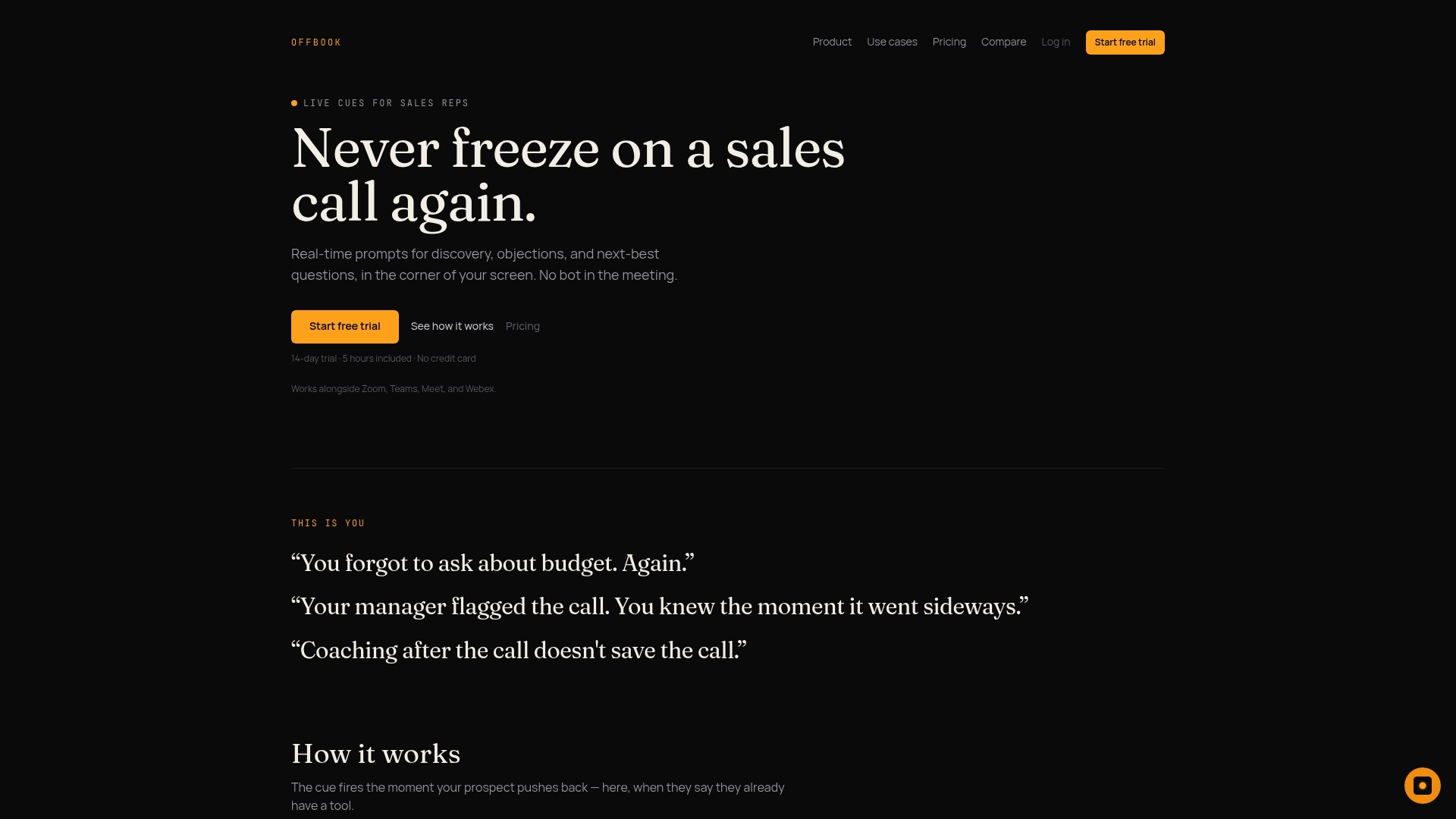
Offbook also generates pre-call briefs so you walk into every conversation prepared. For founders running AI call coaching at the seed or Series A stage, Offbook replaces manual call review with structured, automated grading that surfaces patterns across every call. You get the coaching data you need to improve fast, without spending hours reviewing recordings. See how Offbook’s sales coaching works for B2B SaaS teams.
FAQ
What is a good talk ratio for a sales call?
A talk ratio of 35–45% for the rep is the target on most B2B discovery and demo calls. Ratios above 55% indicate over-pitching and insufficient discovery.
How many discovery questions should founders ask per call?
Founders should aim for 8 or more discovery questions per call. This volume surfaces the pain, urgency, and decision context needed to qualify deals accurately.
How do i build a sales call scorecard that actually gets used?
Keep your scorecard to 5–8 criteria focused on observable behaviors like discovery depth, objection handling, and next-step confirmation. Scorecards with 30 or more criteria get abandoned quickly and produce no consistent coaching value.
When should a founder hand off the sales motion to a first hire?
Hand off the motion once conversion rates hold steady across 20 or more consecutive calls and every step is documented with matching performance data. Running 30–50 qualified prospects through the process first gives you the sample size to validate repeatability.
What does a CAC payback period over 12 months signal?
A CAC payback period longer than 12 months signals either the wrong customer type or a product value problem. Elite B2B SaaS operators target 8–10 month payback periods and LTV:CAC ratios of 4:1 or higher.