How AI Changes Sales Management in B2B Teams
Discover how AI changes sales management by freeing up time for coaching, improving forecasting, and boosting quota attainment by 27%.
Published: July 24, 2026
Author: OffBook Editorial Team

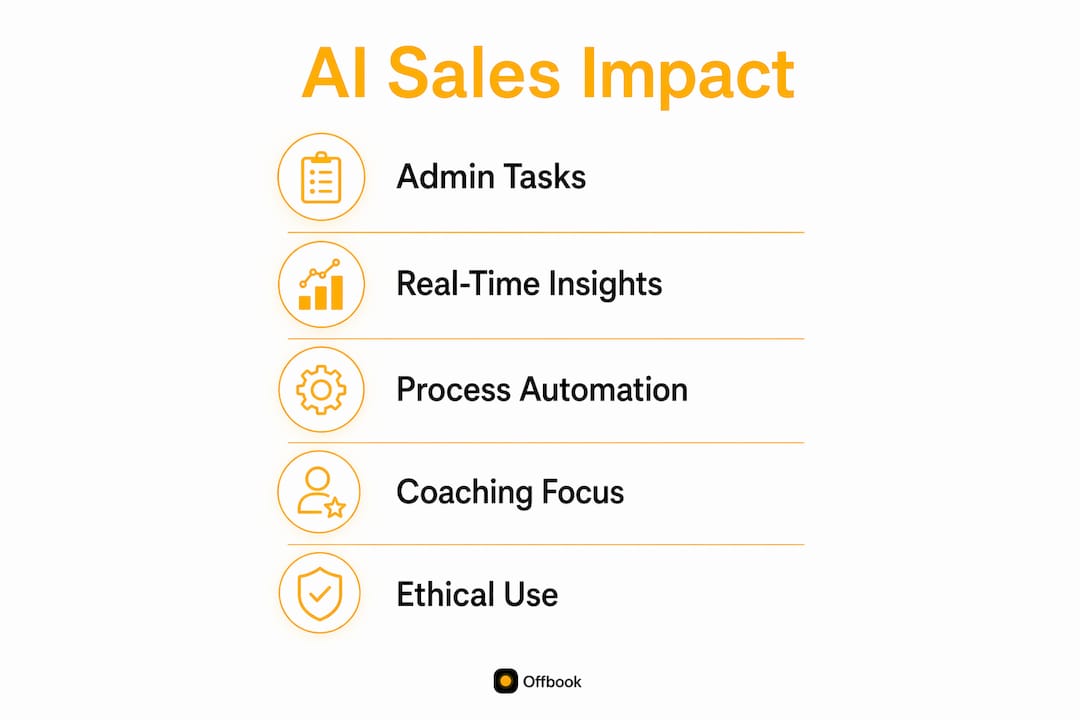
AI has fundamentally changed how sales managers spend their time. The shift is not subtle: managers who adopt AI tools shift a significant portion of their week from administrative work to coaching, resulting in quota attainment improvements of approximately 27% within two quarters. The core mechanism is simple. AI absorbs the administrative load, and managers get their time back to do the work that actually moves revenue.
Here is what that transformation looks like in practice:
- Routine reporting disappears. Call summaries, pipeline rollups, risk flags, and forecast adjustments now run automatically in the background.
- Coaching time multiplies. Freed from dashboards, managers run structured one-on-ones, live deal reviews, and skill development sessions every week.
- Forecasting gets sharper. AI continuously analyzes deal data and reweights the forecast as conditions change, rather than relying on Friday-afternoon spreadsheet guesses.
- At-risk deals surface early. AI watches for stalled stakeholders, skipped milestones, and engagement drop-offs, then flags them before the manager notices a problem.
- The manager’s role shifts. SBI Growth research frames AI as a “time-and-focus reallocation engine” that moves managers from “what happened?” to “why it matters and what we’ll do next.”
- AI augments, not replaces. Human judgment on coaching, accountability, and strategy stays irreplaceable. AI handles the volume work; managers handle the people work.
How AI drives sales efficiency through automation and real-time insights
The administrative burden on a typical sales manager is staggering. Pipeline rollups, call logging, forecast prep, activity reports: these tasks can consume the majority of a manager’s week before a single coaching conversation happens. Agentic AI changes that by capturing and enriching data automatically from conversations already flowing through the business, so sellers stop feeding the database and start building relationships.
The productivity gains are concrete. AI-generated call summaries are produced within 5 minutes of a call ending, compared to the 20–30 minute delay typical of legacy tools. Sales reps using AI agents also save meaningful weekly time on research and email drafting, time that previously disappeared into prep work before a single prospect conversation.
| Reporting task | Traditional approach | AI-automated approach |
|---|---|---|
| Call summaries | 20–30 min manual review per call | Generated within 5 min, highlights surfaced |
| Pipeline rollup | Friday spreadsheet exercise | Live stage data weighted by historical win rates |
| Risk flags | Manager notices after the fact | AI watches for stalled deals and flags proactively |
| Forecast adjustments | Weekly manual retune | Continuous retuning as deals progress |
| Coaching prompts | Manager identifies gaps ad hoc | AI surfaces specific skill gaps per rep |
The efficiency gains compound. When managers stop building reports by hand, they redirect those hours into structured coaching, live deal strategy, and accountability conversations. Gallup research on manager effectiveness shows that upskilled managers see 8%–18% higher team engagement, 21%–28% lower turnover, and a 20%–28% higher likelihood of performance improvement. Every one of those outcomes traces back to coaching time, not reporting time.
What AI cannot do is equally worth naming. It cannot judge whether a rep is coachable or needs a different role. It cannot hold an accountability conversation when someone misses their number three months running. It cannot design territory strategy or negotiate a compensation change. Those decisions require context the model will never have.
How AI reshapes the sales process and coaching practices
The sales process itself is changing, not just the reporting layer around it. Agentic AI replaces manual CRM updates with autonomous agents that handle specific jobs: updating fields from call context, flagging at-risk deals daily, producing bottom-up forecasts, and identifying individual skill gaps. The model flips from pull (you dig through dashboards) to push (you receive exactly what needs attention, delivered where you already work).

For managers, this means a new operating posture. SBI Growth describes the near-term evolution as “AI-Human Orchestrator”: managers configure agents, triage risk, and translate data into clear actions, rather than assembling that data themselves. Coaching emails get drafted as starting points. Pre-call briefs arrive before a rep walks into a high-stakes meeting. Role-play scenarios are generated from the buyer’s role, industry, and prior objections so reps get practice reps before the real conversation.
Offbook operates exactly in this space. It delivers live AI cues to reps during video calls, without a bot ever joining the meeting, structured around qualification frameworks like MEDDIC and MEDDPICC. Reps see on-screen prompts for the right questions to ask, objections to handle, and gaps to close, all in the moment when it changes the outcome. Pre-call briefs give reps company and contact context before they dial. The result is more disciplined calls and faster deal progression, particularly for founder-led B2B SaaS teams at the seed and Series A stage where every call counts.
Pro Tip: Before rolling out any AI coaching tool, audit your current call methodology. AI cues built around MEDDIC or MEDDPICC only compound value when reps already understand the framework. Pair tool deployment with a methodology refresher, and the lift is immediate.
The best practices for AI-assisted coaching come down to a short list:
- Use AI call scores as one signal, not the verdict. A rep who scores low on discovery for a month but carries the highest win rate on the team is running a different style, not a worse one.
- Edit every AI-drafted coaching email before it goes out. Reps recognize the rhythm of unedited AI output, and a coaching message that reads like a competent stranger wrote it erodes trust faster than saying nothing.
- Feed role-play scenarios with real context: the buyer’s prior objections, recent personnel changes, internal politics from past calls. AI generates the framework; you supply what the model cannot know.
- Share effective prompts internally. SBI’s research across 600+ B2B transactions found a strong correlation between scaled AI adoption and revenue overperformance, and the differentiator was codifying best practices and sharing prompts consistently across the team.
How to prepare your sales organization for AI adoption
Start with a time audit. Track how your manager actually spends her week in 30-minute blocks. Most sales leaders are surprised by the result: nearly half of a frontline manager’s time goes to reporting, admin, pipeline hygiene, and internal coordination, according to SBI Growth’s time study. That audit tells you exactly which tasks AI should absorb first.
The rollout sequence matters. Piloting too broadly too fast produces confusion and low adoption. A phased approach works better:
- Week 1: Audit manager time in 30-minute blocks to identify the highest-volume reporting tasks.
- Week 2: Pick one task, usually call summaries or pipeline rollups, and pilot a single tool with two reps.
- Week 3: Expand to the full team and install a weekly coaching rhythm using the reclaimed hours.
- Week 4: Measure the shift in coaching time and early performance indicators, then identify the next task to automate.
The biggest mistake is automating mediocre processes. Bain & Company research makes this point directly: significant productivity gains come from reimagining workflows around high-value use cases, not from digitizing whatever the team was already doing badly. If your pipeline review process was broken before AI, automating it produces a faster broken process.
Pair every AI rollout with coaching skill development. Reclaimed hours are wasted if managers do not know how to use them. A coaching operating rhythm with defined cadences, weekly one-on-ones, live deal reviews, monthly performance deep dives, gives structure to the time AI returns. AI adoption in B2B sales is now mainstream, but the organizations pulling ahead are the ones that have moved beyond experimenting and embedded AI into the operating rhythm of their frontline managers.
Ethical guardrails belong in the rollout plan from day one. Define what AI can and cannot do, require human review before AI outputs reach customers or personnel files, and make clear that accountability for decisions stays with the manager, not the model. That boundary protects both the team and the organization.
How Offbook delivers real-time AI coaching in B2B sales calls
Offbook’s core insight is that post-call note-taking changes nothing. By the time a rep reviews a transcript or reads a coaching email, the deal moment has already passed. Offbook coaches in the call, surfacing live cues on-screen while the conversation is happening, without a bot joining the meeting or the prospect ever knowing the tool is there.
The practical workflow looks like this:
| Feature | What it does | When it matters |
|---|---|---|
| Pre-call brief | Generates company and contact context before the call | Rep walks in prepared, not scrambling |
| Live MEDDIC/MEDDPICC cues | Prompts qualification questions and gap identification in real time | Catches missing criteria before the call ends |
| Objection handling prompts | Surfaces recommended responses during live objections | Keeps reps from freezing on hard questions |
| Methodology scoring | Tracks qualification completeness against the framework | Manager sees gaps without reviewing full recordings |
For seed and Series A B2B SaaS teams, where the founder or a small sales team is running every enterprise call, the margin for error on each conversation is thin. A rep who misses the economic buyer, skips the business case, or fails to surface a technical blocker in the first call rarely gets a second chance to fix it. Offbook’s live cues close those gaps in the moment, not in the debrief.
Pro Tip: Use Offbook’s pre-call briefs as a coaching tool, not just a rep resource. Review the brief with your rep in a two-minute pre-call huddle and ask: “What’s the one qualification gap most likely to kill this deal?” That question alone sharpens call focus more than any post-call review.
The shift Offbook enables mirrors what AI-enabled coaching research consistently shows: managers who move from administrative work to active coaching see measurable improvements in quota attainment, team engagement, and retention. Real-time coaching technology accelerates that shift by making every call a coached call, regardless of whether the manager is in the room.
Offbook’s AI call coaching is built specifically for B2B sales teams that need to run more disciplined calls and close more deals, starting with the next conversation on the calendar.
Ethical considerations and data privacy in AI-driven sales management
AI in sales generates a large volume of sensitive data: call recordings, buyer sentiment, rep performance scores, and pipeline health signals. That data creates real obligations. Reps deserve to know which calls are recorded, how AI scores are generated, and how those scores factor into performance reviews. Buyers deserve to know when AI is analyzing their conversations.
Transparency is the foundation. Define clearly what data AI collects, who can access it, and how long it is retained. Compensation decisions, terminations, and performance reviews should never be driven by AI scores alone. The model does not know what you promised in a hallway conversation, which territory was oversized as a retention move, or which rep’s numbers were inflated by deals handed over from a team that no longer exists. Human judgment has to own those decisions.
Data governance also matters for compliance. Depending on the buyer’s location and the nature of the data captured, call recording and AI analysis may trigger obligations under regulations like GDPR or state-level privacy laws. Build consent and disclosure into the sales process before deploying any AI tool that captures conversation data, not after.
The practical guardrail is straightforward: AI identifies skill gaps and flags deal risks, but managers retain final judgment and personalized coaching roles. Treat AI output as one input among several, not as a verdict that removes the need for human accountability.
Challenges and limitations of implementing AI in sales management
The gap between AI’s potential and its actual impact in most organizations comes down to adoption quality, not technology quality. Most organizations sit between Level 1 and Level 2 on the AI maturity curve: individuals experiment with AI in their daily work, but there is no playbook, no shared prompt library, and no systematic approach to scaling what works.
Several specific failure modes show up repeatedly:
Over-reliance on machine scores. Top-performing managers combine AI scores with their own judgment rather than treating model output as the final word. A rep who scores poorly on discovery for weeks but carries the team’s highest win rate is running a different style, not a worse one. Treating the score as truth costs you diverse selling approaches that actually work.
Automating broken processes. AI accelerates whatever process it is applied to. If the underlying sales workflow is poorly designed, AI makes the dysfunction faster and harder to see. The fix is to redesign the workflow first, then automate the redesigned version.
Prompt quality. Most managers never get past the first layer of AI prompting. Effective direction requires four inputs: rep context, recent history, your own voice, and constraints on length and tone. Generic prompts produce generic output that reps immediately recognize as impersonal.
Change resistance. Reps worry that AI monitoring means surveillance, not support. Managers worry that AI will make their role redundant. Both concerns are addressable with clear communication about what AI does and does not do, but they have to be addressed directly, not ignored.
The AI tools for sales teams that deliver real results share one characteristic: they are deployed with a clear use case, a human review step, and a feedback loop that improves the model’s outputs over time. Tools deployed without those elements tend to generate dashboards nobody reads.
How AI personalizes outreach and customer segmentation
AI’s ability to analyze large volumes of unstructured data changes what personalization actually means in B2B sales. Rather than segmenting by firmographic criteria alone, industry, company size, revenue, AI can identify behavioral signals: which prospects are actively researching a problem, which accounts show engagement patterns that match past buyers, which contacts within an account are most likely to champion a deal internally.
Gartner describes this as “atomic insights”: synthesized, easy-to-consume perspectives that AI extracts from analyzing multiple data sources. The sales organization configures what data to analyze and from what perspective, and AI converts those signals into targeted value messages tailored to each buyer’s specific situation. That is a different capability than mail-merge personalization.
For customer segmentation, AI continuously updates segment assignments as buyer behavior changes, rather than locking accounts into static tiers set at the start of the quarter. A prospect who was cold three months ago but has visited the pricing page four times this week belongs in a different segment today. AI catches that shift; a quarterly review cycle does not.
The practical limit is data quality. AI personalization is only as good as the underlying CRM data, and most CRMs carry stale records, duplicate contacts, and incomplete fields. Investing in CRM data quality before deploying AI personalization tools pays off faster than deploying the tools first and cleaning the data later.
How AI is changing sales team roles and skills requirements
The sales manager role is not disappearing. It is splitting into two distinct tracks. The administrative version of the job, the one built around assembling reports, cleaning CRM data, and building forecast slides, is being automated. The leadership version, coaching reps, developing talent, making judgment calls on complex deals, is becoming more valuable and more visible.
For reps, the shift is equally real. AI handles research, drafts outreach, and surfaces talking points. What it cannot do is read the room, navigate internal politics at a prospect account, or build the kind of trust that closes a seven-figure deal. Those skills are becoming the differentiator, not the baseline. Reps who treat AI as a productivity tool and invest the saved time in deeper customer relationships will outperform reps who use AI as a crutch and let their judgment atrophy.
The skills that compound in an AI-assisted sales environment are judgment, coaching ability, and the capacity to direct AI outputs rather than accept them. Effective AI use in sales management requires managers to configure agents, triage risk signals, and translate data into clear actions for their teams. That is a harder job than building a pipeline spreadsheet. It demands real leadership skill, not spreadsheet fluency.
For sales organizations planning ahead, the skills investment is clear: coaching certification for managers, methodology training for reps, and AI fluency for both. Fluency here means knowing how to direct AI effectively, including how to avoid common AI prompt mistakes that produce generic output nobody uses. The teams that build all three capabilities together are the ones that will compound their advantage as AI tools mature.
Key Takeaways
AI changes sales management by automating administrative work and returning that time to coaching, deal strategy, and team development, producing measurable gains in quota attainment, engagement, and retention.
| Point | Details |
|---|---|
| Coaching time multiplies with AI | Managers shift a significant portion of their week to coaching when AI handles reporting tasks. |
| Quota attainment improves measurably | Managers see quota attainment improvements around 27% within two quarters after the coaching shift. |
| Agentic AI changes the CRM model | AI agents now capture, update, and enrich CRM data automatically, replacing manual data entry. |
| Human judgment stays irreplaceable | AI flags risks and surfaces insights, but managers own coaching, accountability, and strategic decisions. |
| Adoption quality determines outcomes | Organizations that codify AI best practices and share prompts internally outperform those that experiment without a system. |