Early Stage B2B Sales Motion: A Founder's Guide
Discover what is early stage B2B sales motion and learn how to craft a repeatable sales process that drives revenue growth for your startup.
Published: June 13, 2026
Author: OffBook Editorial Team

Early Stage B2B Sales Motion: A Founder’s Guide
An early-stage B2B sales motion is the repeatable operating model a startup uses to consistently convert qualified prospects into paying customers, matched to its current stage and deal complexity. Most founders conflate this with go-to-market strategy, but the distinction matters. Strategy defines where you compete. The sales motion defines how the work actually gets done, call by call, deal by deal. Getting this right before you scale is the difference between building a revenue engine and burning headcount on a process nobody can replicate.
Frameworks from The Starr Conspiracy and J12 Ventures both treat the early sales motion as a signal-generating experiment first and a scale vehicle second. That framing is exactly right.
What is an early stage B2B sales motion?
An early-stage B2B sales motion is a repeatable approach to converting prospects into paying customers, owned by a single named person, and aligned to the company’s ARR stage and product complexity. Before product-market fit, that owner is almost always the founder. The motion is not a department, a tech stack, or a hiring plan. It is a documented sequence of steps from first contact to closed deal.
The core components of any early motion follow a consistent pattern:
- ICP targeting: A tightly defined ideal customer profile that narrows outreach to buyers with the highest probability of converting and renewing
- Outreach channel: One primary channel, tested before adding others, whether cold email, LinkedIn, warm referrals, or community
- Discovery and qualification: Structured conversations that surface pain, budget authority, and decision timeline before any demo
- Closing sequence: A defined set of steps from verbal agreement to signed contract, with known objections and prepared responses
- Conversion tracking: Simple metrics that measure each stage so you can spot where deals stall
The minimum viable motion means one owner, one channel, and one documented process. Companies under $1M ARR should focus on one motion aligned to product complexity and deal economics rather than running multiple competing approaches in parallel. Product-led motions fit simple, low-friction products. Sales-led motions suit complex, high-value deals where a buyer needs a human to navigate risk and justify spend.
Pro Tip: Write your sales motion as a one-page deal-flow document before you hire anyone. If you cannot explain every step from first touch to close in plain language, you do not yet have a motion. You have a habit.
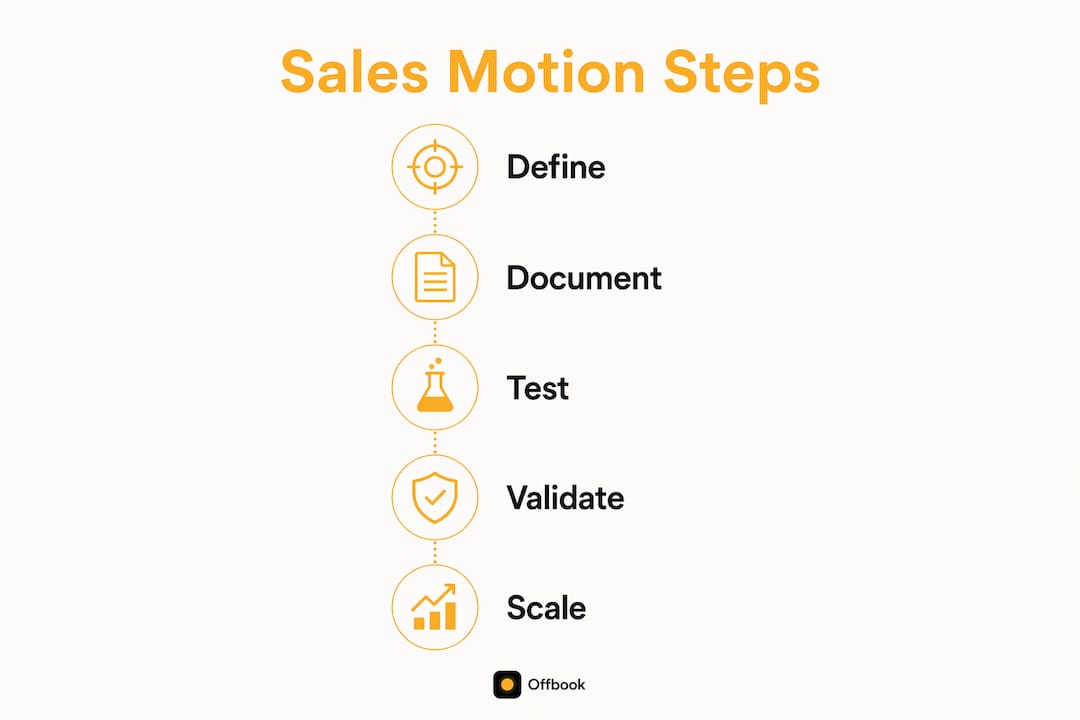
How does sequential channel experimentation improve your motion?
Channel selection in early-stage B2B is not a strategy decision. It is an experiment. Each channel reveals unique signals about buyer behavior, product fit, and conversion blockers that no amount of planning can surface in advance.
The right sequence for most seed-stage B2B teams looks like this:
- Start with direct outbound. Cold outreach to your ICP gives you the fastest feedback loop. You hear objections in real time, learn which pain points land, and discover which titles actually pick up the phone or reply to email.
- Layer in warm referrals. Once you have a handful of customers, referral outreach converts at dramatically higher rates and validates that your ICP definition is accurate.
- Test content and inbound. Blog posts, LinkedIn thought leadership, and SEO-driven content build pipeline over months, not weeks. Add this channel only after outbound has taught you what messaging works.
- Evaluate community and partnership channels. Slack communities, industry events, and co-sell arrangements with adjacent vendors become viable once you have proof points and a repeatable pitch.
“Early GTM initiatives function primarily as signal-generating experiments to learn what works for customer engagement and motion fit, not as scale attempts.” — J12 Ventures
Running all four channels simultaneously is a common and costly mistake. Parallel channel experiments dilute your attention, make it impossible to attribute results, and generate noise instead of signal. Phased sequencing builds confidence at each stage and reduces wasted effort. The goal is to learn what your buyers respond to before you invest in scaling any single channel. Once outbound teaches you the message and the ICP, inbound amplifies what already works.
How do modern buyer preferences shape early sales motions?

Buyer behavior has shifted in ways that directly affect how you design your motion. 67% of B2B buyers now prefer a rep-free buying experience, according to a 2025 Gartner survey. That means the majority of your prospects want to research, evaluate, and shortlist your product before they ever talk to a human. Ignoring this preference does not make it go away. It just means your motion creates friction at the exact moment buyers are trying to move forward.
The same Gartner data shows that 45% of B2B buyers used AI during a recent purchase decision. Buyers are now arriving at discovery calls already informed, having used tools like ChatGPT or Perplexity to compare solutions, generate questions, and pressure-test vendor claims. This raises the bar for every conversation your team has. A rep who shows up to a discovery call with generic questions and a standard deck will lose to a competitor whose rep arrives prepared.
| Buyer behavior | Implication for your motion |
|---|---|
| 67% prefer rep-free research | Build self-service content: case studies, pricing pages, comparison docs |
| 45% use AI before buying | Reps must arrive to calls with deeper context and sharper questions |
| Buyers shortlist before contacting | Your outbound must interrupt a process already underway, not start one |
The practical response is to design your motion around two tracks. The first is a self-service track: content, documentation, and product trials that let buyers qualify themselves. The second is a human track: targeted touchpoints where a rep adds context, handles risk, and accelerates a decision the buyer has already started making. Understanding how enterprise B2B buying works in 2026 is a prerequisite for designing a motion that fits how buyers actually behave.
Pro Tip: Before your next discovery call, spend ten minutes researching what your prospect could have already learned about your product through AI tools and public content. Then open the call by acknowledging what they likely already know. It signals preparation and immediately differentiates you.
What steps validate and scale an early sales motion?
Validation comes before scale. The threshold for statistical confidence in your motion is 30 to 50 qualified prospects processed through the same documented steps, with 10 to 20 conversions. Below that sample size, your conversion rate is noise. Above it, you have a signal you can act on.
The documentation that enables delegation covers five areas:
- Deal-flow steps: Every action from first contact to signed contract, written in the order they happen, with the owner of each step named
- Buyer personas: The specific titles, company sizes, and industries where your ICP definition has proven accurate
- Qualification criteria: The conditions a prospect must meet before you invest time in a demo or proposal, structured around frameworks like MEDDIC or MEDDPICC
- Common objections: The five to ten objections you hear most often, with tested responses that move the deal forward
- Proof points: Customer quotes, case study metrics, and competitive differentiators that address the specific concerns your ICP raises
Validated motions include written deal-flow steps, buyer personas, objections, proof points, and conversion rates that allow a new rep to replicate founder results. The founder’s job is not to close every deal forever. It is to close enough deals to prove the motion works, document exactly how it works, and then hand it to someone else with enough context to execute it without reinventing it.
The hiring sequence matters too. Your first sales rep should be an executor, not a builder. Hire someone who can follow a documented process and generate feedback on where it breaks. Hire sales leadership only after the motion is proven and the volume of deals justifies a manager. Reversing this order is one of the most common and expensive mistakes early-stage founders make.
Key takeaways
A validated early-stage B2B sales motion requires one owner, one documented process, and at least 30 qualified prospects before you scale or hire.
| Point | Details |
|---|---|
| Define before you scale | Document every step from first contact to close before adding headcount or channels. |
| One motion, one owner | Companies under $1M ARR should run a single motion aligned to deal complexity, not multiple competing approaches. |
| Sequence channels as experiments | Start with outbound for fast feedback, then layer inbound and referrals once messaging is proven. |
| Design for self-directed buyers | 67% of B2B buyers prefer rep-free research, so build content that supports their process before they contact you. |
| Validate with sample size | Process 30 to 50 qualified prospects through the same steps before treating your conversion rate as reliable. |
Why most founders get the motion wrong before they know it
The most common mistake I see is founders treating the sales motion as something that emerges naturally from enough activity. They run outbound, take inbound calls, attend conferences, and close a few deals, then assume they have a motion because revenue is moving. They do not. They have a founder with good instincts and no documentation.
The discovery call is where this gap shows up most clearly. Founder-led discovery is the main qualification and evidence-gathering step in early-stage sales, and it is the hardest thing to delegate because founders do it intuitively. They read the room, adjust their pitch mid-call, and close on instinct. None of that transfers to a new rep unless it is written down.
The channel sequencing problem is equally common. I have watched seed-stage teams try to run LinkedIn outreach, cold email, content marketing, and a partner program simultaneously with two people. Every channel gets a fraction of the attention it needs, none of them generate enough data to learn from, and the team concludes that “outbound doesn’t work” when the real problem is that they never gave any single channel enough volume to produce a signal.
The fix is deliberate sequencing. Pick one channel. Run it hard enough to get 30 conversations. Document what you learn. Then decide whether to double down or move to the next experiment. This approach feels slower in the short term and is dramatically faster in the long term because you are building knowledge, not just activity.
Balancing automation with personal engagement is the last tension worth naming. Tools that automate outreach sequences, enrich contact data, or score leads are genuinely useful. But they work best when they amplify a motion you already understand, not when they substitute for the learning that only comes from real conversations. Automate the logistics. Keep the discovery human.
— Neil
How Offbook helps you run a sharper sales motion
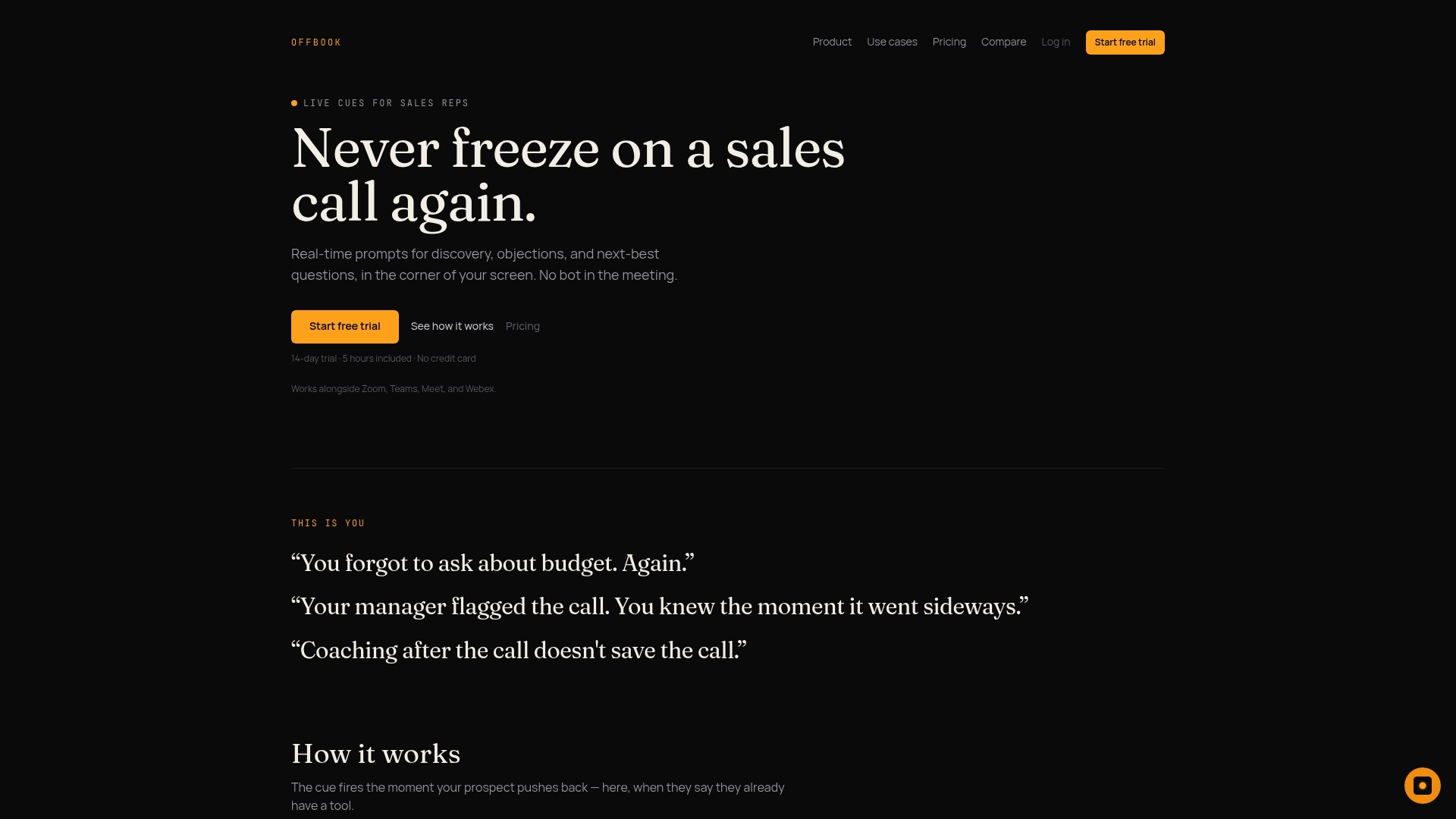
Offbook is built for exactly the moment this article describes: the founder or early rep on a live call, trying to qualify a prospect, handle an objection, and advance the deal, all at once. Offbook surfaces live AI cues on-screen during video calls without a bot joining the meeting. It prompts reps with the right questions to ask, qualification gaps to close, and objections to address, structured around MEDDIC and MEDDPICC. For founders building their first documented motion, Offbook also generates pre-call briefs so every conversation starts with context. If you are at the stage where you are trying to turn founder instincts into a repeatable process, AI call coaching for founders is the fastest way to close that gap.
FAQ
What is an early stage B2B sales motion?
An early-stage B2B sales motion is a repeatable, documented process for converting qualified prospects into paying customers, owned by a single person and aligned to the startup’s ARR stage and product complexity. Before product-market fit, this is almost always founder-led.
How is a sales motion different from a GTM strategy?
A go-to-market strategy defines which market you target and how you position your product. A sales motion defines the operational steps your team takes to execute that strategy, from first outreach to closed deal.
When should a founder stop leading sales?
A founder should begin delegating sales after processing 30 to 50 qualified prospects through a documented motion with a consistent conversion rate, as this sample size provides enough confidence that a new rep can replicate the results.
Why should early-stage startups focus on one sales channel at a time?
Running multiple channels simultaneously dilutes attention and makes it impossible to attribute results or learn from them. Phased, sequential channel experimentation surfaces cleaner signals about buyer behavior and lets you build on what works before adding complexity.
How do buyer preferences affect early B2B sales motion design?
67% of B2B buyers prefer a rep-free experience and 45% use AI during purchase decisions, which means your motion needs a self-service content track alongside targeted human touchpoints, not a purely rep-driven process.