Common B2B Sales Objections Explained for Reps
Discover how to tackle common B2B sales objections explained. Master buyer concerns to boost your closing rates and sales success.
Published: June 1, 2026
Author: OffBook Editorial Team

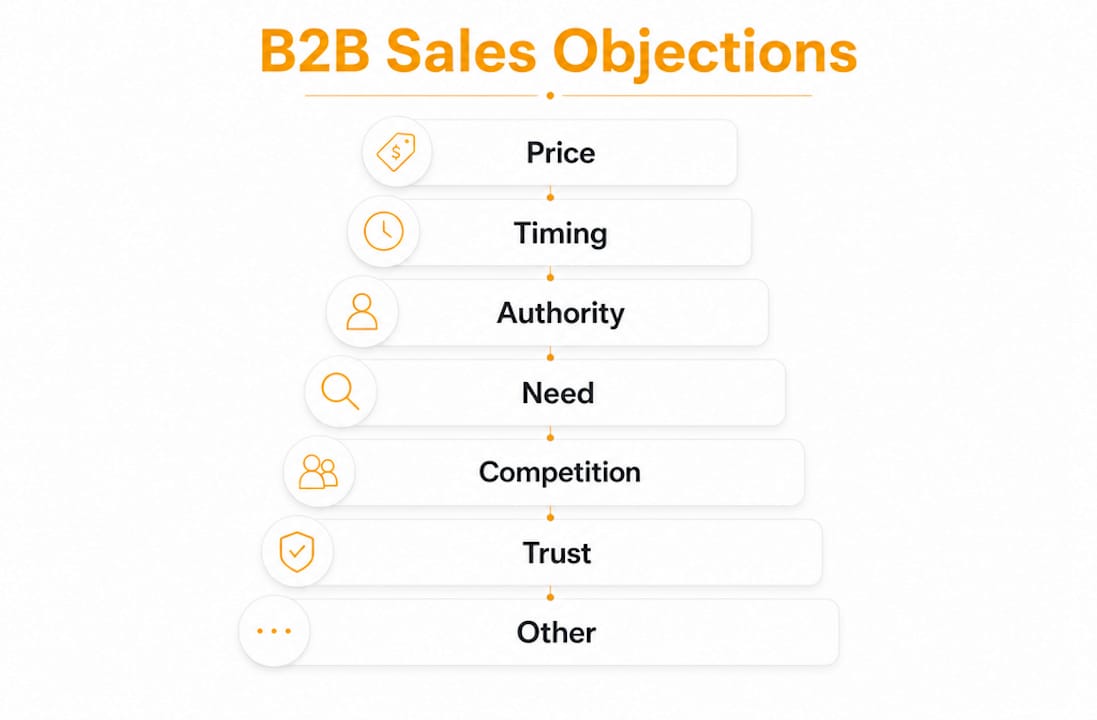
B2B sales objections are specific buyer concerns that signal hesitation in the purchase process, not outright refusal. They fall into seven recognized categories: price, timing, authority, need, competition, trust, and status quo. Price and timing objections together account for roughly 50 to 60% of all B2B objections, making them the most frequent challenge reps face on discovery and demo calls. Understanding these categories is the foundation of common b2b sales objections explained properly. Reps who recognize the category behind a buyer’s words respond faster, with more precision, and close more deals.
What are the main types of B2B sales objections and what do they really mean?
Most sales objections fall into four primary categories: price, timing, need, and authority. These four account for the vast majority of what reps encounter in B2B sales cycles. Competition, trust, and status quo objections round out the full picture, but they appear less frequently and often overlap with the core four.
Understanding the types of buyer objections in B2B means decoding what buyers actually mean versus what they say out loud.
- Price: “It’s too expensive” rarely means the budget doesn’t exist. About 70% of budget objections are value objections in disguise. The buyer hasn’t yet connected your solution to a return they can defend internally. The correct response is to probe the value metrics they’re using, not to discount.
- Timing: “Now isn’t the right time” is a prioritization signal. The buyer has competing initiatives and your solution hasn’t ranked high enough. Urgency needs to be built through business impact, not pressure.
- Authority: “I need to check with my team” reveals a gap in your understanding of the decision-making process. You haven’t mapped the buying committee, and you’re likely talking to someone who can’t approve the purchase alone.
- Need: “We don’t really have that problem” points to a discovery failure. Either the rep hasn’t uncovered the pain clearly enough, or the buyer hasn’t yet connected their problem to your solution category.
- Competition: “We’re already looking at another vendor” requires you to differentiate on specific proof, not feature comparisons.
- Trust: “We’ve never heard of your company” calls for social proof, case studies, and reference customers in the buyer’s industry.
- Status quo: “We’re fine with how we do it now” is the hardest objection because inertia is the real competitor. Quantifying the cost of doing nothing is the only reliable counter.
Every objection in this list is a coded message. The surface statement is rarely the full story. Reps who treat objections as literal statements miss the underlying concern and respond to the wrong problem.
Pro Tip: Before responding to any objection, ask one clarifying question. “Can you help me understand what’s driving that concern?” buys you critical diagnostic information and prevents you from solving the wrong problem.

How to diagnose and respond effectively to common B2B sales objections
Diagnosing the root cause of an objection before responding is the single most important skill in overcoming sales objections. Two frameworks give reps a reliable structure for doing this well.
The Acknowledge-Ask-Advocate (AAA) method works as follows:
- Acknowledge the concern without agreeing or dismissing it. “That makes sense given where you are in the budget cycle” validates the buyer without conceding ground.
- Ask a clarifying question to uncover the real concern. “When you say the timing isn’t right, what would need to change for this to become a priority?” surfaces the actual blocker.
- Advocate with a targeted proof point once you understand the real concern. ROI data for price objections, a champion enablement asset for authority objections, or a relevant case study for trust objections.
The Feel-Felt-Found method is older but still effective for emotional objections. “I understand how you feel. Other customers in your position felt the same way. What they found was…” This structure normalizes the concern and introduces social proof without sounding scripted when delivered with genuine conviction.
Mapping objections to buyer roles clarifies which proof points to present, making objection response more strategic. Finance stakeholders need ROI models. Technical evaluators need risk mitigation data. Executive sponsors need internal consensus support. Presenting the wrong proof to the wrong person wastes the conversation.
Three common pitfalls destroy otherwise good objection handling:
- Discounting immediately when a price objection appears. This trains buyers to object on price every time.
- Talking over the buyer after asking a clarifying question. Silence after a question is productive. Fill it and you lose the diagnostic value.
- Trashing competitors when a competition objection surfaces. Buyers interpret this as insecurity, not confidence.
Pro Tip: Build a one-page objection map for each major account. List the three most likely objections by stakeholder role, the clarifying question for each, and the proof point you’ll use. Walk into every call with this ready.
Why objection handling is more than rebuttals: understanding buyer psychology
Objections are signals that the decision is still open and buyers need more clarity, priority alignment, or internal acceptance. This reframe changes everything about how reps should respond. An objection is not a rejection. It is a buyer telling you what they still need to move forward.
This psychological reality has direct implications for b2b sales strategies:
- Slow down. Rushing past an objection to get back to your pitch signals that you don’t take the buyer’s concern seriously. Buyers notice this and disengage.
- Maintain dialogue. Defensive or scripted rebuttals close the conversation. Open questions keep it going. The goal is more information, not a verbal win.
- Recognize inertia as a structural force. Status quo objections aren’t personal. They reflect organizational risk aversion and the cost of change. Addressing them requires quantifying the cost of inaction, not just the value of your solution.
The multi-stakeholder reality of B2B buying adds another layer of complexity. Repeated objections often result from failing to tailor messaging and lacking access to the correct stakeholders. When the same objection surfaces in multiple calls, it’s a systemic signal. The rep hasn’t reached the right people, or the messaging isn’t resonating with the specific concerns of each role in the buying committee.
Qualification frameworks matter here. BANT surfaces readiness superficially, while MEDDIC dives deeper to identify risks like unclear decision processes or missing champions that cause late-stage objections. Reps using MEDDIC or MEDDPICC are better positioned to catch objection-causing gaps early, before they become deal-killers. Offbook structures its real-time coaching prompts around MEDDIC and MEDDPICC precisely because these frameworks surface the qualification gaps that generate objections in the first place. Understanding procurement’s role in B2B sales is equally critical when authority objections appear late in a deal cycle.
How does the AI-augmented buying environment change objection handling?
The rise of AI-assisted research has changed how buyers arrive at sales conversations. They come in more informed, with pre-formed opinions shaped by AI-generated summaries, vendor comparison tools, and peer review platforms like G2 and Gartner Peer Insights. This shifts the nature of objections. Buyers aren’t asking for information. They’re asking for validation.
Buyers rely on human sales reps to validate AI-generated information and reduce uncertainty at key decision points. This Gartner finding reframes the rep’s role entirely. The job is no longer to inform. It’s to build confidence. Objection handling in 2026 is fundamentally a confidence-building exercise.
“Human sellers still close the confidence gap” is not a platitude. It’s a competitive advantage. Reps who understand this invest in listening, empathy, and tailored evidence rather than faster rebuttals.
This has practical implications for how reps prepare. Pre-call research needs to anticipate what AI tools have already told the buyer. If a buyer has read three AI-generated comparisons of your product against a competitor, walking in without knowing those comparisons exist is a preparation failure. Offbook’s pre-call briefs address this directly by surfacing company and stakeholder context before the call starts.
AI-assisted workflows also free sellers from administrative tasks, creating more time for the high-value work that only humans can do: reading the room, adjusting tone, and building the kind of trust that closes deals. Improving call quality scoring is one practical way to measure whether reps are using that freed-up time effectively.
Key takeaways
Effective objection handling requires diagnosing the real concern behind the buyer’s words, responding with role-specific proof, and treating every objection as an open door rather than a closed one.
| Point | Details |
|---|---|
| Know the seven categories | Price, timing, authority, need, competition, trust, and status quo cover the full range of B2B objections. |
| Price objections are value gaps | 70% of budget objections signal missing ROI clarity, not absent funds. Probe value before discounting. |
| Use AAA or Feel-Felt-Found | Both frameworks slow the rep down, surface the real concern, and match proof to the actual blocker. |
| Repeated objections signal systemic gaps | Recurring objections mean messaging isn’t tailored or the right stakeholders haven’t been reached. |
| Human confidence-building wins deals | Buyers trust reps over AI at critical decision points, making empathy and evidence the rep’s core tools. |
Why I think most reps handle objections backwards
Most reps treat objection handling as a performance. They memorize rebuttals, practice delivery, and measure success by whether the buyer stopped pushing back. That’s the wrong metric entirely.
The best objection conversations I’ve seen don’t end with a rep winning an argument. They end with a buyer saying something they hadn’t said before. A real concern surfaced. A blocker named. A stakeholder revealed. That’s progress. That’s what moves a deal.
The mistake I see most often is speed. Reps hear an objection and immediately reach for the rebuttal they rehearsed. They skip the diagnostic step entirely. They answer the surface statement instead of the underlying concern, and then they wonder why the same objection comes back in the next call.
Slow down. Ask the clarifying question. Sit in the silence after you ask it. The buyer will tell you exactly what they need to move forward, if you give them the space to do it.
Building account-specific objection playbooks, as Challenger Inc’s research supports, is the single most underused practice in B2B sales. Generic scripts fail because buyers aren’t generic. A CFO at a 200-person SaaS company has different concerns than a VP of Operations at a manufacturing firm. Tailoring your response to the person and the account isn’t optional. It’s the job.
Objections are signs of progress, not rejection. A buyer who objects is still in the conversation. The ones you should worry about are the ones who go quiet.
— Neil
Handle objections in real time with Offbook
Understanding objection categories and response frameworks is one thing. Applying them live, under pressure, in the middle of a call is another challenge entirely.
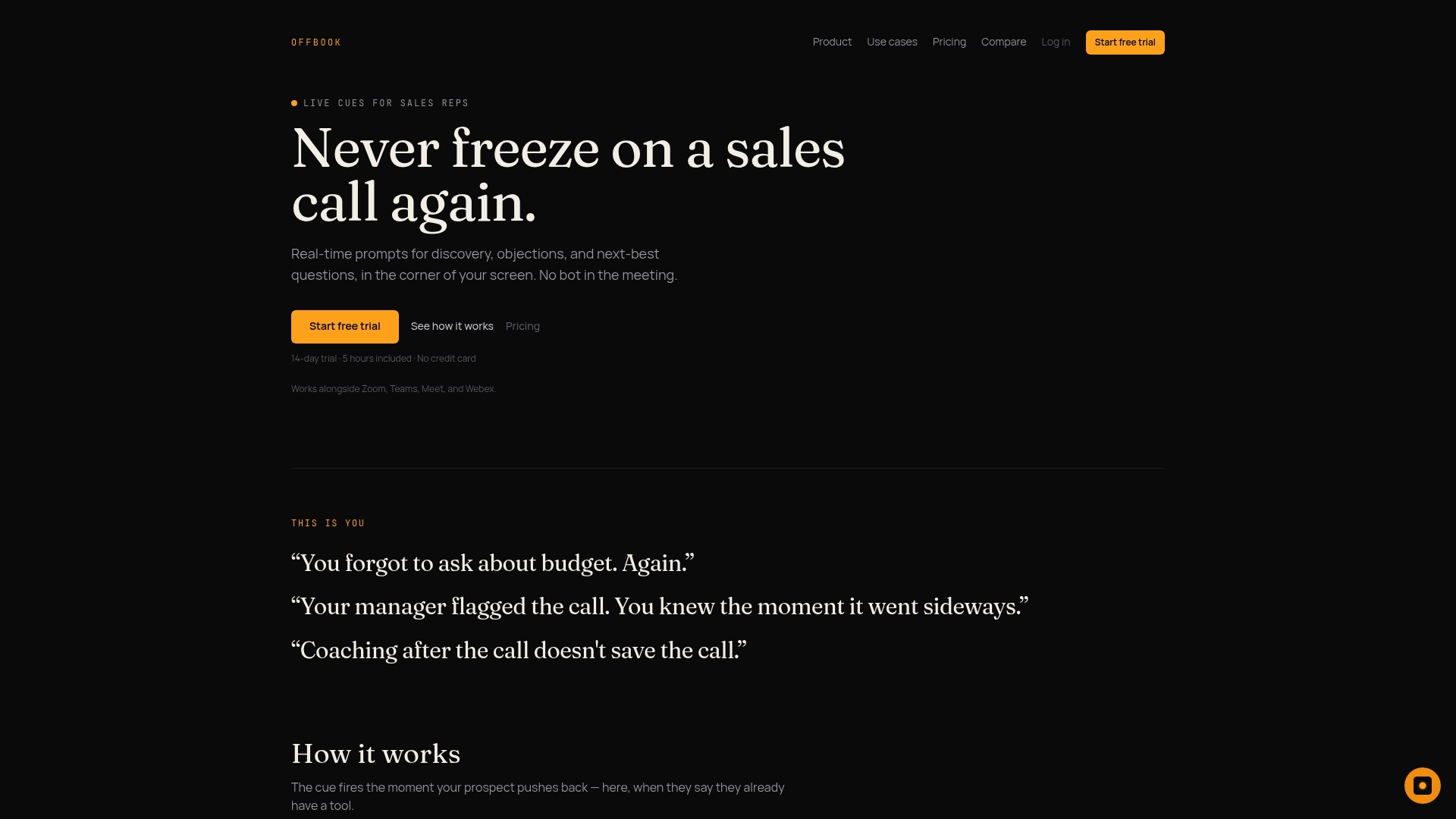
Offbook is real-time AI call coaching built for B2B sales reps. It listens to your calls and surfaces live prompts on-screen when an objection appears, suggesting the right clarifying question, the relevant proof point, and the qualification gap to address. It works without a bot joining the meeting, so the buyer experience stays natural. For founder-led SaaS teams at seed and Series A, Offbook turns every call into a coached rep. Explore how it works for your team and see what changes when coaching happens in the moment.
FAQ
What are the most common B2B sales objections?
The most common B2B sales objections fall into seven categories: price, timing, authority, need, competition, trust, and status quo. Price and timing objections together account for roughly 50 to 60% of all objections in B2B sales cycles.
How do you handle a price objection in B2B sales?
Treat price objections as value gaps, not budget problems. About 70% of budget objections are actually about missing ROI clarity, so probe the buyer’s value metrics before offering any discount.
What is the difference between BANT and MEDDIC for objection handling?
BANT surfaces deal readiness at a surface level, while MEDDIC identifies deeper risks like unclear decision processes and missing champions that cause late-stage objections. MEDDIC gives reps earlier warning of the gaps most likely to generate objections.
Why do the same objections keep coming up in B2B deals?
Repeated objections signal that messaging isn’t tailored to the buyer’s specific concerns or that the rep hasn’t reached the right stakeholders. Building account-specific objection playbooks and multi-threading the buying committee resolves recurring objection patterns.
How has AI changed B2B objection handling?
Buyers now arrive at sales calls pre-informed by AI-generated research, so objections are less about missing information and more about confidence gaps. Gartner data confirms that buyers still rely on human reps to validate AI-generated insights and reduce uncertainty at key decision points.